
- 320 pages
- English
- ePUB (mobile friendly)
- Available on iOS & Android
eBook - ePub
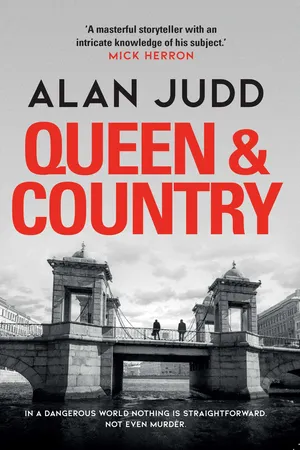
Queen & Country
About this book
In a dangerous world nothing is straightforward. Not even murder.
‘Judd…knows his stuff when it comes to the milieu of espionage.’ The Times
‘An elegant and informed British espionage novel.’ Financial Times
‘Authentic, clever and wonderfully entertaining.’ Sir Richard Dearlove, former head of MI6
'We can't think of a better Christmas read.' Oxford Alumni Magazine
‘He saw Cleaner Bob arrive that morning, the morning of his death.’
In the peaceful towns and villages of England, Cleaner Bob is washing windows, and people are dying in sudden and unexpected circumstances. When it becomes clear that the victims have a common history as Russian defectors, foul play is suspected and a hunt begins to locate their assailant, the lethal poison that killed them, and the mole who is leaking their locations.
In a race against time, only one man has the connections and experience to crack the case before more people perish. Charles Thoroughgood, former head of MI6, is enjoying retirement in the Oxfordshire hamlet he calls home when the call comes in. A man of duty, he agrees to take part in a mission that will lead him into the heart of enemy territory and threaten to undermine the very values he holds most dear.
Tense, engrossing and terrifyingly believable, the latest Charles Thoroughgood novel is a timely and brilliant reminder that Alan Judd is a master of the spy thriller and a writer of the very highest quality.
‘Judd…knows his stuff when it comes to the milieu of espionage.’ The Times
‘An elegant and informed British espionage novel.’ Financial Times
‘Authentic, clever and wonderfully entertaining.’ Sir Richard Dearlove, former head of MI6
'We can't think of a better Christmas read.' Oxford Alumni Magazine
‘He saw Cleaner Bob arrive that morning, the morning of his death.’
In the peaceful towns and villages of England, Cleaner Bob is washing windows, and people are dying in sudden and unexpected circumstances. When it becomes clear that the victims have a common history as Russian defectors, foul play is suspected and a hunt begins to locate their assailant, the lethal poison that killed them, and the mole who is leaking their locations.
In a race against time, only one man has the connections and experience to crack the case before more people perish. Charles Thoroughgood, former head of MI6, is enjoying retirement in the Oxfordshire hamlet he calls home when the call comes in. A man of duty, he agrees to take part in a mission that will lead him into the heart of enemy territory and threaten to undermine the very values he holds most dear.
Tense, engrossing and terrifyingly believable, the latest Charles Thoroughgood novel is a timely and brilliant reminder that Alan Judd is a master of the spy thriller and a writer of the very highest quality.
Frequently asked questions
Yes, you can cancel anytime from the Subscription tab in your account settings on the Perlego website. Your subscription will stay active until the end of your current billing period. Learn how to cancel your subscription.
No, books cannot be downloaded as external files, such as PDFs, for use outside of Perlego. However, you can download books within the Perlego app for offline reading on mobile or tablet. Learn more here.
Perlego offers two plans: Essential and Complete
- Essential is ideal for learners and professionals who enjoy exploring a wide range of subjects. Access the Essential Library with 800,000+ trusted titles and best-sellers across business, personal growth, and the humanities. Includes unlimited reading time and Standard Read Aloud voice.
- Complete: Perfect for advanced learners and researchers needing full, unrestricted access. Unlock 1.4M+ books across hundreds of subjects, including academic and specialized titles. The Complete Plan also includes advanced features like Premium Read Aloud and Research Assistant.
We are an online textbook subscription service, where you can get access to an entire online library for less than the price of a single book per month. With over 1 million books across 1000+ topics, weāve got you covered! Learn more here.
Look out for the read-aloud symbol on your next book to see if you can listen to it. The read-aloud tool reads text aloud for you, highlighting the text as it is being read. You can pause it, speed it up and slow it down. Learn more here.
Yes! You can use the Perlego app on both iOS or Android devices to read anytime, anywhere ā even offline. Perfect for commutes or when youāre on the go.
Please note we cannot support devices running on iOS 13 and Android 7 or earlier. Learn more about using the app.
Yes, you can access Queen & Country by Alan Judd in PDF and/or ePUB format, as well as other popular books in Literature & Historical Fiction. We have over one million books available in our catalogue for you to explore.
Information
CHAPTER ONE
When a sudden illness struck down Mr Noble, window cleaner in the Wiltshire village of Sherston, his place was taken by a younger man who drove a white Fiat van with āCleaner Bobā written in black lettering on the side. But there was no telephone number or website.
Cleaner Bob was Polish, people said, although an elderly lady who had been brought up in Hungary insisted his accent was Russian. It didnāt matter; he was one of the many Eastern European immigrants everyone heard about, did a good job, charged no more than Mr Noble, made a fuss of children and pets and would clean windows when householders were out, content to collect his money next time. His cheerful visits brightened the days of the pensioners in the bungalows and small modern houses behind the handsome eighteenth-century high street. He was said to live in Malmesbury.
Subsequent police inquires established that no one locally knew his surname. He took payment in cash ā no cards, no cheques, no electronic banking. āI will become electric, I promise,ā he would say, smiling apologetically. āWhen I have been established and my bank account will be changed. Until then, please, cash. Thank you.ā
When investigating officers eventually discovered the name he used ā Kazakov ā they were unaware of its possible significance. Reasonably; there was no reason why local police recording an apparently natural death should connect the name of a temporary window cleaner with that of the long-dead Professor Ignaty Kazakov. In 1921 he had been appointed the first head of Leninās Special Room, established to develop poisons that successive Russian governments would use to assassinate those who opposed them. His name had been revered in Russiaās secret poisons industry ever since, though he was little-known outside it and his achievements hadnāt prevented him from falling victim to Stalinās show trials in 1938.
But in Whitehall a small number of officials ā fewer than a handful ā recognised the name when Wiltshire Police reported it. From the start they did not believe it would be Cleaner Bobās real name. He would have left that behind in Russia, unused during his professional life. What puzzled them was whether his use of it was coincidental or deliberate. It could have been coincidental ā it wasnāt rare and a Pole or Ukrainian of Russian ancestry might plausibly have had it. But if were deliberate, it could only be a sign that Cleaner Bobās controllers were being provocatively facetious. They must have assumed that their British adversaries were too complacent, too incurious, too historically ignorant to recognise the reference. Ninety-nine times out of a hundred they would have been right.
When Bobās van turned into the crescent that morning he brought the weather with him, Mrs Wickens from number seven told the police. He usually did, he was such a cheerful presence. He came a little after ten, just as the sun came out. He did her windows then went to the last house, Mr Johanssonās next door. She was just going out to the shops and Bob called to ask if she knew when Mr Johansson would be back. She didnāt ā she didnāt even know Mr Johansson was out. His car was in the drive but that meant nothing because he didnāt always take it, even when he was away for days at a time. Kept himself to himself, Mr Johansson. Nothing wrong with that, of course, and he was always very nice when he did speak, very polite. That came from being Swedish, she supposed; his father, anyway, heād told her. She didnāt know about his mother.
She was just going out, had just closed the door, when Bob asked her to tell Mr Johansson when he got back that heād do his windows anyway and not to worry about the money, it could wait till next time. Which wasnāt unusual because people were often at the doctorās or in hospital, being such a lot of old crocks in this neighbourhood.
She thought no more about it until first thing next morning when she went out to water her plants. It had been a while since it had rained, and she thought sheād do Mr Johanssonās geraniums in the pots in front of his sitting-room window as well. She often did when he was away and he was always very grateful, always said thank you and offered to do the same, which he never did because she never went anywhere except to her brother in Shrewsbury at Christmas.
Anyway, sheād just done them when she thought sheād take a peek through his window, make sure everything was all right. Not that she was being nosy, but you never knew these days and the house looked as if it hadnāt been slept in. Silly thing to say, of course, but itās funny with houses, they look empty sometimes, you can just look at them and know. Well, it wasnāt easy because of those thick net curtains and she had to put her nose right up against the gap like a real nosy parker. Which Bob hadnāt done, obviously, because heās not like that, doesnāt look in peopleās windows, just cleans and gets on with it.
Then, of course, she got the shock of her life. Mr Johansson was just sprawled there in his armchair, his head at a funny angle. It didnāt look right; she knew straight away there was something wrong. Gave her quite a turn, it did. So then she rang the police and the ambulance and all and they came and had to break into his house and thatās when it all started, the coming and going. Poor Mr Johansson, he wasnāt what you call old nowadays, still in his sixties most likely. But it mustāve been quick and he probably didnāt know anything about it. Heart, the ambulance woman said, probably in his sleep, so he wouldnāt have known anything at all.
But he had known. For a few seconds he knew enough to know what was happening to him.
The man behind the alias, Michael Johansson, had been born Mikhail Lubimov, a Russian biochemist, code-named within MI6 as Beech Tree. He had worked in Laboratory 12 of the Operational Technical directorate, a secret facility tasked by Department 8 of Directorate S of the Russian foreign intelligence service, the SVR, formerly known as the First Chief Directorate of the KGB. Department 8 was responsible for assassinations and subversion on foreign soil. During the Soviet era, Beech Tree had travelled overseas as a representative of Biopreparat, the chemical and biological weapons organisation that pretended its business was civilian pharmaceutical and vaccine research. After the collapse of the Soviet Union he continued to travel on behalf of one of Biopreparatās successor companies, with the same role and under the same pretence. During an international conference in Toronto, he was recruited by MI6.
Over the next few years, before defecting, he provided a comprehensive account of Russian BCW ā biological and chemical weapons ā research and deployment in contravention of international treaties, including the results of experiments on prisoners. During his debriefs he said he had long felt guilty about the use to which his scientific achievements were put, and that it eased his conscience to tell British scientists at Porton Down all he knew of these secret weapons and techniques. Thereafter his ambition, he said, was to live out his natural life in undisturbed anonymity. He had a great fondness for railways and his absences from Sherston, which Mrs Wickens had noticed, comprised solitary train and walking holidays throughout Britain. He wanted no publicity nor any continuing involvement in his old field. He had seen enough of Russian liquidations, he said, not to risk facilitating the death sentence passed on him in Moscow.
He saw Cleaner Bob arrive that morning, the morning of his death. He was in his armchair in the sitting-room, his laptop open on his knees. He was planning a walk in Teesdale, County Durham, looking for a branch line that would take him nearer to the inn at Romaldkirk than the mainline station at Darlington. The ideal line, from Barnard Castle to Middleton-in-Teesdale, had long been closed, though six miles of it was still open for walking. He would have to get a bus from Darlington. When he saw Cleaner Bob come round from Mrs Wickensās next door with his ladder and bucket, he got up and went through to the kitchen to find his wallet on the table. He owed for Bobās previous visit, having been away. In fact, he had spoken to Bob only once. He did not encourage strangers, especially strangers who spoke foreign-accented English, like himself. Mrs Wickens had told him that Bob was Polish. He had shown no interest. Like many Russians, he didnāt like Poles.
He opened the back door as Bob was setting up his ladder to do the upstairs windows. āGood morning. I owe you money for last time,ā he said.
Bob nodded and smiled. āAll part of service, sir.ā He settled the ladder against the wall and picked up his bucket. āMay I please have clean water?ā
āOf course. Help yourself.ā Beech Tree backed away from the door to let him in, there being no outside tap. It had suited him to continue the social-distancing habits of the coronavirus scare. There was peace in distance; he wanted distance from everyone and from the entirety of his past, with one exception. But that was impossible, so he tried not to think of it. Distance was safer, anyway, in every respect. He searched his wallet while Bob stood at the sink with his bucket. āI do not have enough cash. I thought I did. Perhaps I put it somewhere else. But I can give you what I have. Or will you take a cheque or bank transfer? Or wait again until next time?ā
āI can wait. Thank you.ā Cleaner Bob lowered his bucket into the sink then reached into the thigh pocket of his overalls for a face mask and small spray can.
āMaybe I put the money in the sitting-room,ā said Beech Tree. He left his wallet open on the kitchen table and walked through to the sitting-room, adding over his shoulder, āI would like to pay now if I can because I may not be here next time.ā
Cleaner Bob followed him. āThat is true, you may not.ā He spoke in Russian.
Beech Tree turned sharply. Bob was wearing the face mask and holding the spray can before him at eye level. āFarewell, Mikhail,ā he said, again in Russian.
The few seconds of life remaining to Beech Tree were enough for him to realise he had been discovered but not enough to avoid the concentrated stream of tiny droplets sprayed directly into his face. It felt as if a great fist was clenched inside his chest, gripping and twisting him with a pain that overwhelmed everything. Then blackness, then nothing.
He collapsed backwards as his knees buckled. Cleaner Bob, who had done this before, stepped nimbly around and caught him in an embrace, carefully pointing the spray can away while lowering him into the armchair. He put the can on the carpet, checked Beech Treeās eyes and pulse, and heaved him farther up into the chair. Then he gently, almost reverently, placed his hands one on top of the other in his lap and lifted one leg over the other so that they crossed at the ankle. The leg was heavy and the right slipper had come off. Bob edged it across the carpet with his own foot until it was beneath the crossed leg. Finally he tipped Beech Treeās upturned head towards the left shoulder where it lolled, eyes and mouth open.
He removed his face mask, picked up his spray can, went to the kitchen, replaced the lid on the spray, put it and the mask back in his overall pocket, ran some water into his bucket and went out, opening and closing the kitchen door with his elbow. Then he cleaned the windows.
Mrs Wickens thought it quite a coincidence because Mr Noble, their old window cleaner, had also passed away suddenly, at home.
CHAPTER TWO
Charles Thoroughgood took the call in Swinbrook, the Oxfordshire hamlet where his wife Sarah owned a house. It came at a good moment, just after he had wriggled out from beneath his car after changing the oil and fitting a new filter. All had gone well, the old filter had come off with less trouble than he feared, but he now had to dispose of the old oil. The call came as he stood wiping his hands on a discarded pyjama jacket. He ran into the house and picked up the phone with a clean bit of sleeve.
āMr Thoroughgood? The Office. I have DCEO for you.ā
He recognised the voice of an MI6 switchboard operator who must have served longer than he had. He recalled that voice from his training days and he had now been retired some years. At least they still maintained a manual switchboard. That was something. There had been two attempts to get rid of it during his time as Chief, which he had overruled on the grounds that sometimes agents who rang in needed a person, not a machine.
There was a pause, then another voice. āCharles? Apologies for bothering you. Martin Manners. You probably donāt remember me. I was OS/1 ā Ops Security ā when you were Chief.ā
āMorning, Martin.ā He remembered the name but not the man. Ex-army ā Guards? Rifle Brigade? Paras? He couldnāt remember. He didnāt recognise the DCEO designation.
āThereās something we were wondering if you could help with. Itās not screamingly urgent but we need to crack on with it. Any chance you could pop in for a chat in the next day or two? Today ideally, if youāre in London. You still live in Westminster, donāt you? You know weāre back in Vauxhall Cross now?ā
āSo I read, yes, but Iām in Oxfordshire. Tomorrow morning?ā
āThanks, thatās very kind. Oh-nine-hundred if thatās okay? Sarah well? Good, havenāt seen her for years. Very fond memories of Swinbrook. Please give her my best wishes.ā
It wasnāt uncommon for Sarah to know Office people whom Charles didnāt. She had never served but had been married to his predecessor as Chief, who had been keen on entertaining.
Rubbing his hands again on the pyjama jacket, he returned to the car, started it, lay down and poked his head under. Gratifyingly, there was no oil leaking onto the gravel. But the problem was the bowlful of dirty oil. Not all recycling centres would accept it. The one that did was miles away and he wouldnāt be able to take it in the bowl without spilling it, having no cans in which to decant it neatly. He was tempted to tip it onto the earth in a remote part of the garden where Sarah might not notice. After all, oil came from the earth so presumably there was no harm in returning it. Or perhaps he could pour it on the bonfire and burn it before returning to London that evening. Sarah was at work in London and by the time they came down at the weekend, there should be no trace. It struck him, not for the first time, that marriage and retirement seemed to demand as many subterfuges as spying. Though the consequences were different. He emptied the oil into a patch of nettles behind the compost bin.
āSmarmy,ā was Sarahās prompt response when he mentioned Martin Manners that evening. āA real smoothie. Thinks heās Godās gift, though I canāt for the life of me see why. Heās not even good-looking. What does he want?ā
āDonāt know yet.ā
āWell, watch out. Heād put on a lot of weight, last time I saw him. Wears his paunch with pride. Not that thatās catching but I wouldnāt trust him as far as I could throw him.ā
Martin Manners was indeed large, with dark hair, heavy-framed glasses, a loud voice and a brisk, welcoming manner. He was dressed in expensive-looking jeans, trainers and a crisp white shirt with no tie. His paunch bulged over his brown leather belt, his hands were wide and hairy, his handshake firm and he wore a wedding ring and a Rolex. Charles wore suit and tie, as used to be the norm in the Office.
āGood of you to come in,ā Martin said. āMust be a few years since you were in Vauxhall Cross? Few changes since then too. Denim permitted, ties no longer de rigueur, as you see.ā He smiled.
Charles nodded. He had read the LGBT notices in the lift and the offers of counselling.
Martinās office faced the river. It was one of the largest in the building, in Charlesās day occupied by the director of operations. Martin pointed to a percolator bubbling on a side table. āCoffee?ā
āThanks.ā
They sat in low armchairs by the coffee table. āI wanted to talk to you about Beech Tree. Russian biochemist. You were his case officer. You ran him until he defected and was resettled.ā
Charles nodded again. Beech Tree had not been a difficult case to run, apart from the elaborate security precautions surrounding any Russian case. A clever, calm, focused man who knew what he wanted and had no illusions about what he was doing, or why. Charles had liked him.
āThought you ought to know heās dead,ā said Martin. āPoisoned, we believe. Ironically appropriate, you might say.ā
He described what was thought to have happened. āTurns out the window cleaner wasnāt who he said he was. He was traced to Malmesbury but disappeared immediately after the murder, vehicle vanished, rented flat emptied and professionally cleaned. The Poles have no trace of the name he used, no passport issued in that name. Must have entered and left the country on another. In other words, a classic, old-fashioned, Cold War-type Russian Illegal op, infiltrating an intelligence officer under alias who has no contact with the residency, though they may have provided logistical or information support without knowing for whom or what. Different class of op altogether from the Skripals in Salisbury. That was perpetrated by those two GRU clowns, Chepiga and Mishkin from Unit 29155, their destabilisation unit. Anyway, the Beech Tree op was much more sophisticated, planned long in advance. They went to great lengths to make it appear natural, like a heart attack. In fact, it was a heart attack. Thatās what he had, thatās what killed him.ā
āHow do we know it wasnāt natural?ā
āAs a result of Skripal, the body was...
Table of contents
- Cover
- Title Page
- Dedication
- Chapter One
- Chapter Two
- Chapter Three
- Chapter Four
- Chapter Five
- Chapter Six
- Chapter Seven
- Chapter Eight
- Chapter Nine
- Chapter Ten
- Chapter Eleven
- Chapter Twelve
- Chapter Thirteen
- Chapter Fourteen
- Chapter Fifteen
- Copyright