The Evening Hero
eBook - ePub

The Evening Hero

  1. 432 pages
  2. English
  3. ePUB (mobile friendly)
  4. Available on iOS & Android
eBook - ePub

The Evening Hero

About this book

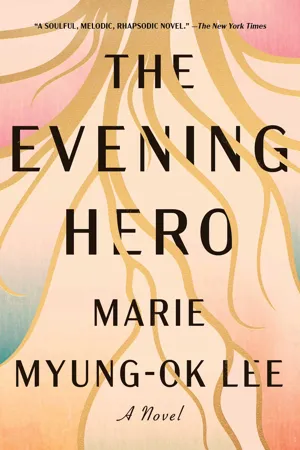
A “moving and captivating” (Cathy Park Hong, New York Times bestselling author of Minor Feelings) novel following a Korean immigrant pursuing the American dream who must confront the secrets of the past or risk watching the world he’s worked so hard to build come crumbling down.

Dr. Yungman Kwak is in the twilight of his life. Every day for the last fifty years, he has brushed his teeth, slipped on his shoes, and headed to Horse Breath’s General Hospital, where, as an obstetrician, he treats the women and babies of the small rural Minnesota town he chose to call home.

This was the life he longed for. The so-called American dream. He immigrated from Korea after the Korean War, forced to leave his family, ancestors, village, and all that he knew behind. But his life is built on a lie. And one day, a letter arrives that threatens to expose it.

Yungman’s life is thrown into chaos—the hospital abruptly closes, his wife refuses to spend time with him, and his son is busy investing in a struggling health start-up. Yungman faces a choice—he must choose to hide his secret from his family and friends or confess and potentially lose all he’s built. He begins to question the very assumptions on which his life is built—the so-called American dream, with the abject failure of its healthcare system, patients and neighbors who perpetuate racism, a town flawed with infrastructure, and a history that doesn’t see him in it.

Toggling between the past and the present, Korea and America, Evening Hero is a “soulful, melodic, rhapsodic novel” (The New York Times) about a man looking back at his life and asking big questions about what is lost and what is gained when immigrants leave home for new shores.
Frequently asked questions

Yes, you can cancel anytime from the Subscription tab in your account settings on the Perlego website. Your subscription will stay active until the end of your current billing period. Learn how to cancel your subscription.
No, books cannot be downloaded as external files, such as PDFs, for use outside of Perlego. However, you can download books within the Perlego app for offline reading on mobile or tablet. Learn more here.
Perlego offers two plans: Essential and Complete
  • Essential is ideal for learners and professionals who enjoy exploring a wide range of subjects. Access the Essential Library with 800,000+ trusted titles and best-sellers across business, personal growth, and the humanities. Includes unlimited reading time and Standard Read Aloud voice.
  • Complete: Perfect for advanced learners and researchers needing full, unrestricted access. Unlock 1.4M+ books across hundreds of subjects, including academic and specialized titles. The Complete Plan also includes advanced features like Premium Read Aloud and Research Assistant.
Both plans are available with monthly, semester, or annual billing cycles.
We are an online textbook subscription service, where you can get access to an entire online library for less than the price of a single book per month. With over 1 million books across 1000+ topics, we’ve got you covered! Learn more here.
Look out for the read-aloud symbol on your next book to see if you can listen to it. The read-aloud tool reads text aloud for you, highlighting the text as it is being read. You can pause it, speed it up and slow it down. Learn more here.
Yes! You can use the Perlego app on both iOS or Android devices to read anytime, anywhere — even offline. Perfect for commutes or when you’re on the go.
Please note we cannot support devices running on iOS 13 and Android 7 or earlier. Learn more about using the app.
Yes, you can access The Evening Hero by Marie Myung-Ok Lee in PDF and/or ePUB format, as well as other popular books in Literature & Literature General. We have over one million books available in our catalogue for you to explore.

Information

BOOK IV

BLOOMINGTON, MINNESOTA
A woman named Gracie, who wore a neon-green pantsuit and high heels, showed Yungman in.
ā€œHi, Sir!ā€ Einstein sat at a glass-topped desk. He wore a checkered dress shirt, no tie, and an electric-blue suit that looked like it had shrunk in the wash while he was wearing it. His hairless wrists were exposed, and there was a good inch of patterned sock between the hem of his pants and his shoes—sneakers again!
Yungman would certainly never have dressed so casually, but this was his son’s private labor/delivery/surgical suite. All the medical things were hidden—there wasn’t even a blood pressure cuff or an RX pad to be seen. It was just wide-open space with a wall of bookshelves, like an executive would have. Maybe an executive at an architecture firm. On the wall by his desk was a huge modern art print of a giant, unmistakably vulvar pink rose. Next to it was what would be called a ā€œglamour shotā€ of Marni in a white negligee—something he’d noticed only after it was too late to avert his eyes. Who has such a picture at their place of work?
ā€œWhere is all the medical equipment?ā€ Yungman asked.
ā€œBehind these walls,ā€ Einstein said. ā€œYou wouldn’t think it, but my desk slides away and the bookcase swivels like in the Bat Cave, and this room converts into a sterile OR. It’s all controlled by my SANUSwatch.ā€
As if on cue, Einstein’s watch, the size of a prisoner’s manacle, buzzed. It had a gold-link band, unlike the cheap silicone of the operator’s SANUSwatch. He tapped at its oversize screen, then spoke into his pronated wrist like Dick Tracy.
ā€œI’m on my way to lunch,ā€ he said. ā€œI can stop by. But only for a minute.
ā€œMidwives,ā€ Einstein said with companionable exasperation.
ā€œThe HoSPAtal uses midwives?ā€ Yungman asked in surprise. ā€œWith all this technology?ā€
ā€œIt’s market-driven: a subset of the Guests want a so-called natural option. If this midwife, Verna, wasn’t so popular, I don’t think SANUS would bother. It doesn’t fit with the brand. Her office is on the way to the restaurant, if you don’t mind.ā€
ā€œI don’t mind.ā€
The elevator, like so many other things in the Tower, was completely clear. It didn’t even have buttons. Einstein had summoned it like magic with his SANUSwatch alone.

Nature’s Way, said the sign that greeted them as they stepped into the crystalline hall.
ā€œIs that onions I smell?ā€ asked Yungman, sniffing the air. It was particularly strange because the rest of the building was neutral-smelling, that sort of staticky clean after-rain smell, fresh and wet like green tea, thanks to the ozone mist, both from generators that pumped it into the halls and from individuals’ SANUSwatches.
ā€œUnfortunately, yes,ā€ said Einstein. ā€œEven ozone can’t defeat onions.ā€
ā€œHello!ā€ said a woman whose springy hair was the gleaming white color of the inside of an oyster shell. She wore open-toed shoes, Jesus sandals, which made Yungman stare. At least her feet were immaculately clean, toenails trimmed.
ā€œVerna, this is my father, Dr. Yungman Kwak. He’s an operator at Depilation Nation.ā€
ā€œHonored to meet you, I’m Verna Carlson!ā€ She extended her elbow. ā€œTo avoid unnecessary transfer of germs.ā€
Yungman touched his rented-white-coated elbow to her naked one, feeling slightly affronted—did she think he was unclean? ā€œI greet everyone this way,ā€ she said, as if catching his mood. ā€œSemmelweis died hounded and insane in the poorhouse in 1865 just because he challenged his fellow doctors to wash their hands after handling corpses and before delivering babies—that’s why I think your Asian bowing is much smarter. Doctors like to think they’re superior to germs. But germs don’t care.ā€ Einstein may have rolled his eyes a bit, for she stared right at him and said, ā€œThe most recent Hospital Journal showed that doctors say they wash one hundred percent of the time, but when they culture their hands, they find that more than fifty percent are carriers of fecal-borne infections—uff da.ā€
ā€œWhat have you got cooking?ā€ Yungman asked.
ā€œPlacenta.ā€
Einstein now openly made a face.
ā€œReally?ā€ said Yungman. ā€œMay I look?ā€
ā€œBe my guest.ā€
Yungman peered into the pan. It looked like liver and onions. The placenta was an organ, after all. In Korean, the name for it was Tae, ā€œlife.ā€ In the village, Tae was dried and ground into a powder for a poultice to put on wounds. There were times, when food was low, that it was eaten. At the very least, it was not to be thrown away. But in the West, that hardworking organ was plopped into a plastic container, sent to the pathologist, who would give it a cursory look then incinerate it as medical waste.
Verna spread out a new placenta, rich with dark red and black endometrial veins that radiated outward, splitting off into smaller and smaller capillaries.
ā€œThe tree of life,ā€ she said.
Einstein looked impatient to get to lunch.
ā€œIn Korea, the midwives save it as well,ā€ Yungman said, despite himself.
She nodded. ā€œWe give the Guests the option to dehydrate and encapsulate it, eat it as a meal, or just put it in a smoothie. We take a remembrance picture of it regardless.ā€
ā€œThat’s great, Verna,ā€ Einstein said, ā€œbut we have a 12:15 meeting.ā€
ā€œAll right. So, Dr. Kwak, I was thinkingā€”ā€
As they talked, Yungman wandered around. While Einstein’s office had been sleekly spare, this place looked like a child’s gym, with brightly colored rugs and floor mats. He walked to a wicker basket that contained tennis balls and various nubbly massage tools, tubes and ovals, a squishy pillow, hot and cold packs, and a blanket that looked to be the same expansive size as the ones they used in Korea to attach babies to their mothers’ backs so that the mothers could continue to go about their day in the fields or at home. Next to the basket were various exercise balls. In the other corner, a volcano-shaped device was spewing a cool smoke that smelled like lavender.
ā€œAnd Dr. Kwak,ā€ Yungman heard Verna say, ā€œif you feel the need to question my practice without evidence, please see my statistics first and then come talk to me. Oh, and on those pregnancy forums, I see what you’re doing—there’s a law against giving yourself good reviews under a pseudonym.ā€
Einstein rolled his eyes and led Yungman back to the elevator.
ā€œThe downside of the Birth Boutique being for-profit is that it’s harder to report people,ā€ said Einstein. ā€œThe medical board told me to report it to the Better Business Bureau and not them when I caught her letting a woman nurse a blue baby. A blue, hypoxic baby!ā€
ā€œDid the baby pink up?ā€
ā€œAfter a while—a good while, yes,ā€ he admitted.
ā€œAny adverse outcomes? Sequelae?ā€
ā€œWell, no. But she just got lucky.ā€
ā€œHow are her outcomes in general?ā€
ā€œThey’re perfect so far. Obviously using ginned-up statistics.ā€
ā€œWhat does that mean?ā€ Yungman envisioned drunk data.
ā€œShe cherry-picks the cases, or maybe just makes them all up. She came in to SANUS having zero maternal and infant mortality.ā€
ā€œNone?ā€
ā€œNone. You can imagine how appealing that would be to the rather large demographic of rich, safety-obsessed customers. In Greenwich, we had a number of successful malpractice cases seventeen years later when a hypoxic baby didn’t get into Harvard; I can totally see that happening here. One of the medmal cases paid out a million dollars. That former colleague of mine is toast—although I get it; the kid ended up going to Lehigh.ā€
Yungman considered how in the village, women got pregnant and had babies that came out blue all the time; blue was just one of the many hues newborns came in. Some of them probably died or had brain damage, but he couldn’t remember any specific ones, because he’d been seven when he was no longer allowed into a laboring woman’s hut. In medical school, they were taught to panic at any sight of a blue baby, to rush it to an incubator and turn up the oxygen. Only later did they find that too much supplemental oxygen could blow out the fragile newborn retina and make the babies blind.
ā€œHow can you be so sure she’s using misleading numbers?ā€
ā€œIt’s so far off the mean. If she were smarter, she would make her data more believable. Throw in at least one death or a birth injury, come on.ā€
His son was so sure. Yungman supposed there’d been a time when he, too, was so sure about things—until age and experience had proven him wrong, time and again. He understood now why the Buddhists preferred to float along in the slipstream between the two values, good and bad.
They stepped off the elevator into a cavernous dining room on the top floor of the Quartz Tower, blue sky massively above them.
ā€œThere are six different exclusive MDiety cafĆ©s in the HoSPAtal,ā€ Einstein said excitedly. ā€œAll Michelin-starred. This one is the best, and it’s Korean!ā€
The M(omofuku) Diety CafƩ
ā€œMomofuku sounds Japanese,ā€ Yungman remarked. He still remembered how, as a child, he’d had to learn the Momotaro story about the infertile Japanese couple who find a boy in a peach. ā€œ ā€˜Momo’ means peach,ā€ he said. ā€œI think ā€˜fuku’ means assistant. Assistant peach?ā€
ā€œI’m pretty sure the chef is Korean. He’s been on that TV show, Mind of a Chef. David Chang. Chang is a Korean name, right?ā€
ā€œIt can be,ā€ said Yungman. ā€œIt depends on the underlying Chinese character.ā€
ā€œThat makes it Chinese?ā€
ā€œNo. Most Korean surnames have an underlying Chinese character. Like, ā€˜Kim’ is ā€˜gold.’ ā€ Yungman wondered if Einstein would ask what their name meant. He didn’t.
ā€œNo DRones Allowed!ā€ said the sign on the wall.
ā€œPeople bring their drones in here?ā€ said Yungman.
ā€œNo, it’s a joke. Conventional doctors are called DRones. Get it?ā€
ā€œI suppose.ā€
ā€œOur CEO/founder, Magnus Goodbetter, is a funny guy. His philosophy is that in the world, medical professionals are divided into service providers—the DRones—and the MDieties. It’s all in good fun. Our CEO likes to think we’re gangsters. I’m more formally known within the organization not just as a concierge specialist but also as a SANUS ā€˜Doctorpreneur.’ ā€
ā€œDoctorpreneur,ā€ repeated Yungman.
ā€œYes; here we have free rein to invent and develop trademarked products.ā€
ā€œAnd yours is?ā€
ā€œI’m the inventor of the Kwak Vaginal Rejuvenation, Tee Em.ā€
ā€œThe Kwak what?ā€ Yungman had always dreamed his son might come up with a named surgical instrument, like the Mayo scissors, the Kocher clamp, his beloved Allis, the uterine sound. Why not a Kwak obstetrical retractor? He’d even take a Kwak bladder blade.
ā€œIt’s actually a suite of products. Why don’t we sit down and I’ll fill you in?ā€ They followed the maĆ®tre d’ to a bank of seats along the outer edge of the cafĆ©.
Yungman took a moment. Always so fixated on getting to where he was going, he was always forgetting to take in the view, as if he were afraid to waste the two seconds looking up or feared what might be coming down on him. The clear panels and vaulted glass ceiling of the Quartz Tower provided a panoramic perspective: you could see the nearby Minneapolis–St. Paul airport, where toylike planes were taking off and landing. If you tipped your head up, you could see the planes traversing the sky, a sight that made Yungman involuntarily tense, because he had to consciously remind himself—even so many years later—that these planes never dropped bombs.
ā€œThere’s the office of Magnus Goodbetter.ā€
ā€œBut there’s nothing there,ā€ protested Yungman. ā€œIs the CEO a ghost?ā€
ā€œYou see, the transparency is an illusion.ā€
ā€œExcuse me?ā€
Einstein grinned. ā€œThere are cameras outside that are projecting the viewā€ā€”Yungman tracked the next plane with his eyes the entire time it moved across the skyā€”ā€œin real time,ā€ Einstein continued. ā€œSo we don’t see what’s going on in the office.ā€
ā€œAh, showing you what you expect to see. You’re halfway to accepting the illusion already.ā€
ā€œExactly,ā€ his son said.
ā€œSo, is your ā€˜suite’ of rejuvenation products related to aesthetics or functionality?ā€
ā€œBoth!ā€ said Einstein with a gleam in his eye. ā€œMarni helped me come up with ā€˜suite.’ She’s a natural marketer. The laser can tighten and restore elasticity, but you can also use it for very precise cutting and sculpting for labiaplasties.ā€
His son’s face was the one Yungman assumed Nobel made when he’d discovered dynamite.
ā€œI suppose that’s good, Einsteinā€”ā€ he said now, trying to be supportive.
ā€œExcuse me, Sir, but you’re supposed to call me ā€˜Dr. Kwak’ when we’re in the Tower.ā€
ā€œThen are you also supposed to call me ā€˜Dr. Kwak’?ā€ he rebutted. His son smiled weakly and pointed to his SANUS pin, the green double-snaked MDiety logo, on his collar.
All right. In the HoSPAtal hierarchy, he was just an ā€œoperator.ā€ Lower than a DRone.
ā€œAll right, Dr. Kwak, do you remember how you wanted to be a doctor so badly, even when you were little? How you visited me at the hospital? You walked over, all by yourself. The nurses were amazed.ā€
ā€œOh yes. Dr. Mitzner’s tonsillectomy.ā€ He smiled at the remembrance.
ā€œOh, well before that one.ā€ Yungman had ordered something called risotto, and a gluey lump of it went down the wrong pipe. He resented even the tiniest spark of admiration in his son’s eyes for his detested colleague, his frenemy Charles Lindbergh. ā€œYou walked all the way from home to the hospital to see me. You were barely out of kindergarten. Everyone thought that was so cute. You had your little stethoscope on.ā€
Yungman didn’t mention the clucks of concern, the comments about ā€œWho the heck is supposed to be at home watching him?ā€ In their small town, Yungman supposed people must have noticed that it was he, the man, at the grocery store, the PTA meetings, driving Einst...

Table of contents

  1. Cover
  2. Title Page
  3. Dedication
  4. Epigraph
  5. Prologue
  6. Book I
  7. Book II
  8. Book III
  9. Book IV
  10. Book V
  11. Author’s Note
  12. Acknowledgments
  13. About the Author
  14. Copyright