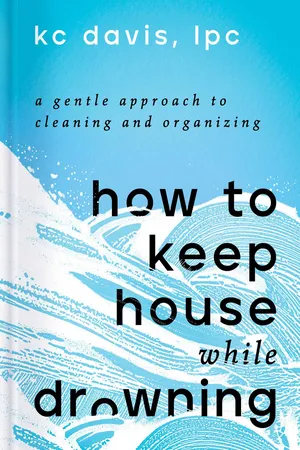
How to Keep House While Drowning
eBook - ePub

How to Keep House While Drowning

A Gentle Approach to Cleaning and Organizing

  1. 128 pages
  2. English
  3. ePUB (mobile friendly)
  4. Available on iOS & Android
eBook - ePub

How to Keep House While Drowning

A Gentle Approach to Cleaning and Organizing

About this book

An NPR Best Book of the Year | USA TODAY Bestseller

This revolutionary approach to cleaning and organizing helps free you from feeling ashamed or overwhelmed by a messy home.

If you’re struggling to stay on top of your to-do list, you probably have a good reason: anxiety, fatigue, depression, ADHD, or lack of support. For therapist KC Davis, the birth of her second child triggered a stress-mess cycle. The more behind she felt, the less motivated she was to start. She didn’t fold a single piece of laundry for seven months. One life-changing realization restored her sanity—and the functionality of her home: You don’t work for your home; your home works for you.

In other words, messiness is not a moral failing. A new sense of calm washed over her as she let go of the shame-based messaging that interpreted a pile of dirty laundry as “I can never keep up” and a chaotic kitchen as “I’m a bad mother.” Instead, she looked at unwashed clothes and thought, “I am alive,” and at stacks of dishes and thought, “I cooked my family dinner three nights in a row.”

Building on this foundation of self-compassion, KC devised the powerful practical approach that has exploded in popularity through her TikTok account, @domesticblisters. The secret is to simplify your to-do list and to find creative workarounds that accommodate your limited time and energy. In this book, you’ll learn exactly how to customize your cleaning strategy and rebuild your relationship with your home, including:

-How to see chores as kindnesses to your future self, not as a reflection of your worth
-How to start by setting priorities
-How to stagger tasks so you won’t procrastinate
-How to clean in quick bursts within your existing daily routine
-How to use creative shortcuts to transform a room from messy to functional

With KC’s help, your home will feel like a sanctuary again. It will become a place to rest, even when things aren’t finished. You will move with ease, and peace and calm will edge out guilt, self-criticism, and endless checklists. They have no place here.
Frequently asked questions

Yes, you can cancel anytime from the Subscription tab in your account settings on the Perlego website. Your subscription will stay active until the end of your current billing period. Learn how to cancel your subscription.
At the moment all of our mobile-responsive ePub books are available to download via the app. Most of our PDFs are also available to download and we're working on making the final remaining ones downloadable now. Learn more here.
Perlego offers two plans: Essential and Complete
  • Essential is ideal for learners and professionals who enjoy exploring a wide range of subjects. Access the Essential Library with 800,000+ trusted titles and best-sellers across business, personal growth, and the humanities. Includes unlimited reading time and Standard Read Aloud voice.
  • Complete: Perfect for advanced learners and researchers needing full, unrestricted access. Unlock 1.4M+ books across hundreds of subjects, including academic and specialized titles. The Complete Plan also includes advanced features like Premium Read Aloud and Research Assistant.
Both plans are available with monthly, semester, or annual billing cycles.
We are an online textbook subscription service, where you can get access to an entire online library for less than the price of a single book per month. With over 1 million books across 1000+ topics, we’ve got you covered! Learn more here.
Look out for the read-aloud symbol on your next book to see if you can listen to it. The read-aloud tool reads text aloud for you, highlighting the text as it is being read. You can pause it, speed it up and slow it down. Learn more here.
Yes! You can use the Perlego app on both iOS or Android devices to read anytime, anywhere — even offline. Perfect for commutes or when you’re on the go.
Please note we cannot support devices running on iOS 13 and Android 7 or earlier. Learn more about using the app.
Yes, you can access How to Keep House While Drowning by KC Davis,To Be Confirmed SE in PDF and/or ePUB format, as well as other popular books in Personal Development & Attention-Deficit Disorder (ADD-ADHD). We have over one million books available in our catalogue for you to explore.

chapter 1 care tasks are morally neutral

morality concerns itself with the goodness or badness of your character and the rightness or wrongness of decisions. Lots of decisions are moral decisions, but cleaning your car regularly is not one of them. You can be a fully functioning, fully successful, happy, kind, generous adult and never be very good at cleaning your dishes in a timely manner or have an organized home. How you relate to care tasks—whether you are clean or dirty, messy or tidy, organized or unorganized—has absolutely no bearing on whether you are a good enough person.
When you view care tasks as moral, the motivation for completing them is often shame. When everything is in place, you don’t feel like a failure; when it’s messy or untidy, you do.
If you are completing care tasks from a motivation of shame, you are probably also relaxing in shame too—because care tasks never end and you view rest as a reward for good boys and girls. So if you ever actually let yourself sit down and rest, you’re thinking, “I don’t deserve to do this. There is more to do.”
This is an incredibly painful way to live. It affects your entire life: your mental health, your relationships, your friendships, your work or schooling, your physical health. It is impossible for the kindness or affirmation of others to penetrate your heart when you are thinking, “If you only knew…” But it doesn’t have to be this way. In fact, I have very good news for you.
Care tasks are morally neutral. Being good or bad at them has nothing to do with being a good person, parent, man, woman, spouse, friend. Literally nothing. You are not a failure because you can’t keep up with laundry. Laundry is morally neutral.

chapter 2 kindness to future you

on the weekends, my husband, Michael, and I take turns getting up early with the kids so the other one can sleep in. Cleaning the kitchen is one of my tasks in our partnership, and I’m pretty renowned for only doing it every few days. Yet the evening before it’s Michael’s turn to wake up I found myself taking the time to clear the counter, do the dishes, and take out the trash so that it would be easy for him to prepare the girls’ breakfast and take care of them in the morning. Michael has never asked or expected this of me; it was simply something I did to make his life easier. I was typically one to not think that far ahead for myself and find myself hand-washing a day-old milk cup at 7:00 am while my kids cried because they were thirsty. Sort of a stressful way to start the day and I guess I didn’t want him to have to go through that. One day I had a thought: “I deserve that exact same kindness. I also deserve a functional space for those mornings I’m taking care of our kids.” That I could consider nighttime prep as a kindness to morning me changed my entire relationship with care tasks.
Next time you are trying to talk yourself into doing a care task, what would it be like to replace the voice that says, “Ugh, I should really go clean my house right now because it’s a disaster,” with “It would be such a kindness to future me if I were to get up right now and do _______. That task will allow me to experience comfort, convenience, and pleasure later.”
It isn’t a hack, really. It’s not a formula guaranteed to make you get up. Sometimes you may not get up even with the change in self-talk. But you know what? You weren’t getting up when you were being mean to yourself either, so at least you can be nice to yourself. No one ever shamed themselves into better mental health.

chapter 3 for all the self-help rejects

marie Kondo says to tri-fold your underwear. The admiral swears making your bed will change your life. Rachel Hollis thinks the key to success is washing your face and believing in yourself. Capsule wardrobes! Rainbow-colored organization! Bullet journals! How many of these have we tried? How many did we stick with? If you’re like me, the answer is probably none.
Image
Why is it we rarely stick with them?
I’ve already talked about the role of shame in first motivating, then ultimately demotivating us. But there’s more.
  1. 1. Any task or habit requiring extreme force of will depletes your ability to exert that type of energy over time. The truth is that human beings can only exert high effort for short periods. As someone in the addiction recovery world, I often think of a phrase we use when someone is attempting to maintain sobriety through sheer force of will. We call it white-knuckling sobriety because it brings to mind a person whose only solution for restraining themselves from drinking is to grip the edge of their chair so tightly their knuckles turn white. And those of us who have been around awhile know no one stays sober long that way. In addiction recovery, as in most of life, success depends not on having strong willpower, but in developing mental and emotional tools to help you experience the world differently.
  2. 2. Many self-help gurus overattribute their success to their own hard work without any regard to the physical, mental, or economic privileges they hold. You can see this when a twenty-year-old fitness influencer says, “We all have the same twenty-four hours!” to a single mom of three. The fitness influencer only needed to add effort to see drastic changes in her health and so assumes that’s all anyone is missing. The single mom of three, however, is experiencing very different demands and limitations on her time. For her, she needs not only effort but also childcare, money for exercise classes, and extra time and energy at the end of a day when she has worked nine hours and then spent an additional five caring for kids and cleaning house. You can see this when a thin, white, rich self-help influencer posts “Choose Joy” on her Instagram with a caption that tells us all that joy is a choice. Her belief that the decision to be a positive person was the key to her joyful life reveals she really does not grasp just how much of her success is due to privileges beyond her control. Someone who is affected by serious mental illness or systemic oppression has a lot more standing in the way of a happy life than a simple attitude adjustment.
  3. 3. Different people struggle differently—and privilege isn’t the only difference. Someone might find a way to meal plan, or exercise, or organize their pantry that revolutionizes their life. But the solutions that work for them are highly dependent on not only their unique barriers but also their strengths, personality, and interests.
For example, when it comes to my home, I have never been able to just “clean as you go.” When I try to, I find myself stressed, overwhelmed, and unable to be present with my family. Instead, I rely on dozens of systems I’ve created that help me keep my home functional (and I still usually have dishes in the sink and clutter on the floor). However, when I sit down to write or to work on my business, everything flows naturally. Sometimes I have to push myself slightly to get over a hurdle, but the hurdles always feel surmountable. I actually have to set a timer to remind me to look at the clock because I will get carried away and lose track of time. I feel creative, energized, and rewarded at the end of the day.
I have a dear friend who runs a similar business, and we often use each other as a sounding board and support each other. She often calls feeling stuck because she knows what she needs to do to grow her business but struggles to get it done. “It seems like you can crank out seven videos for your social media in the time it takes me to do one. It takes me so long to figure out what to say and to get over my self-consciousness.”
She also keeps the cleanest house I’ve ever seen.
One day she said to me, “You know, KC, the way you feel about your business is the way I feel about my home. I can virtually float through my home tidying here, putting something away there, doing a little housework as I see it, all while enjoying my life and keeping a very clean home. It feels natural and takes only a bit of effort. But when I sit down to run my business, certain aspects of what need to be done make me feel paralyzed, unmotivated, and overwhelmed. It takes extreme effort for me to power through, and I usually have to set up lots of external systems and accountability to get it done.”
My friend and I are simply strength-oriented and stuck in different ways, with no discernable reason to which we can point. Because of this, my advice for getting things done at work won’t help her at all, mostly because it amounts to “Drink a big coffee and just make yourself do it. Then wait around to be inspired about what to do next.” And her advice for getting things done around the house is useless to me. (She once told me, “I just light a candle and think about how good it will feel to get some things done around the house.” Lol what?)
I suspect that many people doling out productivity advice focus on areas where they’re naturally gifted—areas where all they needed was a little push or a couple of tips to get themselves unstuck. Unlike coffee and candles and believing in yourself, the principles in this book can be customized to your unique barriers, strengths, and interests.

chapter 4 gentle skill building: the five things tidying method

when you look at very messy space, it’s easy to feel overwhelmed. Take a few minutes to speak some compassionate words to yourself and take a deep breath. Although it looks like a lot, there are actually only five things in any room: (1) trash, (2) dishes, (3) laundry, (4) things that have a place and are not in their place, and (5) things that do not have a place.
  1. 1. The first step is to take a trash bag and pick up all the trash. Throw it away into the bag. Take large trash items like boxes and stack them together and place the trash bag with it. Do not take the trash out.
  2. 2. Next gather all of the dishes and place them in your sink or on your counter. Do not do the dishes.
  3. 3. Take a laundry basket and pick up all the clothes and shoes. Place the laundry basket next to the trash pile. Do not do the laundry.
  4. 4. Next pick a space in the room like a corner or a desk and put all the items there that have a place back in their place. Then put the items that have no place in a pile. Move to the next space and repeat until all things are back in their spots.
  5. 5. Now you will have a pile of things that do not have a place. It will be easier now that the space is clear to tackle this category. You may choose to get rid of some items that have no place and are contributing to clutter. For important things, you can find them a permanent place.
  6. 6. Take out your trash to the bin; throw laundry into the wash or laundry room. Now your space is livable. I always save the dishes for another day.

why the five things tidying method works

The Five Things Tidying Method helps the brain know exactly what it is looking for, so instead of seeing a sea of clutter and being paralyzed, it can start to see individual items. Ignoring everything but that one category helps to keep you on track and not get distracted. You can move faster when you know what you are looking for. Trash, laundry, and dishes are being placed into their own containers, so you are not spending lots of time walking around your house putting things away in different places. This makes things get tidier faster. Lastly, completing a category gives you a little dopamine reward. No more spending hours trying to clean and seeing no progress. Our brains need to see progress or they get discouraged. Category cleaning gives your brain multiple, quick finish lines to feel good about.
The categories can be tackled all at once or over a few days. You can choose to do only trash today, only dishes tomorrow, et cetera. You can also institute the timer technique. Decide that you are going to do twenty minutes a day, starting with the categories. Perhaps it takes you three days to get all the trash, but you stick with only trash until it’s done. Music, a Netflix show, a podcast, a timer, racing to see how fast you can go, a friend to help you tag team, rewarding yoursel...

Table of contents

  1. Cover
  2. Title Page
  3. Dedication
  4. How to Read This Book
  5. Introduction
  6. Chapter 1: Care Tasks Are Morally Neutral
  7. Chapter 2: Kindness to Future You
  8. Chapter 3: For All the Self-Help Rejects
  9. Chapter 4: Gentle Skill Building: The Five Things Tidying Method
  10. Chapter 5: Gentle Self-Talk: Mess Has No Inherent Meaning
  11. Chapter 6: Care Tasks Are Functional
  12. Chapter 7: Gentle Self-Talk: Find the Compassionate Observer
  13. Chapter 8: Organized Is Not the Same as Tidy
  14. Chapter 9: Susie with Depression
  15. Chapter 10: Gentle Skill Building: Kick-Starting Motivation
  16. Chapter 11: Care Tasks Are Cyclical
  17. Chapter 12: Gentle Skill Building: Setting Functional Priorities
  18. Chapter 13: Women and Care Tasks
  19. Chapter 14: Gentle Skill Building: Laundry
  20. Chapter 15: You Can’t Save the Rain Forest If You’re Depressed
  21. Chapter 16: Drop the Plastic Balls
  22. Chapter 17: Gentle Skill Building: Doing the Dishes
  23. Chapter 18: When You Don’t Have Kids
  24. Chapter 19: When It’s Hard to Shower
  25. Chapter 20: Caring for Your Body When You Hate It
  26. Chapter 21: Gentle Self-Talk: “I Am Allowed to Be Human”
  27. Chapter 22: Good Enough Is Perfect
  28. Chapter 23: Gentle Skill Building: Changing Bedsheets
  29. Chapter 24: Rest Is a Right, Not a Reward
  30. Chapter 25: Division of Labor: The Rest Should Be Fair
  31. Chapter 26: Gentle Skill Building: Bathrooms
  32. Chapter 27: Gentle Skill Building: A System for Keeping Your Car Clean
  33. Chapter 28: When Your Body Doesn’t Cooperate
  34. Chapter 29: Contributing Is Morally Neutral
  35. Chapter 30: Cleaning and Parental Trauma
  36. Chapter 31: Critical Family Members
  37. Chapter 32: Rhythms Over Routines
  38. Chapter 33: Gentle Skill Building: Maintaining a Space
  39. Chapter 34: My Favorite Ritual: Closing Duties
  40. Chapter 35: Skill Deficit Versus Support Deficit
  41. Chapter 36: Outsourcing Care Tasks Is Morally Neutral
  42. Chapter 37: Exercise Sucks
  43. Chapter 38: Your Weight Is Morally Neutral
  44. Chapter 39: Food Is Morally Neutral
  45. Chapter 40: Getting Back Into Rhythm
  46. Chapter 41: You Deserve a Beautiful Sunday
  47. Appendix 1
  48. Appendix 2
  49. Acknowledgments
  50. About the Author
  51. Copyright