Raising Antiracist Children
eBook - ePub

Raising Antiracist Children

A Practical Parenting Guide

  1. 224 pages
  2. English
  3. ePUB (mobile friendly)
  4. Available on iOS & Android
eBook - ePub

Raising Antiracist Children

A Practical Parenting Guide

About this book

NEW YORK TIMES BESTSELLER

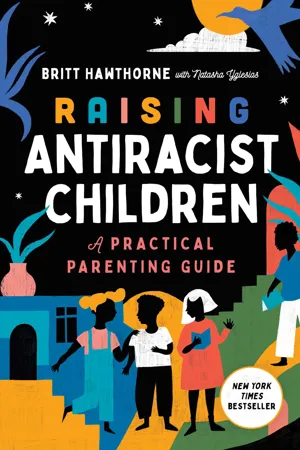
A must-have guide to raising inclusive, antiracist children from educator and advocate, Britt Hawthorne.

Raising antiracist children is a noble goal for any parent, caregiver, or educator, but it can be hard to know where to start. Let Britt Hawthorne—a nationally recognized teacher and advocate—be your guide. Raising Antiracist Children acts as an interactive guide for strategically incorporating the tools of inclusivity into everyday life and parenting. Hawthorne breaks down antiracist parenting into four comprehensive sections:

-Healthy bodies—Establishing a safe and body-positive home environment to combat stereotypes and create boundaries.

-Radical minds—Encouraging children to be agents of change, accompanied by scripts for teaching advocacy, giving and taking productive feedback, and becoming a coconspirator for change.

-Conscious shopping—Raising awareness of how local shopping can empower or hinder a community’s ability to thrive, and teaching readers of all ages how to create shopping habits that support their values.

-Thriving communities—Acknowledging the personal power we have to shape our schools, towns, and worlds, accompanied by exercises for instigating change.

Full of questionnaires, stories, activities, tips, and tools, Raising Antiracist Children is a must-have, practical guide essential for parents and caregivers everywhere.
Frequently asked questions

Yes, you can cancel anytime from the Subscription tab in your account settings on the Perlego website. Your subscription will stay active until the end of your current billing period. Learn how to cancel your subscription.
No, books cannot be downloaded as external files, such as PDFs, for use outside of Perlego. However, you can download books within the Perlego app for offline reading on mobile or tablet. Learn more here.
Perlego offers two plans: Essential and Complete
  • Essential is ideal for learners and professionals who enjoy exploring a wide range of subjects. Access the Essential Library with 800,000+ trusted titles and best-sellers across business, personal growth, and the humanities. Includes unlimited reading time and Standard Read Aloud voice.
  • Complete: Perfect for advanced learners and researchers needing full, unrestricted access. Unlock 1.4M+ books across hundreds of subjects, including academic and specialized titles. The Complete Plan also includes advanced features like Premium Read Aloud and Research Assistant.
Both plans are available with monthly, semester, or annual billing cycles.
We are an online textbook subscription service, where you can get access to an entire online library for less than the price of a single book per month. With over 1 million books across 1000+ topics, we’ve got you covered! Learn more here.
Look out for the read-aloud symbol on your next book to see if you can listen to it. The read-aloud tool reads text aloud for you, highlighting the text as it is being read. You can pause it, speed it up and slow it down. Learn more here.
Yes! You can use the Perlego app on both iOS or Android devices to read anytime, anywhere — even offline. Perfect for commutes or when you’re on the go.
Please note we cannot support devices running on iOS 13 and Android 7 or earlier. Learn more about using the app.
Yes, you can access Raising Antiracist Children by Britt Hawthorne,Natasha Yglesias in PDF and/or ePUB format, as well as other popular books in Psychology & Multicultural Education. We have over one million books available in our catalogue for you to explore.

Information

PART ONE deepening our understandings

In order to begin the work of anti-bias and antiracism, we must first identify our starting points of reference so we can know where we need to begin our educational journey. This section will be all about ensuring we’re on the same page so you can move forward confident and informed. Remember: the point is not to talk at your child for these exercises and discussions. In order to achieve liberation and equality, we must partner with the next generation to create the future they deserve.

Where Do We Begin?

Cultivating liberation is a framework for families seeking social, political, and economic change. When engaging with the framework, one will feel a sense of responsibility and direction. We did not create the oppressive system, and yet we’re always being advantaged or disadvantaged by that system, and we have the power to bring about different outcomes. The foundation of our liberation framework is community: we must cultivate the ability and capacity to deeply care for one another. When we’re truly in and relating to our community, we’ll sense the injustices and justices of the world. If we’re lucky enough to have a strong community, its members will challenge us to take action, encourage us to listen more, and generously share their wisdom.
Our sense of community encourages us to plant seeds of curiosity and watch them grow. We’re curious about our language, position, thoughts, ideas, and beliefs. We watch for the bias and injustice our children may encounter. Most important, we’re curious about power: who has it, who’s using it, and who’s misusing it? The seeds of curiosity will grow into possibilities of change. What are your values, goals, and desired outcomes? What do you imagine happening instead? How much time do you have to commit, and what are your resources? Once we have a running list of choices, we’re ready to create change with our community.
Creating change looks and feels different for each person. You might create change with your local parent-teacher organization, by preparing your home environment to affirm your children, by supporting someone else in creating change, by working with your family members to create change, or any combination of these. There’s no one right way to create change. Laying the foundation for community helps us know we aren’t doing this work alone. Our community cultivates liberation when we’re curious about who we are and the systems we uphold, and when we consider different possibilities and commit to change.

An Antiracist Prepared Environment Is Imperative

Our home becomes our workspace to create an environment where children are affirmed, play with the language of justice, and embrace human diversity. We start by acknowledging that we live in a racist society and that we must challenge the racist messages, ideas, and actions our children encounter. We use books, toys, art supplies, puzzles, dolls, movies, podcasts, audiobooks, and other mediums as tools to center joy. Materials, prompts, and family discussions are used to think about power, the misuse of power, accountability, and agency.

Children Need Respect and Understanding

In an antiracist home, we build trusting relationships with our children. Instead of viewing our children as a problem to be solved, appreciate their mystery. Offer them respect and seek to understand them. We’re not raising children for compliance and obedience. Our purpose as parents and caregivers is to raise children to be full participants in a democracy for liberation. This requires children to think critically, make choices, accept responsibility for their actions, and be empowered creatives. My friend Simone Davies beautifully explains how children as young as toddlers can practice this by having “the freedom of choice, movement, and will.” This freedom (with limits) means our children have the right to choose what they’d like to wear, how much they want to eat, what they’ll watch, and who they’ll play with. It means trusting the environment you’ve prepared and your children to make choices for themselves. When mistakes happen, it also means moving away from a reward-and-punishment system and into a restorative practice.

Creating Your Own Practices

We don’t need perfect antiracist parents, we need parents willing to practice antiracism with curiosity and commitment. As I’ve mentioned previously, antiracism isn’t just something to read about or something to do at a set time of the day, it’s a lifestyle. Moving forward, each section is filled with practices you can do with your child. As always with lists, we never want to limit our imagination, so feel empowered to create your own practices and share with your community. Here are a few things I kept in mind when creating my lists:
  1. 1. Use what I have.
  2. 2. Lead by example and model the attitudes, language, and actions I expect.
  3. 3. Go slow and steady with each concept, accepting we won’t finish learning today.
  4. 4. Ask my community for support.
  5. 5. Spend time observing my children and listening to their stories.

What Does It Mean to Be an Antiracist Co-Conspirator?

For many of us, living in a racist society means we begin our accountability work as active allies. Allies spend their time thinking, analyzing, and understanding. Dr. Barbara J. Love’s words sit with me when I think of this notion: “Asking what, if anything, needs to happen to move the reality that we are witnessing or experiencing on a path toward liberation, and what our role should be in that movement.” An ally believes with their heart but doesn’t live in harmony with their actions. Changing your profile picture to say “Black Lives Matter” or posting a black square on social media tells your community what you believe, but your actions (or lack thereof) do little to change the institutional and systemic injustices, allowing the status quo to thrive. Being a co-conspirator means you’re willing to disrupt, build, and when necessary, dismantle for the future you want to have. You want to be able to say, “I’m an active participant working toward justice.”
An accomplice in justice understands that Black, Indigenous, and people of color don’t have the luxury to pause racial injustice, and so an accomplice doesn’t, either. You move from ally to accomplice when you live in harmony with your beliefs and actions. bell hooks says, “What we do is more important than what we say, or what we say we believe.” An accomplice understands that this is a weight you must be willing to carry and never put down.
You know you’re becoming a co-conspirator when those actions become a lifestyle. These are active verbs we’re practicing and moving through—they’re never static identities—so I prefer to preface each one with becoming. We acknowledge that we’re not always and can’t always be co-conspirators. Sometimes we’re active allies because we’re still learning, while other times we’re accomplices. If this resonates with you, will you say the next three sentences with me?
I am becoming an active ally.
I am becoming an accomplice in justice.
I am becoming a co-conspirator.

What Is Bias?

All brains have bias. In the simplest terms, biases are preferences or shortcuts our brains take to process information we receive. Reducing bias is pretty demanding, because it’s easier to see someone else’s bias rather than our own. That’s why having authentic relationships where people can share the gift of truth with us is necessary. We would never want to eliminate all of our biases, because it would mean starting every decision from zero. However, we do want to be aware of what biases negatively affect the way we connect with other human beings and the messages we’re sending to our children. Otherwise, we could unintentionally commit microaggressions: swift, offhand remarks that reveal our prejudices, perpetuating discrimination and preventing us from being aligned with our values.
Let’s focus on two biases—the ostrich effect and the affinity effect (or in-group bias)—that will help your family make better decisions.
Have you ever seen a cartoon with an ostrich sticking its head in the sand? Even though ostriches don’t actually do that, the imagery remains pretty powerful. The ostrich effect causes us to avoid the information we think will cause a negative emotional reaction. Humans are great at avoidance, either physically or mentally. We avoid the news, we let those bills pile up, we put off the dentist appointment, or telling a coworker that comment was rooted in racism, even when we know it’s better to address the concern. Instead of being the ostrich, work to be the eagle. Looking at issues from up high helps you to see the bigger picture and find your place in the work.
When you’re shopping and you need to ask a store associate a question, you’re much more likely to seek someone who shares your racialized identity. This is known as the affinity effect, which thrives due to in-group bias. In-group bias is very common and unlike out-group—or unconscious—bias. Out-group bias says: I’m treating you unfairly because you’re different or in the “out-group.” In-group bias causes us to favor people who we perceive are like us. This can affect our decision-making about things like the school we choose, the pediatrician we choose, where we purchase a house, the accounts we follow on social media, the places we worship, the friendships we make, and even how we offer people grace in tough situa...

Table of contents

  1. Cover
  2. Title Page
  3. Dedication
  4. Authors’ Note
  5. A Note to Parents
  6. Introduction
  7. Part One: Deepening Our Understandings
  8. Part Two: Healthy Bodies
  9. Part Three: Radical Minds
  10. Part Four: Conscious Consumption
  11. Part Five: Thriving Communities
  12. Conclusion
  13. Further Resources for Parents
  14. Contributors
  15. Acknowledgments
  16. About the Authors
  17. Notes
  18. Bibliography
  19. Index
  20. Copyright