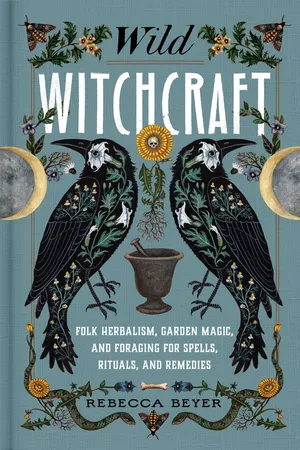
Wild Witchcraft
eBook - ePub

Wild Witchcraft

Folk Herbalism, Garden Magic, and Foraging for Spells, Rituals, and Remedies

  1. 224 pages
  2. English
  3. ePUB (mobile friendly)
  4. Available on iOS & Android
eBook - ePub

Wild Witchcraft

Folk Herbalism, Garden Magic, and Foraging for Spells, Rituals, and Remedies

About this book

Learn how to cultivate your own magical garden, begin your journey with folk herbalism, and awaken to your place in nature through practical skills from an experienced Appalachian forager and witch.

Witchcraft is wild at heart, calling us into a relationship with the untamed world around us. Through the power of developing a relationship with plants, a witch—beginner or experienced—can practice their art more deeply and authentically by interacting with the beings that grow around us all. Bridging the gap between armchair witchcraft and the hedge witches of old, Wild Witchcraft empowers you to work directly with a wide variety of plants and trees safely and sustainably.

With Wild Witchcraft, Rebecca Beyer draws from her years of experience as an Appalachian witch and forager to give you a practical guide to herbalism and natural magic that will share:
-The history of witchcraft and Western herbalism
-How to create and maintain your own herbal garden
-Recipes for tinctures, teas, salves, and other potions to use in rites and rituals
-Spells, remedies, and rituals created with the wild green world around you, covering a range of topics, from self-healing to love to celebrating the turning of the seasons
-And much more!

Wild Witchcraft welcomes us home to the natural world we all dwell in by exploring practical folk herbal and magical rites grounded in historical practices and a sustainable, green ethic.
Frequently asked questions

Yes, you can cancel anytime from the Subscription tab in your account settings on the Perlego website. Your subscription will stay active until the end of your current billing period. Learn how to cancel your subscription.
No, books cannot be downloaded as external files, such as PDFs, for use outside of Perlego. However, you can download books within the Perlego app for offline reading on mobile or tablet. Learn more here.
Perlego offers two plans: Essential and Complete
  • Essential is ideal for learners and professionals who enjoy exploring a wide range of subjects. Access the Essential Library with 800,000+ trusted titles and best-sellers across business, personal growth, and the humanities. Includes unlimited reading time and Standard Read Aloud voice.
  • Complete: Perfect for advanced learners and researchers needing full, unrestricted access. Unlock 1.4M+ books across hundreds of subjects, including academic and specialized titles. The Complete Plan also includes advanced features like Premium Read Aloud and Research Assistant.
Both plans are available with monthly, semester, or annual billing cycles.
We are an online textbook subscription service, where you can get access to an entire online library for less than the price of a single book per month. With over 1 million books across 1000+ topics, we’ve got you covered! Learn more here.
Look out for the read-aloud symbol on your next book to see if you can listen to it. The read-aloud tool reads text aloud for you, highlighting the text as it is being read. You can pause it, speed it up and slow it down. Learn more here.
Yes! You can use the Perlego app on both iOS or Android devices to read anytime, anywhere — even offline. Perfect for commutes or when you’re on the go.
Please note we cannot support devices running on iOS 13 and Android 7 or earlier. Learn more about using the app.
Yes, you can access Wild Witchcraft by Rebecca Beyer in PDF and/or ePUB format, as well as other popular books in Theology & Religion & Horticulture. We have over one million books available in our catalogue for you to explore.

Information

1 THE LEGACY A History of Witchcraft

Image
In an age of epic consumption and ecological destruction, it’s difficult to imagine a lifeway more connected with the land we live on. It’s also sometimes difficult to imagine we have the capacity and the power to heal ourselves and others. Don’t get me wrong, I’m not a purist. I use Western medicine alongside herbalism because I’ve seen they aren’t mutually exclusive. They often complement and aid each other. It’s important to note the history of our medicine in the West led us to both practices.

Ancient Medicine: A Brief History of Western Herbalism

In my opinion, understanding the history of Western herbalism is imperative before you try to practice it. In North America, so much of our body of knowledge comes from peoples who have been historically killed, enslaved, and have had their history rewritten to dampen the deep and lasting wounds inflicted upon them. It’s not only important to understand and acknowledge that history, but as in all things in the history of North America, it’s important to question who has written that history, to what ends, and why. Acknowledging where we get herb uses and folklore from is a vital part of battling cultural appropriation and other harmful beliefs that exclude and erase Black, brown, and Indigenous contributions to a very large body of knowledge.
Herbalism begins in prehistory. Our paleolithic ancestors ingested and interacted with many plant species, including many medicinal ones like yarrow, willow, and more. When humans began to write things down, no longer did we have to wonder how and why they used plants. The first recorded mention of herbal remedies that we know of is from over 5,000 years ago. Clay tablets found in ancient Mesopotamia described a dozen herbal recipes calling for the use of over an astonishing 250 plant species by the Sumerians.1
Egypt, India, and China all collected, wrote, and disseminated texts on medicine and herbs as far back as 400 BCE. They birthed some of the longest and most well-studied plant medicine traditions, namely Ayurveda and traditional Chinese medicine. These systems directly influenced and inspired where this story often begins: ancient Greece and Rome. Hippocrates, often called the father of modern medicine, was one of the first to write about the separation of illness from spiritual causes around 400 BCE. At the time it was a controversial view to dismiss that angry spirits and gods could cause illness as it seemed to tempt the Fates themselves into dealing untimely blows.
The history of Western herbalism is often mistakenly told as a European story, yet nearly every continent’s people have influenced it in different and complex ways, from Asia to North America and from Africa to India.
The first and arguably most important medical school in Europe was in Salerno, Italy, in the 10th century CE. It was through a rich history of Islamic medical texts and their translations from Arabic to Latin that North African medicine made its way into the very foundations of this practice. Greek medical texts from Hippocrates and Galen were also translated at this school and integrated into this institution. This school was unique in many aspects, particularly because it supported practitioners of all genders in a time where women were not encouraged to pursue professions. One of the most famous women was Trota of Solerno, who wrote some of the most influential texts on women’s medicine in the Middle Ages.2
Monasteries also contributed to the recording and dissemination of plant knowledge through libraries and translations. It was not until the 15th century that printing presses made the painstaking labor of hand copying herbals a thing of the past. Though literacy was still a privilege of the clergy and upper classes, more books recording the uses of plants could now circulate and begin the slow process of crossing class lines. Translating works to common languages instead of Greek and Latin also allowed for plant medicine to make its way into the hands of more diverse classes of people in Europe.
One of the most well-known and cited English-speaking herbalists of the Western herbal tradition is Nicholas Culpeper. He wrote about the 17th-century countryside, recording and printing his own English-language texts on herbal remedies and astrological medicine. He treated people for low or even no cost and sold his works for affordable prices, believing this type of healing should not be relegated to the upper class. This earned him two accusations of witchcraft as well as a close call with a prohibition from practicing medicine due to the stranglehold that the College of Physicians kept over medical knowledge.
Culpeper is important not only for his anarchic heart but also for the way his work influenced herbalism in America. The English Physician (now known most often as Culpeper’s Complete Herbal) was printed in Boston in 1708. It was the first medical text and the first book on herbalism printed in North America. The ethnobotany of First Nations people in North America blended with the knowledge system European colonists brought with them and that of enslaved African peoples into the Western herbal and American folk herbal traditions we know today. Some of this information was mingled by choice, but much of it was brought together by force.
This is a very abbreviated history, but it can be helpful to think of herbalism in America as a stool with three legs: one Indigenous, one African, and one European. As time went on, many more cultures came together in North America. Today we see the fingerprints of Latinx medicinal practices, as well as many more influences from the diverse cultures that now reside here. Honor where medicine comes from, acknowledge the culture, people, and nation, and pronounce it correctly. If you make a mistake, it’s okay, apologize authentically, and try again. It’s always okay to ask and say, “I’m still learning.” I know I am.

The Birth of the “Witch”

As a self-identified forager-witch, I am often asked where forager ends and witch begins. To me, it’s nearly impossible to tease them apart. As I said before, I found my way to Traditional Witchcraft through Wicca. Many people believe they’re one and the same, and while some Wiccans are witches, not all witches are Wiccans. Wicca is a modern religion born in England in the 1950s that is inspired by an eclectic blend of occult practices both Eastern and Western. Wicca shares many things with Traditional Witchcraft, but the two have important distinctions. Just as the history of Western herbalism is necessary to the practice, so too is the history of witchcraft necessary to the witch. It’s good to know who died for our folkways, who suffered for our magic, and conversely, who thrived from its practice. Let’s look at a brief history of witchcraft as it was practiced in history (and is still today) in the Western world.
Traditional Witchcraft is an umbrella term under which many traditions lie. Generally speaking, it means a modern witchcraft tradition based on practices and beliefs of witchcraft from Europe and America from the 1500s to the 1800s. It is unique folk magic traditions and witchcraft beliefs of the land one lives on. These practices and beliefs are generally seen to have survived Christianity in recorded folklore, songs, and superstitions.
Traditional Witchcraft isn’t just what witchcraft may have been like centuries to millennia ago, but what it was like. We know this through surviving documentation, oral lore, and folk practices that exist today in different cultures. What sets Traditional Witchcraft apart is that the practitioners base their practices in the old lores—chants, incantations, ballads, superstitions, oral lore, and documented witchcraft practices and rituals.
Some Traditional Witchcraft traditions are culture-based, such as Cornish or Balkan witchcraft, while other traditions are based on the writings of specific people, such as Robert Cochrane or the Andersons, who founded the Feri tradition. There are many subtle differences between different traditions, mostly revolving around the personalities behind the belief sets.
Modern Traditional Witchcraft largely did not exist as a term before the early 2000s. It was inspired by a group of witches writing in the 1950s–1970s, namely Robert Cochrane, Paul Huson, Joe Wilson, Robert Graves, and Victor Anderson. People like E. J. Jones, Michael Howard, Nigel Jackson, Nigel Pennick, Andrew Chumbley, and Daniel Schulke have, since 1980, gone on to help create what we know today to be Traditional Witchcraft.3 Although many of these traditions are based on ancient practices, we’re still forging what it means to practice Traditional Witchcraft in a modern world.4 When I sunk into studying this lore, the ways in which I melded my foraging and gardening practices into these traditions felt like a perfect fit. Much of Traditional Witchcraft and our sabbaths and holidays revolve around the agricultural year. So, what better way to celebrate the Old Ways than to live them?
When was witchcraft as well known as it is today? What informed the legacy modern-day witches continue? It begins before the written word, when our ancient ancestors worshipped the animistic world that pulsed with life around them through prayer, offering, dance, song, and ritual. In the written word, it begins in 1750 BCE with the Code of Hammurabi. This was one of the first written law codes containing sections dealing with magic and legal charges of sorcery and witchcraft.

Time Line of the History of Witchcraft

(Based on Michael Bailey’s A Dictionary of Witchcraft)5

The word magia first began to appear in Latin in the first century BCE. The first use of the truly general concept of “magic” in Roman usage was found late in the century (23–79 BCE) by the poet Virgil. Below is a brief historical list of what follows.
From here Wicca and other witchcraft traditions jump to America and take off in the 1970s. Many new sects of Wicca were born in the US alongside Traditional Witchcraft traditions. Yet of course, the continuation of the long history of American folk magic practices, like Hexerei in Pennsylvania, Appalachian folk magic, and African influenced traditions like Hoodoo and Voodoo continue and flourish. This time line gets us to the present day, but how did the folklore of the witch arise? What makes a witch?

What Is a Witch?

As we can see, the understanding of witchcraft as a crime or set of heretical beliefs against the Catholic Church began in earnest in the 13th century in Europe. Actions and practices once seen as a part of someone living on the fringes of society soon became a crime punishable by death. More often than not, many were accused of being witches for being single women, mentally ill, disabled, or being different from the norm. Sometimes people were accused of being witches for owning land desired by others or because of petty interpersonal disputes. In the 15th century, when demonologists began to argue that witchcraft was heresy rather than delusion, ideas of the witches’ Sabbath and the Devil took a hold of the minds of Europeans, and witchcraft confessions became the new written record of witch lore.
Much of what witchcraft was assumed to be was simply the opposite of the God-given order of the world. This means that witches brought death and destruction, whereas God brought life and salvation. It was espoused that witches worshipped the Devil in the form of a goat, cat, or toad. They had sexual orgies with demons and one another. They raised storms to destroy crops and injure people. These were the things Church officials warned of and what most of Europe believed.
400 BCE
Plato condemns magoi, or magic practicing priestly caste members, and they’re given a negative reputation.
1022 CE
First known burning of heretics at Orleans.
1233
Pope Gregory XI issues the Vox in Rama, in which he describes heretics gathering to worship a demon in the form of a toad or a pallid man, then engaging in orgies much like the later descriptions of the Witches’ Sabbath.
1400
One of the earliest known witch hunts in Western Europe, in the Alps, Simme Valley.
1427-1436
Major witch hunts in Europe: Savoy, Dauphine, and Valais.
1458
Nicholas Jacquier writes Flagellum haereticorum (Scourge of Heretical Witches), one of the first major treatises on witchcraft and witch hunting.
1486
Malleus Maleficarum (Hammer of the Witches) is written, outlining how to identify and hunt witches.
1575-1675
Witch hunts reach their peak in Europe.
1584
Reginald Scott, the skeptical thinker, publishes The Discoverie of Witchcraft.
1675-1750
Most of Europe sees reductions in witch hunts.
1692-1693
Salem witch trials in Massachusetts.
1736
Witchcraft Act is repealed in London.
1828
Karl Ernst-Jarcke argues that historical witchcraft is actually a pre-Christian religion.
1888
The Hermetic Order of the Golden Dawn, an elite secret society devoted to ritual magic, is founded in England.
1899
Amateur folkorist Charles Leland publishes Aradia, or the Gospel of the Witches.
1921
Margaret Murray’s The Witch-Cult in Western Europe is published: first of three works arguing that historical witchcraft was actually a form of ancient pagan fertility worship.
1951
Witchcraft Act of 1736 is repealed.
1954
Gerald Gardner publishes Witchcraft Today, laying the foundations for Wicca.
Some of these ideas were gathered from Jewish stereotypes and other Christian/Catholic heresies. These stories were affirmed by forced confessions. Many of these beliefs may also stem from the beli...

Table of contents

  1. Cover
  2. Title Page
  3. Dedication
  4. Introduction
  5. Part One: The Legacy A History of Witchcraft
  6. Part Two: The Relationship Gardening Your Own Magical and Healing Herbs
  7. Part Three: Foraging Your Own Magical and Healing Herbs Foraging Basics for the Wild Witch
  8. Part Four: Remedies, Spells, Rituals, and the Wheel of the Year
  9. Photographs
  10. Conclusion
  11. Acknowledgments
  12. About the Author
  13. Notes
  14. Index
  15. Image Credits
  16. Copyright