Cuba Betrayed, first published in 1962, is an autobiographical work of former Cuban dictator Fulgencio Batista, in which he expresses his viewpoint regarding his two terms as dictator, his defeat, and his successors—Cuba's "Betrayers."
"The book is not meant to be a literary masterpiece. Still less has there been any attempt at stylistic elegance. It is, rather, an exposition of facts, a narration based on memory and notes."—Introduction
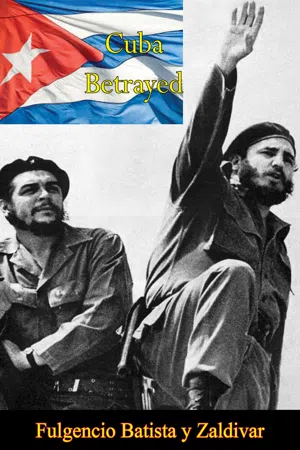
- 288 pages
- English
- ePUB (mobile friendly)
- Available on iOS & Android
eBook - ePub
Cuba Betrayed
About this book
Information
Subtopic
American Civil War HistoryIndex
HistoryPART I—EVENTS: CAUSE AND EFFECT
CHAPTER I—DEMOCRATIC PLANS
IN ORDER TO assure internal and international confidence, the revolution of the “10th of March,” 1952, maintained all the norms, principles and guarantees of the Constitution of 1940, with modifications only in regulatory measures. In accord with these norms and principles, there was no attack on the lives or the property and political rights of citizens. Nor was there political censure for anyone fulfilling the obligations of public office. The government tried to reach an agreement with the opposition for the holding of immediate elections. But most of the leaders of the opposition, realizing that the times were not propitious for their success and, in their own interests, wishing to delay the return to normalcy, refused the offer, and eagerly set out to promote disorder and violence.
Respect for Tenure
At the same time the government gave an example—without precedent in a revolution—of respecting in their positions the officers of all the autonomous bodies which exercise a good share of public power in the Cuban Government. This was our attitude in dealing with the Court of Accounts (Tribunal de Cuentas)—to respect all its justices and subordinates—in dealing with the National Bank of Cuba (Banco Nacional de Cuba), and with the Bank of Agricultural and Industrial Development (Banco de Fomento Agrícola e Industrial), making new appointments only when an office-holder had resigned; in dealing with the Commission of National Development (Comisión de Fomento Nacional); with the Cuban Institute for the Stabilization of Sugar (Instituto Cubano de Estabilización del Azúcar); with the Commission for Arbitration of the Sugar Industry (Comisión de Arbitraje Azucarero), and with all the bodies connected with social security, whether of the laboring or professional classes. Among the bureaucracy of other government departments, where formerly any change in leadership had meant a massive wave of dismissals, the revolutionary government of the “10th of March” created hardly a stir.
Terrorism and Sabotage
The purpose of all these acts was to stabilize the country, to create as little upheaval as possible, gaining general confidence by seeking the national unity indispensable to progress, economic liberation and consolidation. But personal ambitions, political passions, and the desire to restore the old order vied with these patriotic objectives. They gave rise with diabolical intensity to the terror which, in the beginning, revealed its presence through bombs and explosives, in streets, parks, theatres, cinemas, restaurants, cabarets and stores. It brought death or mutilation to children, women and men, most of whom were not concerned with politics. Then terror attacked the public services, the aqueducts and the electric works, highways, railways, bridges, telephone networks, telegraph stations, post offices, and industrial and agricultural centers.
Economic Aggression
In describing this destructive process one must emphasize the effort made to destroy the economy, not only through the actions summarized above, but also by attempts to obstruct the sugar harvests, and by organizing a campaign of slander through telephone calls, and propaganda protected by the absolute freedom of the press.{7} A rumor was spread that “the government planned to seize bank deposits as well as the contents of safe deposit boxes in order to overcome its and the country’s bankruptcy.” After repeated failures of this campaign, public confidence was weakened in April, 1958, when a general strike, which threatened to put important national and foreign banks in a difficult spot, was called without success.
These then were the negative methods of a struggle, which, as we have many times repeated, was directed not against the government but against Cuba.
Attacks on Schools and Children
The lawless campaign accentuated its own vile nature when it directed aggressive acts against kindergartens, hurling “Molotov cocktails” and attacking buses carrying boys and girls to their schools.
In the wave of terror and violence which lashed the Island in the last two years, our government repeatedly tried the method of pardon, of forgetting offenses and calling for unity and national concord. What follows is an example of this policy.
Two months before the assassination in Holguín of Col. Fermin Cowley Gallegos, military chief of the zone in which the Castro family resided, the mother of Fidel and Raúl, Mrs. Ruz Castro, addressed herself, with Cowley as intermediary, to the General Chief of Staff. I was to grant a truce, and through diplomatic safe-conduct or by the withdrawal of our troops from the region, the two could take a plane or a ship out of the country.
There was nothing suspicious about these overtures. Col. Cowley’s job was to protect the Castro Ruz family on the farm where the widowed mother lived with her children, Ramon and Juanita. These two children acted as messengers between the Colonel and Mrs. Ruz Castro.
The Office of the Chief of Staff gave instructions for the withdrawal of the troops and called a halt to all fighting. A six-man patrol of marines and soldiers withdrew to relax on the sea coast. As they were not on duty, they reconnoitered the area and then spent the night in two abandoned huts.
Trustingly, they took no precautions. They fell fast asleep, believing that the truce would be observed. About 4:30 in the morning one of them arose to prepare breakfast. Kindling the fire was to be, unknowingly, the signal for the consequent tragedy. Fidel Castro and a group of villains who accompanied him, making a mockery of his mother’s effort and of the truce, fell “heroically” upon those defenseless troops and slew them with knife and gun.
Tolerance and Law
Five laws of amnesty, one of them so comprehensive as to include the assailants of the “Moncada” barracks in 1953, and their ringleader Castro; wholesale pardons; repeated invitations to exiled leaders to return to the country; respect for the freedom of the press as ordered by the Constitution; and, finally, the inclusion into the Electoral Code of the demands formulated by the opposition, particularly the direct and secret vote—these acts demonstrated the will of any government to maintain peace and advance progress.
Work and Credit
If one examines to what extent Cuba advanced, although deep in the sorrow, confusion and uncertainty of this struggle, the conclusion is obvious. If neither sugar{8}, nor minerals, nor other exports reached high price levels; if agreements could not be reached with foreign enterprise and if world investment capital was adversely influenced; if international opinion turned so hostile to Cuba as to convert Havana embassies into centers of conspiracy; if embargoes against the shipment of arms to the government were established—practically giving the status of belligerents to terrorists who committed every sort of outrage and violated laws, and, even enjoyed advantages in certain countries—then we must ask ourselves: How did Cuba attain such a high level of solvency and economic development at this time and under such circumstances?
We must conclude that world opinion had been led astray by propaganda but that the Cuban Government had the positive support of internal public opinion, because in no other way could the miracle of this economic development{9}, this height of prosperity and the high standard of living of labor, have been possible.
These heights are not reached with guns. They are achieved through the confidence of businessmen, of investment capital, of farmers, of all sectors of the population sharing in the production and commerce of a country{10}.
Constitution and Despotism
Any suspension of constitutional guarantees was always preceded by national clamor for such action. The people saw how the Legislative Power acted within the framework of the Constitution to modify the messages of the Executive Power, and approved or disapproved measures recommended by the Council of Ministers (Consejo de Ministros). It made its own decisions, without conflicts on questions of party discipline. In the area of Judicial Power not one judge, magistrate, or employee was removed by the revolutionary government. Nor were there any dismissals when the constitutional government came to power after the election of 1954. In accordance with the Constitution, the internal control of the judges and courts was maintained by the Supreme Court (Tribunal Supremo), the majority of whose members had taken their seats under previous administrations.
Intelligent public opinion observed the opposite take place later under Castro; and the world noted it with horror. We have seen assault, pillage and confiscation of newspapers imposing a gag of terror on the press. Those who professed to be defenders of the Constitution, rule without obeying it; nor do they have even their own revolutionary constitution. Those who claimed to respect the Judicial Power, defending Manuel Urrutia against the simple criticisms directed against his lies, destroyed the courts of justice. It must be strange to watch men who proclaimed the independence of civil power—among them the lawyer José Miró Cardona—converted into puppets of the Argentine (“Ché Guevara) who speaks in the name of military power and chieftain Castro. It is easy to observe the difference between the two regimes, because the latter has usurped all power, while we worked earnestly in harmony with the other government departments.
There, in constant effort, in respect for laws and property rights, lies the secret of the economic greatness of Cuba.
CHAPTER II—POLITICAL EFFORTS
IMMEDIATELY AFTER the triumph of the revolutionary movement of March 10, 1952, Constitutional Statutes were promulgated which revived, with slight changes, the Constitution of 1940. To assume Legislative functions there was created, as an urgent stopgap, a Consultive Council (Consejo Consultivo) of 80 members. This body began deliberations April 28, 1952, and ceased functioning January 27, 1955, when the elected Representatives and Senators took office.
All sectors of national life were represented in the Council: The Presidents of the Associations of Sugar Mill and Sugar Plantation Owners (Asociaciones de Hacendados y Colonos); the Secretaries-General of the Cuban Labor Confederation (C.T.C.), of the National Federation of Sugar Workers (F.N.T.A.), and of other federations of workers; the glorious veterans of the War of Independence; lawyers, engineers, physicians, teachers, journalists, agrarian leaders, career politicians and ex-Congressmen, and social, economic and industrial technicians. This body considered 67 bills submitted by the Council of Ministers and 280 initiated by its own members. The Consultive Council was called to session 168 times, and only 10 times failed to deliberate for want of a quorum.
Outstanding among their decrees were those which created the Offices for Construction of Local Highways (Construcción de Caminos Vecinales) in each Municipal District; the Repair and Construction of Rural Housing (Reparación y Construcción de Viviendas Campesinas) and Rehabilitation of Slum Areas (Rehabilitación de los Barrios de Indigentes) the Administration for the Construction of Low Cost and Rent Housing (Régimen de Construcción de Viviendas de Costo y Rentas Reducidos); the National Organization for School Clothing and Meals (Organización Nacional del Ropero y Almuerzo Escolar); the Cuban Bank for Foreign Trade (Banco Cubano del Comercio Eterior) the Fund for the Retirement of Workers in the Shoe Industry (Caja de Retiro de los Trabajadores de la Industria del Calzado) the Cuban Institute of Composers (Instituto Cubano de Autores Musicales); the Social Security for Agronomists (Seguro Social del Ingeniero Agrónomo); the National Finance Corporation of Cuba (Financiera Nacional de Cuba); the Professional Security for the Journalist (Seguro Professional del Periodista); the Varadero Tourist Center (Centro Turístico de Varadero); the National Organization for the Rehabilitation of the Handicapped (Organización Nacional de Rehabilitación de Inválidos); the Cuban National Corporation for the Blind (Corporación Nacional de Ciegos de Cuba); the Juvenile Courts, (Tribunales de Menores); the Fund for the Retirement and Social Assistance of Construction Workers (Caja de Retiro y Asistencia Social de los Obreros de la Construcción); the Organization of Banks for Human Resources (Organización de Bancos de Material Humano); the Retirement Fun...
Table of contents
- Title page
- TABLE OF CONTENTS
- DEDICATION
- ACKNOWLEDGEMENT
- INTRODUCTION
- A POSTSCRIPT
- PART I-EVENTS: CAUSE AND EFFECT
- PART II-HISTORICAL REVIEWS
- PART III-LIES AND ANSWERS
- APPENDIX
- FINAL WORDS
- REQUEST FROM THE PUBLISHER
Trusted by 375,005 students
Access to over 1.5 million titles for a fair monthly price.
Study more efficiently using our study tools.
Frequently asked questions
Yes, you can cancel anytime from the Subscription tab in your account settings on the Perlego website. Your subscription will stay active until the end of your current billing period. Learn how to cancel your subscription
No, books cannot be downloaded as external files, such as PDFs, for use outside of Perlego. However, you can download books within the Perlego app for offline reading on mobile or tablet. Learn how to download books offline
Perlego offers two plans: Essential and Complete
- Essential is ideal for learners and professionals who enjoy exploring a wide range of subjects. Access the Essential Library with 800,000+ trusted titles and best-sellers across business, personal growth, and the humanities. Includes unlimited reading time and Standard Read Aloud voice.
- Complete: Perfect for advanced learners and researchers needing full, unrestricted access. Unlock 1.5M+ books across hundreds of subjects, including academic and specialized titles. The Complete Plan also includes advanced features like Premium Read Aloud and Research Assistant.
We are an online textbook subscription service, where you can get access to an entire online library for less than the price of a single book per month. With over 1.5 million books across 990+ topics, we’ve got you covered! Learn about our mission
Look out for the read-aloud symbol on your next book to see if you can listen to it. The read-aloud tool reads text aloud for you, highlighting the text as it is being read. You can pause it, speed it up and slow it down. Learn more about Read Aloud
Yes! You can use the Perlego app on both iOS and Android devices to read anytime, anywhere — even offline. Perfect for commutes or when you’re on the go.
Please note we cannot support devices running on iOS 13 and Android 7 or earlier. Learn more about using the app
Please note we cannot support devices running on iOS 13 and Android 7 or earlier. Learn more about using the app
Yes, you can access Cuba Betrayed by Fulgencio Batista y Zaldivar in PDF and/or ePUB format, as well as other popular books in History & American Civil War History. We have over 1.5 million books available in our catalogue for you to explore.