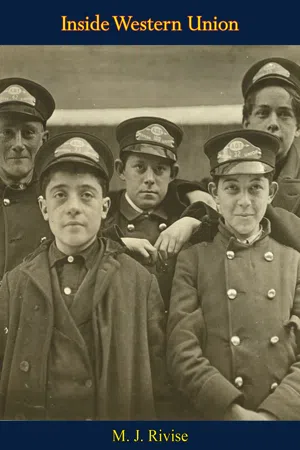
Recalling the days before the advent of the internet and social media, when rapid written communication came not electronically, but electromechanically, Inside Western Union is a nostalgic collection of anecdotes by Mike Rivise, an experienced sales manager.
In this fascinating book, first published in 1950, the author draws on his own experiences to with many tales of demanding customers who expected the most from their messenger boys, recalls stories of coded messages used to minimize word counts, and provides accounts of crooks that tried to wire the loot across town for later pick up.
Rivise also includes details of the history of the Western Union company, including its early takeover by financier Jay Gould in 1881, its acquisition by American Telephone and Telegraph in 1909 following Gould's death, the arrival of the competing service Postal Telegraph, and the invention of the telegraph by Samuel F. B. Morse, which revolutionised communication.
An invaluable read!
- 177 pages
- English
- ePUB (mobile friendly)
- Available on iOS & Android
eBook - ePub
Inside Western Union
About this book
Information
Subtopic
American Civil War HistoryIndex
History1—The General of the Sahara
IF YOU WERE to ask me to name the most unusual customer I ever served, I’d say “The General of the Sahara Desert.” A constant subject of conversation among the messengers, his fame had spread from Brooklyn to the far reaches of the Bronx.…
One day a peculiar thin man came to see me at my office. He carried an umbrella although it was a sunny day. In a crisp British accent, he introduced himself as Mr. Dobbins and asked if I would furnish messengers for his employer’s “army.”
Mr. Dobbins was a butler and his employer was a self-appointed General, a man of peculiar tastes, with little knowledge of English but a convenient quantity of wealth. Mr. Dobbins spoke with much profusion about the wealth, and gestured mysteriously with his hands as he told of sugar plantations in Haiti and high palm trees swaying in groves, but whether the wealth came from the sugar cane or was buried in small satchels under the sugar plants I was not able to determine. Neither was our credit department, but they opened a charge account anyway.
Several times a week after that I received calls to send him his “army.” The platoon size varied: sometimes I’d send twelve messengers, sometimes six, sometimes only three or four. It depended on how many “men” were available and the mood he was in.
The General never called me personally. Mr. Dobbins was liaison between his battleground and our “camp.”
“Maneuvers will commence in two hours,” Dobbins would say in his very very British way.
All maneuvers were performed with military correctness. This was in the early nine teen-twenties, and the General’s home was a brownstone mansion near Gramercy Park. The messengers assembled in formation at our office and marched to the front of the General’s house. There they stood at strict attention in their smart Western Union uniforms, awaiting orders.
Mr. Dobbins was the aide-de-camp. His entrance was spectacular. He would suddenly step out from behind high green bushes and formally announce “The General of the Sahara” to all within ear-shout. Then the General would come onto the scene, marching from behind the garden gate to the sidewalk with short mincing steps. He was built like a beer barrel and his neck was lost from view as his chin rested securely on his chest.
Both the General and Mr. Dobbins wore custom-made uniforms and both were bedecked with a razzle-dazzle of specially-designed medals. Sometimes the General wore thirty of them. He had awarded them to himself for acts of valor.
From his sidewalk perch, the General inspected the boys, oblivious of the inevitable gathering of amazed passers-by. Soon he shouted commands and marched the boys back and forth in military drill. He had a strong Haitian accent and a constant burp and new boys had to follow his “‘bout face” barkings by instinct, carefully distinguishing between the bark and the burp. The burp was on a contralto level.
Sometimes during the course of drilling, the General halted the men and announced a mythical victory. The butler then ran from the house with a box of new medals, and the General pinned medals on the kids and on himself.
There were other honors that went with working “the Sahara job,” as the boys called it. The General often appointed various boys as ministers to his cabinet. This was strictly an honorary job with no extra pay. However, when he hired sixteen or twenty boys, the General had his butler appoint sergeants and corporals. The ranks were temporary, good only for that day’s drill. Just before they were dismissed, the boys were each tipped. Naturally, the non-coms got the larger tips.
One day when the General’s picture appeared in the newspapers, our offices were very excited and the messengers were duly impressed by the news story that he would wed a former Ziegfeld beauty. The morning after the wedding, my telephone rang.
“I am calling for the General of the Sahara,” Mr. Dobbins announced. “Maneuvers will commence in two hours.”
It was business as usual.
The kids liked working for the General. They didn’t understand the whole thing, but it was a way to earn money and it broke up the usual messenger routine.
Sometimes the General was very stern and very military. But at other times, the “army” was given time out for mess. The boys reported that the food, usually served in the General’s basement or kitchen, was excellent.
None of them ever saw the main rooms of the house. The boys always talked about how they’d like to get a glimpse of the General’s Ziegfeld-beauty wife, but they never managed it.
One morning there was an additional request as the boys returned from their drill. The “temporary sergeant” reported to me: “The General says war is imminent, sir. He wants us to come armed tomorrow.”
At first I didn’t take the boy seriously. The boy was insistent. “Mr. Rivise, he really told me that.”
The “temporary corporal” backed him up. “He really did, sir,” the corporal said. “I heard him.” The corporal was a red-headed youth with a keen sense of rumor. “I think the General saw a few ‘blues’ in the neighborhood,” he added. Blue was the color of the uniforms of our rival Postal Telegraph messengers.
I checked with Mr. Dobbins.
“His Majesty, the General of the Sahara, hears that the enemy troops are throwing precaution to the wind. He orders that henceforth his regiment arrive armed with broomsticks.” We never questioned the General’s orders. We bought twenty-four brooms and thereafter, when the “Grand Army of the Sahara” marched to the Generals mansion, each boy carried a broomstick over his shoulder. The General paid for the brooms, of course.
The boys always attributed this defense measure to the General’s mysterious wife.
Trouble!
Never before had we seen the General at the main office. Now here he was in all his uniformed finery...and nearly frothing at the mouth. His butler, rather calm about the whole thing, stood at his right.
“There ees a spy among my zoldiers!” he shouted.
I was speechless. The General stomped over to where the idle messengers were sitting. Carefully he peered into each boy’s eyes. Suddenly his right arm shot out and he pointed accusingly at a very small messenger named Bobby.
“You!” he screamed. “Arrest him! He’s a spy!”
The butler placed a restraining arm on the messenger’s shoulder. “You are under military arrest,” he said crisply.
I watched, fascinated, as the General appointed our messengers members of a court-martial. Mr. Dobbins approached me. In a throaty whisper he told me: “We should like to employ all of these messengers for a period of one hour.” I agreed.
Meanwhile, the General addressed the messengers. “Men,” he said, “thees ees a wery zerious zituation...”
The boys listened, enraptured.
For twenty minutes the General called for security, an alert counter-espionage system, stout hearts and strong spirits. Once he became so wrapped up in what he was saying that he lapsed into a mixture of French and Spanish. When the boys exchanged glances, he caught himself and jumped back to English in the middle of a sentence. He spoke glowingly of recent victories. He took time out to award a medal or two.
Through it all, he maintained an air of injured solemnity whenever his eyes so much as grazed “the prisoner.” At last he turned to the accused and fastened his beady eyes upon him. “Confess!” he said. “Thees ees your final chance!”
“What’d I do?” asked the alleged spy.
“You zee!” boomed the General, “He confuses nozing and denies everyzing. Thees ees zee proof of guilt!”
The butler whispered something into the General’s ear. “Oui,” said the General. “Let heem haf defense before we find heem guilty.”
I was appointed defense counselor. “What did you do, Bobby?” I asked him.
Bobby, it seems, was a new boy. He’d heard so much office talk about the General of the Sahara that curiosity had gotten the best of him. The morning before, during an off-duty hour, he’d trailed along after the others to watch the notorious General drill his army.
“I stayed on the other side of the street,” he said.
“Were you in uniform?”
“Yes,” he said. He thought about it. “That must have been my undoing, I guess,” he said.
The trial was resumed. The General had changed his mind. No defense allowed. All was fair in war and this was treachery in the ranks.
Bobby sat stone still as the General delivered his final passionate appeal for a plea of guilty. His vast abdomen quaked each time he sucked in an air supply. The verdict was guilty, of course. The penalty?
“Death by a firing squad,” announced the butler.
So saying, the butler examined his watch. The hour was up. The General of the Sahara and his aide-de-camp retired from the scene, leaving the guilty man unexecuted.
A few days later a call came in for twelve boys. Bobby was among those in the office at the time.
“Not me, Mr. Rivise,” he said. He was thoroughly frightened. “They’re liable to shoot me!”
Weeks passed without a word from the General. Some of the boys used to make fun of the maneuvers but now they were all concerned.
“Let’s call him,” someone suggested.
Another boy offered the thought that perhaps the General had used up his money. The boys talked about the possibility of drilling for the General gratis, on their own time, “just once for old time’s sake.”
Another week and still no communiqué from the General. The rumor went around that he had gone over to the enemy and was now employing Postal Telegraph boys. Morale was seriously threatened. I phoned.
“No,” Mr. Dobbins said...
Table of contents
- Title page
- TABLE OF CONTENTS
- DEDICATION
- 1950: Prologue
- 1-The General of the Sahara
- 2-Boys and Their Dogs
- 3-The Customers Never Write
- 4-My Favorite Millionaire
- 5-Miss Primrose
- 6-Any Help Wanted
- 7-The Duchess and the V-Girls
- 8-The Morse Men and Me
- 9-Birth of a Salesman
- 10-“Special” Messengers
- 11-Boys on Boys’ Errands
- 12-Who’s Who from WU
- 13-Scratching for Heroes
- 14-Wrought from an Old Picture Frame
- 15-Cold War and Hot Wires
- 16-The Singing Division
- 17-Tailor-Made Telegrams
- 18-The Headache Division
- 19-The Yellow Blank
- 20-Cuban Bon-Bons
- 21-What Price Efficiency?
- 22-Strike Scene
- 23-How to Sell Stunts
- 24-Persistence Is Its Own Reward
- 1950: Epilogue
- REQUEST FROM THE PUBLISHER
Trusted by 375,005 students
Access to over 1.5 million titles for a fair monthly price.
Study more efficiently using our study tools.
Frequently asked questions
Yes, you can cancel anytime from the Subscription tab in your account settings on the Perlego website. Your subscription will stay active until the end of your current billing period. Learn how to cancel your subscription
No, books cannot be downloaded as external files, such as PDFs, for use outside of Perlego. However, you can download books within the Perlego app for offline reading on mobile or tablet. Learn how to download books offline
Perlego offers two plans: Essential and Complete
- Essential is ideal for learners and professionals who enjoy exploring a wide range of subjects. Access the Essential Library with 800,000+ trusted titles and best-sellers across business, personal growth, and the humanities. Includes unlimited reading time and Standard Read Aloud voice.
- Complete: Perfect for advanced learners and researchers needing full, unrestricted access. Unlock 1.5M+ books across hundreds of subjects, including academic and specialized titles. The Complete Plan also includes advanced features like Premium Read Aloud and Research Assistant.
We are an online textbook subscription service, where you can get access to an entire online library for less than the price of a single book per month. With over 1.5 million books across 990+ topics, we’ve got you covered! Learn about our mission
Look out for the read-aloud symbol on your next book to see if you can listen to it. The read-aloud tool reads text aloud for you, highlighting the text as it is being read. You can pause it, speed it up and slow it down. Learn more about Read Aloud
Yes! You can use the Perlego app on both iOS and Android devices to read anytime, anywhere — even offline. Perfect for commutes or when you’re on the go.
Please note we cannot support devices running on iOS 13 and Android 7 or earlier. Learn more about using the app
Please note we cannot support devices running on iOS 13 and Android 7 or earlier. Learn more about using the app
Yes, you can access Inside Western Union by M. J. Rivise,John Fischetti in PDF and/or ePUB format, as well as other popular books in History & American Civil War History. We have over 1.5 million books available in our catalogue for you to explore.