Includes over 180 illustrations, portraits and maps covering the Russian Campaign of 1812.
"These Memoirs are the findings of a professional soldier, sitting in judgment upon the foremost soldier of fortune the world has known. But they are something more than that. They are the observations of a man of the Old Régime, whose lot had been cast in with the new Empire. The soldier who wrote them was a statesman as well—a diplomatist of the school of Talleyrand, but without any of that strange creature's womanish ways. He was also—and one often feels the lack of this quality in memorialists who were near Napoleon—an administrator of sufficient skill to comprehend the Emperor's plans, and to do justice to the recording of them. And finally, he was a man with physical energy enough to match, and on occasion to outdo, the Emperor's own."
eBook - ePub
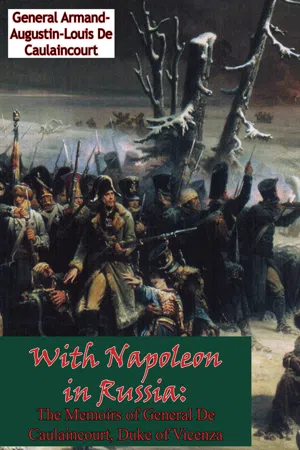
With Napoleon in Russia
The Memoirs of General De Caulaincourt, Duke of Vicenza [Illustrated Edition]
- 516 pages
- English
- ePUB (mobile friendly)
- Available on iOS & Android
eBook - ePub
With Napoleon in Russia
The Memoirs of General De Caulaincourt, Duke of Vicenza [Illustrated Edition]
About this book
Information
Subtopic
British HistoryIndex
HistoryPART I—PREPARATION
CHAPTER I—AMBASSADOR’S RETURN
THE events in Europe leading up to 1812 had so great an influence on those which followed later, by placing the balance of Europe’s destinies into the hands of Russia, that I have felt it would be valuable to preserve the notes which I made regarding various circumstances of those days. In writing them my sole motive was to keep an account of my life, my impressions, and my conduct. Since then I have come to regard them as indispensable material for the completion of the official part of my correspondence as ambassador, and even, it may well be, for the history of that great epoch.
My aim will be fulfilled if my notes help also to formulate opinion on the character and the political views of the Emperor Napoleon.
My notes were made everywhere, at my desk and in camp, every day and at all times of day; they are the work of every moment. I have touched up nothing and disguised nothing, because although there were moments when the man showed himself, it was the demigod whom one recognized most often. More than once the thought occurred to me that this journal, written under the very eyes of the Emperor, might fall into his hands; but that reflection did not check my pen. This fact is an answer to those who have claimed that men could neither think nor speak nor write under his reign, and that the truth made him an irreconcilable enemy. No doubt the truth chilled his good will, but his strong and lofty character raised him above all criticisms made in good faith. I was confident that, as my notes were only the exact record of what I had said to him, they would seem to him injurious only if I published them as an attack on his policy and his fame.
If these pages should someday be read and severity imputed to me, I hope that allowance will be made for the happenings under the influence of which they were penned.
The Emperor was at Saint-Cloud. By eleven o’clock I was there. [June 5, 1811.] His Majesty received me coldly, and at once began heatedly to enumerate his imaginary grievances against the Tsar Alexander, but without reproaching me personally. He spoke of the ukase prohibiting foreign imports,{2} and of the admission of neutral and American ships into Russian ports, which, he said, was an infringement of the Continental System. He went on to say that the Tsar was treacherous, that he was arming to make war on France. The Emperor repeated all the fantastic stories which, to please him, were fabricated in Danzig, in the Duchy of Warsaw, and even in the north of Germany—stories the accuracy of which had been disproved time and again, sometimes by means of investigations carried out on the spot, sometimes even by the march of events.
“Admit frankly,” said the Emperor Napoleon, “that it is Alexander who wants to make war on me.”
“No, Sire,” I replied once again; “I would stake my life on his not firing the first shot or being the first to cross his frontiers.”
“We’re agreed, then,” the Emperor went on; “because I have no intention of going into Russia, nor any wish for a war or the re-establishment of Poland.”
“Then, Sire, you ought to explain your intentions, so that everyone may know why Your Majesty’s troops are concentrated in Danzig and the north of Prussia.”
The Emperor made no answer to this. He spoke of the Russian nobles who, in the event of a war, would fear for their palaces, and, after a good battle, would force the Tsar Alexander to conclude a peace.
“Your Majesty is mistaken,” I replied, and repeated to the Emperor words used by the Tsar which had greatly impressed me in the course of certain private conversations I had with him after the arrival of M. Lauriston,{3} when my position no longer had any political significance; words which were merely a more emphatic expression of what he had led me to understand some time before. They impressed me so much that I noted them down on returning home, and quote them here with the certainty that, to the best of my knowledge, my recollection of them was substantially correct:
“If the Emperor Napoleon makes war on me,” the Tsar Alexander said to me, “it is possible, even probable, that we shall be defeated, assuming that we fight. But that will not mean that he can dictate a peace. The Spaniards have often been defeated; and they are not beaten, nor have they submitted. But they are not so far away from Paris as we are, and have neither our climate nor our resources to help them. We shall take no risks. We have plenty of room; and our standing army is well-organized, which means, as the Emperor Napoleon has admitted, that we need never accept a dictated peace, whatever reverses we may suffer. What is more, in such circumstances the victor is forced to accept the terms of the vanquished. The Emperor Napoleon made a remark to this effect to Tchernychev{4} in Vienna after the battle of Wagram. He would not have made peace then if Austria had not kept an army intact. Results have to keep pace with his thoughts, because, being often absent from France, he is always anxious to return there. This is the teaching of a Master. I shall not be the first to draw my sword, but I shall be the last to sheathe it. The Spaniards have proved that lack of perseverance has been the undoing of all the States on which your master has made war. The Emperor Napoleon’s remark to Tchernychev, in the latest war with Austria, shows clearly enough that the Austrians could have obtained better terms if they had been more persevering. People don’t know how to suffer. If the fighting went against me, I should retire to Kamtchatka rather than cede provinces and sign, in my capital, treaties that were really only truces. Your Frenchman is brave; hut long privations and a bad climate wear him down and discourage him. Our climate, our winter, will fight on our side. With you, marvels only take place where the Emperor is in personal attendance; and he cannot be everywhere, he cannot be absent from Paris year after year.”
The Emperor listened to me with the closest attention, even with some astonishment. He appeared to be greatly preoccupied, and kept silent for a while. I thought I had made a deep impression on him, since his face, his whole bearing, which hitherto had manifested only an extreme severity, became open and friendly. He seemed to wish to encourage me to go on, not only by looks but by the questions he put. He spoke of society in Russia, of the army, of the administration, and even referred to the Tsar Alexander without manifesting his usual ill-humour at mention of this name. In fact, the Emperor gave every indication at this moment of being kindly disposed towards me, and referred appreciatively to the manner in which I had served him. I assured him that he was mistaken about the Tsar Alexander and about Russia; that it was of the utmost importance not to base his conclusions about that country on what certain persons told him, or about the army on what he had seen at Friedland; that, having been threatened for a year, it had been possible for the Russians to take account of all eventualities, particularly to take account of the possibility of our enjoying immediate successes.
After listening to me attentively, the Emperor began enumerating the troops and general resources at his disposal. When he reverted to this theme I realized that all hope of peace was at an end, since it was enumerations of this kind which, more than anything, intoxicated him. Indeed he ended by telling me that one good battle would knock the bottom out of my friend Alexander’s fine resolutions, not to mention his sand fortifications, alluding to the defence works which were being thrown up along the banks of the Dwina and at Riga.
He spoke of the situation in Spain, and complained irritably of his generals there and the setbacks they had suffered, expressing his opinion that this vexatious state of affairs was due to the incompetence of the King, his brother [Joseph of Spain], and of the French generals, and announcing his determination to make an end of it. He tried to persuade me that he could do this whenever he was so minded, but that the English would then attack elsewhere, perhaps even in France. Thus, he concluded, it was just as well—perhaps a positive advantage—for them to be in Portugal. Then he returned to the Tsar Alexander.
“He is fickle and feeble,” he said once again.
“He is obstinate,” I replied. “His conciliatory nature makes him give way easily when he does not feel the issues at stake to be particularly important; but nonetheless he draws a line beyond which he will not be pushed.”
“He has the Greek character—he is untrustworthy,” the Emperor repeated yet again.
“I would not suggest,” I said, “that he has always spoken everything that was in his mind; but whatever he has deigned to say to me has proved correct, and whatever promises he has made to Your Majesty through me he has kept.”
“Alexander is ambitious. There is some hidden purpose which he hopes to achieve through war. He wants war, I tell you. Otherwise, why should he refuse every arrangement I put forward? He has some secret purpose. Can’t you see through him? No, he has larger motives than Poland and Oldenburg.”
“These motives, and the fact that your army is at Danzig, are in themselves enough to explain the line he has taken; though naturally, like every government in Europe, he is uneasy about the change Your Majesty has made in your policy since Tilsit, and, more particularly, since the Peace of Vienna.”
“What has all that to do with Alexander? It does not affect him. Have I not told him to take Finland, Wallachia and Moldavia? Have I not suggested that he should partition Turkey? Did I not give him three hundred millions for the Austrian war?”
“Yes, Sire; but you would not expect such enticements to blind him to the fact that Your Majesty has since then marked out a quite new policy, whose execution begins in Poland—that is, in Russian territory.”
“Like him, you are simply dreaming! Once more—I do not want to go to war with him; but he must fulfil the commitments which he has undertaken, and enforce an embargo on English trade. What has he to fear from changes in my policy? What do such changes matter to a country like Russia, away at the back of beyond?”
“On that point he has never explained himself to me.”
“I don’t prevent him from extending his dominions in Asia, or even in Turkey, if he wants to, so long as he does not touch Constantinople. He is vexed that I should hold Holland. That galls him because he needs foreign loans.”
“The reunion of the Hanseatic towns, the establishment of the Grand Duchy of Frankfort, which means that Your Majesty intends to keep Italy; the giving of Hanover to Westphalia—all these changes, made in times of peace and simply announced by decree, alienate England and put obstacles in the way of making peace with her. Therefore they conflict with Russia’s best interests. Even so, it will not be on that account that she goes to war.”
“And must I be dictated to by the English and by my brother [Louis of Holland?] just to please Alexander? Rumiantsof{5} knows quite well that before taking these steps I did everything in my power to induce England to make peace. Labouchère has been to London several times, even on behalf of the Dutch. Am I to allow the north of Germany to be flooded with English goods?”
“Had one merely threatened to put those measures in force, that would have been good policy. The execution of those measures, however, plus the movement of whole armies towards the north—instead of a few battalions to put pressure on the customs officers—has aroused apprehension.”
“You see no further than Alexander; and he is merely frightened. It is these very policies to which you object that are taking all the heart out of the English, and will force them to make peace.”
This conversation continued for some time longer. The Emperor jumped from one question to another, and, at long intervals, returned to the same questions, no doubt to see if I kept to the same answers. To judge from his air of preoccupation, and from the long silences which broke up our five hours of conversation, it looked as if he were giving more serious consideration to the matters under discussion than perhaps he had ever given them before. After one of these long silences, he said, “It is the Austrian marriage which has set us at variance. The Tsar Alexander was angry because I did not marry his sister.”
I took the liberty of reminding the Emperor that, as I had formerly reported to him, Russia was not at all eager for such a marriage; that, although the Emperor had not been able to refuse outright to lend himself to the project, he would never have given way on the question of religion; that in any case there would have been a year’s delay, even if the Tsar had been able to obtain his mother’s consent; in short, that he had not committed himself in regard to the matter, and that Russia was rather pleased than otherwise to learn of the unexpected Austrian marriage having taken place,{6} notwithstanding our somewhat unceremonious manner of going back on the proposals of our own making—proposals which, happily, had not been accepted, but which, had they been accepted, would have made my position decidedly embarrassing.
“I have forgotten the details of the affair,” the Emperor replied; “but Russia was certainly angry about our rapprochement with Austria.”
I pointed out that in fact, as everyone had realized at the time, and as was proved by conversations with the Emperor and Count Rumiantsof when the first overtures in regard to this matter were made, the immediate reaction in Petersburg was an agreeable sense of relief at the removal of a very delicate question between the French and Russian governments, and a still more delicate question between the Tsar and his mother and family.
The Emperor Napoleon again repeated that he desired neither war nor the re-establishment of Poland, but that an understanding in the matter of neutral shipping and other differences was essential.
“If Your Majesty really desires an understanding, it will not be hard to bring one about,” I said.
“Are you sure about that?” the Emperor asked.
“Quite sure,” was my reply. “But reasonable proposals must be put forward.”
“What proposals?” the Emperor said, and urged me to enumerate them.
“Your Majesty knows as well as I do, and has known for long enough, the causes of the present estrangement; and you know better than I do what you are prepared to do to remedy it.”
“But what? What does he want me to do?”
“In regard to trade between the two countries, an arrangement should be made on a basis of reciprocal benefits, and a similar arrangement for merchant shipping in general. The admission of neutral ships into Russian ports should be countenanced, as long as we go on selling licences and allowing licenced vessels into French ports. The Prince of Oldenburg should be provided for in such a way that he is not, as at Erfurt, entirely dependent on you. An arrangement should be made about Danzig, another about Prussia, and so on....”
When the Emperor saw that I was touching on political matters the discussion of which would force him to commit himself probably more than he wished to, he sa...
Table of contents
- Title page
- TABLE OF CONTENTS
- ARMAND DE CAULAINCOURT
- INTRODUCTION
- PART I-PREPARATION
- PART II-ADVANCE
- PART III-MOSCOW
- PART IV-RETREAT
- PART V-FLIGHT
- BIOGRAPHICAL NOTES
- REQUEST FROM THE PUBLISHER
- Napoleon And The 1812 Campaign
Trusted by 375,005 students
Access to over 1.5 million titles for a fair monthly price.
Study more efficiently using our study tools.
Frequently asked questions
Yes, you can cancel anytime from the Subscription tab in your account settings on the Perlego website. Your subscription will stay active until the end of your current billing period. Learn how to cancel your subscription
No, books cannot be downloaded as external files, such as PDFs, for use outside of Perlego. However, you can download books within the Perlego app for offline reading on mobile or tablet. Learn how to download books offline
Perlego offers two plans: Essential and Complete
- Essential is ideal for learners and professionals who enjoy exploring a wide range of subjects. Access the Essential Library with 800,000+ trusted titles and best-sellers across business, personal growth, and the humanities. Includes unlimited reading time and Standard Read Aloud voice.
- Complete: Perfect for advanced learners and researchers needing full, unrestricted access. Unlock 1.5M+ books across hundreds of subjects, including academic and specialized titles. The Complete Plan also includes advanced features like Premium Read Aloud and Research Assistant.
We are an online textbook subscription service, where you can get access to an entire online library for less than the price of a single book per month. With over 1.5 million books across 990+ topics, we’ve got you covered! Learn about our mission
Look out for the read-aloud symbol on your next book to see if you can listen to it. The read-aloud tool reads text aloud for you, highlighting the text as it is being read. You can pause it, speed it up and slow it down. Learn more about Read Aloud
Yes! You can use the Perlego app on both iOS and Android devices to read anytime, anywhere — even offline. Perfect for commutes or when you’re on the go.
Please note we cannot support devices running on iOS 13 and Android 7 or earlier. Learn more about using the app
Please note we cannot support devices running on iOS 13 and Android 7 or earlier. Learn more about using the app
Yes, you can access With Napoleon in Russia by General Armand Augustin Louis de Caulaincourt, Jean Hanoteau, George Libaire in PDF and/or ePUB format, as well as other popular books in History & British History. We have over 1.5 million books available in our catalogue for you to explore.