First published in 1934, this book tells the story of an American farm woman, her husband and family, and vividly describes farm life and farm psychology.
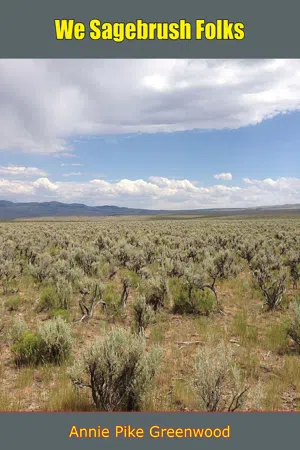
"We Sagebrush Folks tells the experiences of a woman of education, refinement, and culture, who went with her husband to plow up wealth in the land under the then new Minidoka Irrigation Project in Southern Idaho. The 'heart of gold' that experience held was the beauty of Idaho, its sunshine, its sky by day and by night, its mountains, its vast stretches of gray-green sagebrush, which she saw transformed into fields and farms, its pure, clear, inspiring, stimulating air—and what all these meant to her, emotionally and spiritually. She writes with intelligence, a notable gift for expression, and a considerable interest in and knowledge of economics. An intimate, colorful portrayal of the daily life of the sagebrush farmers and their families, mercilessly truthful, but written with vivacity, cleverness, and humor, full of anecdotes, tales, and incidents that are often amusing, sometimes tragic, but always told with a keen sense of their dramatic values." (FLORENCE FINCH KELLY, New York Times Book Review)
- 413 pages
- English
- ePUB (mobile friendly)
- Available on iOS & Android
eBook - ePub
We Sagebrush Folks
About this book
Information
Topic
HistoireV—RECREATION
KNOWING the direction of my unswerving ambition, and also the circumstances of my life before my marriage, the casual observer might have discovered little joy in my existence on that pioneer sagebrush farm, which demanded unremitting labor from one who had been an invalid child, a delicate young girl, and a prey to uremic poisoning over a lifetime. It is true that I was a miserable housekeeper—negligent of dust and grimy windows and such-like breaches of the code, that most of my work in the house was accomplished by such will as measured in horse-power, or electric watts, might have moved one of the lesser stars out of its course. Yes, my house was far from a model. I might have had it so much better with less effort on my part had I known how to manage as did Mrs. Jean from South Carolina. But, alas, I had not been born of useful female ancestry. My little wrists and ankles betray the fact that I came from a race of parasite women, pampered by their men. So, after all, in a way I can blame the men.
But I had my incidental recreations. When the garden made no demand, I would slip out of the house at four in the morning with my big, clumsy, trusty old typewriter, a load for a man, and going into the orchard, with a few sheets of paper and an old alarm clock to check my leisure before breakfast, I would enter Heaven. Pretty, the magpie, was usually my companion. He would steal my pencils and, in great delight, fly away with them, while I followed with almost a flight paralleling his own. And he was so delighted by his trickery of me, coming back to sit on one of my extended shoe toes and chattering madly—yes, and laughing. “If anything is human, all is human; if anything is divine, all is divine.” In Pretty was what is in me.
Besides my vegetable garden, over which my good German neighbor Burkhausen and I used to consult, there was my gift garden of flowers. And perhaps this is the place to tell of my infant career as a writer. Alas! the child died almost aborning. But it was interesting while it lasted.
Clippings sent me from papers and magazines throughout the United States commented on my articles; letters in such abundance that I thought of dying so as not to offend the writers by not answering; letters from the United States, from Europe, from Africa, from our island possessions; letters from all sorts of people—physicians, missionaries, farmers, farmers’ wives, a famous head of a famous girls’ college, a famous governor of a notable state, a United States Senator who said I inspired him to go to Congress. Beautiful shoes came from New York; dish-mops, very fancy, from Washington; cases of honey from Canada; wonderful flower roots from Illinois, four-o’clocks whose seeds had been in a Maine family for generations; a great box of flowering hedge from New Jersey; and many other things. We had fun while it lasted, except that the letters hurt my conscience. I was especially stricken by the letters from a spinster lady in Brooklyn who wanted to come and live with us.
And there was my really wonderful collection of iris, looking like rare orchids, sent me by one who had gathered their roots for his garden from all over the world. I used to stand and look at them and worship God. Imagine having so much beauty there on that desert farm! Blue, bronze, rose, orchid, ivory, and the variegated, the combinations, the browns and purples, the light, the dark—all lovely.
One man had filled my windows with flowers that bloomed in winter. I had a shelf built midway across two windows, and the two windows, from lower sill to top, bloomed with a chorus of harmonizing color set in green. Those were the windows where I could see only out across the lonesome snow, with a view of the barn and the granary and the little hideous outhouse which no amount of high dreaming could disguise as anything but sordid, ugly, necessary convenience.
Our dark-green farm-house with its black roof and toothpick-pillared porch stood up in stark ugliness, no pitying tree to veil its face. But I must not be ungrateful. It was a warm house in winter, and only two houses in the entire district were as comfortable, and only one of these more convenient, the only house with a bathtub until you reached Hazelton. But our house was ugly. And it is a weakness of my character that I can forgive almost anything more easily than lack of beauty, just as it is also my weakness to worship brains. But let me balance my defects by confessing here that out of the whole world of women, throughout all time, I envy the career of one only, and that one is Jane Addams of Chicago’s Hull House.
Make no mistake about beauty. It is not easy to achieve except as Nature achieves it. And it most certainly does not consist in regularity. He who has instinct for balance in irregularity has instinct to achieve beauty. It is born, and can be imitated, but there is always chance of failure in imitation. Beauty is likely to fail when it becomes standardized.
A house on a hill should be white. It should be nested in greenery. I could not change the dark, dour color of our house, so I went down the hill to the barn corral, where the soil was black with the seepage from well-rotted manure. My gift garden should help me to nest the house in green. With two buckets I carried this soil and put it in a bed dug around the house. It was severe labor. But I could watch my gift garden miraculously change to leaves and blossoms; I could have a hand in creation, as though I were God saying, “Let there be light,” and there was light.
All my senses responded to that sagebrush farm. Never a day passed that I was not thrilled with the changing beauty of the vast cloud-filled skies, the purple and gold sunsets, the blue and white mountains, our gray and green valley, our own lovely, undulating farm, with its ivory wheat-fields, its green beet-fields, its purple-blooming alfalfa. I loved to go to sleep to the chorus of the crickets in the grass just outside my window, with its thorough-bass of the frogs down along the canal. The cool, delightful summer nights; the limitless stretches of clean, white winter snow.
I think, though, that my memory of my little children is the sweetest thing I have out of it all. I loved the smell of my baking bread, and I might be called an expert at baking, for Hib, the master baker, had taught me. Twice a week, eight big loaves of bread, a big pan of rolls, another of sweet bread of some sort. Pies and cakes made every day. And, too, I loved to see my golden butter. I churned in various ways for various reasons: from six to twelve pounds in the big churn with the handle like a barrel-organ; a little cream in a fruit jar; or, best of all, I churned by shaking a ten-pound syrup pail while my little children marched behind me, around and around the dining-room table, singing,
Count your many blessings,
Name them one by one,
Count your many blessings,
See what God has done!
Around and around the table we marched, I shaking the bucket, rhythmically, plunk-plunk-plunk, Walter following me, Charles following him, then Rhoda, and finally little Joe. My darlings! This is the joy a mother has: forever and ever and ever my little children go marching after me, singing with me,
Count your many blessings,
See what God has done!
I raised a big vegetable garden, probably the largest in the Greenwood District, and it was a distinct success. After the ground was plowed, I did all the work myself—planting, weeding, hoeing, cultivating, thinning, spraying, hand-picking worms, harvesting, cooking, canning. I had a passion for growing things. Memory again gives me that feeling of intoxication always induced in me by the sunshine, the smell of irrigation water, the sight of it crawling slowly down a new-made ditch, and the vision of green things growing. The thrill I feel at seeing things sprout from the seeds I have sown is only surpassed by that I experienced in watching the development of my babies.
Chickens I raised. White Plymouth Rocks—hundreds of them. I have voluntarily worked for hours, missing meals, in order to care for hens, eggs, little chickens. I banded their legs in order to keep track of the generations and to detect the best layers. Every spring, when the chicks had reached a good size, I would pen them in the chicken-house and put a numbered aluminum band on a leg of each chick.
One year I went into the chicken-house, luring the entire flock after me by means of sparsely sprinkled grain. I noticed about midway in the door a hole just large enough to drop a chick through. A happy plan presented itself: a chick is banded, and out it goes. This I did until the job was finished. Then I opened the chicken-house door with a feeling of satisfaction, only to confront four stolid, enormous hogs, which were crunching down the last of my banded chicks. Don’t tell me hogs are not rightly named.
It was the same with the garden. The horses pounded over it by night, and the cows ate it by day, the hogs working on it by day and by night. I think one of my most earnest grievances against life, fate, the farm, and everybody connected with it was that in spite of going on the war-path, in spite of stratagem and guile, I was never able to obtain the fence for my garden I so desired. My passion for growing things was a great disadvantage. Everybody felt reasonably certain that I would not be able to resist the spring when seed-planting time came round again.
My baked beans, strawberry ice-cream, raisin pie, and potato-cake were famous, particularly among the young people, who had to be watched when my cake or my freezer appeared at any of our “doings,” as we called our home-made entertainments. There were other cooks famous for consistently good cooking. Mrs. Epperson was so famous for her cooking that although her man was never known to pay the help he asked, nobody ever refused to go to his rented ranch to put up hay, dig potatoes, or thresh. The men always regarded work done for him as a kind of glorified picnic, without the ants, for he had only a tar-paper shack, so that their eating must be done in the shade of the house, from tables made of lumber set on a sort of trestle. And the food...! Don’t you think Heaven will be a disappointing place if they have no cooking there such as Mrs. Epperson’s? In my mind I have no doubt that there is eating throughout the universe, whether visible to us now or not.
YES, I COULD COOK, and I was expert gardener and poultry woman, and I could make butter, though not so well as Miss Butterworth, and I was a good mother. But I never ceased to regard threshing as a kind of nightmare which must be endured and lived through until I could get to the other side of it. I had no near friend to help me, as Mrs. Baldy Parsons and Mrs. Stillton helped each other, getting fun out of it. And I had no mother and sisters as had Mrs. Jean. I did the whole thing alone, except for the help of a woman to wait on table. At times I had as many as thirty-two men to feed, some of these being agents, ditch-riders, and so forth, for wherever there was a threshing, all the men in the district gathered like flies around a screen door when a rain-storm is threatening. And it was grand visiting-time for the men, too. They were in a genial mood, and the agents could talk up business to half a dozen at once during the noon-hour or a breakdown of the machinery. For there always was a breakdown, and we sagebrush women must expect to feed the threshing crew several more meals than we had been warned about, while some one dashed to town for broken parts, and the men enjoyed a rest. Leaving out mortgages, farming is the ideal life for a man who does not know where he is going and does not care when he gets there.
We threshed several times each summer. With a crop in which wheat, beans, and oats are ripening at different times, there are at least three threshings. Just before one of these events Charley thrusts his head past the screen door of the kitchen, where I am scalloping the edges of pies with a fork, preparatory to putting them in the oven just hot enough to make you withdraw your bare arm when you have counted ten slowly...it is twenty for bread. “We’ll have thrashers day after tomorrow,” he says.
I have so much to do with the day’s ordinary routine, interrupted continually, as it is, by insistent demands of one sort or another, that not until the dinner dishes are done and I have carried the heavy crocks of milk down into the outdoor dirt cellar, can I give a thought to threshers. Then I look to see how much bread there is—decide to set sponge and bake on the morrow. That night, when I finally get to bed, it is not to sleep. I had not then learned to take no thought for the morrow, but all night long I lie there planning, cooking five or six, sometimes eight days’ meals in my head.
I do all the cooking possible the next day. By putting on the range a gallon of soaked beans, which have turned into a gallon over night from two quarts of dried beans, I can soon have them baked and ready. I use a hotel pressure-canner, my only real convenience and luxury. After the beans have been cooked under pressure, they are ready to go into crocks on the following morning, with slabs of ham laid upon them, to be given the final oven-baking which completed the sum resulting in my famous beans.
The pies I made the day before have been eaten by the six in my family and our several hired hands. So now I make raisin pies, cream pies, fresh-prune pies, apple pies, and Jeff Davis pies, the recipe for the last having been given me by Mrs. Jean. No, my night’s sleepless planning has not resulted in dementia piecox. The men love pie, lots of pie, and all kinds of pie, and are disappointed when they do not get it. The first two or three years I made one dainty dessert, served threshers with my precious linen napkins at their plates, and did things in style, with flowers as a centerpiece. But the flowers were exasperatingly in the way of the swift passage of dishes, and you could see that the men were wondering how on earth that garden stuff got in one of the vegetable dishes. I would not have been surprised to have had them put gravy on the flowers and eat them. My lovely napkins had no identifying fingerprints in case of murder, but they did have manure sole-marks, and the murder in this case would have been performed, gladly, by me, had any men lingered, to become preys to my wrath, a...
Table of contents
- Title page
- TABLE OF CONTENTS
- DEDICATION
- A KEY FOR THE READER
- ILLUSTRATIONS
- I-WILDERNESS
- II-EDUCATION
- III-BIRTH
- IV-DEATH
- V-RECREATION
- VI-OUTDOORS
- VII-SEX
- VIII-WAR
- IX-POLITICS
- X-FAITH
- XI-ECONOMICS
- REQUEST FROM THE PUBLISHER
Trusted by 375,005 students
Access to over 1.5 million titles for a fair monthly price.
Study more efficiently using our study tools.
Frequently asked questions
Yes, you can cancel anytime from the Subscription tab in your account settings on the Perlego website. Your subscription will stay active until the end of your current billing period. Learn how to cancel your subscription
No, books cannot be downloaded as external files, such as PDFs, for use outside of Perlego. However, you can download books within the Perlego app for offline reading on mobile or tablet. Learn how to download books offline
Perlego offers two plans: Essential and Complete
- Essential is ideal for learners and professionals who enjoy exploring a wide range of subjects. Access the Essential Library with 800,000+ trusted titles and best-sellers across business, personal growth, and the humanities. Includes unlimited reading time and Standard Read Aloud voice.
- Complete: Perfect for advanced learners and researchers needing full, unrestricted access. Unlock 1.5M+ books across hundreds of subjects, including academic and specialized titles. The Complete Plan also includes advanced features like Premium Read Aloud and Research Assistant.
We are an online textbook subscription service, where you can get access to an entire online library for less than the price of a single book per month. With over 1.5 million books across 990+ topics, we’ve got you covered! Learn about our mission
Look out for the read-aloud symbol on your next book to see if you can listen to it. The read-aloud tool reads text aloud for you, highlighting the text as it is being read. You can pause it, speed it up and slow it down. Learn more about Read Aloud
Yes! You can use the Perlego app on both iOS and Android devices to read anytime, anywhere — even offline. Perfect for commutes or when you’re on the go.
Please note we cannot support devices running on iOS 13 and Android 7 or earlier. Learn more about using the app
Please note we cannot support devices running on iOS 13 and Android 7 or earlier. Learn more about using the app
Yes, you can access We Sagebrush Folks by Annie Pike Greenwood in PDF and/or ePUB format, as well as other popular books in Histoire & Histoire de la guerre de Sécession. We have over 1.5 million books available in our catalogue for you to explore.