eBook - ePub
Williwaw
About this book
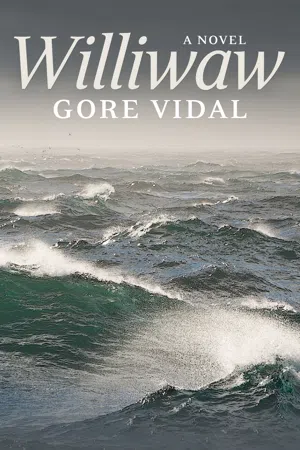
Williwaw first published in 1946, is the notable first novel of a young Gore Vidal, who during World War II was a first mate of a supply ship stationed in the Aleutian Islands. The story revolves around the small ship and her crew as they battle both the elements in the Bering Sea and the mounting tensions between some of the crew members. An intense wind—williwaw—strikes the ship, damaging the craft as she struggles to make her way back to port.
Information
Subtopic
European HistoryIndex
HistoryChapter One
i
SOMEONE turned on the radio in the wheelhouse. A loud and sentimental song awakened him. He lay there for a moment in his bunk and stared at the square window in the wall opposite him. A sea gull flew lazily by the window. He watched it glide back and forth until it was out of sight.
He yawned and became conscious of an ache behind his eyes. There had been a party, he remembered. He felt sick. The radio became louder as the door to his cabin opened. A brown Indian face looked in at him.
“Hey, Skipper, chow’s ready below.” The face vanished.
Slowly he got out of his bunk and onto the deck. He stood in front of the mirror. Cautiously he pressed his fingers against his eyelids and morbidly enjoyed the pain it gave him. He noticed his eyes were bloodshot and his face was grimy. He scowled at himself in the mirror. From the wheelhouse the sound of Negro music thudded painfully in his ears.
“Turn that damn thing off!” he shouted.
“O.K., Skipper,” his second mate’s voice answered. The music faded away and he began to dress. The second mate came into the cabin. “Quite a party, wasn’t it, Mr. Evans?”
Evans grunted. “Some party. What time is it?”
The mate looked at his watch. “Six-twenty.”
Evans closed his eyes and began to count to himself: one, two—he had had four hours and thirty minutes of sleep. That was too little sleep. The mate was watching him. “You don’t look so good,” he said finally.
“I know it.” He picked up his tie. “Anything new? Weather look all right?”
The mate sat down on the bunk and ran his hands through his hair. It was an irritating habit. His hair was long and the color of mouldering straw; when he relaxed he fingered it. On board a ship one noticed such things.
“Weather looks fine. A little wind from the south but not enough to hurt. We scraped some paint off the bow last night. I guess we were too close to that piling.” He pushed back his hair and left it alone. Evans was glad of that.
“We’ll have to paint the whole ship this month anyway.” Evans buttoned the pockets of his olive-drab shirt. High-ranking officers were apt to criticize, even in the Aleutians. He pinned the Warrant Officer insignia on his collar. His hands shook.
Bervick watched him. “You really had some party, I guess.”
“That’s right. Joe’s going back to the States on rotation. We were celebrating. It was some party all right.” Evans rubbed his eyes. “Have you had chow yet, Bervick?”
The mate, Bervick, nodded. “I had it with the cooks. I’ve been around since five.” He stood up. He was shorter than Evans and Evans was not tall. Bervick was lightly built; he had large gray Norwegian eyes, and there were many fine lines about his eyes. He was an old seaman at thirty.
“I think I’ll go below now,” said Evans. He stepped out of his cabin and into the wheelhouse, glancing automatically at the barometer. The needle pointed between Fair and Change; this was usual. He went below. At the end of the companionway, the doors to the engine room were open and the generator was going. The twin Diesel engines were silent. He went into the galley.
John Smith, the Indian cook, was kneading dough. He was a bad cook from southeastern Alaska. Cooks of any kind were scarce, though, and Evans was glad to have even this bad one.
“What’s new?” asked Evans, preparing to listen to Smitty’s many troubles.
“The new cook.” Smitty pointed to a fat man in a white apron gathering dishes in the dining salon.
“What’s wrong now?”
“I ask him to wash dishes last night. It was his turn, but he won’t do nothing like that. So I tell him what I think. I tell him off good, but he no listen. I seen everything now...Smitty’s black eyes glittered as he talked. Evans stopped him.
“O.K. I’ll talk to him.” He went into the dining salon. Here two tables ran parallel to the bulkheads. One table was for the crew; the other for the ship’s officers and the engineers. The crew’s table was empty; only the Chief Engineer, Duval, sat at the other table.
“Morning, Skipper,” he said. He was an older man. His hair was gray and black in streaks. It was clipped very short. His nose was long and hooked and his mouth was wide but not pleasant. Duval was a New Orleans Frenchman.
“Good morning, Chief. Looks like everybody’s up early today.”
“Yeah, I guess they are at that.” The Chief cleared his throat. He waited for a comment. There was none. Then he remarked casually, “I guess it’s because they all heard we was going to Arunga. I guess that’s just a rumor.” He looked at his fork. Evans could see that he was anxious to know if they were leaving. The Chief would never ask a direct question, though.
The fat cook put a plate of eggs in front of Evans and poured him some black coffee. The cook’s hand was unsteady and the coffee spilled on the table. The cook ignored the puddle of coffee, and went back into the galley.
Evans watched the brown liquid drip slowly off onto the deck. Dreamily he made patterns with his forefinger. He thought of Arunga island. Finally he said, “I wonder where they pick up rumors like that?”
“Just about anywhere,” said the Chief. “They probably figured we was going there because that’s our port’s headquarters and the General’s Adjutant is here and they say he’s breaking his back to get back fast and that there aren’t no planes flying out for a week. We’re the only ship in the harbor that could take him to Arunga.”
“That sounds pretty interesting,” said Evans and he began to eat. Duval scowled and pushed back his chair from the table. He stood up and stretched himself. “Arunga’s a nice trip anyway.” He waited for a remark. Again there was none. “Think I’ll go look at the engines.”
Evans smiled as he left. Duval did not think highly of him. Evans was easily half the Chief Engineers age and that meant trouble. The Chief thought that age was a substitute for both brains and experience; Evans could not like that idea. He knew, however, that he would eventually have to tell the Chief that they were leaving for Arunga.
Evans ate quickly. He noticed that the first mate’s place was untouched. He would have to speak to him again about getting up earlier.
Breakfast over, he left the salon by the after door. He stood on the stern and breathed deeply. The sky was gray. A filmy haze hung over the harbor and there was no wind. The water of the harbor was like a dark glass. Overhead the sea gulls darted about, looking for scraps on the water. A quiet day for winter in these islands.
Evans climbed over the starboard side and stepped down on the dock. There were two large warehouses on the dock. They were military and impermanent. Several power barges were moored near his ship and he would have to let his bow swing far out when they left; mechanically, he figured time and distance.
Longshoremen in soiled blue coveralls were loading the barges, and the various crews, civilians and soldiers mixed, were preparing to cast off for their day’s work in the harbor.
A large wooden-faced Indian skipper shouted at Evans from the wheelhouse of one of the barges. Evans shouted back a jovial curse; then he turned and walked across the dock to the shore.
Andrefski Bay was the main harbor for this Aleutian island. The bay was well protected, and, though not large, there were no reefs or shallow places in the main part of the harbor. No trees grew on the island. The only vegetation was a coarse brown turf which furred the low hills that edged the bay. Beyond these low hills were high, sharp and pyramidal mountains, blotched with snow.
Evans looked at the mountains but did not see them. He had seen them many times before and they were of no interest to him now. He never noticed them. He thought of the trip to Arunga. A good trip to make, a long one, three days, that was the best thing about going. He had found that when they were too much in port everyone got a little bored and irritable. A change would be good now.
Someone called his name. He looked behind him. The second mate, Bervick, was hurrying toward him.
“Going over to the office, Skipper?” he asked, when he had caught up.
“That’s right. Going to pick up our orders.”
“Arunga?”
“Yes.” They walked on together.
The second mate was not wearing his Technical Sergeant’s stripes. Evans hoped the Adjutant would not mind. One could never tell about these Headquarters people. He would warn Bervick later.
They walked slowly along the black volcanic ash roadway. At various intervals there were wooden huts and warehouses. Between many of the buildings equipment was piled, waiting to be shipped out.
“It’s been almost a year since we was to Arunga,” remarked Bervick.
“That’s right.”
“Have w...
Table of contents
- Title page
- TABLE OF CONTENTS
- DEDICATION
- Chapter One
- Chapter Two
- Chapter Three
- Chapter Four
- Chapter Five
- Chapter Six
- Chapter Seven
Trusted by 375,005 students
Access to over 1.5 million titles for a fair monthly price.
Study more efficiently using our study tools.
Frequently asked questions
Yes, you can cancel anytime from the Subscription tab in your account settings on the Perlego website. Your subscription will stay active until the end of your current billing period. Learn how to cancel your subscription
No, books cannot be downloaded as external files, such as PDFs, for use outside of Perlego. However, you can download books within the Perlego app for offline reading on mobile or tablet. Learn how to download books offline
Perlego offers two plans: Essential and Complete
- Essential is ideal for learners and professionals who enjoy exploring a wide range of subjects. Access the Essential Library with 800,000+ trusted titles and best-sellers across business, personal growth, and the humanities. Includes unlimited reading time and Standard Read Aloud voice.
- Complete: Perfect for advanced learners and researchers needing full, unrestricted access. Unlock 1.5M+ books across hundreds of subjects, including academic and specialized titles. The Complete Plan also includes advanced features like Premium Read Aloud and Research Assistant.
We are an online textbook subscription service, where you can get access to an entire online library for less than the price of a single book per month. With over 1.5 million books across 990+ topics, we’ve got you covered! Learn about our mission
Look out for the read-aloud symbol on your next book to see if you can listen to it. The read-aloud tool reads text aloud for you, highlighting the text as it is being read. You can pause it, speed it up and slow it down. Learn more about Read Aloud
Yes! You can use the Perlego app on both iOS and Android devices to read anytime, anywhere — even offline. Perfect for commutes or when you’re on the go.
Please note we cannot support devices running on iOS 13 and Android 7 or earlier. Learn more about using the app
Please note we cannot support devices running on iOS 13 and Android 7 or earlier. Learn more about using the app
Yes, you can access Williwaw by Gore Vidal in PDF and/or ePUB format, as well as other popular books in History & European History. We have over 1.5 million books available in our catalogue for you to explore.