"...he shall give you another Comforter, that he may abide with you forever."
—John 14:16
Personal, intimate fellowship between the believer and the Spirit is essential for spiritual growth. God's purpose in redemption is to bring believers into fellowship with Himself. He has therefore given the believer a mind to know Him, a heart to love Him, and a Person to commune with him—the person of the Holy Spirit.
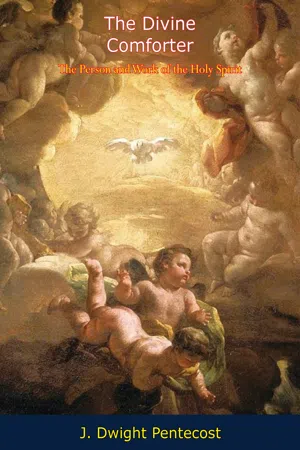
Internationally known author and Bible teacher J. Dwight Pentecost examines the Person and ministry of the Holy Spirit in this thorough yet practical work that seeks to know the Spirit's work in daily life. "It is my desire," he writes, "to bring you face-to-face with a Person so that you might enjoy fellowship with Him."
Some of the subjects discussed in the eighteen chapters of this work include the nature of the Spirit, the filling of the Spirit, the baptism of the Spirit, the Spirit and the inspiration of Scripture, the witness of the Spirit to the world, and gifts of the Spirit.
- 170 pages
- English
- ePUB (mobile friendly)
- Available on iOS & Android
eBook - ePub
About this book
Information
Topic
Theology & ReligionSubtopic
Religion1—THE SPIRIT: A PERSON OR AN INFLUENCE
IF I WERE TO ASK YOU, “IS JESUS CHRIST A PERSON, AND ARE YOU conscious of personal fellowship with Him?” without doubt or hesitation you would reply, “Of course, He is very real to me.” If I were to ask you, “Is God the Father a Person, and are you conscious of personal fellowship with Him?” with perhaps a little less assurance you would respond, “Yes, I know God is a Person, and even though I feel closer to and more intimately associated with the Lord Jesus Christ, I recognize that fellowship with God the Father is possible.” If I were to ask you, “Is the Holy Spirit a Person, and are you conscious of personal relationship with Him?” probably you would say, “I have never been conscious of any personal fellowship with the Holy Spirit,” or, “How can you have fellowship with the Holy Ghost?”
As we present to you the teaching that the Holy Spirit is a Person, you may feel that the subject under consideration is best reserved for a theological classroom. However, no subsequent study in the great doctrines of the work of the Holy Spirit will mean much to you personally unless you realize that we are considering One who is as much a Person as God the Father or God the Son. The Holy Spirit is as much a Person as you are or I am.
As we study these important doctrines, it is not our desire only to enlighten your mind so that you might grasp the truth of the Word intellectually; it is our desire to bring you face to face with a Person so that you might enjoy fellowship with Him. A person can only have fellowship with another person. Therefore we begin our study of the ministry of the Holy Spirit with a consideration of the question, “Is the Holy Spirit a Person or an influence?” so that you may know He possesses all the components of personality. We may fellowship with Him, listen to Him speak, love Him and obey Him.
Several centuries after the death of Christ, there lived a man who became known for his heretical views. His name was Arius. He said that the Holy Spirit was only the exerted energy of God: Since God the Father is a person, His personality may manifest itself, and that manifestation of the personality of the Father is the exercised energy that goes forth from the Father. Arius therefore denied the true personality of the third person of the Trinity, the Holy Spirit. While that interpretation was condemned at the Council of Nicea in A.D. 325 as an heretical interpretation and an heretical doctrine, it did not cease. Following the Reformation, Socinus took up the condemned heresy of Arius. He denied the personality of the Holy Spirit, and took one further step by saying that the Spirit is the eternally proceeding energy of God: Since God is eternal, and God as a Person was always manifesting power, that eternal manifestation of the power of God was the Spirit of God. This doctrine has come to be the foundation of Unitarianism and those kindred movements which deny the Trinity. It is an interpretation which the Word of God condemns and which the church in its past history has held to be an heretical doctrine.
What, then, is the basis of this concept that the Holy Spirit is an influence or a power or energy, and not a Person? It is based chiefly on the fact that the Greek word that is translated “spirit” is neuter in gender. It is the Greek word pneuma, the word for “spirit” or “air.” You are familiar with it in our English word “pneumatic”: you ride on pneumatic tires, tires that are inflated with pneuma, or air or breath. Because the word pneuma is neuter, translators of the Bible sometimes translated the pronoun that referred to the Spirit as “it.” Romans 8:26 reads: “the Spirit itself maketh intercession for us....” Because of that accident of English translation, many have thought that the Holy Spirit is not “He,” but “it.” That which is “it” is not a person. It is from that translation that a great deal of false doctrine has derived.
Now we find a strange thing in connection with the translation of the original text. Even though the word “spirit,” or pneuma, is neuter, there are occasions where the masculine pronoun is used. In John 14:26 we read: “But the Comforter, which is the Holy Ghost, whom the Father will send you in my name, he [that is, the Holy Spirit] shall teach you all things....” The only reason that the Greek text could use the masculine pronoun “he,” when it refers to the neuter noun pneuma or “spirit,” was because it was recognized that the Spirit was not an influence or a power, but a Person. Therefore this masculine pronoun must be used in reference to the Spirit. We find the same thing again in John 16:13-14: “Howbeit when he, the Spirit of truth, is come, he will guide you into all truth: for he shall not speak of himself; but whatsoever he shall hear, that shall he speak: and he will shew you things to come.” For many of you this may seem to be a technicality and of relative unimportance, yet it is a very important consideration. From the original text itself, we see that because pneuma, or the spirit, happened to be a neuter noun, one may not infer that the Holy Spirit is not a Person.
Let us examine several passages of Scripture that show us quite conclusively that the Holy Spirit is, first of all, a Person, and second, that the Holy Spirit is God. We usually divide the categories of personality into three realms: intellect, emotion and will. With the intellect a person can know and think and understand. With the emotional capacity, a person can feel and love. With the will, a person can decide and act. You can prove that you are a person because you think, because you love, and because you will certain things into action. If we can see, from the Word of God, that the Holy Spirit has these capacities, we would have to conclude that He is a Person.
In I Corinthians 2:10-11 we have a ministry of the Spirit that reveals His capacity of intellect. Paul tells us, “God hath revealed them unto us by his Spirit: for the Spirit searcheth all things, yea, the deep things of God. For what man knoweth the things of man, save the spirit of man which is in him? even so the things of God knoweth no man, but the Spirit of God.” The Spirit of God knoweth. Now, what does the Spirit of God know? He knows the deep things of God. All that is in the Father, and all that repository of divine truth that is in the Father, is understood and known by the Holy Spirit. Because He knows, He can reveal what He knows concerning God. It is difficult for a man to teach something that he doesn’t know himself, and one of the first requisites of a good teacher is that he must know his subject. If the Holy Spirit is able to teach the things of Christ, reveal the things of the Father and the Son, it is because He knows the things of God. And the Spirit knows because He possesses the capacity of intellect, the ability to know—one of the necessary components of a true personality.
In Ephesians 4:30 we have a clue to the emotional capacity of the Holy Spirit: “grieve not the holy Spirit of God, whereby ye are sealed unto the day of redemption.” Grief is a manifestation of the capacity of emotion, and a person must have the ability to love before love can be grieved. The fact that the Holy Spirit can be grieved is revelation that the Spirit possesses an emotional capacity, which may be wounded by sins against His heart. Hence, as the Apostle gives us the command, “grieve not the holy Spirit,” indirectly he is teaching us the fact that the Holy Spirit possesses the capacity of emotion.
In I Corinthians 12 the Apostle is teaching us about spiritual gifts, and in verse 11 Paul writes, “But all these worketh that one and self-same Spirit, dividing to every man severally [individually] as he will.” Here the Apostle says that the distribution of spiritual gifts is the result of an act of the will of the Holy Spirit of God. Paul clearly attributes to the Holy Spirit the capacity of will. When we put these three passages together, we observe that the Holy Spirit possesses the capacity of intellect, so that He can know; the capacity of emotion, so that He can love and His love can be sinned against; and the capacity of will, so that He can decide and bring action into being. Because of this we would say that the Holy Spirit is not an influence, not a power emanating from God, nor a manifestation of God’s personality; but the Holy Spirit is a Person as much as you are a person, and the same proofs of your personality are demonstrable concerning the Holy Spirit of God.
Is the Holy Spirit God? Is the Holy Spirit Deity? The Word of God presents the truth that the Spirit, no less than the Father and the Son, is God, and all three are one in essence, one in being, one in their attributes. The Word of God relates the Holy Spirit to both the Father and the Son. And since they are related to each other and equated with each other, on the basis of the principle that two things equal to the same thing are equal to each other, we must conclude that the Spirit is Deity.
Several passages show the relationship of the Holy Spirit to God the Father. In Matthew 3:16 we read, “And Jesus, when he was baptized, went up straightway out of the water: and, lo, the heavens were opened unto him, and he saw the Spirit of God descending like a dove, and lighting upon him.” Here the Holy Spirit is called “the Spirit of God,” stressing the equality of the Spirit with the Father. In Luke 4:18 we find that He is referred to as “The Spirit of the Lord....” In Isaiah 61:1 He is referred to as “The Spirit of the Lord God....” There are many other references that could be given to relate the Spirit to the Father, but these three are sufficient to show that the Word of God relates Him to God the Father, for He is the Spirit of God, the Spirit of the Lord, or the Spirit of the Lord God.
Not only is the Spirit related to the Father, but He is also related to the Son. In Romans 8:9 Paul writes, “But ye are not in the flesh, but in the Spirit, if so be that the Spirit of God dwell in you. Now if any man have not the Spirit of Christ, he is none of his.” In the beginning of that verse Paul refers to the Spirit of God and then, in the next phrase, he refers to the Spirit of Christ. The Spirit, who is related to God, is also related to Christ, for He is “the Spirit of Christ.” The Apostle, in Philippians 1:19, says, “I know that this shall turn to my salvation through your prayer, and the supply of the Spirit of Jesus Christ.” The fact that the Spirit is related to the Father establishes His Deity; the fact that He is related to the Son is added substantiation of His Deity.
The titles used to refer to the Holy Spirit show us that He possesses the same attributes that God the Father and God the Son possess. The Holy Spirit, if He is God, cannot be less than God. There must be in the Spirit that which is in the Father and in the Son. In Hebrews 9:14 we read, “How much more shall the blood of Christ, who through the eternal Spirit offered himself without spot to God, purge your conscience from dead works to serve the living God?” There are different interpretations given to this verse, and particularly this phrase, “the eternal Spirit.” Some see this as a reference to the eternal spirit of the Lord Jesus Christ; there are others who are quite satisfied that the eternal Spirit is a reference to the third Person of the Trinity and that He is referred to in the same way God the Father and God the Son are referred to; He is the eternal One. If the Spirit of God possesses the eternalness of God, it therefore is evident that He is equal with God and possesses full Deity.
In Romans 8:2 the Apostle refers to life possessed by the Spirit: “For the law of the Spirit of life in Christ Jesus hath made me free from the law of sin and death.” The Spirit is the living One. As the living One, He possesses the same life that God possesses. God does not possess created life; God possesses uncreated life. Created life had its beginning in time; uncreated life is eternal life. The Spirit of God possesses the same quality of life that God the Father possesses. When He is referred to as the Spirit of life, it is not only a reference to the fact that He gives life, but that He is life.
In Romans 1:4 the Spirit is referred to as “the spirit of holiness.” The Spirit of God, no less than God the Father and God the Son, possesses unchangeable, unalterable holiness. That quality of holiness belonging to God the Father and Son likewise belongs to the Holy Spirit, and we refer to Him as He is referred to all through the Word of God as the Holy Spirit. That says more than that the Spirit does not commit any sin, or that He has never sinned. While that is true, this title, the Holy Spirit, emphasizes for us the fact of the oneness of the essence of the Spirit with the essence of God. A Holy God, a Holy Son and a Holy Spirit; three in one.
In John 14:17 we observe that the Spirit is “the Spirit of Truth.” This says more than that the Holy Spirit tells us true things. Rather it affirms that the Holy Spirit, in His being, is Truth, and that, as Truth, He can reveal truth to man. This further attests the equality of the Spirit with the Father and the Son.
God is omnipotent, omniscient and omnipresent. Those words of course, are Latin derivatives which simply mean that God is all-powerful, God is all-wise and God is everywhere present. As we go into the Scripture, we observe that the Holy Spirit is said to be omnipotent, omniscient and omnipresent. The omnipotence of the Spirit is affirmed in Genesis 1:12 where, concerning the act of creation, we read: “In the beginning God created the heaven and the earth,” and then, “the earth was without form, and void; and darkness was upon the face of the deep. And the Spirit of God [that is, the third Person of the Trinity] moved upon the face of the waters.” The Holy Spirit was an active agent in the creation of all things. When we look at the vast expanse of this universe, we recognize that God the Father was the Architect and Jesus Christ was the Builder, for “All things were made by him; and without him was not any thing made that was made” (John 1:3). The Holy Spirit was the active agent in creation. Thus Genesis 1:2 demonstrates the omnipotence of the Spirit of God, for He brooded upon the face of the waters and creation came into existence because of the operation of the Spirit of God.
There is a greater demonstration of the omnipotence of the Spirit of God than that shown in creation and that is the omnipotence that was manifested by the Spirit in the salvation of your soul. The Spirit of God moved upon that which was dead, devoid of spiritual life and at enmity with God, that which was lawless and rebellious and stubborn. And the Spirit of God manifested omnipotence as He brought life out of that which was dead and caused the enmity to be turned to amity and brought one who was a child of the evil one into the family of God as His own child by faith in the Lord Jesus Christ. The Holy Spirit is God for He possesses the omnipotence of God.
There are no secrets that God the Father has from God the Holy Spirit, and the deep things of God are known to Him. Likewise, there is no secret locked away in the recesses of your heart or mine that is unknown to the Spirit of God. He knows every thought and intent of the heart. He is the omniscient one.
When we think of the omnipresence of the Spirit of God, we could go into a passage such as David penned in Psalm 139:7-10: “Whither shall I go from thy spirit? or whither shall I flee from thy presence? If I ascend up into heaven, thou art there: if I make my bed in hell, behold, thou art there. If I take the wings of the morning, and dwell in the uttermost parts of the sea; Even there shall thy hand lead me, and thy right hand shall hold me.” And there the omnipresence of the Father and the Spirit are affirmed by the psalmist. “Whither shall I go from thy spirit?” The Holy Spirit, no less than the Father, is omnipresent.
It is the consistent teaching of the Word of God that the Holy Spirit is a Person. This Person dwells within all believers: “your body is the temple of the Holy Ghost...” (I Corinthians 6:19). It is not some impersonal influence or force that has moved into you. It is a Person who has moved in and clothed Himself with your body. Therefore, personal, intimate fellowship is possible between you and the Holy Spirit. As a Person He wants to be known and wants to cause you to know Him. He wants to love and He wants to be loved. He has a will and He wants His will to be followed and obeyed. If we are indwelt with only a power, the question is, “How can power be released through the individual?” But the Christian life is more than a manifestation of some impersonal power through the individual; it is the manifestation of a Person. God’s purpose in redemption is to bring believers into fellowship with Himself. Therefore, He has given believers a mind to know Him, a heart to love Him, a will to obey Him. He has put a Person within, with whom the believer can have the most personal intimate relationship. At the incarnation the Son of God came to tabernacle among men. On the day of Pentecost the Spirit of God came to tabernacle in men who believe. Not an influence, not a power, but a Person has come!
2—THE SPIRIT AND THE REVELATION OF DIVINE TRUTH
A PHILOSOPHER IS A MAN WHO TELLS US WHAT HE THINKS. A scientist is a man who tells us what he knows or has discovered. A gossip is one who tells us what he suspects. But a witness is one who tells us what he has seen and heard. Before one can give a revelation of fact, one must know that fact, and apart from an experimental entrance into any truth, it is impossible for an individual to impart truth to another person. We are to consider a very important subject in reference to the Person and work of the Holy Spirit: the Holy Spirit as the revealer of truth; the Holy Spirit and His relationship to divine revelation.
The Apostle writes, “Eye hath not seen, nor ear heard, neither have entered into the heart of man, the things which God hath prepared for them that love him. But God hath revealed them unto us by his Spirit...” (I Corinthians 2:9-10). The Holy Spirit is the agent in divine revelation and that which is incomprehensible and undiscoverable to the natural mind has been revealed to us by Him. This same passage tells us the reason that the Holy Spirit is able to reveal truth: “for the Spirit searcheth all things, yea, the deep things of God. For what man knoweth the things of a man, save the spirit of man which is in him? even so the things of God knoweth no man, but the Spirit of God” (vv. 10-11). Because the Spirit of God is one with the Father and the Son, the Spirit discerns and understands the deep things of God and is able to reveal them to man.
Natural men may discover things that are true but they cannot discover truth, for truth i...
Table of contents
- Title page
- TABLE OF CONTENTS
- DEDICATION
- PREFACE
- 1-THE SPIRIT: A PERSON OR AN INFLUENCE
- 2-THE SPIRIT AND THE REVELATION OF DIVINE TRUTH
- 3-THE SPIRIT AND THE INSPIRATION OF SCRIPTURE
- 4-THE MINISTRY OF THE SPIRIT BEFORE PENTECOST
- 5-THE MINISTRY OF THE SPIRIT TO THE WORLD
- 6-THE MIRACLE OF MIRACLES: THE VIRGIN BIRTH OF CHRIST
- 7-RESURRECTION BY THE SPIRIT
- 8-THE ADVENT OF THE SPIRIT
- 9-THE SPIRIT AND REGENERATION
- 10-THE BAPTIZING MINISTRY OF THE SPIRIT
- 11-THE SEALING MINISTRY OF THE SPIRIT
- 12-THE FILLING OF THE SPIRIT
- 13-THE PERMANENT GIFTS OF THE SPIRIT
- 14-THE TEMPORARY GIFTS OF THE SPIRIT
- 15-THE BELIEVER, THE SPIRIT, AND THE FLESH
- 16-THE BELIEVER, THE SPIRIT, AND THE WORLD
- 17-THE BELIEVER, THE SPIRIT, AND SATAN
- 18-IS THERE A SECOND WORK OF GRACE?
- REQUEST FROM THE PUBLISHER
Trusted by 375,005 students
Access to over 1.5 million titles for a fair monthly price.
Study more efficiently using our study tools.
Frequently asked questions
Yes, you can cancel anytime from the Subscription tab in your account settings on the Perlego website. Your subscription will stay active until the end of your current billing period. Learn how to cancel your subscription
No, books cannot be downloaded as external files, such as PDFs, for use outside of Perlego. However, you can download books within the Perlego app for offline reading on mobile or tablet. Learn how to download books offline
Perlego offers two plans: Essential and Complete
- Essential is ideal for learners and professionals who enjoy exploring a wide range of subjects. Access the Essential Library with 800,000+ trusted titles and best-sellers across business, personal growth, and the humanities. Includes unlimited reading time and Standard Read Aloud voice.
- Complete: Perfect for advanced learners and researchers needing full, unrestricted access. Unlock 1.5M+ books across hundreds of subjects, including academic and specialized titles. The Complete Plan also includes advanced features like Premium Read Aloud and Research Assistant.
We are an online textbook subscription service, where you can get access to an entire online library for less than the price of a single book per month. With over 1.5 million books across 990+ topics, we’ve got you covered! Learn about our mission
Look out for the read-aloud symbol on your next book to see if you can listen to it. The read-aloud tool reads text aloud for you, highlighting the text as it is being read. You can pause it, speed it up and slow it down. Learn more about Read Aloud
Yes! You can use the Perlego app on both iOS and Android devices to read anytime, anywhere — even offline. Perfect for commutes or when you’re on the go.
Please note we cannot support devices running on iOS 13 and Android 7 or earlier. Learn more about using the app
Please note we cannot support devices running on iOS 13 and Android 7 or earlier. Learn more about using the app
Yes, you can access The Divine Comforter by J. Dwight Pentecost in PDF and/or ePUB format, as well as other popular books in Theology & Religion & Religion. We have over 1.5 million books available in our catalogue for you to explore.