"The most exciting theological book I have read in many years. In some ways, it is a parallel to Karl Barth's Römerbrief."—RUDOLF BULTMANN
"An unhesitating, unflinching analysis of an age which, Vahanian believes, has no concerns even to deny God…a cultural analysis of the religious, political, artistic, literary and societal movements of our era."—PAUL RAMSEY
"In his preface to The Death of God, Paul Ramsey, Professor of Religion at Princeton university, explains that we are now in the second phase of the period post-mortem Dei—the first phase was anti-Christian, ours is post-Christian…Vahanian's message has to do with the 'dishabilitation' of the Christian tradition, with its replacement by bourgeois religiosity and a theology of 'immanentism,' with the desperate effort of Western culture to shake off the 'crippling shackles' of a superannuated piety.
"The quality of mind which enters into this book is unique and fascinating…Vahanian is a fierce but eloquent prophet of the Lord."—ROBERT E. FITCH, New York Times Book Review
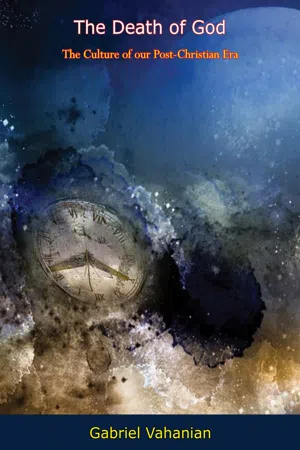
- 175 pages
- English
- ePUB (mobile friendly)
- Available on iOS & Android
eBook - ePub
About this book
Information
Topic
Theology & ReligionSubtopic
ReligionPART ONE—THE RELIGIOUS AGONY OF CHRISTIANITY
CHAPTER I—Modern Religiosity and the Christian Tradition
THE essence of Christianity, in the highest hours of man’s faith in God, manifested itself (in C. S. Lewis’s words) in drawing man away from gossiping about God. The strange fate of Christianity in its modern dress is precisely that it has reduced man to the futility of idly gossiping about God. Our interest in religion goes no deeper and is no less irresponsible than Adam’s curiosity about the knowledge of good and evil. But what, from a theological point of view, curiosity and gossip alike indicate is the same pseudo-concern that is characteristic of religiosity. Religiosity is to the communion of saints, which is cemented together by the bonds of a common faith in God, as the Peeping Tom is to society or to the family. Morbid curiosity is no less morbid for expressing a certain concern, if this concern is in itself basically inauthentic. The Peeping Tom is not a lover because he will not assume the responsibility of such a role. Religiosity is not faith. In religious curiosity, man substitutes superstition for faith in God. And superstition is a crude attempt to build a coherent universe which will compensate for an inner incoherence. Failing to resolve the contradictions of life, superstition seeks to justify these contradictions; in an admittedly awkward way, it seeks for a principle of consistency. Religiosity, though it may be a slight improvement on superstition, only serves to fill the vacuum created by the breakdown of man’s understanding of himself and his relation to the universe and to the human community. In the last analysis, religiosity is an expression of sublimated loneliness, and for this reason is often collectivistic in its manifestations. It is also the symptom of a suppressed doubt, of a subliminal faithlessness resulting from failure to admit “that faith in God offers doubt as its corollary.
Accordingly, it would be erroneous to interpret the collectivism which underlies today’s manifestations of religiosity to mean that modern man has finally recognized the need for a rediscovery of the communal dimension of existence. Nothing could be further from the truth. The fact is that collectivism is but another face of the many aspects an unreconstructed individualism can present. The respective extravagances of collectivism and individualism are equally irresponsible and equally irrational; they are equally without justification from a Christian point of view.
To the extent that modern religiosity is partly a Protestant extravagance, Protestantism has been unable to foster, other than sporadically and on a limited scale, anything comparable to the Catholic consciousness of a common bond (even though this bond has been dualistically understood, i.e. in terms of the orders of nature and of grace). More often than not, Protestants have understood the New Testament demand for radical obedience as a demand for radical individualism, oblivious to the fact that obedience also entails common allegiance. It is no wonder, then, that the recent revival of religion has been neither radical nor an act of obedience. It has no other allegiance than to its own inauthenticity. And it is inauthentic because it reduces religion to a feeling of togetherness, which is to community as the romantic subjectivistic feeling of absolute dependence is to the Biblical concept of creatureliness, or as faith in faith is to true faith. Togetherness is a substitute sense of community, a counterfeit communion. This amounts to saying that the recent revival promotes the feeling that one can be religious and can even have faith in God by proxy. It is evident that no one can live another man’s faith, just as no one can die another man’s death. The question then rises from our memory of Western history and its immediate religious and philosophical background: Is not religiosity by proxy man’s overt attempt to evade the reality that he has killed God, and does it not indicate that he will not face this fact, let alone assume responsibility for the deed?
To be sure, the recent upsurge of religiosity at least reminds us that it is an unavoidable constituent of human existence (albeit a negative one), and that it will always remain so. But this can be stated only in the same sense as one says that death is ineluctably a part of life. Just as death is loss of being, so religiosity is loss of faith in God. Death constantly threatens existence, as religiosity threatens faith in God.
The modern period in general and the contemporary upsurge of interest in religion in particular have made clear something which has never been properly acknowledged in either Christian or non-Christian circles. This is the existential fact that, both theoretically and practically, God’s death is not accidental. It belongs wholly to, and is grounded in, man’s natural inclination to religiosity. The death of God, therefore, cannot be viewed in any way as a recent historical or cultural misfortune which a revival, be it of religiosity or even of authentic faith, will overcome. The death of God is not an accident, an accessory, or nonessential, accompaniment of existence; it is not a diversion, but a fundamental possibility which confronts every man. Briefly and simply, it corresponds to the serpent’s eritis sicut dii in the Biblical myth of Adam’s fall. And just as Adam was responsible for his own fall, so is this post-Christian era the product of Christianity.
Consequently, the Christian faith today is neither coextensive nor even partly contiguous with man’s faithlessness. According to the Christian tradition it has always been implicit, if not explicit, that faith in God (as well as God’s faithfulness to man) is somehow bound up with man’s faithlessness: “Lord, I believe; help Thou mine unbelief.” No longer, it appears, is this so. It seems that the Christian faith has ceased to provide for unbelief. As a result, the Christian concept of man has been devalued. It offers no point of contact to modern man, because his self-understanding is completely divergent from the Christian concept. Emphatically, it is not simply a question of the loss of the sacramental dimension manifest in the classical Christian image of man. Nor is it a question of the loss of the sacral dimension so indelibly characteristic of past stages of Western culture. The loss is incomparably greater and deeper. It has affected man’s outlook on life, his raison d’être, and his view of reality. To use a scholastic distinction, what has taken place is not a mere transformation, but a transubstantiation. The transition (for want of a better term) is more like that of China before and after the Communist accession to power than like that of Europe before and after the Reformation.
The Reformation changed the form but not the content of Christianity. It affected dogmas and rituals, but not the faith that these were intended to proclaim. It altered the structure of the Church but not its reality, its foundation. The change today resides in the very content of the Christian faith itself. What is unacceptable is not the religio-cultural tradition of Christianity, but the very source of this tradition. More precisely, today’s protest is directed against the core itself of the Christian faith in that the latter is felt to be not only exhausted but also incompatible with, contemptuous of, and inimical to the actual situation of man. The essence of Christianity is felt as alien to man’s condition, and, of course, it must be admitted that organized Christianity has often degraded and enslaved man, and deprecated his creative imagination and the intrinsic worth of his finitude.
Indeed, it is historically verifiable that Christianity when it is organized is less apt than when it is not organized to inform and transform genuinely and creatively its secular cultural background. The evidence of the sects as well as of early Christianity helps to corroborate this assertion. When Christianity became organized, it almost immediately arrogated to itself what rightly belonged to culture and to the sphere of the secular. Medieval Christianity may legitimately be cited as an illustration of this tendency toward usurpation. It is not that the spiritual concern of Christianity should be insulated and preserved from pervading the secular goals and aspirations of man. (Indeed, this has often been the religious and cultural heresy of the sects.) But the spiritual can only usurp the prerogatives of and negate the secular by assimilation into the structures of organized religion. For there is nothing about these structures which is intrinsically spiritual. Structures are either cultural or neutral, even when they support the essence of Christianity. When organized religion thus associates itself with secular structures and, unnecessarily, fuses with them, it deprives both the spiritual (or faith) and culture of their reciprocal freedom. It may be more accurate to say that as a result of this fusion Christianity is forced on the world and on culture. But even more important, under such circumstances the spiritual loses its intrinsic worth and becomes but one among rival cultural influences. Organized Christianity transforms the gospel into a tradition to be accepted without the exercise of individual decision, even as it transforms faith into a cultural pattern which, naturally enough, seeks its own preservation and perpetuation.
If it is true that the sects, better than organized churchly Christianity, exemplify the reality of spiritual communion stemming from an individual’s decision in faith, then it may be asserted that churchly Christianity does not transform the world, but enslaves it. Enslavement, however, works both ways and not one way alone. It implies the petrifaction of Christianity, which is another mode of Christianity’s loss of relevance. Enslavement, or spiritual colonialism, comes to be substituted for the spiritual world-facing and world-honoring responsibility that springs from the vocation of faith itself. Seen in this light the age of colonialism now fretfully drawing to a close with the aura of a mal du siècle can be interpreted as the political and cultural replica, if not direct application, of a tradition-bound and spiritually colonialist organized Christianity. Would it not be rational to say that the decadence of imperialism, with which indubitably Christianity was entangled, spells the decadence of religious patterns and structures as we have known them? It is possible that the fate of Christianity still depends on an unsuspected demonstration of its power of self-apprehension. Unfortunately, Christianity is too intimately, even inextricably, bound up with patterns and structures which, having become secularized, are likely to prevent such a demonstration.
An organized Christianity does not simulate the patterns of the spirit. Nor is there any inconsistency in referring to patterns of the spirit. They can be distinguished from those of the world, and this distinction is not qualitative only; it is also quantitative. To contrast the two, one can say that the patterns of the spirit are prophetic, while those of the world and those of an organization are institutional or tradition-bound. The prophetic spirit does not deny the world and its traditions or its organizations. It even makes use of them. But it does not wed itself to them. Nor does it enslave them. Were it to do so, the prophetic spirit would lose its own identity, its own authenticity.
It is highly significant that the renowned Church historian, Kenneth S. Latourette, should regard the nineteenth century as the great century of Christianity, because the latter’s global expansion was possible largely on account of its intricate organization; and that Søren Kierkegaard, who lived in the nineteenth century, not unlike a prophet, excoriated Christianity for having submitted to the inauthentic mores imbedded in and fettered by its cultural accommodations and compromises. Now, as then, today and always, the Christian problem is to correlate the truth of Christianity with the empirical truths men live by, without confusing them: man cannot live by one or the other kind of truth alone.
Paul Tillich, in his Systematic Theology,{13} writes that “theology moves back and forth between two poles, the eternal truth of its foundations and the temporal situation in which the eternal truth must be received.” In as much as theology represents that form of knowledge which “in all its forms and degrees besides being an understanding of its object is simultaneously an existential understanding of one’s self in ‘faith,’ “{14} Tillich’s definition of theology can be applied to Christianity itself. The temporal situation of the nineteenth century was definitely imbued with an optimistic view of man and a general progressivism. To say, as some theologians do, that the nineteenth-century religious thinkers at once neglected both the poles mentioned by Tillich is to blind oneself to the fact that these thinkers did after all speak to their situation. This should not be minimized, even if their efforts later proved to be disastrous, since without doubt not only did the nineteenth-century thinkers speak to the situation of that time, but they also went so far as to adapt the spiritual foundation of Christianity to the structures of that situation. That is why the evidences of spiritual earnest and missionary zeal were by far grievously counterbalanced by the anonymous victory of the secular structures and their goals, to which Christianity in effect bowed down. In doing so, Christianity was killing Western culture, just as Western culture was killing Christianity.{15}
But, if the decay of Christianity is partially due to its culturally superannuated structures, it also has its source in the sclerosis and the expropriation of the Christian faith itself. As was pointed out earlier, faith is no longer contingent upon unfaith. The contingency has ceased either because religious faith is dead or because unfaith, once satisfied, cannot help but be self-reliant; or for both these reasons. But there is a still more important reason: it is the severance of doubt from faith: “Lord, I believe; help Thou mine unbelief Only the unbeliever can believe: only the sinner can be justified. He who believes, believes as only an unbeliever can. He who is justified, is justified as only a sinner can be. Whatever else modern man is, he is not an unbeliever and not a sinner in the Biblical sense. Why? Because faith, in the Biblical sense, is dead. It is not essential to man’s unfaith. It has estranged itself from doubt. And it is human to doubt. As Unamuno observed, while Christianity lay dying before him, “a faith which does not doubt is a dead faith.”{16}
Looking at the contemporary situation of religiosity, with the sense of agony with which Unamuno penetrated the meaning of Christianity, one may wholly agree with him that, today, faith entertains no doubt. It is much too monolithic and doctrinaire—much too hopeless. Indeed, only through hope can faith doubt. For hope is an integral element of faith. But so is doubt—even to the extent that the element of hope can doubt and the element of doubt can hope.
In the present age doubt has become immune to faith and faith has dissociated itself from doubt. Nothing is worse than a dead faith, except a dead doubt.
When doubting no longer liberates the moment of faith or propels the movement of faith, it is quite likely that faith has become petrified and threatened with self-extinction, and that this condition threatens with extinction the cultural forms to which such rigid faith was wedded. Remarking how the scorpion injects its poison into its own head when it is caught in a fatal situation like a fire, Unamuno then raises the question whether Christianity and our civilization are not committing a similar suicide. Is not indeed the literature of “peace of mind,” of “mental health,” a poison which is now attacking the head of Christianity—the heart presumably having stopped long since?
CHAPTER II—The Dishabilitation of the Christian Tradition
SINCE the advent of the modern period the Biblical view of man and the world has so deteriorated that it has no means of commanding the response and assent of the modern mind. For the sake of convenience, the gradual elimination of the Biblical view can be best observed in the cultural climate created by Protestantism. And it is still more tangible in the development of American Protestantism.
Two points must be clarified right away. First, neither Protestantism as a movement nor Protestantism in America is solely responsible for this elimination: it is just that the transition from the Christian to the post-Christian era is most clearly exemplified in the Protestant tradition. Second, a brief definition of the now allegedly eliminated Biblical view is necessary. Succinctly stated, this view is transcendentalist. Man and the world are God’s creation; therefore God is wholly other than what he creates and neith...
Table of contents
- Title page
- TABLE OF CONTENTS
- DEDICATION
- ACKNOWLEDGMENTS
- PREFACE
- FOREWORD
- PART ONE-THE RELIGIOUS AGONY OF CHRISTIANITY
- PART TWO-THE CULTURAL AGONY OF CHRISTIANITY
- AFTERWORD
- SUGGESTIONS FOR FURTHER READING
- REQUEST FROM THE PUBLISHER
Trusted by 375,005 students
Access to over 1.5 million titles for a fair monthly price.
Study more efficiently using our study tools.
Frequently asked questions
Yes, you can cancel anytime from the Subscription tab in your account settings on the Perlego website. Your subscription will stay active until the end of your current billing period. Learn how to cancel your subscription
No, books cannot be downloaded as external files, such as PDFs, for use outside of Perlego. However, you can download books within the Perlego app for offline reading on mobile or tablet. Learn how to download books offline
Perlego offers two plans: Essential and Complete
- Essential is ideal for learners and professionals who enjoy exploring a wide range of subjects. Access the Essential Library with 800,000+ trusted titles and best-sellers across business, personal growth, and the humanities. Includes unlimited reading time and Standard Read Aloud voice.
- Complete: Perfect for advanced learners and researchers needing full, unrestricted access. Unlock 1.5M+ books across hundreds of subjects, including academic and specialized titles. The Complete Plan also includes advanced features like Premium Read Aloud and Research Assistant.
We are an online textbook subscription service, where you can get access to an entire online library for less than the price of a single book per month. With over 1.5 million books across 990+ topics, we’ve got you covered! Learn about our mission
Look out for the read-aloud symbol on your next book to see if you can listen to it. The read-aloud tool reads text aloud for you, highlighting the text as it is being read. You can pause it, speed it up and slow it down. Learn more about Read Aloud
Yes! You can use the Perlego app on both iOS and Android devices to read anytime, anywhere — even offline. Perfect for commutes or when you’re on the go.
Please note we cannot support devices running on iOS 13 and Android 7 or earlier. Learn more about using the app
Please note we cannot support devices running on iOS 13 and Android 7 or earlier. Learn more about using the app
Yes, you can access The Death of God by Gabriel Vahanian in PDF and/or ePUB format, as well as other popular books in Theology & Religion & Religion. We have over 1.5 million books available in our catalogue for you to explore.