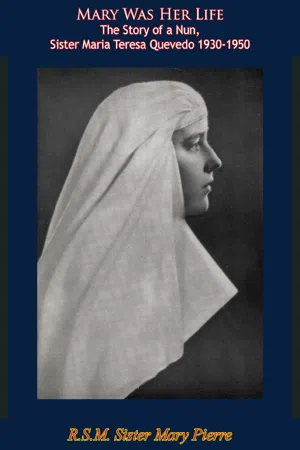
This book is the first full-length biography of Maria Teresa Quevedo that has been written in English. Teresita, as she was called by her friends and family, was a Spanish girl who was born just thirty years ago and who died in 1950 at the age of twenty.
Throughout her short life, Teresita was an inspiration and a delight to everyone around her as she calmly strove to exemplify Christian virtue in her everyday life.
Teresita tried to do everything perfectly. As a girl living with her parents, she was an obedient child. With her friends, she was not only respected but popular. As a sodalist, she gave evidence of being a born leader for Mary. As a tennis player, she was an expert. As captain of her basketball team, she consistently led the group to victory. At any young people's gathering which she attended, she was the life of the party.
When Teresita entered the Congregation of the Carmelite Sisters of Charity, she did so because she desired to become a saint and to devote all her life to Jesus and Mary. But, in her own words, she wished only to become "a little saint for I cannot do big things."
María Teresa Quevedo was a lively modern girl—a talented dancer, an expert swimmer, an outstanding tennis player, who devoted herself to generous works of sacrifice.
Her life can be summed up in her own motto, "May all who look at me see you, O Mary."
Teresita, as her family and friends called her, died in 1950 when she was twenty years old. Her cause for beatification is now being examined by the Sacred Congregation of Rites.
"You will find the story of this popular beautiful girl an inspiration. It is a happy biography....Don't miss it." Herbert O H. Walker, S. J. in the Queen's Work.
eBook - ePub
Mary Was Her Life The Story of a Nun
Sister Maria Teresa Quevedo 1930-1950
- 199 pages
- English
- ePUB (mobile friendly)
- Available on iOS & Android
eBook - ePub
About this book
Trusted by 375,005 students
Access to over 1.5 million titles for a fair monthly price.
Study more efficiently using our study tools.
Information
Topic
Theology & ReligionSubtopic
ReligionCHAPTER I — María Teresa Quevedo
WITH the agility of a boy, old Ricardo mounted the circular staircase to the belfry of Saint Francis’ Church in Madrid. Strange that his customary limp did not retard him! Had the friars seen him, they would have been amused. Many times, when he had been reprimanded for having rung the Angelus late, he had declared that his stiff right leg always hindered him from taking the stairs quickly. However, such punctuality on April 14, 1930, was understandable; for it was not an ordinary day in the life of the aging sexton. Never—and Ricardo had been at Saint Francis’ Church for fifty-nine years—had the birth of a parishioner’s child been providentially slated to coincide with the Angelus bell. Padre Fernando had just given him that news.
“Any moment now, perhaps while you are ringing the Angelus, the new Quevedo baby will come to town, Ricardo. I have given the mother my blessing.”
Padre Fernando was never wrong, Ricardo mused. And today was no exception! On the second floor of an unpretentious apartment house, not too far from Saint Francis’ Church, the cry of a new-born baby girl blended with the dying sounds of the Angelus.
In the church whose bells had heralded her birth, Father Ignatius Navarro, Chaplain to His Majesty King Alfonso XIII, and an intimate friend of the Quevedo family, christened the little girl María Teresa Josefina Justina. Her names honored Our Lady, the Seraph of Avila, Saint Joseph, and Saint Justina to whom her mother had a strong devotion.
María Teresa’s father, Doctor Calixto Quevedo, distinguished in the medical field, owned that seven-story apartment house, No. 7 Plaza de Oriente, which is situated directly across the square from Madrid’s Royal Palace. No, 7 is the only city home this generation of Quevedos has known; in fact, the doctor and his wife still occupy the spacious second floor in which María Teresa was born.
The Quevedo apartment house, built around a very large patio, is of modern architecture—sober and practical. On the whole, it is not artistic. The patio, however, has been made charming with orange trees planted in great ceramic tubs, magnolia trees, gardenias, hydrangeas, and the red geranium beds which sketch a lively design in the green clover which carpets it.
Perhaps the most attractive feature of the seven-story house lies in the balconies of the façade which overlook the gardens of the Royal Palace. From the Quevedo balconies can be seen the life-size white marble statues of ancient Spanish kings, which accentuate the verdure of the royal gardens and stand as if in admiration of their floral beauty.
These aspects of nature, which had set the background for María Teresa Quevedo’s birth, might well suggest a Spain flowing with milk and honey were we not cognizant of the savage spirit that permeated the country in 1930. The soul of Castile was terrified because the cold war that Communism was waging on Catholicism had long been undermining the country and had now grown hot enough to explode.
What a pity that a girl born with a natural love for the pageantry of a monarchy should be deprived of elaborate spectacles like those her parents had enjoyed from the balconies of their home. Heaven alone knows whether the Quevedos will ever again watch noble guests alight from American Cadillacs, gather regal robes about them, and ascend the marble staircase to the Palace reception rooms. In 1930 that royal era was on the wane. A year later, on Teresita’s—as they had come to call her—first birthday, King Alfonso XIII was forced to abdicate, and the Spanish monarchy went with him.
The baby knew nothing about King Alfonso or the dissolution of the monarchy as she lay crying in her cradle.
“The baby sounds hysterical!” Mrs. Quevedo’s voice rose sharply as she hurried to the nursery. The granddaughter of Admiral Luis Cadarso of Spanish-American War fame seldom raised her voice. “Daria, where are you?” she called excitedly to the nursemaid as she picked up the baby, whose unusual hiccoughing had brought her to its crib.
“Put her back in the cradle, Mama. Let me show you how she kicks and laughs when I tickle her.” The large brown eyes of four-year-old Luis looked up innocently at his mother.
So that was it! How many times had she told Daria not to allow Luis in the nursery alone? And she herself had warned him not to touch Teresita unless one of the grown-ups was present.
“He must not be scolded,” Mrs. Quevedo told herself. “Luis dearly loves his baby sister and I must do nothing that would diminish his affection.” Soothing Teresita, she turned to Luis and said: “Son, run along to Carmencita’s room and tell Daria that I want to see her. You take care of your little sister until she returns.”
An appeal to the protective instinct in Luis brought immediate action. He ran to babysit with sixteen-month-old Carmen.
That little trio made up the family of Don Calixto and Doña María del Carmen Quevedo.
“They are happy, healthy children; we are blessed,” Mrs. Quevedo wrote to her sister-in-law in Puerto Rico when Teresita was three years old. “Each one, however, is different. Luis has the manner of an army general. Carmencita is quiet and thoughtful; she will probably enter a cloister. Teresita is a bundle of happiness. Everyone loves her. She is the exact opposite of Carmen in every way, even to her golden hair and blue eyes. Pretty as a picture, but terribly self-willed. Perhaps we have indulged her more than we should because she is the youngest. Whatever the reason, she cannot be crossed. We shall have to do something about it.”
It was not long before Mrs. Quevedo found the cure for Teresita’s wilfulness. She told Doctor Quevedo about it one evening at dinner. “Teresita was playing in the patio this afternoon with Carmen, Luis and the children from the neighborhood. Suddenly she ran into the house, sobbing aloud. I called to her but she didn’t answer, nor did she come to cry in my arms as usual. I decided to follow, for I wondered about her strange behavior. Do you know what that dear child did, Calixto? She went directly to her bedroom, knelt before the statue of Our Lady, and wept.”
“I suspect, María del Carmen, that the tears may have relieved a bad temper?” Don Calixto replied quizzically.
“Oh, I am ahead of my story, Calixto. I’ve left out the most important part! Daria told me that Teresita slapped one of the children because he would not give her his toy. A quarrel followed. To punish Teresita, the nurse ordered her to sit on a bench. Teresita refused. Disconcerted, Daria told her that she was the most disobedient little girl she had ever known. ‘What does disobedient mean?’ Teresita asked. ‘It means that you have hurt Our Blessed Mother,’ Daria replied. Then, Daria said, she ran into the house as fast as a frightened rabbit. You know the rest of the story, Calixto. Incidentally, she ate very little dinner tonight. Teresita can’t bear the thought of having hurt Our Lady. Isn’t she a little young to react like that, Calixto?” Doña Maria asked.
“Yes, she is. However, Daria’s ignorance concerns me more than Teresita’s pious behavior, Just imagine what my Jesuit brothers would reply to her definition of obedience! I must instruct her not to act as a catechist, but to send the children to you when questions of this nature arise in the future.”
Perhaps Daria’s ignorance caused Doctor Quevedo a troubled thought; but we wonder if the servant’s remark might, have fallen like the mustard seed. For alter that incident in the patio, little Teresita began to make frequent visits to Our Lady’s statue in her bedroom. Apparently she prayed in earnest—as pilgrims pray at a shrine.
During this period of her childhood, it was also common for Teresita to steal into her father’s bedroom early in the morning and whisper in his ear: “Papa, may I get in bed with you?”
Don Calixto, reluctant to move but unable to resist, would take her in his arms and teach her to pray: “O sweet Virgin Mary, my Mother, I offer myself today completely to you. I beg you to give my body, eyes, ears and tongue, my heart and soul to Jesus. I am all yours, holy Mother of God. Watch over me! Amen.”
Years later, a priest asked Teresita how her devotion to Our Lady began. “I believe Our Lady herself taught me to pray, through Papa,” she answered. “From early childhood, when Papa taught me to make the Morning Offering, it was always a prayer of holocaust to Our Lady.”
In June of 1934, the Quevedo family was en route to their summer home in Santander. They stopped to buy gasoline in the plaza of a small town in the Province of León, where several barefoot ragamuffins were playing at the fountain. Eager to get a good look at the “elite” of Madrid, the youngsters crowded around the car and pressed their smutty faces against the half-open windows. It was Tereska’s first conscious encounter with “dirt,” and since she was an extremely fastidious child her reaction was violent. She ordered the children to get away from here.”
Don Calixto observed her behavior and he was annoyed; but he waived his annoyance in favor of the tact he knew the situation called for. As they drove on, he explained to Teresita that those children were poor—”Poorer than the Baby Jesus was in the cave at Bethlehem,” he told her. “Their poverty makes God the Father love them very much. It may be that they, too, offer their hearts to Our Lady every morning and that Mary loves and accepts their offering just as she does yours, Princess.” For the first time since she had learned to talk, Teresita was speechless! Her silence convinced Don Calixto that he had taught her a lesson.
A similar situation arose on their return to Madrid in September, when a group of rough gypsies tried to make friends with Teresita. “Now,” Doctor Quevedo thought, “we shall see what fruit my June lesson bears.” Teresita fought her antipathy, but she could not force a whole-hearted response to their friendliness. The expression on her little face betrayed traces of an intolerance that had not been utterly conquered. However, she “uttered” no offense. That was praiseworthy. So her good father decided to ignore her displeased expression and encourage the effort lie knew she had made.
“We believe Teresita is trying very hard to convert her horror of ‘dirt’ into a kind and sympathetic tolerance,” Mrs. Quevedo told Sister Carmen, Dr. Quevedo’s sister, one day when Teresita was five. “She came in after nursery school yesterday with three urchins she and Daria had met in the plaza. It amused me to see her teach them to wash their hands and face. Afterwards, she invited them to the patio where Daria served them hot chocolate and cookies. Their ‘hostess’ insisted on napkins. I’m sure they had never seen them before, but they were patient pupils. When the time came for the children to leave, Teresita gave each of them one of her treasured toys. Sometimes I wonder about Teresita, Carmen; she seems unusual for her age. She is different from Luis and your little namesake. But don’t misunderstand me, they are precious children, too. It is the unique things that Teresita does that makes her unlike the others.”
Carmen Quevedo associates Teresita’s early years at the family dinner table with a vehement expression of: “No me gusta.” (I do not like it.) She was a finicky child, and refused many tasty dishes served in their dining room. Teresita preferred to choose her own diet. Realizing that wilfullness played a far greater role in this than the child’s palate, Don Calixto set about to correct the fault. He explained to her that food is one of God’s gifts to us—that it helps our soul grow in love of God, just as it gives strength to our body. Unfortunately, he added that we should eat “whatever agrees with us.” Teresita absorbed the explanation. The following day at dinner, she declined a serving; of soup with an impish smile, saying: “No, thank you, it doesn’t agree with me” And a charmingly evoked “It doesn’t agree with me” carried her through what might have been many a mealtime struggle with her parents.
When the Quevedo girls went to Our Lady of Mount Carmel Academy, the noonday meal was served to the day students. Carmen feared what she knew would be her sister’s fate if she tried her “It doesn’t agree with me” on the Sister in charge of the dining room. Apparently there were no “battles,” for some months later, Carmen’s curiosity having risen to a peak, she asked Teresita how she liked the meals. Her little sister declared triumphantly: “I’m really learning self-control, Chatina.{1} I heard Sister Mary Teresa tell the eighth-grade proctor that girls her age ought to be controlled. I decided to get off to a start by eating whatever they serve at meals. I think I’d like ‘to be controlled’ by the time I reach eighth grade.”
Evening Rosary had for generations been a Quevedo family custom. Before the children would retire, Tía Josefina, Mrs. Quevedo’s aunt who lived with them, and the Quevedo quintet would gather around a beautiful wood carving modeled after Murillo’s Immaculate Conception. It stood on a pedestal in the foyer off the main parlor. Kneeling in the soft light of two blessed candles, the group would follow Don Calixto through the prayers for the decades of the day. Teresita had not missed an evening Rosary since her fifth birthday, but tonight, April 14, 1936, she was putting up a desperate fight against the temptation to skip off to bed unnoticed. The suspense that cloaked her sixth birthday party had fatigued her. Besides, rumors of the war that was devastating their beloved Madrid had excited her. In spite of the somber shadow cast upon normal family living, Don Calixto had insisted on a quiet party for his youngest child. It was quiet, for merrymaking was neither possible nor desired. That is why Teresita’s golden head began to nod after she had consumed the last morsel of her portion of orange chiffon birthday cake.
“I was exhausted” she has said referring to that incident. “I fought hard to overcome sleep until we had said the Rosary. However, only minutes before it was to begin, I gave in to an overpowering temptation. Hoping no one was watching me, I tiptoed to my room. In the twinkle of an eye, I had exchanged my party dress for pajamas. Then I knelt before my statue of Our Lady and whispered, ‘I give you ...
Table of contents
- Title page
- DEDICATION
- Preface
- CHAPTER I - María Teresa Quevedo
- CHAPTER II - School Days
- CHAPTER III - Vacations at Fuenterrabia
- CHAPTER IV - Child of Mary
- CHAPTER V - A Vow
- CHAPTER VI - Vocation
- CHAPTER VII - Off to Be a Saint
- CHAPTER VIII - The Institute
- CHAPTER IX - The Postulant
- CHAPTER X - Stepping Stones
- CHAPTER XI - Sister María Teresa of Jesus
- CHAPTER XII - Her Little Sack
- CHAPTER XIV - Illness and Convalescence
- CHAPTER XV - Teresita’s Way of Confidence
- CHAPTER XVI - Holy Year
- CHAPTER XVII - Profession
- CHAPTER XVIII - A Spiritual Garden
- CHAPTER XIX - New Sacrifice
- CHAPTER XX - Saturday of Glory
- CHAPTER XXI - Easter Aura
- CHAPTER XXII - Fulfillment
- SISTER MARIE PIERRE, R.S.M.
Frequently asked questions
Yes, you can cancel anytime from the Subscription tab in your account settings on the Perlego website. Your subscription will stay active until the end of your current billing period. Learn how to cancel your subscription
No, books cannot be downloaded as external files, such as PDFs, for use outside of Perlego. However, you can download books within the Perlego app for offline reading on mobile or tablet. Learn how to download books offline
Perlego offers two plans: Essential and Complete
- Essential is ideal for learners and professionals who enjoy exploring a wide range of subjects. Access the Essential Library with 800,000+ trusted titles and best-sellers across business, personal growth, and the humanities. Includes unlimited reading time and Standard Read Aloud voice.
- Complete: Perfect for advanced learners and researchers needing full, unrestricted access. Unlock 1.5M+ books across hundreds of subjects, including academic and specialized titles. The Complete Plan also includes advanced features like Premium Read Aloud and Research Assistant.
We are an online textbook subscription service, where you can get access to an entire online library for less than the price of a single book per month. With over 1.5 million books across 990+ topics, we’ve got you covered! Learn about our mission
Look out for the read-aloud symbol on your next book to see if you can listen to it. The read-aloud tool reads text aloud for you, highlighting the text as it is being read. You can pause it, speed it up and slow it down. Learn more about Read Aloud
Yes! You can use the Perlego app on both iOS and Android devices to read anytime, anywhere — even offline. Perfect for commutes or when you’re on the go.
Please note we cannot support devices running on iOS 13 and Android 7 or earlier. Learn more about using the app
Please note we cannot support devices running on iOS 13 and Android 7 or earlier. Learn more about using the app
Yes, you can access Mary Was Her Life The Story of a Nun by R.S.M. Sister Mary Pierre in PDF and/or ePUB format, as well as other popular books in Theology & Religion & Religion. We have over 1.5 million books available in our catalogue for you to explore.