THIS IS THE TRUTH, THOUGH THE FORM IS FICTION…
The terrible and inspiring truth about the French underground, the way it's men and women operate, fight, die, a story full of nobility, heroism, and brutal violence.
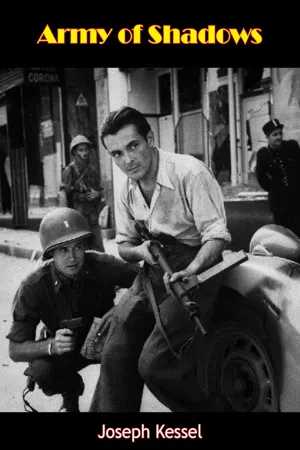
First published in its English translation in 1944, this is the fictionalized account of French writer Joseph Kessel's own experiences as a member of the French Resistance in World War II.
- 144 pages
- English
- ePUB (mobile friendly)
- Available on iOS & Android
eBook - ePub
Army of Shadows
About this book
Information
Subtopic
European HistoryIndex
HistoryPHILIPPE GERBIER’S NOTEBOOK
BACK from England yesterday. At the moment of plunging from the plane into the black night I remembered J. He had made a bad landing and broken both his legs. He nevertheless buried his parachute and dragged himself five or six kilometers to the nearest farm, where he was taken in. In my own case a rather acute stricture about the heart when the pilot signaled to me. Afraid for no reason. Not a bit of wind. Landed in a ploughed field. Buried the parachute. Knowing the region, had no difficulty finding the small local railway station.
Some peasants, workers, railroad men were waiting for the first train. At first, the usual conversation: food, food, food. Fewer markets, requisitions becoming intolerable, no fuel for heat. But also a new note: the deportations. Not a family, they said, which was not affected or about to be. They were thinking up ways of keeping their sons, their nephews, their cousins from going. A sense of being dragged off to prison. The rage of prisoners straining at their chains. An organic hatred. They likewise discussed the war news. Those who had a radio told the others all about the London broadcasts. I was reminded that I had spoken over the B.B.C. in behalf of the French engineers two days before.
Got off the train at the small town of C. I didn’t want to rejoin our headquarters of the southern zone directly. The last telegrams sent to London were disturbing. Went to an architect friend of ours who treated me like a ghost. “You come from England, you come from England,” he kept saying. He had recognized my voice over the radio. I didn’t realize that it was so unmistakable. There I committed a rather stupid and serious blunder. Indiscretions are due not so much to malevolence, the temptation to talk or even stupidity as to admiration. Most of our people are carried away by their enthusiasm. They like to magnify, to create a halo around our comrades, especially the leaders. It keeps them going, rouses them and gives color to their monotonous little everyday work. “You know, X has done a magnificent thing,” says one who is in the know to another. And the latter feels a need to share his enthusiasm with a third. And so on until the story reaches the ears of an informer. There is nothing so dangerous as this generosity of feeling.
So, because I’ve been to London I am in danger of becoming the object of a cult. I could tell this from the way the architect treated me. He is a man of substantial character and judgment. Yet he looked at me as though there were something a little miraculous about me. The fact that I came back did not overly astonish him, but the fact that I had spent a few weeks in London, that I had breathed the air of London, that I had rubbed elbows with the people of London bowled him over. He considered that holiday, those days of comfort and security as an act of the rarest merit. Such an apparently absurd attitude is rather simple to explain. When everything seemed lost, England was the only source of hope and warmth. For millions of Europeans in the night it was the fire of faith, and all those who have come near this fire and still come near it take on a reflection of its wonder. Among the Mohammedans the pilgrim who has been to Mecca bears the title of Hadji and wears a green turban. I am a Hadji. I have a right to the green turban of enslaved Europe. This strikes me as rather absurd, because I haven’t the slightest religious sense, but also because I happen to have come back from London. And there the point of view is exactly the opposite.
Their admiration goes to those who are living in France. The hunger, cold, privations and the persecutions which we have had to get used to have deeply affected the imagination and the sensibility of the people across the Channel. As for those in the resistance movement, they arouse an almost mystical emotion. One feels the legend already taking shape. If I were to tell our people this they would shrug their shoulders. Never would a woman who grumbles for hours in queues, who weeps with impotence to see her children wasting away, curses the government and the enemy for taking her husband from her and sending him to Germany, who grovels to the milkman and the butcher to get a drop of milk or an ounce of meat, never would such a woman believe that she is anything out of the ordinary. And never would the lad who goes about every week with an old suitcase full of our clandestine newspapers, the operator who taps out our radio messages, the girl who types my reports, the priest who gives us information, the doctor who looks after our wounded, and above all Felix, and the Bison, never would any of these people believe they are heroes, and neither do I.
Subjective opinions and feeling have no value. Truth lies only in actions. When I have leisure I want to keep a record for a time of the facts which a man whom events have placed in a good observation post can get to know about the Resistance. Later, with perspective, these accumulated details will add up to something and make it possible for me to form a judgment.
If I am still alive.
***
Spent the night at the architect’s. Had a visit from our local chief. A railroad worker. A former union secretary. Very red. An excellent organizer. A staunch character. If all groups in the country were as united and resolute as the railroad workers our political organizations wouldn’t have much to do.
This man confirmed the bad impression I got from the telegrams. Searches, police raids, traps. The Gestapo is trying to decapitate the resistance. Ten times its blows miscarry, but they end by striking home. Our Command Posts discovered in Lyon, Marseille, Toulouse and in Savoy. Three radio stations seized. We don’t yet know what is happening in the North, but down here it’s serious. My second in command, a petty registry official, who was bilious and tireless, has been summarily executed. My secretary deported to Poland. Felix arrested.
Lemasque, it appears, has done very well. He has set up an emergency Post in his office. Little by little, as the others fell, this Post has become important. Lemasque has replaced the men who have been taken by new men. He has proved to be quick, energetic, efficient. But I don’t trust his nerve. I came back just in time.
The railroad workers advise me not to stay too long with the architect. He is too well known as a Gaullist. It’s a small town.
***
My present host is the Baron de V. and I live in a beautiful Louis XIII château. The estate includes a park, a wood, a pond, rich and extensive lands. It would be hard to imagine a safer and more pleasant refuge. I shall be able to re-establish my liaisons and work out plans in peace. The Baron has put himself entirely at my service. He is a character. With his long nose, his complexion tanned by sun and wind, his hard little eyes, there is something both of the wolf and of the fox about him. He cares only for his domain and his hunting. A former cavalry officer, needless to say, whose wife and children live in terror of him. The only person who can stand up to him is his older sister, an old maid who is never out of her riding breeches. The Baron de V. was a sworn enemy of the Republic. Before the war he had organized his farmers, his kennelmen and his huntsmen into a squadron armed with hunting rifles and revolvers at the head of which he had planned to take the nearest Prefecture by a cavalry charge in the event of a Royalist uprising. This squadron, perfectly organized, perfectly trained, is still intact. But it will go into action against the Germans. There is no lack of weapons. Many parachutists have dropped on the baron’s lands. He belongs to no underground organization, but he helps them all. After his wife and his children have gone off to bed he sets out with his sister, both of them on horseback, to look for parachutists.
It is to this feudal character that our sector leader, the secretary of the syndicate, has entrusted me. I teased the Baron de V. about his alliance with a revolutionary. His answer was, “Je préfère, Monsieur, une France rouge à une France qui rougisse.”{5}
***
News of Felix from Jean François.
Felix was arrested in the street by two men who spoke perfect French, but were agents of the Gestapo. He was questioned without being too badly beaten. As he would not admit his identity, three of the Gestapo took him to his house in the middle of the night. His wife and his little boy, terrified as they were and knowing nothing of Felix’s underground activities, made no bones about recognizing him. The German policeman beat him in front of his wife and child till he fainted. Then they began a search, smashing everything in the room. Felix came around again, but this time he didn’t move. He had the presence of mind to lie still and recuperate, as Jean-François put it, and suddenly he dashed to the window, broke through the shutters and jumped into the street. His room was on the second floor. He sprained an ankle, but ran all the same. A patrol of French cyclist police was passing. Felix told the sergeant what had happened. They took him to one of our people. The next day he was in one of our clinics, the next in another, the next in still another. It was only there that the Gestapo lost trace of him. Felix has his foot in a light plaster and will soon be out. He has asked me for a new assignment. He won’t be able to see his wife and child again till the war is over. He thinks his wife is very angry.
***
A schoolteacher from Lyon has taken advantage of his Sunday off to spend two nights on the train and bring me the mail. He is asleep at this moment before taking the train back. He is so undernourished that he often forgets in his class the rudiments of what he is teaching. As for the children, he no longer dares send them to the blackboard. Their legs no longer carry them. They fall down faint from hunger.
***
A country priest has come to say mass at the château. He spends his days and nights going from farm to farm. “You,” he says to a peasant, “you have room to hide three men who refuse to go to Germany.” “You,” he says to another, “you must feed two more,” and so on. He knows exactly what each one can do. He has a lot of influence and people obey him. He has been reported to the Germans and warned by the French authorities. “I have no time to lose,” he says. “Before I go to prison I should like to place three hundred.” It’s become a kind of sport. A race against time.
***
The number of those who refuse to work in Germany ran to a few thousand when I went away. Today they can be counted by tens of thousands. Many are swallowed up by the countryside. But many have fled to the natural hiding places and occupy the maquis: the maquis of Savoy, of the Cévennes, of the Massif Central, of the Pyrénées. Each one holds an army of young people. They have to be fed, organized; and armed as much as possible. It is a new and terrible problem for the resistance.
Ce...
Table of contents
- Title page
- TABLE OF CONTENTS
- PREFACE
- THE ESCAPE
- THE EXECUTION
- THE EMBARKATION FOR GIBRALTAR
- “THOSE PEOPLE ARE WONDERFUL”
- PHILIPPE GERBIER’S NOTEBOOK
- A WAKE IN THE HITLERIAN AGE
- THE RIFLE RANGE
- MATHILDE’S DAUGHTER
- REQUEST FROM THE PUBLISHER
Trusted by 375,005 students
Access to over 1.5 million titles for a fair monthly price.
Study more efficiently using our study tools.
Frequently asked questions
Yes, you can cancel anytime from the Subscription tab in your account settings on the Perlego website. Your subscription will stay active until the end of your current billing period. Learn how to cancel your subscription
No, books cannot be downloaded as external files, such as PDFs, for use outside of Perlego. However, you can download books within the Perlego app for offline reading on mobile or tablet. Learn how to download books offline
Perlego offers two plans: Essential and Complete
- Essential is ideal for learners and professionals who enjoy exploring a wide range of subjects. Access the Essential Library with 800,000+ trusted titles and best-sellers across business, personal growth, and the humanities. Includes unlimited reading time and Standard Read Aloud voice.
- Complete: Perfect for advanced learners and researchers needing full, unrestricted access. Unlock 1.5M+ books across hundreds of subjects, including academic and specialized titles. The Complete Plan also includes advanced features like Premium Read Aloud and Research Assistant.
We are an online textbook subscription service, where you can get access to an entire online library for less than the price of a single book per month. With over 1.5 million books across 990+ topics, we’ve got you covered! Learn about our mission
Look out for the read-aloud symbol on your next book to see if you can listen to it. The read-aloud tool reads text aloud for you, highlighting the text as it is being read. You can pause it, speed it up and slow it down. Learn more about Read Aloud
Yes! You can use the Perlego app on both iOS and Android devices to read anytime, anywhere — even offline. Perfect for commutes or when you’re on the go.
Please note we cannot support devices running on iOS 13 and Android 7 or earlier. Learn more about using the app
Please note we cannot support devices running on iOS 13 and Android 7 or earlier. Learn more about using the app
Yes, you can access Army of Shadows by Joseph Kessel, Haakon Chevalier in PDF and/or ePUB format, as well as other popular books in History & European History. We have over 1.5 million books available in our catalogue for you to explore.