From the Morocco Crisis to Resignation 1903-1909
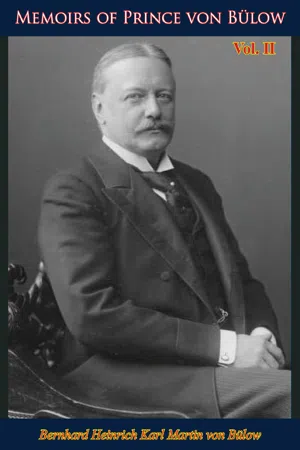
"When the last trumpet sounds, I shall present myself before the Sovereign Judge with this book in my hand, and say aloud: Thus have I acted; these were my thoughts; such was I." So Jean-Jacques Rousseau in his celebrated "Confessions." In their intense subjectivity and frankness the memoirs of Prince von Bulow resemble those of the illustrious Frenchman. Brilliantly composed in an informal conversational style, well spiced with gossip, and containing many striking characterizations of notable contemporaries, the reminiscences of the fourth Chancellor of the German Empire will certainly rank high among the lighter political memoirs of the present century.
An eventful life, important contacts, and a long political career supplied Bülow with ideal material for the writing of a stimulating autobiography. Prince Bulow bore a name distinguished in the history of German diplomacy, politics, and military affairs. Trained in the Bismarckian school, and a protege of the Iron Chancellor, Bulow served in every important diplomatic post in Europe with the exception of London and Constantinople. With Bismarck's resignation in 1890, he might have become a brilliant young diplomat with a great future behind him, had he not caught on with the new regime under William II. In 1897 he was appointed Secretary for Foreign Affairs, and three years later he became Imperial Chancellor. His resignation in 1909 was occasioned by the famous Daily Telegraph incident which cost him the Kaiser's confidence and embittered his entire later life. He reappeared on the political stage for a brief moment during the War as Ambassador to Italy, but his mission ended in failure when Italy joined the Allied Powers in 1915. Six years later, at the age of seventy-two, he began the composition of his memoirs, a task that occupied him until his death in 1929.-VQR
eBook - ePub
Memoirs of Prince von Bülow Vol. 2
From the Morocco Crisis to Resignation 1903-1909
- 596 pages
- English
- ePUB (mobile friendly)
- Available on iOS & Android
eBook - ePub
Memoirs of Prince von Bülow Vol. 2
From the Morocco Crisis to Resignation 1903-1909
About this book
Information
Subtopic
19th Century HistoryIndex
HistoryMEMOIRS OF PRINCE VON BÜLOW—From the Morocco Crisis to Resignation 1903-1909
CHAPTER I
The Morocco Affair—Queen Maria Cristina of Spain—Metternich’s Dispatch Concerning Morocco—Prince Henry VII of Reuss on St. Petersburg—Admiral Tirpitz in St. Petersburg—The 1903 Elections to the Reichstag—Socialist Gains Increased—A Parliamentary Duel with Bebel—The Jesuit Law; Abrogation of Paragraph Number 2—William II’s Feeling towards the Jesuits—The Attitude at Court—Letters from Cardinal Kopp and Franz Arenberg—The Kaiser’s Mediterranean Trip in March, 1904—Professor Theodor Schiemann—The Kaiser’s Eagerness for a Meeting with President Loubet—Return via Karlsruhe—Eckardstein in Karlsruhe—Motor Racing in Homburg.
FOR some time past I had been keeping my eye on Morocco, fully aware of a possible, ever closer rapprochement between France and England, through the exchange of Morocco for Egypt.
In Vienna, during the Kaiser’s visit there, I had had a chance of renewing my information on the subject. I had been received by Queen Maria Cristina of Spain, a woman of great insight and decision, to whose dignity and intelligence the Spanish dynasty owed its survival of the disastrous Spanish peace with America.
She had told me in confidence that France, for some time past, had been trying to persuade the Spanish Government to an offensive-defensive alliance, but that, so far, Spain had not accepted, in spite of urgent French importunities.
France, together with this alliance, had suggested a partition of Morocco, on the basis of which the French would receive the North and Spain the South. The Queen expressed the opinion that France had used King Edward’s mediation to get England’s consent to this plan. For herself, all Spain really asked was not to be left with empty hands, since, in view of traditional Spanish claims to Morocco and of that country’s geographical position, this might mean a collapse of the Spanish dynasty.
Back in Berlin I asked our ambassador in London to draft me his opinion on this matter. Count Metternich based his reply on an article in a great English newspaper which had suggested that, throughout the Boer War, the attitude of the German Government, in particular that of the Chancellor and of the Secretary of State for Foreign Affairs—of the Kaiser even, had all undoubtedly been pro-English, but that the German people had displayed, throughout the whole of that period, more animosity, envy, and hatred of England than the people of any other country. Since Germany, through the surprising development of her industry, the growth of her overseas interests—a commerce that, nowadays, had begun to extend all over the world—and the construction of a large new fleet, was from day to day becoming her most serious rival, England was forced to regulate her policy accordingly.
French competition had long since ceased to be dangerous to England; Russia was only dangerous in Asia. Germany was the one real menace. Metternich, however, added that he did not believe in any durable friendship between Great Britain, Russia, and France. A temporary Anglo-Russian rapprochement, the cooperation, ad hoc, against Germany, of England, France, and Russia, was quite feasible. Should this ever actually materialize, even though it might last some time, it would still be premature to speak of any German isolation. On the one hand, Austria was dependent on her German alliance, while on the other, Russia, if our policy were calm and skilful, would be equally disinclined to win back Alsace for the French or to destroy German trade to oblige England.
Metternich’s unofficial but none the less reliable information suggested conflicting streams of Russian opinion: a distrust in Russian Government circles of Republican and atheist France as against the old Slav hatred of the German. All would depend on our own political skill. He closed his letter as follows:
I repeat and emphasize my opinion that the British Government does not desire a rupture, and will not lightly undertake any step against us. But anti-German feeling in England is so decided that, on any major international issue, no British Government, even with the best will in the world, would be free to take our side. The best we can hope for the moment is the maintenance of what diplomatic language calls “correct and friendly” Anglo-German relationships.
Ever since you have guided our policy our position in Russia has slowly but steadily improved. I think it would be a great mistake to force this amelioration.
On October 4, 1903, Metternich reported on Morocco:
Should England, France and Spain agree to a partition of Morocco we could only inform these powers from the outset that, unless we ourselves were included in it, we could never recognize such a scheme. We should be bound to protest any disregard of our considerable commercial interests on the Atlantic coast. It may be objected that an empty protest not reinforced by active threats and diplomatic pressure is usually more dangerous than letting matters slide. It is always possible, of course, to apply such pressure, but might be dangerous. Should England make any important Moroccan concession to France she will endeavour, in return, to free Egypt from all international fetters. The French have long since made up their minds to this and would gladly, in return for Morocco, relinquish to England the little remaining Egyptian influence they possess. Obviously we could only embark on any active anti-British policy in Egypt if England were to oppose us in Morocco. Mere suspicion of that would not suffice, unless we wished to force the British Government to an attitude inimical to us on principle.
If [Metternich concluded] England agrees with France in spite of everything, for a complete partition of Morocco—though, since the relinquishment of the few remaining French rights in Egypt would not outweigh any British surrender in Morocco, I still consider this unlikely—she can only be impelled by the desire to consolidate her new French entente, à tout prix. Should the partition be arranged behind our backs any pressure we could bring to bear on France would be far more effective than a protest to England. We could suggest to the French Government—le cas échéant—that we are convinced that France is far too prudent to jeopardize the excellent Franco-German relations so carefully fostered for over thirty years. There would be no necessity to mobilize an army corps for that...and neither would the French! Nevertheless Morocco is quite a serious “little game of bluff.”
Finally Metternich warned me against any premature German participation in the Morocco question, and especially against an inopportune press campaign.
If necessary, and at the right moment, we shall be able to get all we want by the use of heavy diplomatic artillery. But if we bring up our batteries too early that will only give our opponents time to take cover and prepare their defences. When is this psychological moment due? Only further developments and a fairly complete knowledge of Anglo-French agreements can show us that.
Not long after the meeting of our Kaiser with the Russian Imperial couple at Wolfsgarten, I had received a not uninteresting letter from Prince Henry VII of Reuss, my former chief, the patron and friend of many years. He wrote of events in Russia and conditions at the Russian Court. He had just received a visit from his niece, the Grand Duchess Vladimir, at his estate, Trebschen, in the Neumark. He remarked as follows, apropos of that charming lady’s confidences:
All I have managed to gather has left a very disturbing impression. The good will and clearer intelligence of Tsar Nicholas fail in their effect because of a complete lack of energy or interest in State affairs. Moreover certain influences, which can only be described as pernicious, are beginning to make themselves felt. These influences, feminine in origin, with a very dubious admixture of mysticism, emanate from the Montenegrin princesses, who wield so decisive a power over the reigning Tsarina that even the Dowager Empress cannot combat it. One instance is the disfavour which overtook Witte when he refused to grant the ruler of the Tcherna Gora as much money as the daughters would have liked. The Grand Duchess Vladimir is convinced that the mystic preoccupations of this clique form a grave danger to the dynasty. The Russian people scents corruption and the Little Father’s prestige suffers accordingly. All this is being carefully used by the Nihilists to undermine Imperial prestige still further. Revolution, today, has changed its tactics. The mot d’ordre is no longer to assassinate a sovereign, but to discredit dynastic infallibility with the people. At the top there is utter ignorance of this danger, and the belief that “all is for the best”, etc. No one has a chance of being listened to unless he can paint it all in glowing colours. Everybody else is ignored. No one who tells the truth can get a hearing, but is jealously watched and pushed aside.
To these views of his niece, the Grand Duchess, Prince Henry added:
It is fortunate that the Tsar is so well disposed towards our Emperor. Though the sea itself is a fickle and unstable element the rendezvous arranged on it may be to the good—especially since the eternal feminine is excluded from them. But the greatest care is advisable that no exaggerated advances be made. Their effect would be exactly the opposite of what was intended. The passion for the Ally on the Seine appears to be artificially stimulated. With regard to Lambsdorff the Grand Duchess thought he lacked much of what goes to the making of a statesman, but that he was reliable.
A week before the visit of the Grand Duchess Vladimir to Trebschen, Tirpitz had been in St. Petersburg. The Kaiser had ordered him to deliver to the Tsar some sketches of our battleships in course of construction, and to explain that our naval power remained concentrated in the North Sea. Tirpitz was to satisfy the Tsar that the rumour spread by the French press that we intended to turn Danzig into a naval base was unfounded. The Admiral had, of course, no opportunity of observing the intimate life at the Tsar’s Court, but he was received there with great distinction. He lunched at Tsarskoe Selo with their Majesties, in the innermost circle. The Grand Dukes Alexei Alexandrovitch and Alexander Michaelovitch, hitherto reported anti-German, were very friendly. Vice-Admiral Avellan, who had led the Russian squadron to Toulon thirteen years previously, showed himself especially well disposed.
The 1903 elections in Germany had brought the Social Democrats great gains. William II was too intelligent not to feel that, by his speeches and “gestures”, he himself had done much to increase them. But, as was unluckily too often his habit, he shut his eyes to his own responsibility and, proprio mote, sent me a telegram, not in cipher, announcing that it was all the same to him whether red, black, or yellow monkeys gambolled in the Reichstag cage. This schoolboy joke was never allowed to reach the public—a fine proof of the loyalty and discretion of our telegraph officials. To me it was less the Socialist gains which seemed significant, than the belief, now gaining ground all over Germany and becoming in many cases almost an article of faith—that the Socialist movement could never be brought to a standstill, but must roll ahead like some elemental force—like the sea or an avalanche. I therefore sought an opportunity for a reckoning with the Socialists. I was convinced that, at the psychological moment, it would be necessary to dissolve the Reichstag, so as to bring about one better constituted. Fully determined to uphold law and order, I was as opposed as ever to any measure of unprovoked violence, much more so to a coup d’état or infringement of the sworn constitution. I believed and still believe that, in the long run, no great social tendency or undercurrent can be successfully fought with other than intellectual weapons—reason, that is to say, and common sense. These need not exclude strong measures in case of necessity. The spoken word is undervalued in Germany. Without pretensions to the temperament or gifts of a Faust many of our German Philistines crassly repeat Faust’s dictum:
“Ich kann das Wort so hoch unmöglich schätzen.”{1}
In actual fact, the value of words is incalculable. I doubt whether, in 1906, we should have won such brilliant victories over Socialism if my Reichstag speeches of the previous months had not been circulated in millions of copies and paved the way for our victory.
If I fought the Socialists it was not because I failed to understand their aspirations. Still less did I oppose them from the standpoint of any narrow class consciousness, or from reasons of personal egotism. But I was convinced that any Socialist rule in Germany would mean the end of the greatness, power, and prosperity of the German Empire. The virtues as much as the weakness of the German national temperament make Socialism a danger to Germany.
The German is more doctrinaire than other races. Far less than the English, French, or Italians can he distinguish between the theory of a case and its practise. His doctrinaire obstinacy makes him run his head against a brick wall. When, during my term of office, an international conference met in Berne to attempt to regulate the hours of women’s and children’s labour, Alexandre Mille-rand, later president of the French Republic, said to my brother Alfred, who was then German representative in Berne: “Do try to control your bureaucrats who have been sent from Berlin for this Congress. They are more doctrinaire an...
Table of contents
- Title page
- ILLUSTRATIONS
- CHAPTER I
- CHAPTER II
- CHAPTER III
- CHAPTER IV
- CHAPTER V
- CHAPTER VI
- CHAPTER VII
- CHAPTER VIII
- CHAPTER IX
- CHAPTER X
- CHAPTER XI
- CHAPTER XII
- CHAPTER XIII
- CHAPTER XIV
- CHAPTER XV
- CHAPTER XVI
- CHAPTER XVII
- CHAPTER XVIII
- CHAPTER XIX
- CHAPTER XX
- CHAPTER XXI
- CHAPTER XXII
- CHAPTER XXIII
- CHAPTER XXIV
- CHAPTER XXV
- CHAPTER XXVI
- CHAPTER XXVII
- CHAPTER XXVIII
- CHAPTER XXIX
- CHAPTER XXX
- CHAPTER XXXI
- CHAPTER XXXII
- CHAPTER XXXIII
- CHAPTER XXXIV
Trusted by 375,005 students
Access to over 1.5 million titles for a fair monthly price.
Study more efficiently using our study tools.
Frequently asked questions
Yes, you can cancel anytime from the Subscription tab in your account settings on the Perlego website. Your subscription will stay active until the end of your current billing period. Learn how to cancel your subscription
No, books cannot be downloaded as external files, such as PDFs, for use outside of Perlego. However, you can download books within the Perlego app for offline reading on mobile or tablet. Learn how to download books offline
Perlego offers two plans: Essential and Complete
- Essential is ideal for learners and professionals who enjoy exploring a wide range of subjects. Access the Essential Library with 800,000+ trusted titles and best-sellers across business, personal growth, and the humanities. Includes unlimited reading time and Standard Read Aloud voice.
- Complete: Perfect for advanced learners and researchers needing full, unrestricted access. Unlock 1.5M+ books across hundreds of subjects, including academic and specialized titles. The Complete Plan also includes advanced features like Premium Read Aloud and Research Assistant.
We are an online textbook subscription service, where you can get access to an entire online library for less than the price of a single book per month. With over 1.5 million books across 990+ topics, we’ve got you covered! Learn about our mission
Look out for the read-aloud symbol on your next book to see if you can listen to it. The read-aloud tool reads text aloud for you, highlighting the text as it is being read. You can pause it, speed it up and slow it down. Learn more about Read Aloud
Yes! You can use the Perlego app on both iOS and Android devices to read anytime, anywhere — even offline. Perfect for commutes or when you’re on the go.
Please note we cannot support devices running on iOS 13 and Android 7 or earlier. Learn more about using the app
Please note we cannot support devices running on iOS 13 and Android 7 or earlier. Learn more about using the app
Yes, you can access Memoirs of Prince von Bülow Vol. 2 by fürst Bernhard Heinrich Martin Karl von Bülow, Geoffrey Dunlop in PDF and/or ePUB format, as well as other popular books in History & 19th Century History. We have over 1.5 million books available in our catalogue for you to explore.