First published in 1947, this novel from British author John Lodwick is an accolade to the British Special Boat Service (SBS), a commando force of some 300 men that inflicted great damage on the enemy in the Mediterranean and the Aegean seas during World War II.
Founded in July 1940 by Commando officer Roger Courtney, and initially named the Folboat Troop—after the type of folding canoe employed in raiding operations—the Special Boat Service became the special forces unit of the Naval Service of the United Kingdom. Together with the Special Air Service, Special Reconnaissance Regiment and the Special Forces Support Group, they form the United Kingdom Special Forces and come under joint control of the same Director Special Forces.
In The Filibusters: The Story of the Special Boat Service, Lodwick reflects his war experiences and exploits as an officer in the Special Boat Service.
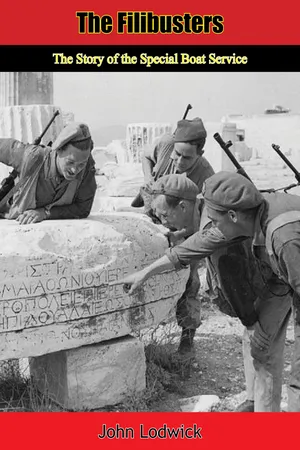
- 235 pages
- English
- ePUB (mobile friendly)
- Available on iOS & Android
eBook - ePub
About this book
Trusted by 375,005 students
Access to over 1.5 million titles for a fair monthly price.
Study more efficiently using our study tools.
Information
Subtopic
European HistoryIndex
HistoryCHAPTER ONE
A few minutes before ten o’clock on an evening in June the submarine surfaced. She lay four miles offshore. The sea was calm, and there was a slight mist—but no moon. The moon would not rise for another two hours.
The two men were sitting in the ward-room eating ham sandwiches when this occurred. When they had eaten seven or eight ham sandwiches they lit cigarettes and inhaled deeply and deliberately for they would not be smoking again for some time. Presently, the captain called down that all was in readiness. The two men extinguished their cigarettes and, carrying their collapsible canoe and stores, mounted the steel steps to the conning-tower. Twenty minutes later they were sitting in their canoe on the casing, ready to be floated off. The submarine proceeded inshore, and at about distance of three-quarters of a mile from the beach the canoe was slipped overboard.
One of the men in the canoe was an officer. The other man was a marine. They paddled gently, exercising great caution as they neared the coast, for voices could be heard and occasional lights observed. Several small craft were seen close inshore, probably local fishing boats. Since the officer knew that the railway ran along the coast, no definite point was made for, but for safety’s sake he used a compass-bearing for his run-in. Presently, he sighted a large mass of rock, rising vertically to a height of two or three hundred feet. Since the railway must run either through or round his spur, the officer decided to take advantage of the protection afforded by its shadow. In this he did himself a good turn, for after a short distance, a shingle beach was sighted where the two men were able to land without making too much noise. They hid their canoe from sight among the rocks.
Inland the ground rose steeply. Some distance up the incline, the telegraph poles which marked the railway track could be seen. The two men swung their load over their shoulders and climbed slowly, sweating, for the night was warm, cursing as they slipped on loose stones, making contact with cactus bushes. On reaching the railway they discovered that it entered a tunnel which ran through the spur. Both tunnel and line were unguarded. Some distance away a white light was shining, probably the signal for a train.
Finding no more suitable place, the officer decided to lay his explosive charge in the entrance of the tunnel. The two men knelt down and the work began. They had brought a pick with them, but picks are noisy. They scooped at the stones with their hands and laid their charge between two sleepers, where it nestled conveniently, immediately under the line.
The officer busied himself with the final details. He laid his dual-pressure ignition studs flush with the under-side of the rail. He connected up the main charge. While he was doing this the marine nudged him and pointed. The white light down the line had turned green. A train was approaching.
The officer placed his detonators in positions and the two men slipped away. Voices could still be heard, and in consequence they moved with great care. Two boatloads of fishermen were now lying directly off the beach. The two men hid for some time behind a rock, but their position was uncomfortable, and they were much bothered by gnats and mosquitoes. After a brief consultation they launched their canoe and, unobserved by the fishermen, made off.
Half a mile offshore the officer made a prearranged signal with a torch. He sighted the submarine on his starboard bow. The two men boarded her from the gun-platform. The canoe was passed inboard and dismantled. The submarine got under way.
Some ham sandwiches remained in the ward-room. The canoeists had eaten five or six of these when the officer was called for from the bridge. He mounted the steel ladder in time to see a train entering the far end of the tunnel. Fifty seconds later a large flash was visible. This flash was followed by an explosion.
These events occurred on the night of the 22nd of June 1941, on the western coast of Italy. They represented the first successful attack upon the Italian metropolis and the birth of the Special Boat Service. The men who laid the charge were Lieutenant (R.A.) ‘Tug’ Wilson and Marine Hughes.
When Dunkirk fell, many things fell with it. General officers retired, pausing on their way to Home Guard duties to buy bowler hats at Lock’s. Other officers were promoted, and orders were placed with London tailors for acres of red tabs. To the British public, these changes seemed salutary, but not startling. A disaster had occurred and, no matter how slowly, a disaster would be put right. Meanwhile, the major problem remained how to get to one’s office through debris-strewn streets and morning air raids.
But behind the scenes...behind the imposing change of nomenclature and command...a metamorphosis was taking place in British military thinking. If a cataclysm is required to shake the War Office the reaction of that old-established firm is none the less rapid. In this case, it was also efficient. New personalities appeared with new ideas. The era of the swashbuckling adventurer and the licensed privateer was at hand again, and as the glad tidings spread round, the spiritual descendants of Hawkins, of Peterborough and of Drake swallowed a last double whisky in their messes and took the train for London. They carried with them in their luggage mysterious rope ladders, alpenstocks, home-made bombs and magnetic devices, which they proposed to attach to the sides of enemy ships. England was reeling beneath the nightly assaults of the Luftwaffe, but the main concern of these men was to get back in the shortest possible time to the Continent. There was one who had sailed the entire length of the Danube in a rubber boat, and who saw no reason why he should not repeat this exploit on the Seine. There was another who had spent half his life as a Himalayan mountaineer and who offered his experience now for the purposes of cliff-scaling in Normandy. These men were neither deranged nor were they cranks. The gadgets which they invented—from tyre bursters to time incendiaries—their vast experience at sea, in mountains and in many strange countries, were later to form the stock-in-trade of raiding and invasion forces everywhere.
The talent was there; it remained to co-ordinate and direct it. Admiral of the Fleet Sir Roger Keyes, a man universally respected and the hero of Zeebrugge in the First World War, was chosen for this task. Throughout the autumn and winter of 1940 the newly formed Commandos were training for amphibious operations, firstly at Inverary, and later at Largs and in the island of Arran. Looking back, these now seem almost legendary times, comparable only with the foundation of the Roman Empire. Were Romulus and Remus actually suckled by the wolf—who can tell? The historians state the fact blandly, as later they will no doubt observe that even in far-off ‘forty, Britain was preparing to strike back. But of the personalities in those early days under Admiral Keyes many are now dead, many dispersed throughout the world, and not a few deep in the respectability of stockbroking and market-gardening. They have done a great deal since Inverary, and they talk, not of training, but of operations. When they came north in that first winter they lacked experience sadly. Each, while willing to learn from others, sought refuge in his own speciality. The men who had crossed the Gobi Desert in rope sandals insisted upon the benefits of marching; the amateur anarchists showed real enthusiasm only during the periods devoted to explosives; officers, who in civvy street had spent much time in night-clubs, issued benzedrine to their sections and expounded upon the benefit of long periods without repose.
There were even advocates of dress reform. George Duncan, a captain, condemned both shorts and battle-dress trousers as useless. ‘You must march in breeches,’ he would declare, ‘trousers chafe the skin...chafe the skin,’ and, suiting the action to his word, he would spend much time with needle and thread. A crony of Duncan’s was George Barnes, a Grenadier Guardsman, whose talents lay in another direction. A professional swimmer, Barnes could eat bananas and drink beer below water, accomplishments which stood him in good stead later, when he specialized in the use of the Davis submarine apparatus.
Attached to No. 8 Commando at this period was a small group of highly trained canoeists, whose job was to carry out the reconnaissance for commando landings and to do various small sabotage jobs. This ‘Folboat Section’, as it was called, was run by Captain Roger Courtney, who had pre-war canoeing experience on the Nile and elsewhere. If Courtney had a permanent residence it was probably in East Africa, where he had spent much of his life hunting big game. Courtney had a persuasive tongue, and he needed it, for the idea, in those days, of canoes as implements of warfare was revolutionary in the extreme. To his flow of golden words Courtney added an ability to drink any two men under a mess table and a propensity for issuing broadsheets to his men. ‘Are you TOUGH?’ one of them demanded, ‘if so, get out. I want——’s with intelligence.’
Courtney’s second-in-command was a lieutenant. His name was ‘Tug’ Wilson, and with that delightful inconsequence peculiar to the British Army, he had been commissioned in the Royal Artillery, though he was not to touch anything of larger calibre than a tommy-gun for years. Wilson was fanatical in his enthusiasm for canoes. As leader of the first successful raids, by this means, he occupies a position in our hierarchy not unlike that of St. Peter in Holy Mother Church. It was he who, when chivvied by Cairo, was later to say, ‘The miserable precautionary methods taken by the Italians to counter our attacks are entirely inadequate and by no means warrant an even temporary cessation of landings’.
Wilson’s comrade on operations, his ‘mucker’ or ‘mate’ was Marine Hughes. It is useless to ask where Hughes came from. People were not transferred to the then embryonic unit: they arrived, following a conversation in a pub or on a railway station. Subsequently, their position was regularized by the ubiquitous Courtney, who could return the soft answer when he so wished. The recruits came, often, from the most unlikely sounding units: for example, James Sherwood, from the R.A.S.C., who did very well in the Middle East before returning to the U.K. and the respectability of a commission. In all, by the end of 1940, about twelve officers and men had been recruited by Courtney, and to each officer his ‘half-section’ in the shape of a man he filled with buns and tea on all possible occasions.
The atmosphere was far from formal.
The training imposed by Keyes, not only upon the Folboat Section but upon all special service troops in the Island of Arran, had not been without an object. That object, though few realized it at the time, was no less than the invasion of the Italian island of Pantellaria. Wavell was now in Bardia and would soon be skirmishing outside Benghazi. British strategists, fortified by captured dumps of pecorino and chianti, were beginning to think ambitiously. Only at the last moment was the assault upon Pantellaria cancelled. Speculation as to the likelihood of its success seems to me untimely. It would have been a very bloody operation.
Meanwhile, Wavell had got wind of the formation of these peculiar units in Scotland and, in January 1941, he sent for them. Middle East strategy at that time had two principal objects. The first—the occupation of Cyrenaica—had now been almost achieved. The second was the occupation of Rhodes, for the attack on which island elementary landing-craft and small naval vessels of all kinds were being assembled in Alexandria. On 31st January 1941, the three most highly trained of the new Commandos...the 7th, 8th, and 11th Scottish (under Lt.-Col. Dick Pedder) left Arran, arriving in the Middle East by the tiresome Cape route on 11th March. The whole force was under command of Colonel Robert Laycock, from whom it took its name of ‘Layforce’. Somewhere in the bowels of one of the smallest ships the still tiny Folboat Section was quartered. The precious canoes themselves had been dismantled and packed in waterproof cases. No replacements would be available in Cairo.
Arrived in Egypt, ‘Layforce’ settled down to the traditional first tasks of the British ‘squaddie’ in those parts. They allowed their literal and metaphorical knees to brown. They learnt to wear shorts, learned not to lapse into the symptoms of dementia praecos when pursued all day by swarms of flies. They trained arduously for Rhodes; though, as events turned out, they were to go almost everywhere except there.
For, in late March and early April, unfortunate events were taking place in Greece. Every available landing-craft and small ship was commandeered for the evacuation for the British and Anzac Expeditionary Forces. The attack upon Rhodes was finally and utterly cancelled. In these circumstances, Courtney, who barely knew the purpose for which a chair was intended, let alone being prepared to sit still in it, decided to act upon his own initiative. With a triumphant ‘so there!’ to his colleagues, he arranged for the transfer of the Folboat Section to H.M.S. Medway, where they would work in conjunction with the 1st Submarine Flotilla.
From this moment the Special Boat Section can be said to have been formed, but in spite of the imposing change of nomenclature they were to remain for some time nobody’s baby. Parades—when parades took place—revealed that their effectives had jumped to eight officers and approximately thirty men. These parades also revealed the most astonishing variety of headgear ever seen in the Middle East; with a majority inclination towards tam-o’-shanters. The S.B.S. as yet possessed no badge, no motto, none of the personal paraphernalia of a normal unit. There existed, however, a unit stamp. It was neither well-made nor easily decipherable. A myopic field cashier, upon seeing it, inquired plaintively as to the nature of this Special Boot Section.
Meanwhile, ‘Layforce’, still bloodthirsty but baulked in all its major plans, was splitting up. In June it was disbanded, but not before 11th Scottish Commando had made its remarkable crossing of the Litani River in the Syrian campaign against some of the stiffest opposition ever met by special service troops. A bleak cemetery beside a lonely road still annotates this now forgotten sacrifice.
Members of ‘Layforce’ were now offered employment in the newly forced Middle East Commando, the effectives of which were to be made up to strength by the incorporation of the two Commandos which had fought well in East Africa. Many accepted; others passed to the various peculiar organizations, which were now springing up like mushrooms...sturdy mushrooms. One of these units, if one accepts its pacific title at its face value, was concerned with transport protection. How it ever got across the desert, killed 120 Italians and captured or destroyed all their transport is a mystery. After this episode the unit name was changed.
This middle and final trimester of 1941 was the raiders’ honey-moon. The great David Stirling was already present...and could be seen at Shepheard’s on occasion...but he had not yet thrown his gigantic shadow and his passion for incorporation across the paths of all these little groups. Comfortably installed in the ward-room of H.M.S. Medway, Roger Courtney plotted in peace, was affable to the influential, abrupt with the conventionally minded. He got on well with the Navy: the Navy got on well with him. He owed allegiance to nobody and, when he judged the moment ripe for another operation, he would pay a polite call upon Admiral Maund, Director of Combined Operations at G.H.Q.
Admiral Maund was amiability itself...indeed, he was more; he was enlightened. His submarines were obliged to carry out their routine patrols. Why not, in the course of them, allow a couple of these queer chaps in tam-o’-shanters ashore with their sacks of gelignite and pressure switches, to do a bit of dirty work into the bargain? Admiral Maund saw no objection, neither did his eminent colleagues. The period, indeed, was propitious for nuisance raids, for there was small comfort elsewhere.
Nor was Admiral Maund the only client: the cloak and dagger gentlemen, with dingy but sinister headquarters in ...
Table of contents
- Title page
- TABLE OF CONTENTS
- ILLUSTRATIONS
- CHAPTER ONE
- CHAPTER TWO
- CHAPTER THREE
- CHAPTER FOUR
- CHAPTER FIVE
- CHAPTER SIX
- CHAPTER SEVEN
- CHAPTER EIGHT
- CHAPTER NINE
- CHAPTER TEN
- CHAPTER ELEVEN
- CHAPTER TWELVE
- CHAPTER THIRTEEN
- CHAPTER FOURTEEN
- CHAPTER FIFTEEN
- CHAPTER SIXTEEN
- CHAPTER SEVENTEEN
- CHAPTER EIGHTEEN
- CHAPTER NINETEEN
- CHAPTER TWENTY
- CHAPTER TWENTY-ONE
- CHAPTER TWENTY-TWO
- CHAPTER TWENTY-THREE
- CHAPTER TWENTY-FOUR
- CHAPTER TWENTY-FIVE
- CHAPTER TWENTY-SIX
- REQUEST FROM THE PUBLISHER
Frequently asked questions
Yes, you can cancel anytime from the Subscription tab in your account settings on the Perlego website. Your subscription will stay active until the end of your current billing period. Learn how to cancel your subscription
No, books cannot be downloaded as external files, such as PDFs, for use outside of Perlego. However, you can download books within the Perlego app for offline reading on mobile or tablet. Learn how to download books offline
Perlego offers two plans: Essential and Complete
- Essential is ideal for learners and professionals who enjoy exploring a wide range of subjects. Access the Essential Library with 800,000+ trusted titles and best-sellers across business, personal growth, and the humanities. Includes unlimited reading time and Standard Read Aloud voice.
- Complete: Perfect for advanced learners and researchers needing full, unrestricted access. Unlock 1.5M+ books across hundreds of subjects, including academic and specialized titles. The Complete Plan also includes advanced features like Premium Read Aloud and Research Assistant.
We are an online textbook subscription service, where you can get access to an entire online library for less than the price of a single book per month. With over 1.5 million books across 990+ topics, we’ve got you covered! Learn about our mission
Look out for the read-aloud symbol on your next book to see if you can listen to it. The read-aloud tool reads text aloud for you, highlighting the text as it is being read. You can pause it, speed it up and slow it down. Learn more about Read Aloud
Yes! You can use the Perlego app on both iOS and Android devices to read anytime, anywhere — even offline. Perfect for commutes or when you’re on the go.
Please note we cannot support devices running on iOS 13 and Android 7 or earlier. Learn more about using the app
Please note we cannot support devices running on iOS 13 and Android 7 or earlier. Learn more about using the app
Yes, you can access The Filibusters by John Lodwick in PDF and/or ePUB format, as well as other popular books in History & European History. We have over 1.5 million books available in our catalogue for you to explore.