ONE OF BRITAIN'S MOST DECORATED FIGHTER PILOTS TELLS HIS RIVETING TRUE STORY OF AERIAL COMBAT…
Fast-paced, hard-hitting and personal, Wing Commander J. R. D. "Bob" Braham recounts his brilliant career as a World War II fighter pilot. Beginning with his pre-war training, he takes us battle-by-battle through that fateful afternoon in June, 1944, when he was shot down over occupied Denmark and taken prisoner. From the desperate night-time sorties against the Luftwaffe's air strikes during the Battle of Britain to the daring daylight intruder raids against Hitler's crumbling Reich, his story reveals the skill, courage and teamwork between pilot and navigator that made him one of the RAF's most deadly fighter pilots.
"HE'S 400 YARDS DEAD AHEAD!"
Suddenly there he was as clear as could be—twin engines, twin tail, our opposite number, an Me110 night-fighter. He was turning gently to port.
I climbed back to 16,000 feet, heading again towards Ameland. Before we had straightened out Jacko called urgently: "Hard starboard!" I hauled the Beau round in a tight turn when Jacko called, Look out, you're closing too fast!"
"I've got him," I yelled. He was above me, in a tight turn, and at the speed we were travelling we looked as if we were going to ram him. I eased back the stick, put the sights on him and fired at the point-blank range of about fifty yards. There was a blinding flash as the Me exploded in my face.
- 226 pages
- English
- ePUB (mobile friendly)
- Available on iOS & Android
eBook - ePub
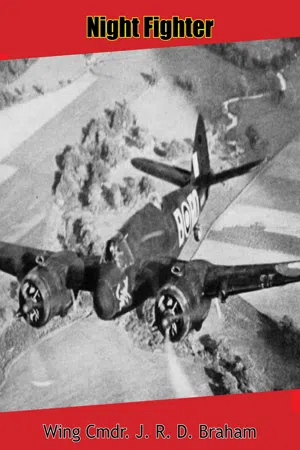
Night Fighter
About this book
Information
Subtopic
European HistoryIndex
History1
This is a story of war in the air, of ruthless personal combat, man against man, machine against machine and man against death; the most exciting, dangerous and highly skilled form of duelling ever devised.
It is also the story of a whole generation of young men of many nationalities, most of them fresh from school or university, who fought it out in the sky over Britain and Europe between September, 1939, and the Allied victory in 1945. There is gallantry in this story by friend and foe. There is sacrifice, too, of the many young men who died for what they believed to be right. Those of us who then defended Britain lived a strange, unnatural life in a besieged fortress. We were frontline fighters, out day after day or night after night to destroy the enemy. Yet when we came back hot from battle for a few hours of rest we tried to live a near-normal, social, civilized life among a civilian population, often in quiet villages and small towns, which war had not hit and where life remained calm. Many of us came back to wife and children and our own home as, for long periods, I did. We drank with the locals in English pubs an hour, perhaps, after a fantastic escape or a hazardous victory. Who will blame us if we often drank too much to release our tension?
Above all, this is the story of wonderful comradeship, loyalty and devotion. These were the things that gave us the heart and the will to go on fighting until we won.
June 25, 1944, was a fine day and the invasion of Europe had been in progress for nearly three weeks. The Allies were consolidating their initial gains, but not making much progress because of bitter resistance by the Germans, particularly against the British and Canadians where the bulk of the powerful Panzer divisions were massed. However, for Don Walsh, my new Aussie navigator, and me, this day will be remembered as long as we live. We set out to destroy my thirtieth enemy aircraft. Instead we became “guests” of the Germans for nearly a year.
We took off from Gravesend in a Mosquito fighter-bomber, borrowed from the obliging “Daddy” Dale, Commander of 21 Squadron, and landed at West Raynham, Norfolk, to refuel for a long-range intruder mission to the area of Barth on the Baltic German coast. The object of this freelance flight was to destroy German aircraft in the air or on the ground and to shoot up any transport movements we might see on the roads or railways.
To operate inside enemy territory in daylight surprise was essential. The route would have to be well planned to dodge enemy radar, flak and airfields, from which we might encounter his single-seat Messerschmitt 109s and Focke-Wulf 190s. A single Mosquito, despite its excellent qualities, was no match for determined formations of these highly manoeuvrable fighters. The most important requisite for such a mission as ours was cloud cover over enemy territory and the sea approaches.
While at West Raynham, ground personnel topped up our fuel and checked the formidable fixed forward-firing armament of four 20-mm. cannons and four 303 machine guns. Don and I went to the office of the Station Intelligence Officer, Buster Reynolds, an old friend, about whom there is more later in this book. Buster briefed us on the enemy radar network, flak and fighter dispositions in Denmark and Northern Germany. We planned to cross the Jutland coast just north of Esbjerg, where a lighthouse provided a landmark; then, by a series of changes of course, to confuse the enemy, to another point about ten miles south of Copenhagen, and from there over the Baltic Sea to Barth in Northern Germany. Our enterprise required very low flying over sea and land to make it as difficult as possible for the German radar chain and observer corps to follow us.
This was not the first time I had flown over Denmark on similar missions, but the very latest information was essential if our mission was to be successful. Our main worry was the two enemy fighter fields at Alborg near the northern tip of Jutland and at Husum just below the German-Danish border. Indications were that there were several Messerschmitts and Focke-Wulfs at these bases. If they were alerted to our presence over Denmark things would be difficult. So we changed our route to the target area slightly and worked out a completely different route for the trip back. The Met Officer wasn’t optimistic that we would have the sort of cloud conditions we wanted over the whole of our route, but we felt that there was just a chance. Perhaps his uncertainty should have been a warning to us, but our eagerness to have a go overcame any qualms.
We little realized that the uncertain weather, coupled with a number of mistakes I was to make, was to cost us our freedom and almost our lives. Cheerfully we ate lunch in the officers’ mess with comrades from 141 Squadron, which I had commanded a year before. In the early afternoon Don and I clambered up the ladder into the chummy side-by-side seats of our fully-loaded aircraft and waved farewell. We were full of confidence. A minute or so later, with the engines roaring evenly, we were on our way to our landfall on the Danish coast. At 240 m.p.h. I flew the Mosquito at nought feet over the rich green Norfolk countryside. In less than fifteen minutes we crossed the coast near Cromer and dropped to within twenty-five feet or so of the North Sea, our props at times throwing up a light spray. All this was no bravado, for the lower we stayed the less chance the German radar would have of picking us up. If we were as lucky as on previous occasions we might achieve complete surprise. This sort of flying was very tiring and required complete concentration. A slight error would put us down with King Neptune.
Don was checking his charts and instruments to ensure that we should fly over the enemy coast at the right place. As we had some 300 miles of North Sea to cross this was no easy task. It would be over an hour before we saw the Danish coastline, so he had time to concentrate.
This part of the flight was always the worst. One had time to think—too much time. I knew from experience that I was afraid and that I wouldn’t regain my confidence until we reached enemy territory. It had always been that way; some-how my worries invariably disappeared once we were over the enemy’s coast.
The engines sounded sweet and, at the moment at any rate, it looked as if the weather was just what the doctor ordered. Cloud completely covered the sky at about 2,000 to 3,000 feet and visibility was excellent. Soon we became more alert, searching ahead for a glimpse of the coastline and scanning the sky for lurking enemy fighters. Don’s navigation was perfect. We should be there in about ten minutes. Now I was leaning forward, straining to pick up the distant coastline. “There it is, a thin pencil-line on the horizon. That tower must be the lighthouse. Bang on.” Don checked the position of the landmark on his maps and we changed course slightly to make an exact landfall. At that moment, with the coast still some miles ahead, I saw two ships, German destroyers or torpedo boats. “Damn it.” They couldn’t help but see us, and would pass warnings to the coast defence units and the Luftwaffe. I changed course to the right in the hope that they might not see us, but we were out of luck. Both ships started to zigzag and increase speed as we could easily see by their wake. So instead of going in north of Esbjerg, we went in some miles south. We could both detect a slight whine over our radio receivers which we knew was interference from some German ground radar unit searching the ether to pick us up. Momentarily I thought about attacking the two ships, but as we had no bombs it seemed pointless. So we continued on over the coast, climbing slightly to cross the sand-dunes.
Ahead of us lay the fertile, flat, Danish countryside, and as we weaved our way low over the fields and hedgerows, Don and I rapidly debated whether to call the mission off. There was now no doubt that we had lost the vital element of surprise, so the cards were stacked heavily against us. Then we noted that the whine in the radios had ceased. “They’ve lost us. All they know is that we are somewhere inland, and it will be like looking for a needle in a haystack to find us now. What do you say, Don? Shall we carry on?”
“O.K., let’s keep going.” Unfortunately we hadn’t allowed for the enemy’s efficient ground observer service which was at that moment phoning in our progress to the Luftwaffe air defence headquarters in Denmark.
We were now committed and there was no turning back. If I had been worried, this state of mind soon left me. In spite of the ill-omens we both still felt confident of success. It didn’t perturb us even when, as we crossed eastwards out over Jutland skirting the northern edge of Fyn Island, we were fired on by several small ships. This should have been an indication to both of us that the enemy was very much on the alert. Further, the weather to the east and south seemed to be clearing and our cloud sanctuary was disappearing. Just then Don spotted the radio masts of Kalundborg on the western edge of Sjaeland, the largest of the Danish islands on which lies the capital city of Copenhagen. Many was the time at home before the war that I had tuned my parents’ radio to Radio Kalundborg, little thinking that one day I would be seeing it from an aircraft on a warlike mission. We were still on course, hoping that our periodic change of heading by thirty or so degrees (doglegging) would throw the Germans off our scent.
At last, in the distance we could make out the green towers of Roskilde Cathedral, at which point we turned south across Moen Island and so over the Baltic Sea. By now there wasn’t a cloud in the sky and again we detected the whine over our wireless. There was little doubt that the Huns again knew just where we were, and at this late stage apprehension hit us both. With the north German coast looming up menacingly in the distance we decided to call it a day and turned to start heading back home.
As we skimmed over the waters of the Baltic, Don quickly gave me a rough course to take us back over Fyn Island and so home. There was cloud to the north and west and although the base appeared to be considerably higher than 2,000 feet, conditions there looked the most favourable. We decided that it would be wisest to fly out over the coast of Jutland at just about the spot where we entered. The faint whine over our receivers was now nearly continuous, so I kept reminding Don to look to the rear and watch for German fighters. I scanned the country ahead, keeping close to the hedges and fields and unintentionally frightening Danish civilians and their cattle. This was the only way to keep out of sight of, or at least make it difficult for, enemy fighters. Don was constantly giving me small corrections of course.
We were about half-way across Fyn Island when we saw a large house which had once been a private mansion. It was now flying a large Swastika flag from its roof. Just turning out of the driveway on to a secondary road was a car. By the time we had taken all this in we had roared over it at 240 m.p.h. I was convinced that it must be a staff car so I pulled the Mossie up and around in a screaming turn till we were at about 500 feet. At least we would stop whoever was driving in this vehicle. It might even be some important Nazi official, or, better still, some Gestapo swine. Quickly switching on the electric gun-sight, I eased the stick slightly forward, putting the aircraft into a shallow 260-m.p.h. dive. Ahead at about 800 yards was the car. Maybe the occupants thought we were German flyers making a friendly low pass. At 500 yards with the car now in my reflector sight I pressed the trigger on the control column. The Mossie bucked a little and the cockpit filled with cordite fumes as streams of shells and bullets poured from our guns. At first the shots threw up dirt from the ditch at the side of the road alongside the car and then the vehicle was smothered with armour-piercing and explosive shells and bullets. I nearly flew into the ground in my concentration at firing, but Don yelled “Pull up” over the intercom, and I yanked back on the stick just in time to clear some small trees. Out of the corner of my eye I saw the car crash into the ditch belching smoke. “That fixed the bastard,” was Don’s remark. In our excitement we had nearly forgotten our own position, but almost immediately we realized that this little bit of violence would certainly pinpoint us. So we didn’t tarry to gloat over our work, but continued on, more alert than ever.
“We shall be at Ringköbing Fiord in twenty minutes.” Don’s information was encouraging, as this was the place on the West Jutland coast over which we wished to cross out. Once over the North Sea we could relax. German fighters would not have the range to follow us far.
Perhaps our minor, one-sided action had made me overconfident. The cloud cover looked good though it was a little higher than desirable, nobody was shooting at us now and no unfriendly aircraft were in sight. In fact everything was too easy and we were nearly clear of enemy-occupied territory. On we flew over the lovely, peaceful, Danish countryside until at last I could make out the narrow fiord with a thin strip of sand-dunes separating it from the greyness of the North Sea.
It was passing through my mind what an uneventful trip it had been. Next time we would plan a similar one to Norway, where the pickings should be good. My daydream was quickly ended by an urgent, “Two fighters coming in astern.” “Damn it. How far off, Don?” Before he answered I saw by a quick look over my shoulder that they were about a mile away, and coming in fast. I was so close to the ground that I couldn’t dive to pick up speed rapidly, so I rammed the throttles right forward and we had to wait a few precious seconds for the aircraft to accelerate. Why I was only cruising out at 240 m.p.h. I don’t know. We should have been leaving hostile territory flat out at nearly 300 m.p.h., and as our top speed was similar to that of the FW190 and the Me109, it is doubtful whether either could have caught us. Don was now on his knees facing aft having loosened his safety-straps. In this way he could keep me exactly informed of the range and relative position of the enemy, which we confirmed as two FW190s. As soon as we reached 280 m.p.h. I hauled hard back on the stick, pointing the Mossie nearly vertically towards the clouds, knowing well that unless I could escape into this wispy cover our chances would be slim. It would have been a different story if there had been only one fighter; we could probably have held our own as I had managed to do in the past. Two were a different matter. It was only a matter of time before one of them set us up in position for the second fighter to get in a killing burst.
The two FWs had now spread out, one being about 400 yards ahead of the other. “Look out, Bob, the bastard is just about in range.” The Mossie was gradually losing speed in its near vertical climb, and still our cloud sanctuary was a good 2,000 feet above us, much higher than I had thought. Quickly I straightened out of the climb and at the same time put on hard left bank, pulling the control column into my stomach. Things started to go grey as the forces of gravity forced the blood from my head down into my legs. Momentarily I had saved us because the Hun couldn’t follow us in the tight turn. As soon as he broke I switched into a turn in the opposite direction, by which time this particular FW had pulled up into a stalled turn and was coming at me head on. We were now at 2,000 feet above the Jutland coast, but in my concentration I had forgotten about the second fighter. This was the sort of error that one was always warning new pilots about, and yet here I was, with four years’ combat experience, making the same mistake. The first FW was closing fast and suddenly I saw the wicked winking flashes from his nose and wings as he opened up with his cannons and machine guns. It looked as though he couldn’t miss, but in my amazement at not being hit I forgot to press my own trigger, even when for a brief moment he filled my sights. It was too late now. I knew then, I believe, that we had had it because of the urgency in Don’s voice and the sight out of the corner of my eye of the rapidly closing second Focke-Wulf coming in from below on my right. Desperately I turned in to him, pulling up at the same time to make his shooting more difficult, but it was too late. In my violent manoeuvring I had stalled the Mossie, and as my starboard wing dropped, the aircraft shuddered under the impact of his large 30-mm. shells and bullets. He was so close that the whole nose of the FW seemed to be afire as his guns blasted away. My mouth went dry. The port engine and wing caught fire, and at any minute I expected to be blasted to oblivion. As the nose dropped we seemed to be diving vertically towards the North Sea, and at that moment the instrument and glass side panels of the cockpit disintegrated under another burst of fire. I shall never know why his bullets didn’t find a billet in Don or me.
I remember saying to Don, “Well, we’ve had it.” I couldn’t see how we could possibly pull out of the dive in time before we crashed. Even though I thought we were going to die I was no longer afraid. I just felt worried as to what would happen to my family, for at that fleeting moment they were uppermost in my thoughts. Perhaps this galvanized me into trying to save us, so I pulled back hard on the control column, and by some miracle the aircraft responded and started to come out of its death-dive. But only just. We levelled out just above the water, flying parallel to the coast and only about 200 yards from the shore. As I switched off the port engine I told Don to feather the propeller to cut down the amount of drag from slowly revolving unstreamlined blades. In his excitement he started to press the wrong feathering button and nearly stopped our good engine. Luckily I saw it in time and knocked his hand away and feathered the correct one. At the same time I operated the built-in fire extinguisher to the port engine in the hope of putting the fire out. But it had got too good a hold. In these few seconds I found that we still had some control and were keeping about 100 feet above the shore. Then Don called, “Here they come again,” and over my shoulder I saw the enemy closing in from above and behind for the kill. Again there was the rending noise as more shells crashed into the good old Mossie. “Jettison the top hatch. I am going to crash-land on the beach,” I shouted. I knew there was no escape in the air and our only chance of survival was to pancake on the sandy shore, with the hope that our badly-crippled aircraft wouldn’t explode when we hit.
I throttled back the good engine as Don let go the top hatch which whipped back in the slipstream over our tail. I even half-heartedly hoped it would clobber one of our pursuers, but no such luck. Our speed gradually fell as we held off for a bellylanding and at about twenty-five feet up both fighters flew over the top of us. For a second I had the chance of getting in one quick shot in revenge. I only had to ease the stick back ever so slightly and press the firing button, but I was so engrossed in landing on the rough, sandy shore that this slipped my mind. It was a forlorn hope anyway. With a crash which threw both of us violently against our safety-straps we hit, bounced up into the air, then hit again at 150 m.p.h. I hadn’t dared lower the wheels as the aircraft would most certainly have flipped over on to its back when the wheels sank into the soft sand. But with them still tucked up we slid rapidly to a stop. One wing was just in the water and the rest of the plane was on the beach. Regardless of the cuts and bruises we had suffered Don kicked his way through the side entrance while I went out through the top hatch.
I think we broke all records vacating our fiercely-burning aeroplane. At any moment I expected it to explode, so we both started to run up the beach to the shelter of the dunes. This was hard going as the sand was soft. After about twenty paces we gave up and stopped for a breather. Looking up we saw both Focke-Wulfs peel off and start to dive towards us. This was it. I was convinced they were going to strafe us. There was no shelter and we couldn’t run. We just stood still and hoped. As they roared over us at twenty or so feet the leader, whose helmeted head I could clearly see, waved. I waved back, and as they winged away to their base I thought what chivalrous foes they had been. The drone o...
Table of contents
- Title page
- TABLE OF CONTENTS
- DEDICATION
- FOREWORD
- INTRODUCTION
- 1
- 2
- 3
- 4
- 5
- 6
- 7
- 8
- 9
- 10
- 11
- 12
- 13
- 14
- 15
- 16
- 17
- 18
- 19
- 20
- 21
- 22
- 23
- 24
- 25
- 26
- 27
- 28
- 29
- 30
- ABOUT THE AUTHOR
- REQUEST FROM THE PUBLISHER
Trusted by 375,005 students
Access to over 1.5 million titles for a fair monthly price.
Study more efficiently using our study tools.
Frequently asked questions
Yes, you can cancel anytime from the Subscription tab in your account settings on the Perlego website. Your subscription will stay active until the end of your current billing period. Learn how to cancel your subscription
No, books cannot be downloaded as external files, such as PDFs, for use outside of Perlego. However, you can download books within the Perlego app for offline reading on mobile or tablet. Learn how to download books offline
Perlego offers two plans: Essential and Complete
- Essential is ideal for learners and professionals who enjoy exploring a wide range of subjects. Access the Essential Library with 800,000+ trusted titles and best-sellers across business, personal growth, and the humanities. Includes unlimited reading time and Standard Read Aloud voice.
- Complete: Perfect for advanced learners and researchers needing full, unrestricted access. Unlock 1.5M+ books across hundreds of subjects, including academic and specialized titles. The Complete Plan also includes advanced features like Premium Read Aloud and Research Assistant.
We are an online textbook subscription service, where you can get access to an entire online library for less than the price of a single book per month. With over 1.5 million books across 990+ topics, we’ve got you covered! Learn about our mission
Look out for the read-aloud symbol on your next book to see if you can listen to it. The read-aloud tool reads text aloud for you, highlighting the text as it is being read. You can pause it, speed it up and slow it down. Learn more about Read Aloud
Yes! You can use the Perlego app on both iOS and Android devices to read anytime, anywhere — even offline. Perfect for commutes or when you’re on the go.
Please note we cannot support devices running on iOS 13 and Android 7 or earlier. Learn more about using the app
Please note we cannot support devices running on iOS 13 and Android 7 or earlier. Learn more about using the app
Yes, you can access Night Fighter by Wing Cmdr. J. R. D. Braham in PDF and/or ePUB format, as well as other popular books in History & European History. We have over 1.5 million books available in our catalogue for you to explore.