A Czech pilot's incredible experiences as a Legionnaire, a saboteur…and a prisoner.
JO CAPKA was a Captain in the Czechoslovak Air Force who escaped to Poland following the Nazi invasion of Czechoslovakia in 1939. Determined to continue the fight, he joined the French Foreign Legion. Relief came with the declaration of war and secondment to the French Air Force, but when France was overrun, Jo fled to the South of France where at Bordeaux he joined a group of Polish Airman on a ship bound for England.
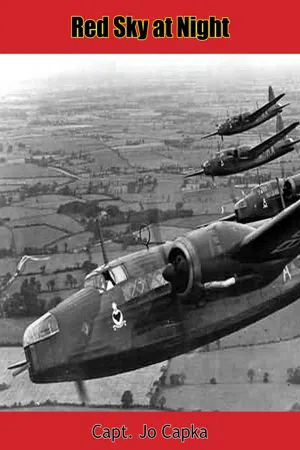
He then joined the RAF and was posted to the newly formed 311 (Czech) Bomber Squadron. He flew 56 bombing missions in Wellingtons and was awarded the DFM. Severely injured over Normandy in June 1944, he was treated by the pioneering plastic surgeon Sir Archibald McIndoe.
After the war, he returned to Czechoslovakia with his wife, a former WAAF, to run a flying school, but following the communist coup in 1948 was arrested as a British spy and charged with High Treason. He spent 7.5 years in prison, 14 months in solitary confinement, and was only released after the death of Stalin. He returned to England 1957.
- 198 pages
- English
- ePUB (mobile friendly)
- Available on iOS & Android
eBook - ePub
About this book
Information
Subtopic
European HistoryIndex
History1
THE hand-grenades burst so quickly one after another that the explosions joined together in one ear-splitting crack. The awakened pigeons rose from the square in a wheeling sweep of protest. It seemed seconds before we saw that the front of the Café Ruprech was hidden by grey smoke from the grenades. There was no blast that we could feel and in the silence that followed the cries of the wounded came clearly out of the splintered chairs and debris that a moment before had been a quiet, well-lit café scene.
This was 15 April, 1939, and in the seconds that followed the grenades being tossed into the café, the main square of the Czech town of Olomouc was frozen into immobility. Though Kaminek and I had known what was to happen we were just as open-mouthed at the reality of the attack as anyone else. We were not allowed to stand like that for very long.
Loudspeakers suddenly blared into action. In fact the first magnified voice started shouting before the last running figures had disappeared into the shadows around the edge of the square. “Stand where you are!” bellowed the voice and then in an instructional tone to unseen figures—“Everyone in the area will be brought to the central police station for interrogation.”
The instructions were not given in vain. As we stood undecided about what to do, a cordon of figures advanced out of the shadows. I turned on my heel and the story was repeated behind me. Grey-clad German soldiers completely ringed the square just as though they had been waiting for this moment. Armoured cars broke through the circle and roared up to the front of the café itself. I felt an instinctive desire to run, but there was nowhere to run to now.
As the ring tightened around us we were no longer alone. All the citizens of Olomouc who had chosen the main square as part of their route at that particular time of 11 p.m. were inside the circle with us and when the rifles finally reached us we were jostled into line with the rest. As I waited for my turn to be interrogated I had the pleasure of seeing—for the cordon had pushed us closer to the café than we had been before—three still figures lying covered with blankets outside the café on the pavement. Three pairs of German boots presented their soles towards us. Whatever happened now the plan to blow up the Gestapo headquarters in the town had not failed. I felt confident that the Germans would not use a café as their headquarters again.
However my elation received a slight set-back when I saw an ambulance drive up and the unmistakable figure of the town’s Gestapo chief half-carried, half-bundled into it.
It would seem from that glimpse that the King Rat had escaped. I had no time to see anything else for my whole attention was concentrated on the German policeman who stood before me with his interpreter by his side. “He is asking you if you saw anything?” said the interpreter. Though Kaminek and I had not expected things to happen so quickly we had anticipated being questioned. I answered, as we had arranged, that we were walking and talking when suddenly....Unfortunately we had been looking the other way at the time. Kaminek answered in the same way and then we were free again, and outside the cordon, after being curtly dismissed by the policeman.
As we walked slowly away, I felt the gold cross that was permanently on my chest and the thin gold chain that held it there under my shirt, slide on my sweating skin. The cross felt as warm as I had been only a few minutes ago and now my skin was cold and greasy. It was only then that I realized how frightened I had been.
I said goodbye to Kaminek at the crossroads and walked homeward in a retrospective mood. The feel of the cross had started me thinking about the past.
I was now twenty-three.
I had left school when I was fifteen and after two years as an apprentice entered the Technical College at Prerov to continue training as an electrical engineer. When I finished this two-year course I wanted to join the Czech Air Force as a pilot. The only snag as I was under age was that my parents had to give signed permission for me to fly. My father was easily won over, but my mother refused and declared her stand with the words: “All pilots are killed”—and that was that.
However, I would not accept her decision as final. Ever since I had paid for a flight from a near-by aero club, I knew that all I wanted to do was to fly myself and so I wheedled and badgered until finally she gave in. The cross and chain, for she was intensely religious, was her only guarantee that I would not end up like all the rest of the pilots she had read about and on the condition that I promised to wear the cross always she gave way.
So I became a student pilot in the Czech Air Force which at that time was run rather on Army lines and had no separate Ministry to look after it. Those early days were among the happiest of my life and though initially I showed little promise I revelled in those first flights.
We would be awakened just before dawn and in the first light when the air was still and undisturbed our training in the sky would take place. This would last until 9 a.m. and then after a ‘siesta’ we would go back to the class-rooms for theoretical work on which it seemed we spent more time than flying.
Looking back on those days I don’t wonder that we didn’t fly in disturbed conditions. The aircraft we used were Komars, which literally translated means Gnats, and the name was a fair description of the planes. They were rather like the Tiger Moth used for training by the R.A.F. and all communication between pilot and instructor was by speaking tube. My own instructor had a novel form of punishment for any misjudgement of mine during flight. He would hold the open end of his tube out into the slipstream and the noise and pain in my ears would tell me—if I didn’t already know it—that the mistake was very much mine.
Gradually, however, this form of punishment was less and less used as I grew more proficient. The class-room work irked me though and in particular I found the chore of returning to theory at 6 p.m. for evening classes very hard to stomach. Discipline was strict and we were confined to camp for days at a time. Compensation for this came in the end for, much to my own surprise, I was classed as ‘exceptional’ at the end of the advanced course.
Then came the great day of the ‘wings’ parade. A tremendous feeling of pride surged over me as the coveted emblem which told all the world that you were a proper pilot was pinned on to my uniform. Even Mother looked proud when I joined her and my father after the parade was over, but I could tell that though she was proud of me she had not changed her opinion about the likely end of all pilots.
Our postings came through the next day and to my delight I found I was destined for No. 4 Wing at Hradec—fighters! Even the sight of the planes I was to fly did nothing to discourage me. The Wing was equipped with B530S—the very latest thing in biplane fighters. The engine was liquid cooled and a 20-millimetre Hispano-Suiza cannon fired through the propeller boss. Machine-guns on the wings were zeroed in so that it was impossible for any bullet to hit the propeller. This meant, of course, that they were mounted well out towards the wing-tips.
I was a happy man for the next few months. All my time was taken up with gunnery and flying. I even enjoyed firing practice on a drogue towed by another aircraft. I rather specialized in getting really close before letting go with my cannon and machine-guns and in this way could be sure of getting a high percentage of hits.
One of my comrades at this time was called Sedivy. I think it was fair in those days to describe him as slap-happy. He genuinely couldn’t care less about anything but flying and that included women, a pursuit that he found much to his taste. He listened carefully as I explained this theory about close-in shooting to him. He had been moaning for days that he could never hit the target because he was worried about shooting-up the towing aircraft. I must have explained my theory too well for the next thing I knew was that he landed with most of the target plastered over the nose of his own aircraft.
The pleasure of flying fighters did not last for long. In the autumn of 1937, following growing evidence of German unrest, the Czech Air Force underwent a major reorganization. More wings were created and for the first time these were split into squadrons. The French were encouraging us to build up our bomber strength and as a result we were short of pilots.
To my horror I was taken away from my beloved fighters and posted to No. 5 Wing to undergo training as a bomber pilot. This was not really so unfair as it seemed to me at the time—for those seconded from fighters to bombers were practically all new pilots who had the least experience of flying fighters, indeed of flying at all. Though I grumbled all the way to my new base at Brno, I was in a way still happy that I was merely moving from one kind of flying to another.
However, the sight of the airfield at Brno gave my morale a further severe shock. I saw then what I was to fly. All over the dispersal area were Bloch 200s, French aircraft with a skin that looked like corrugated iron, twin engines, fixed undercarriage and no flaps. The pilots whom we met in the mess and had been flying these aircraft for some time, had only one name for them—’Flying Coffins’—and that is what they became to us. There was no escape and any applications for transfer met with not-so-polite refusals.
Even after flying these aircraft for some time I never liked them. They were slow and not particularly safe. Day after day we lumbered into the air from Brno, headed out into Slovakia and after flying for some time came to the bombing ranges. This was in deserted marsh country and a complete village had been ‘mocked up’ there to give us something on which to release our bombs. The area was also used as an artillery range and whenever we bombed from low altitude I expected a shell to crash into the aircraft at any and every moment.
We weren’t very good at bombing. More often than not we missed the village completely and set the surrounding forest on fire.
This sort of mishap invariably meant the suspension of any further attacks while the extremely brave men who sat in an observation tower overlooking the range during our raids had to telephone the nearest village fire brigade to come and deal with the fire before the entire forest went up in flames.
Our bombing difficulties were not made any easier by the fact that the bombsight we used was a French one. None of us—for pilots had to take their turn at being bomb-aimer as well as the others—could translate the instructions printed on the sight. For a long time until Czech instructions were painted over the original French we could hardly keep our bombs on the range at all. It was without doubt a complicated piece of apparatus.
So the days passed, but not all of them were spent on bombing. We were trained in long-distance high-altitude flights across country day and night. We had to get used to using radio and to letting the air-gunners get their practice in too.
The Bloch had three gun positions—upper, lower and nose—and when all the guns were firing I used to estimate a loss of a precious five miles an hour from the recoil. It was probably imagination but it didn’t make me feel any happier about the Flying Coffin as a fighting aircraft.
In May 1938 came mobilization. I was now a sergeant pilot and we moved to a field aerodrome—it was that literally—at Krizanov. Here we stayed listening to the radio bulletins day after day. Outside the barn that was our mess, the Flying Coffins stood in complete readiness and though I personally had doubts about the efficiency of the machines in action, I still thought that we would give a good account of ourselves when the call came to go to war.
After six weeks of this the news became better and the state of readiness was called off. We moved back to Brno in an odd state of mind, for in a way we were disappointed that war had not come.
A few weeks later we were off again. This time the Hungarians were getting a bit “uppity”. Our destination was Tryduby in Slovakia and when I arrived there I found I had been granted a commission. Sergeant Pilot Capka became Pilot Officer Capka, but apart from a shocking hangover I felt no different the next day.
Once again our stay was not very long and then came the second full mobilization. The Germans, as they had been all along, were the menace. This time we were sent to a relief aerodrome for the airlines at Pribyslav not far from Brno. Most of the accommodation was in tents, but the mess and operations room were in solid buildings.
The radio was on in the mess one autumn day and a group of us were gathered round waiting for the news bulletin. Once again we were all ready for war, the aircraft waited outside with bombs on board. All we were waiting for was the word to go from Major Pala, who commanded us. Some pilots didn’t get on well with him, but I found that though strict on duty, once he was off duty he was as friendly as you could expect a commanding officer to be. Perhaps he drank a little too much in off duty hours, but for all that he was a good man to have as a C.O.
A hush fell on the group round the radio as the announcer started to speak, and as the import of what he said sank home the silence became horrible. In measured tones we were told that the Germans were to have the Sudetenland.
It was a very depressed unit that flew the Flying Coffins back to Brno. Czechoslovakia was now so narrow in places where the Germans had occupied territory that the main railway lines were cut. At Brno we were told that we would get further orders, but for some time none came. We were not idle though, for the cutting of the railways meant that mail deliveries were affected. So the Flying Coffins became Flying Postmen and we carried light mail to Prague and Bratislava.
Christmas on the station was riotous enough externally, but rumours were already on the move saying that the French intended to sacrifice us for peace. These rumours grew stronger and stronger until on 15 March, 1939, the Germans confirmed them by marching into our country. The radio gave us the first news early in the morning.
“Keep quiet,” said the announcer. “Do not offer resistance. We are being sacrificed to stop war.” Not everyone obeyed the radio’s instructions. There was a bit of fighting but it didn’t help matters.
The German occupation came to us from the air. The weather was bad, windy with fine snow falling from the low cloud base. The first knowledge we had that the Germans had arrived was when one of the pilots burst into the mess, his hair spattered with rapidly melting snowflakes, to tell us that two or three Fiesler Storch aircraft had just landed. Their high-winged monoplanes were really artillery observation aircraft, but the Germans were obviously not risking landing anything more valuable until they knew that there was to be no resistance.
Though we had studied the shape of these odd-looking aircraft in our recognition studies, few of us had actually seen them.
So a group of us pulled on flying jackets and went over to have a look at them close to—but we didn’t get very close. To our amazement there were Czechs guarding the aircraft. As we came closer, we saw to our horror that they all wore swastika armbands. Where they had come from I don’t know, but I do know that all of us felt sick in our hearts at this open treason. Had there been full-scale resistance from our nation, these men and many others like them would have been stabbing us in the back all the ti...
Table of contents
- Title page
- TABLE OF CONTENTS
- FOREWORD
- ILLUSTRATIONS
- PRESENT WHEREABOUTS OF THE CHARACTERS IN THIS DOCUMENT
- 1
- 2
- 3
- 4
- 5
- 6
- 7
- 8
- 9
- 10
- 11
- 12
- 13
- 14
- 15
- REQUEST FROM THE PUBLISHER
Trusted by 375,005 students
Access to over 1.5 million titles for a fair monthly price.
Study more efficiently using our study tools.
Frequently asked questions
Yes, you can cancel anytime from the Subscription tab in your account settings on the Perlego website. Your subscription will stay active until the end of your current billing period. Learn how to cancel your subscription
No, books cannot be downloaded as external files, such as PDFs, for use outside of Perlego. However, you can download books within the Perlego app for offline reading on mobile or tablet. Learn how to download books offline
Perlego offers two plans: Essential and Complete
- Essential is ideal for learners and professionals who enjoy exploring a wide range of subjects. Access the Essential Library with 800,000+ trusted titles and best-sellers across business, personal growth, and the humanities. Includes unlimited reading time and Standard Read Aloud voice.
- Complete: Perfect for advanced learners and researchers needing full, unrestricted access. Unlock 1.5M+ books across hundreds of subjects, including academic and specialized titles. The Complete Plan also includes advanced features like Premium Read Aloud and Research Assistant.
We are an online textbook subscription service, where you can get access to an entire online library for less than the price of a single book per month. With over 1.5 million books across 990+ topics, we’ve got you covered! Learn about our mission
Look out for the read-aloud symbol on your next book to see if you can listen to it. The read-aloud tool reads text aloud for you, highlighting the text as it is being read. You can pause it, speed it up and slow it down. Learn more about Read Aloud
Yes! You can use the Perlego app on both iOS and Android devices to read anytime, anywhere — even offline. Perfect for commutes or when you’re on the go.
Please note we cannot support devices running on iOS 13 and Android 7 or earlier. Learn more about using the app
Please note we cannot support devices running on iOS 13 and Android 7 or earlier. Learn more about using the app
Yes, you can access Red Sky at Night by Capt. Jo Capka in PDF and/or ePUB format, as well as other popular books in History & European History. We have over 1.5 million books available in our catalogue for you to explore.