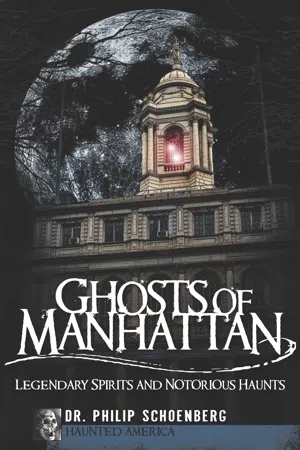
Ghosts abound in Manhattan, and with the aid of Dr. Philip Ernest Schoenberg's extensive guide, you can still hobnob with cultural icons such as Dorothy Parker and Sherwood Anderson or glimpse Harry Houdini's ghost, who is said to haunt the legendary McSorley's. Even the spirits of America's most illustrious leaders, such as George Washington and Teddy Roosevelt, are said to roam Manhattan. This compendium of haunted locales, based on Dr. Schoenberg's own Ghosts of New York Walking Tours, spans the island, from Alexander Hamilton's grave at Trinity Church to the White Horse Tavern, Dylan Thomas's favorite watering hole. Rediscover a city filled with the howls of long-dead slaves in the African Burial Ground and disembodied voices ringing through the Belasco Theatre. Brimming with ghost-hunting tips and spooky lore, this guide is guaranteed to raise hairs.
- 128 pages
- English
- ePUB (mobile friendly)
- Available on iOS & Android
eBook - ePub
About this book
Trusted by 375,005 students
Access to over 1.5 million titles for a fair monthly price.
Study more efficiently using our study tools.
Information
PART I
GUIDE TO KNOWING YOUR GHOSTS
TYPES OF GHOSTLY ENCOUNTERS
Ghostly encounters can take the form of sound, sight, smell, touch, feeling, temperature and/or movement:
1. Visual or sight: a view of an entire being in real time or an orb, an unexplained source of light, which appears in a photograph. We now have YouTube to highlight the more dramatic encounters, while “orbs” are often spotted on photographs. Poltergeist activity such as the movement of an object without any visible force can be documented.
2. Auditory or sound: people hear a noise of some kind. Sometimes, this can be caught as an electronic voice phenomenon (EVP) on a sound recording device. At the same time, these sounds can be manufactured to fake the presence of ghosts. Some people have heard whistles.
3. Olfactory or smell: one can smell perfume, cologne, tobacco or burnt hair or flesh.
4. Tactile or touch: people can touch something.
5. Kinesthetic: One carries out a physical activity. For example, a person is possessed by the spirit or engage in automatic handwriting of some kind.
6. Feeling: people feel uneasy around places such as the scene of an accident, a fire or fatality. Oftentimes, pets (especially cats and dogs) seem to be sensitive to the presence of spirits.
7. Temperature: sudden decrease or increase of temperature or the feeling of a cold or warm spot.
WHERE YOU ARE LIKELY TO FIND GHOSTS
1. Where bodies have physically been buried: graveyards and churchyards. Religions have different conceptions of what happens to the deceased. Those of the Jewish faith believe that the body together with the soul will be physically resurrected. Christians and Muslims believe that the soul will be resurrected. Buddhists, Hindus and Sikhs believe in reincarnation. Peter Stuyvesant does his haunting around the family mausoleum at St. Mark’s Church in the Bowery (after his mansion burned down).
2. Modern parks: many former burial spaces have been turned into green spaces with the deceased left in place. Washington Square Park, a former burial place for the poor, is ghost central in New York City. Greenwood Cemetery was designed to serve as a park for the living.
3. Where natural or unnatural deaths occurred but people are not buried. Sometimes disturbing the scene will stop ghostly phenomena or solving the crime will give the ghost rest. Once McGurk’s Suicide Hall at 295 Bowery was torn down, the ghosts stopped haunting there.
4. Where people lived or worked: Edgar Allan Poe is reported at many locations at the same time: Baltimore, Richmond, Philadelphia, Boston and New York (Manhattan and the Bronx). Occasionally pets seem to be sensitive to ghostly visitors. People who have lived inside the apartments of St. Mark’s Church in the Bowery have reported that their pet cats or dogs refuse to enter certain areas unless they are there.
5. Where people played: abandoned sports facilities, amusement parks and other places where people went to enjoy themselves. The New York Giants have failed to win the World Series since they moved to California to become the San Francisco Giants in 1957. Also, the memorial plaque of Edward L. Grant, the first baseball major leaguer to die in World War I, has disappeared from the Polo Grounds.
6. Where people drink alcohol: bars, inns and drinking establishments are most popular. McSorley’s Old Ale House is where a variety of ghosts can be found.
7. Where people go for entertainment: theatres are popular places for ghosts to haunt or entertain. Judy Garland was channeled by psychic Elizabeth Barton at the Palace Theatre. Barton claimed that the theatre had more than one hundred ghosts reporting for guest haunts.
8. Where people travel: subway and railroad stations. Grand Central has its share of ghosts. Locomotion appears to attract some ghosts. In more recent times, people have reported giving rides to passengers who have disappeared or when they go back to check the drop off point, they discover they once were at the location but are long dead. Staircases and elevators also appear to attract ghosts.
HOW IS THE VALUE OF A HOUSE AFFECTED BY THE PRESENCE OF A HAUNTING?
We simply have no hard statistics. Some people welcome the presence of a ghost as a conversation piece, a way to make friends or to scare off burglars and other intruders. Others see ghosts as pests that disturb them, their friends and the surrounding neighborhood. Depending on the individual state law, you may or may not have an obligation to say whether or not there is a ghost. In the case of the mansion at 19 Gramercy Park South, its value has gone up the more haunted it has become. Over the years, the house has proved to be a successful real estate investment. Benjamin Sonnenberg paid $89,000 in 1945. Richard Tyler and his wife Lisa Trafficante paid $9,500,00 in 1995 and sold it for $19,000,000 in 2000.
THE TEN MOST POPULAR GHOSTS OF NEW YORK CITY
In terms of the frequency of reports over a period of time, there are many popular ghosts in New York City.
1. Most appearances by a single ghost: Edgar Allan Poe has been reported in several New York locations and several other cities at the same time. He has been reported as a ghost in Baltimore, Boston, Philadelphia and Richmond.
2. Most reported family of ghosts: the five Tredwell sisters sadly all haunt separately at the Merchant House.
3. Peter Stuyvesant is the oldest ghost in the city, with the most reports over a period of time.
4. David Belasco haunts several locations inside the Belasco Theatre, named after him.
5. Olive Thomas is a well-known spectral presence in the New Amsterdam Theatre.
6. Samuel Clemens appears as a specter at 14 West Tenth Street.
7. People report being spooked by Mrs. Eliza Jumel at the Morris Jumel Mansion.
8. Aaron Burr has been spotted at Battery Park and elsewhere in Manhattan.
9. Burr’s daughter Theodosia has been reported up to ghostly mischief at One if by Land, Two if by Sea Restaurant at 17 Barrow Street in the West Village.
10. Washington Irving has been reported at his home in Upstate New York as well as a few locations in Manhattan such as the Colonnade.
HOW TO GET RID OF GHOSTS
1. Physical destruction of the site, although this does not always work. When Stuyvesant’s mansion burned down in 1744, he moved his haunting to the Stuyvesant family mausoleum. Edgar Allan Poe no longer haunts at 85 West Third Street once NYU destroyed his original home.
2. Destruction or removal of the physical remains of the body. Once A.T. Stewart’s body was moved from a secret hiding place near St. Mark’s Church in the Bowery to the Episcopal cathedral in Garden City, he stopped haunting.
3. A séance is an encounter or meeting at which a spiritualist or a medium attempts to communicate with the spirits of the dead. The word “séance” comes from the French word for “seat,” “session” or “sitting” and from the Old French word seoir, “to sit.” Hans Holzer, through a medium, would chat with the spirit, find out what the problem was and try to solve it. If Holzer was successful, the supernatural activities would come to an end since the spirit was at rest. Such psychoanalysis might take several séances.
4. Exorcism (from the Latin word exorcismus, from the Greek word exorkizein, to abjure) is the practice of evicting demons or other spiritual entities from a person or place that they are believed to have possessed. An exorcist is the person called upon to perform this ceremony through prayer, ritual, formula or through some other means such as an angel or an amulet. Dr. Joseph Green Cogswell performed a secular exorcism at the Astor Library after he encountered Austin Sands.
5. Solving the problem that causes the ghost to haunt.
6. Simply informing the ghost that he or she is deceased! Sometimes, they don’t know they are dead.
7. Suggesting to the ghost a better place to haunt.
8. Simply asking the ghost to leave or stop haunting.
9. Perhaps welcome the ghost as a friend.
10. Move away from the haunted location. When the New York Times moved uptown in 1904, the newspaper left its resident ghost behind.
DOCUMENTATION
When it comes to ghosts, we have to rely on various sources, from hearsay and legend to eyewitness testimony and photographs. There are people who hide in the shadows as “anonymous,” and others like George Templeton Strong (noted diarist, lawyer and former mayor of New York), who relates a few ghost tales in his diary entries. Some are firsthand accounts based on an immediate experience, while others are warmed-over legends repeated without any effort at accuracy whatsoever. Some accounts are immediately broadcast through newspaper interviews, while others have to be ferreted out from obscure entries in diaries long after their authors have turned into dust.
Some places have the number of ghosts there hyped up or claim a link to a deceased writer without any basis in fact. Newspapers in the nineteenth century loved to report on the presence of ghosts. For example, many articles and guides repeat the claim that the “most haunted” house in the city is the townhouse at 14 West Tenth Street. They claim Samuel Clemens among its twenty-two ghostly denizens, but only a spectral appearance of Samuel Clemens has really been documented.
There is a plaque at 120 East Seventeenth Street and 49 Irving Place that claims that Irving lived there. Irving did visit a nephew there but never stayed overnight or did any writing there.
Someone claimed to be living at a building containing the former stables of Governor George Clinton in the West 40s. When I tried to find an exact address, I discovered that the governor died ten years earlier than the time during which his presence was claimed. He died in Washington, D.C., and was reinterred in his hometown of Kingston, New York. The informant claimed that a ghost unrelated to the governor was doing the haunting. I will discuss this further as “Old Moor” at 420 West Forty-sixth Street.
My purpose in retelling these stories is to present the best-documented cases in the most entertaining fashion possible. Washington Irving declared: “The tongue is the only tool that gets sharper with use.” The book is organized by neighborhood and ghosts in alphabetical order for your convenience. Be forewarned, a ghost may be haunting in more than one neighborhood.
PART II
GHOSTLY NEIGHBORHOODS AND THEIR INHABITANTS
NEW YORK HARBOR
Ellis Island Pirate Ghosts
Ellis Island in the eighteenth century had the nickname of “Gibbet Island” because of all the pirates who swung there courtesy of the British, intent on stamping out piracy. Oyster clammers reported running into the ghosts. Pirates who escaped this fate would steer clear of the island in fear their former buddies would grab them and help them into the next world because misery loves company.
Henry Hudson, the Original “Flying Dutchman”
New York State traditionally has been torn in rivalry between “upstate” and “downstate.” Henry Hudson is both a downstate and an upstate ghost. Henry Hudson, an English explorer working for the Dutch West India Company, was the first European to discover Manhattan Island and the Hudson River in 1609. His discovery of beavers and other fur-bearing animals caused the Dutch to come back to trade with the Indians and settle down to farm the land.
Every twenty years since 1609, Henry Hudson and his crew return to bowl ninepins with the gnomes of the Catskills Mountains. The crash of the pins is heard in the form of thunder. Sometimes this thunder is so loud it can be heard all the way down the Hudson River Valley in New York City. Washington Irving relates how Rip van Winkle encountered Henry Hudson and his crew in a game of ninepins in the story of the same name.

During stormy weather, Captain Henry Hudson may appear on his ship, the Half Moon, riding out a storm in New York Harbor because he is t...
Table of contents
- Front Cover
- Title Page
- Copyright
- Dedication
- Contents
- Foreword, by Lee Gelber
- Introduction
- Part I. Guide to Knowing Your Ghosts
- Part II. Ghostly Neighborhoods and Their Inhabitants
- Appendix 1: Greatest Tellers of Ghost Stories
- Appendix 2: My Favorite Cinematic Ghost Stories
- Ghosts of New York, the Tour
Frequently asked questions
Yes, you can cancel anytime from the Subscription tab in your account settings on the Perlego website. Your subscription will stay active until the end of your current billing period. Learn how to cancel your subscription
No, books cannot be downloaded as external files, such as PDFs, for use outside of Perlego. However, you can download books within the Perlego app for offline reading on mobile or tablet. Learn how to download books offline
Perlego offers two plans: Essential and Complete
- Essential is ideal for learners and professionals who enjoy exploring a wide range of subjects. Access the Essential Library with 800,000+ trusted titles and best-sellers across business, personal growth, and the humanities. Includes unlimited reading time and Standard Read Aloud voice.
- Complete: Perfect for advanced learners and researchers needing full, unrestricted access. Unlock 1.5M+ books across hundreds of subjects, including academic and specialized titles. The Complete Plan also includes advanced features like Premium Read Aloud and Research Assistant.
We are an online textbook subscription service, where you can get access to an entire online library for less than the price of a single book per month. With over 1.5 million books across 990+ topics, we’ve got you covered! Learn about our mission
Look out for the read-aloud symbol on your next book to see if you can listen to it. The read-aloud tool reads text aloud for you, highlighting the text as it is being read. You can pause it, speed it up and slow it down. Learn more about Read Aloud
Yes! You can use the Perlego app on both iOS and Android devices to read anytime, anywhere — even offline. Perfect for commutes or when you’re on the go.
Please note we cannot support devices running on iOS 13 and Android 7 or earlier. Learn more about using the app
Please note we cannot support devices running on iOS 13 and Android 7 or earlier. Learn more about using the app
Yes, you can access Ghosts of Manhattan by Dr. Philip Schoenberg in PDF and/or ePUB format, as well as other popular books in History & North American History. We have over 1.5 million books available in our catalogue for you to explore.