- 160 pages
- English
- ePUB (mobile friendly)
- Available on iOS & Android
eBook - ePub
Haunted Guthrie, Oklahoma
About this book
A Victorian district frozen in time, Guthrie was the first territorial and state capital of Oklahoma, and many of its former residents still wander some of its majestic brick buildings. Outlaws and cultists haunt the infamous Black Jail, the state's first territorial prison. Once a bustling neighborhood, the houses of the overgrown Elbow now stand in ruins. Secrets remain at the famous Masonic Temple shrouded in mystery, and a lonely girl wanders the railroad in search of her beau who never returned home from the Great War. Oklahoma Paranormal Association co-founder Tanya McCoy and Oklahoma historian Jeff Provine invite you to explore these and many more spine-chilling accounts from one of America's most haunted cities.
Trusted by 375,005 students
Access to over 1 million titles for a fair monthly price.
Study more efficiently using our study tools.
Information
CHAPTER 1
SCREAMS FROM THE SHACK
THE STORY OF ELLA MYERS
Along with the need of services for the living like electric lighting and running water, there is also the problem of what to do with those who had died. Life on the prairie was rough, and folks passed away from illness, age and the occasional gunfight. In the country, graves were wherever someone saw fit to bury a fallen relative, but townsfolk needed to be more organized.
An initial cemetery was established on a plat in space shared with the soon-to-be-built school. This must have made youngsters nervous, but they gained some respite when the new cemetery was soon found to be too small and bodies were moved far outside of town to the north, the site of today’s Summit View Cemetery.
Yet Frank Greer noted in the Oklahoma State Capital in 1889 and again in 1905 that not all of the graves were found. In the early days of Guthrie, few had access to fancy headstones, so most of the grave sites were marked with humble wooden crosses or a flat rock. It would take only a windstorm or two to fell the crosses and cover up the rocks. As workers transported bodies, anyone would agree that they missed a few. Rumors of bodies under the school have spawned any number of urban legends about haunts in the halls through the years.
Guthrie’s earliest ghost story, and one of its most gripping, comes from a satellite cemetery established on the west side of town. Unlike the larger municipal cemetery on the hilltop, this was near the creek, an area that an editorial in the Guthrie Daily Leader called “a marsh on the Cottonwood.” Poor folks who could not afford a serious funeral, and those who did not even have the notoriety to be interred at “Boot Hill” at Summit View, found a budget resting place there. One patron, it seemed, did not take the mistreatment lying down.
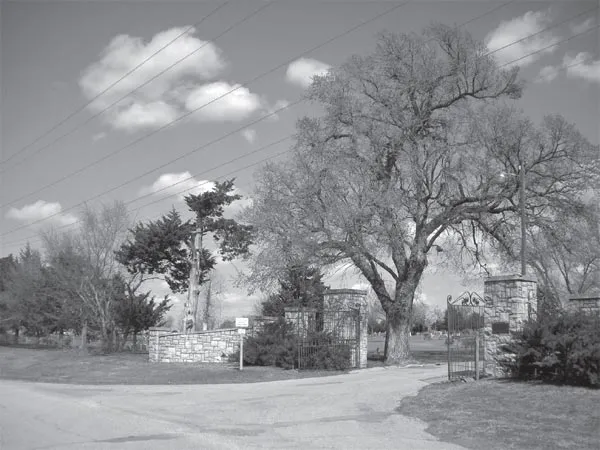
The welcoming entrance to Summit View Cemetery.
In the April 8, 1896 edition of the Guthrie Daily Leader, in the “City in Brief” columns between reports of which town notable was traveling to Chandler and who was returning from Fort Worth, there is a humble three-line obituary: “Ella Myers, inmate of Ella Huston’s place on the Santa Fe right of way, was found dead in bed Sunday morning. Her death was due to an overdose of cocaine.”
Legend fills in the gaps of the story. Ella Myers was a prostitute in the employ of Ella Huston, who owned a shack with a few rooms on the west side of town near the Santa Fe railroad. Locals and those stopping by on the train knew it to be a place for a cheap thrill. Like many madams, Ella Huston kept girls in their line of work through various means of control. According to rumor, young Ella Myers was addicted to cocaine, which, although quite legal in 1896, was a very expensive habit. Few would have seen the overdose as much more than a pitiable tragedy.
Across the columns of the Leader, however, a report digs deeper into the issue by posing the question, “Was She Buried Alive?” The article refers to Ella Myers the “cyprian” (the Victorian way of avoiding the word “prostitute” in polite print), who died a “strange and sudden death.” Some say that a quick autopsy by the city coroner proved the cocaine overdose, but the article maintained, “No one knows positively what caused the woman’s death and no inquest was held over the remains.” Instead, “within a few hours after the woman’s supposed death, the body was thrown into a box.” She was then buried in the pauper’s cemetery, not far from the railroad crossing.
Despite the assurances from Commissioner Stapleton that the girl was clearly dead and the hastiness was only in the best interest of civic health, the Leader argued, “Two reputable physicians asserted yesterday that the girl was buried alive.” It stated, “A speedy investigation is needed here,” but the cry fell on deaf ears.
The mystery of the actual events of the fateful night of Miss Myers’s passing only grew. Ella Huston quickly left the house and locked it up. She disappears from the newspaper’s narrative, along with James Whitman, “the man who was with the Myers girl the night she is supposed to have died [who] has not been seen since the burial.” Whispers around town suggested foul play, and some even believed Whitman was the scapegoat for a more prominent official.
Even though the shack stood empty, strange things began to happen there. At night, the sound of wailing came, sometimes softly, sometimes so loudly that it could be heard down the block. The Leader says some “twenty-five to thirty persons” came out of curiosity to see what was making such noise. Various phantoms, disembodied howls and even floating objects infested the shack. One of the few named visitors, Kickapoo Charley, looked in on the night of Thursday, April 16 and “saw an apparition.” The shock proved so much he fainted. Days later in the paper, it noted he “has been ill ever since.”
One Guthrian, man-about-town George Hardie, was skeptical about the whole thing. He determined that the story was “a supreme josh” and meant to find out how the pranksters were pulling their joke. On Friday, April 17, he approached the house at night during the prime time for activity, planning to catch someone in the act of noise-making.
According to the Guthrie Daily Leader, Hardie “found the front door locked. Going to the back door, it was found locked and bolted.” He went back around to the front door, tried to open it again and soon gave up. The house was secured, just as everyone had said.
Hardie had just turned away when suddenly a mournful wail began. It tore through the quiet night and “assailed his ears.” What had been a lonely, locked shack had suddenly filled with eerie activity.
A moment after the moan sounded, the front door “slowly swung open.”
This was a point where most men would have turned in the investigation and congratulated pranksters from afar, but Hardie was resilient, “although badly rattled,” according to the Leader. He crept into the house and explored until he came to Ella’s room, where the bed she had died in still sat.
There, out of the darkness, something hit him with “four sharp raps on the head.” Recoiling, Hardie couldn’t find anyone standing beside him. The darkness gave way to a bright light, “resembling a calcium ray,” that flashed across the ceiling. Out of it, a “blood-red hand clutching a bottle” descended into the room. The vision and the attack were ample evidence for Hardie to give up his belief in pranksters. He rushed out of the shack and humbly confessed his entire experience to the newspaper.
The supernatural noise only grew as the week wore on. The Leader noted that many of the “shacks in the vicinity of the haunted dwelling have been vacated.” Other neighbors, however, had nowhere to go, and so they stayed and witnessed the howling shack grow louder and more terrifying night by night.
By April 19, the story was front-page material: “The ghost of Ella Myers continues to walk with uncanny tread at the erstwhile dive at the Santa Fe right-of-way.” The article details a frightening picture. At midnight on April 18, the two doors of the little shack burst open, all at once and without any sign of human hands. Neighbors startled by the noise went to investigate, finding “a figure, clad in white” at the windows. Although she was seen as a ghostly woman, the spectators could describe little more than her standing. The sounds that accompanied the strange appearance, however, were vivid.
Groans rattled the night, just as they had for more than a week. Among the howling noise this time, a “plaintive wail” called out the same clear words, “Don’t give me any morphine. I am sick.”
The ghostly line came three times that night, and everyone agreed about what was said. Were these the final words of a poor addict? Some thought that it was a last-ditch effort to use the opiate to prevent Ella’s death from cocaine overdose. Others nodded along with more sinister rumors that the morphine was the actual cause of death and someone gave it to her as part of covering up his or her misdeeds.
With such ghostly turmoil plaguing the town, citizens began demanding answers. Something was keeping Ella Myers from resting in peace, and the strongest voice of opinion turned on the burial practices at the cemetery. The Leader itself asked, “Is her body buried upside-down?” Such an indecent burial would surely cause a spirit to roam. More and more residents insisted that opening the hurriedly buried body would reveal the truth.
Guthrie police, however, were uneasy about opening the grave. They worried that whoever opened the coffin would find the body “distorted and twisted,” following the belief that she was, perhaps, buried alive. They also voiced concern that the African American grave keeper and her family who operated the cemetery would become personally haunted by the increasingly violent ghost.
The matter was finally settled when Ella’s half brother, H.M. Myers, arrived from Kansas. He had learned of Ella’s death through the Leader’s interstate reprints and arrived on the train to her rescue. As next of kin, he was allowed to exhume the body on April 23. Nerves throughout the town were settled when the box was found without any telltale scratch marks of live burial. Myers took her out of the town and had her reburied in Mulhall Cemetery.
The shack went quiet. Ella seemed pacified now that her body had been taken out of the pauper’s cemetery. Many Guthrians took that as the source of Ella’s stirring: the grave was simply unfit for her. A Leader editorial agreed, “A man who would place a dead body in that soggy plat of ground is devoid of all the merciful, humane feelings which go to make up a man…About twice a year the river rises and overflows the graves—and we drink the water.”
Yet the Leader posed a different suggestion: “The girl was not only buried alive…in the rough box face downward, but since the recent comment regarding her burial, interested parties secretly disinterred the remains and placed them in their natural position.” The spirit came to rest because whatever wrongs had been done to the body were righted, even if those who did it were quiet about it. Perhaps a little decent treatment was all that Ella wanted.
CHAPTER 2
A THING OF FLESH AND BLOOD
STATE CAPITAL COMPANY BUILDING
The Foucart-designed three-story brick building at the corner of Harrison Avenue and Second Street is often confused by visitors to Guthrie for the old state capitol, namely because it has “Oklahoma State Capital” printed all over it in big letters. Rather than serving the early state legislature, it was actually the office for, in many ways, the legislature’s arch-nemesis, Frank Greer, editor of the Oklahoma State Capital newspaper.
Greer was born in Leavenworth, Kansas, in 1862, the youngest son of a Union army captain. His father died when Frank was young, and the Greer boys left home to work. Frank began as a delivery boy at his brother Edwin’s newspaper, the Winfield Courier. Young Greer climbed through the ranks at a dizzying pace to reporter and then to managing editor. He was infamous for writing more copy in his articles than there was space on the page and constantly had to be roped in.
Frank had bought an interest in the paper, but as the opening of the Unassigned Lands approached, he had aspirations of starting his own. With Edwin’s blessing, he sold his interest back and prepared to cover a whole new territory with the Oklahoma Capital. The paper launched in April 1889, even before the land was opened. It proved a cunning business measure, since it was passed out to many of the people preparing to make the Run and gave them a tip on whom to hire for their news.
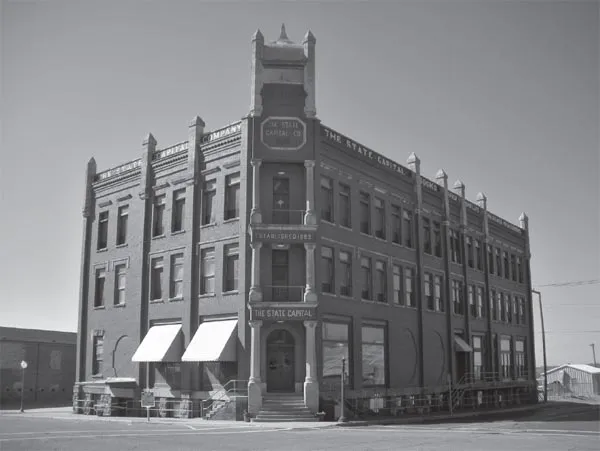
The center of Greer’s State Capital publishing house.
Using the name “Capital” was perhaps ostentatious, especially since Oklahoma was not yet even a formal district, much less a territory in need of a capital. Yet Greer was a man of unbounded vision, and he would not let a simple thing like the nonexistence of a town keep him from publishing a paper for it. The first issues of the Oklahoma Capital came off borrowed machines in Winfield while newly married, twenty-seven-year-old Greer went to cover the Land Run firsthand.
Like many settlers in Guthrie, Greer rode the train into the Unassigned Lands. Unlike most of them, Greer came a little earlier than the noon gunshot. According to his letters written much after the fact, Greer and a pal stowed away on a freight train passing through the empty lands, which were under patrol by soldiers to ensure no Sooner sneaked in under the moonlight and received an unfair advantage. When the train arrived in Guthrie, the pair jumped out and ran into the woods down in Cottonwood Creek. They camped out and hid there until 12:10 p.m. the next day, as the trains for the Run were arriving. Greer then crossed town and staked a claim of his own toward the east.
There has been plenty of argument about whether Greer himself was a Sooner, a term he used often with grating disgust in his editorials, targeting citizens of Oklahoma City and Kingfisher. Greer defended his actions as wanting to get to the scene of the land before the Run, which could make for comparative journalism. There were plenty of people quick to exploit any potential fault in Greer’s career, just as there was a legion of Guthrians who eagerly followed his every energetic word in his articles.
After the Run had settled, Greer printed his first hometown edition on May 12 out of a tent. He later moved into a wooden building, which prompted him to expand his run with a second-hand press. While he was walking the streets awaiting the press to arrive by train, Greer came across O.H. Richards, who had served with him in Winfield as circulation editor. The meeting was a shocking coincidence, and Greer offered Richards a position on the spot. Richards’s first job at the newspaper was helping to unload and assemble the new press.
Richards proved to be a talented ally. In a city without streets, much less addresses, he devised a method of ensuring people received their papers. Each subscription came with a six-by six-inch card with a stark “C” standing out on it. Settlers could hang their cards on a pole or pin them to their tents; whatever worked as long as they were visible to the boys running to make their deliveries.
While Guthrie would always remain at the center of Greer’s heart, he also sought to expand his business. He recalled in his letters, “Arthur Locke and I took a trip to Oklahoma City three days [after the Run] with about 200 copies of the paper. Its name led the people of that town to think that the State Capital had been printed in Oklahoma City. At that time no paper had been printed there.”
Just as Guthrie appeared overnight, so did a half dozen other papers. In November 1889, just seven months after the Run, Edna Swartout wrote, “We have four daily and five weekly papers here now. Some newspapers are competing for news.” Greer quickly gobbled up his earliest rival, the original hometown paper in Guthrie, the Guthrie Get Up, first published April 27, 1889. Then came more dailies competing with the Capital, including the News, the Herald and the Optic. Greer’s powerful editorial stance and charisma throughout the town kept his paper on top, not to mention the flow of national and international news from his brother’s paper arriving “print-ready.”
There was one nut that Greer found impossible to crack: the Guthrie Daily Leader, which took up the minority status in Guthrie as the Democratic voice to Greer’s booming Republican one. Judge Frank Dale founded the Leader in 1892 specifically as a rival to Greer. What Greer criticized, the Leader championed and vice-versa. In 1894, the pa...
Table of contents
- Front Cover
- Title Page
- Copyright
- Dedication
- Contents
- Preface
- Acknowledgements
- Introduction. Guthrie’s Lingering Past
- 1. Screams from the Shack
- 2. A Thing of Flesh and Blood
- 3. Abandoned
- 4. The Girls Upstairs
- 5. Miss Kate’s Room
- 6. The Basement
- 7. Harvey Girls
- 8. The Black Jail
- 9. The Outlaw Who Would Never Be Captured Alive
- 10. All the World’s a Stage
- 11. The Banker and the Barber
- 12. Can You Find Me?
- 13. Brotherhood
- 14. Spirits of Charity
- 15. Taffeta
- 16. The Homefront
- 17. Hospital on the Hill
- 18. Beneath the Streets
- 19. Truly Haunted House
- Bibliography
- About the Authors
Frequently asked questions
Yes, you can cancel anytime from the Subscription tab in your account settings on the Perlego website. Your subscription will stay active until the end of your current billing period. Learn how to cancel your subscription
No, books cannot be downloaded as external files, such as PDFs, for use outside of Perlego. However, you can download books within the Perlego app for offline reading on mobile or tablet. Learn how to download books offline
Perlego offers two plans: Essential and Complete
- Essential is ideal for learners and professionals who enjoy exploring a wide range of subjects. Access the Essential Library with 800,000+ trusted titles and best-sellers across business, personal growth, and the humanities. Includes unlimited reading time and Standard Read Aloud voice.
- Complete: Perfect for advanced learners and researchers needing full, unrestricted access. Unlock 1.4M+ books across hundreds of subjects, including academic and specialized titles. The Complete Plan also includes advanced features like Premium Read Aloud and Research Assistant.
We are an online textbook subscription service, where you can get access to an entire online library for less than the price of a single book per month. With over 1 million books across 990+ topics, we’ve got you covered! Learn about our mission
Look out for the read-aloud symbol on your next book to see if you can listen to it. The read-aloud tool reads text aloud for you, highlighting the text as it is being read. You can pause it, speed it up and slow it down. Learn more about Read Aloud
Yes! You can use the Perlego app on both iOS and Android devices to read anytime, anywhere — even offline. Perfect for commutes or when you’re on the go.
Please note we cannot support devices running on iOS 13 and Android 7 or earlier. Learn more about using the app
Please note we cannot support devices running on iOS 13 and Android 7 or earlier. Learn more about using the app
Yes, you can access Haunted Guthrie, Oklahoma by Tanya McCoy,Jeff Provine in PDF and/or ePUB format, as well as other popular books in History & North American History. We have over one million books available in our catalogue for you to explore.