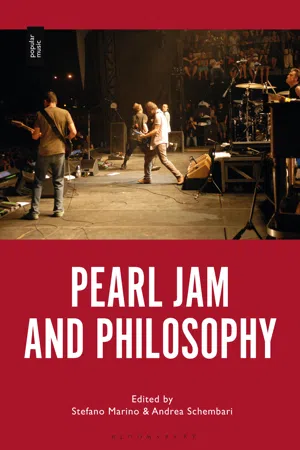
eBook - ePub
Pearl Jam and Philosophy
- 280 pages
- English
- ePUB (mobile friendly)
- Available on iOS & Android
eBook - ePub
Pearl Jam and Philosophy
About this book
The first scholarly discussion on the band, Pearl Jam and Philosophy examines both the songs (music and lyrics) and the activities (live performances, political commitments) of one of the most celebrated and charismatic rock bands of the last 30 years. The book investigates the philosophical aspects of their music at various levels: existential, spiritual, ethical, political, metaphysical and aesthetic. This philosophical interpretation is also dependent on the application of textual and poetic analysis: the interdisciplinary volume puts philosophical aspects of the band's lyrics in close dialogue with 19th- and 20th-century European and American poetry. Through this widespread philosophical examination, the book further looks into the band's immense popularity and commercial success, their deeply loyal fanbase and genuine sense of community surrounding their music, and the pivotal place the band holds within popular music and contemporary culture.
Information
1
Contingency, (In)significance, and the All-Encompassing Trip: Pearl Jam and the Question of the Meaning of Life
Stefano Marino
For Valeria, with love: for our Pearl Jam concert in Milano, June 22, 2000.
For Emi and Simo, with friendship: for the hundreds of times that we listened together to “State of Love and Trust.”
Introduction: Interpretations and constellations
As has already been explained in the final paragraphs of the Introduction to this book, the essays collected in the present volume—including this essay—aim to offer interpretations of what we may call the “philosophy of Pearl Jam.” And, as has already been said, a philosophical enterprise of this kind should not be understood as the search for systematic unity and absolute coherence in the lyrics of the songs of Pearl Jam from Ten to Gigaton, but rather as the attempt to construct something like a figure in which certain concepts enter into a constellation (following here some insights on philosophical interpretation provided by Theodor W. Adorno). In the specific case of the present contribution on the “philosophy of Pearl Jam,” the constellation that I will try to construct is formed by such concepts as contingency, (in)significance, the question of the meaning of life, and the idea of the all-encompassing. This conceptual constellation orbits around the question concerning questioning itself, and we will see that it ultimately leads in the direction of a way of thinking that promises a post-metaphysical rehabilitation of the dimension of time: what Eddie Vedder and Pearl Jam, according to my interpretation, have invoked in their music as the present tense.
The all-encompassing trip: Existential, historical, and metaphysical implications
“Are we getting something out of this all-encompassing trip?”1 This is the looming question posed by Pearl Jam in “Present Tense,” perhaps the most explicitly philosophical song in a catalogue that is abundant with songs rich in philosophical questions. In fact, in a previous song, “Garden,” Pearl Jam had suggested precisely that their intention was not to question the meaning of human existence as such. My interpretation of the lines “I don’t question / Our existence / I just question / Our modern needs”2 is that they limit themselves to questioning the needs and values of human beings who live in increasingly reified and commodified societies, ones that favor the adoption of an unnatural and artificial way of life: namely, in societies in which apparently (and needlessly) it has become harder to “find an approach and a way to live.”3
However, what apparently emerges from the third line of “Present Tense” is a broader and more ambitious proposition than a simple question concerning our modern needs. It is a more totalizing question (“I don’t know anything, I question everything,”4 as Pearl Jam also sing in a recent song) and, above all, it is a genuinely existential question, i.e., something that directly questions our existence and dares to pose the very question of the meaning of life. We could venture a philosophical comparison here: first, to relate the fundamental question of “Present Tense” to Martin Heidegger’s Being and Time, with its radical way of formulating “the question of the meaning of being” by starting from the “guiding look at being [that] grows out of the average understanding of being in which we are always already involved and which ultimately belongs to the essential constitution of Da-sein itself.”5 And second, to connect the more limited question of “Garden” to Hans-Georg Gadamer’s Truth and Method, with its less radical and more “urbanized” version of philosophical hermeneutics, one that shifts attention from the question of the meaning of being in all its vastness to the more limited question concerning the significance of the humanist tradition in the increasingly disenchanted techno-scientific civilization of the present.6
The question about getting something out of the all-encompassing trip of life is undoubtedly a very deep one, which explicitly addresses existential problems but which is also potentially rich in philosophical-historical or metaphysical implications. A lot depends, among other things, on the way in which one understands the concept of the all-encompassing trip. If we understand it as referring to the life of an individual, then it is easy to interpret the question as focused on whether or not our singular life, the individual life of each and every one of us, appears to have some meaning or not, i.e., appears as meaningful or meaningless to he/she who is living it. From this point of view, as I said, the question raised in “Present Tense” can be summarized and briefly defined as the question concerning the meaning of life. The question formulated in these very simple terms might perhaps fall prey to the objection of a certain naivety, but it is one that a rigorous philosopher like Theodor W. Adorno nevertheless recognized in the mid-1960s as one of those fundamental questions that lead human beings to philosophize, even in an age of disillusion and nihilism like ours: “[t]he metaphysical categories live on, secularized, in … the question of the meaning of life.”7
However, we can also understand the all-encompassing trip as metaphorically referring to the wholeness of human history from its inception to the present age, or even as referring to what we may call “the totality of existent things (das Ganze des Seienden).”8 After all, the encompassing (or the embracing: das Umgreifende) was precisely the concept coined by Karl Jaspers to designate reality as a whole in its fullness and richness, i.e., the ultimate experienceable horizon, which is surely hard to describe in its essence and to conceptualize—even to the extent of being ineffable and unspeakable—but which we nevertheless know as a real presence and by which we feel constantly surrounded.9 If so, then it becomes clear that the question asked by Pearl Jam in “Present Tense” can be interpreted not only in an existential way, strictly focusing on the meaning of our individual lives, but also in a philosophical-historical way, or even in a metaphysical way: namely as an ambitious question, focused on whether human history in its entirety, or even being in its totality, has any meaning.
Are we learning something about this immense journey? What are the conditions and limits, and above all what is the meaning, of the life of human beings in this world, i.e., of our “being-in-the-world”? How did this all-encompassing trip start and where will it lead us? We are the “first mammal[s] to wear pants,” of course, but can we “do the evolution”?10 Or are evolution and progress only ideologies and illusions, and our lives (both as individuals and as humankind) directionless and meaningless? As critical philosophers of history like Walter Benjamin and Theodor W. Adorno suggest, we should proba...
Table of contents
- Cover
- Half-Title Page
- Title Page
- Contents
- Foreword
- Introduction
- 1 Contingency, (In)significance, and the All-Encompassing Trip: Pearl Jam and the Question of the Meaning of Life
- 2 “Just Like Innocence”: Pearl Jam and the (Re)Discovery of Hope
- 3 Who’s the Elderly Band Behind the Counter in a Small Town?
- 4 Making a Choice When There Is No “Better Man”
- 5 That’s Where We’re Living: Determinism and Free Will in “Unthought Known”
- 6 No Code Aesthetics
- 7 Can Truth Be Found in the Wild?
- 8 “They Can Buy, But Can’t Put On My Clothes”: Pearl Jam, Grunge, and Subcultural Authenticity in a Postmodern Fashion Climate
- 9 Pearl Jam’s Ghosts: The Ethical Claim Made From the Exiled Space(s) of Homelessness and War—An Aesthetic Response-Ability
- 10 Pearl Jam: Responsible Music or the Tragedy of Culture?
- 11 Pearl Jam/Nirvana: A Dialectical Vortex that Revolves Around the Void
- 12 The Tide on the Shell: Pearl Jam and the Aquatic Allegories of Existence
- Notes on Contributors
- Copyright Notices
- Index
- Copyright
Trusted by 375,005 students
Access to over 1.5 million titles for a fair monthly price.
Study more efficiently using our study tools.
Frequently asked questions
Yes, you can cancel anytime from the Subscription tab in your account settings on the Perlego website. Your subscription will stay active until the end of your current billing period. Learn how to cancel your subscription
No, books cannot be downloaded as external files, such as PDFs, for use outside of Perlego. However, you can download books within the Perlego app for offline reading on mobile or tablet. Learn how to download books offline
Perlego offers two plans: Essential and Complete
- Essential is ideal for learners and professionals who enjoy exploring a wide range of subjects. Access the Essential Library with 800,000+ trusted titles and best-sellers across business, personal growth, and the humanities. Includes unlimited reading time and Standard Read Aloud voice.
- Complete: Perfect for advanced learners and researchers needing full, unrestricted access. Unlock 1.5M+ books across hundreds of subjects, including academic and specialized titles. The Complete Plan also includes advanced features like Premium Read Aloud and Research Assistant.
We are an online textbook subscription service, where you can get access to an entire online library for less than the price of a single book per month. With over 1.5 million books across 990+ topics, we’ve got you covered! Learn about our mission
Look out for the read-aloud symbol on your next book to see if you can listen to it. The read-aloud tool reads text aloud for you, highlighting the text as it is being read. You can pause it, speed it up and slow it down. Learn more about Read Aloud
Yes! You can use the Perlego app on both iOS and Android devices to read anytime, anywhere — even offline. Perfect for commutes or when you’re on the go.
Please note we cannot support devices running on iOS 13 and Android 7 or earlier. Learn more about using the app
Please note we cannot support devices running on iOS 13 and Android 7 or earlier. Learn more about using the app
Yes, you can access Pearl Jam and Philosophy by Stefano Marino, Andrea Schembari, Stefano Marino,Andrea Schembari in PDF and/or ePUB format, as well as other popular books in Medios de comunicación y artes escénicas & Historia y crítica de la música. We have over 1.5 million books available in our catalogue for you to explore.