The first comprehensive study of Pliny the Elder's economic thought—and its implications for understanding the Roman Empire's constrained innovation and economic growth
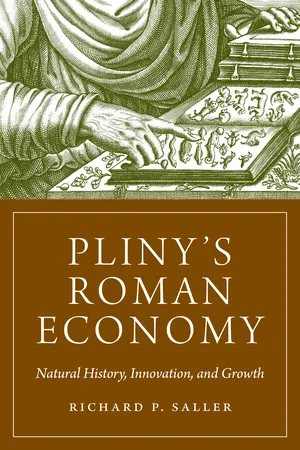
The elder Pliny's Natural History (77 CE), an astonishing compilation of 20,000 "things worth knowing," was avowedly intended to be a repository of ancient Mediterranean knowledge for the use of craftsmen and farmers, but this 37-book, 400,000-word work was too expensive, unwieldy, and impractically organized to be of utilitarian value. Yet, as Richard Saller shows, the Natural History offers more insights into Roman ideas about economic growth than any other ancient source. Pliny's Roman Economy is the first comprehensive study of Pliny's economic thought and its implications for understanding the economy of the Roman Empire.
As Saller reveals, Pliny sometimes anticipates modern economic theory, while at other times his ideas suggest why Rome produced very few major inventions that resulted in sustained economic growth. On one hand, Pliny believed that new knowledge came by accident or divine intervention, not by human initiative; research and development was a foreign concept. When he lists 136 great inventions, they are mostly prehistoric and don't include a single one from Rome—offering a commentary on Roman innovation and displaying a reverence for the past that contrasts with the attitudes of the eighteenth-century encyclopedists credited with contributing to the Industrial Revolution. On the other hand, Pliny shrewdly recognized that Rome's lack of competition from other states suppressed incentives for innovation. Pliny's understanding should be noted because, as Saller shows, recent efforts to use scientific evidence about the ancient climate to measure the Roman economy are flawed.
By exploring Pliny's ideas about discovery, innovation, and growth, Pliny's Roman Economy makes an important new contribution to the ongoing debate about economic growth in ancient Rome.
- 224 pages
- English
- ePUB (mobile friendly)
- Available on iOS & Android
eBook - ePub
About this book
Information
Publisher
Princeton University PressYear
2022Print ISBN
9780691229560
9780691229546
eBook ISBN
9780691229553
1
Proxies for Economic Performance in the Roman Empire
KEITH HOPKINS in a seminal article, “Taxes and Trade in the Roman Empire (200 BC–AD 400),” presented a structural argument for modest growth in the Roman economy, corroborated by proxies implying an increase in “general prosperity.” His proxies—the chronological distribution of shipwrecks and the quantity of coinage—were substitutes for the lack of aggregate statistics for the Roman imperial economy. Over the past four decades these proxies and others have been proposed and critiqued, and despite the criticisms the search for viable proxies to measure the success of the Roman economy has continued. This chapter will summarize the past debate and point to weaknesses in some of the very recent proposals for proxies in support of the more general argument of this book that none of the proxies is reliable enough to justify neglect of literary sources such as Pliny’s Natural History.1
Why have Roman economic historians persisted in trying to identify proxies as indices of aggregate performance despite the criticisms that repeatedly followed? The motives of different historians no doubt vary, but at the heart of the matter is the fundamental question of whether the Roman Empire was benign or oppressive and why it ultimately failed. Was Gibbon right in his famous assertion that “if a man were asked to fix the period in the history of the world, during which the condition of the human race was most happy and prosperous, he would, without hesitation,” point to the years 96 CE to 180 CE.2 Roman conquests were undoubtedly brutal, but did Roman rule also, in the long run, make inhabitants of the empire “safer” and “richer”?3 And if so, how much safer and richer? The level of prosperity of the empire has a bearing on our evaluation of the approaches of New Institutional Economics. Can we demonstrate with proxies that Roman peace, infrastructure, and law had the net effect of continually improving productivity and enriching the population? Or on the other hand, can proxies demonstrate that oppressive Roman institutions eventually put a drag on the economy, as some prominent modern economists have claimed?4 The current optimistic view is that the Pax Romana nurtured sustained growth until the external shock of the Antonine Plague (165 CE) sent that growth trend into reverse. An alternative view is that in the absence of substantial technical breakthroughs to increase per capita productivity the empire could not achieve sustained growth for endogenous reasons. The conclusion of this chapter is that despite the increasing sophistication of the arguments for proxies for growth, the most recent efforts do not hold up to close scrutiny and so do not demonstrate sustained growth up to the Antonine Plague.
Hopkins’s original article, later revised and updated, presented graphs of dated shipwrecks and minted coins in circulation. The graph of shipwrecks peaked sharply in the last two centuries before the common era, declined somewhat in the next two centuries, and then a steep decline set in. The graph of silver coins in circulation, like that of shipwrecks, displayed a steep rise in the second century BCE.5 Hopkins was acutely aware of the limitations of the evidence and his interpretation, acknowledging that “all these arguments, and the evidence from which they are derived, are partial, but they draw strength from their inter-relationship.”6
In the 1990s a set of articles by Hong and colleagues adduced data from environmental science to demonstrate a rise in mining activity. Their measurements of lead pollution frozen in the Greenland ice core showed that anthropogenic lead pollution rose well above natural background levels during the classical period, reaching a peak around the turn of the era. The pollution, it was argued, came primarily from silver mining in Spain in which lead was vaporized in the process of cupellation to refine the ore. The conclusions were based on fourteen sections from the ice core distributed across approximately six hundred years of the Roman Republic and Empire.7 Hopkins later incorporated these findings as an additional proxy for economic performance: “These scientific estimates of ancient pollution and total production give us an unprecedented vision of economic growth and inefficiency in classical antiquity.”8 The data series from Hong and colleagues with fourteen measurements was not sufficiently fine-grained to provide more precise dates for the decline of mining and smelting. Refinement of the data was to come two decades later (see p. 15).
In a much-cited article of 2005, François de Callataÿ summarized the argument from the proxies in the following conclusion:
The convergence of these graphs [showing atmospheric lead pollution, atmospheric copper pollution, and shipwrecks] clarifies an increased activity during the last centuries B.C. and the first three centuries A.D. Of the three, the wrecks is the most spectacular with its peak in the period 200 B.C.–A.D. 200.… Within the margin of a century it is also the one spoken of by J. Andreau when he defined the period of greater prosperity of economic life as being that which runs “du IIe siècle av. J.-C. au premier siècle de l’Empire” [from the second century BCE to the first century of the empire]. While lacking the clarity and precision of that of the wrecks, the charts for lead and copper move in the same direction: they are characterized by significant variations from one measurement to another, which leads us to hope that one day we might possess several complete sets of data spread out over nearly three millennia. For the present, it is wise to resist the temptation to tie such-and-such a high value obtained for such-and-such a year with any known or supposed historical events.9
De Callataÿ’s caution was wise, and his hope for more refined data was soon to be satisfied.
About the same time, Willem Jongman and others pointed to another proxy, based on research by Nobelist Robert Fogel and Dora Costa, who identified stature as an index of human health and well-being.10 In recent centuries populations have grown taller generation by generation as they have grown wealthier, the duration of life has been extended, diets have improved, and many diseases have been brought under control. Jongman in 2007 concluded that “Gibbon was right” based on a study of femur bones excavated by archaeologists: “the rise [in the length of femur bones] is spectacular—the first and early second century peak equates European stature in the early twentieth century. Decline clearly set in in the late second century A.D., to be followed by a recovery later in the third century, and ultimate collapse with the fall of the Western Empire.”11 Whereas the previous studies did not try to tie the proxies to a political history narrative, Jongman’s reference to Gibbon placed the turning point in general prosperity in the late Antonine era with consequences for explanations of exogenous as opposed to endogenous causes. A decade later Jongman reversed his conclusion about the trends in stature and health and offered a different explanation (see p. 19–21).
In 2009, Walter Scheidel and Andrew Wilson engaged in a debate that sharpened the focus on the issues and articulated detailed criticisms of previously suggested proxies. Whereas Hopkins and de Callataÿ had deliberately assigned the timeline of growth and decline in terms too vague to distinguish exogenous from endogenous causes, Scheidel drew attention to the consequences for quite different explanations: “In the most basic terms, we must ask whether Roman economic growth was terminated by endogenous or exogenous factors. Was economic development the result of a limited and unrepeatable improvement in productivity that was gradually offset by population growth …, or was productivity growth theoretically sustainable in the long run but in practice curtailed by shocks to the system such as political or military crises?”12 Of course, the other possible external shock was the Antonine Plague. Scheidel highlighted the weaknesses of each of the proxies as a barometer of productivity growth: the trend in number of shipwrecks was influenced by multiple biases; lead pollution as a measure of silver production need not be related to economic performance as shown by the comparison with early modern Spain; trends in animal bones could reflect changes in taste rather than levels of meat consumption. For these and other reasons,13 the historian should be wary of taking any of these proxies as a reflection of economic performance, but if one does take them seriously, then the appropriate method is to analyze rate of change, not simply to identify the peaks: “Although overall levels of economic performance are by no means irrelevant, from an economic perspective the latter question [rate of change] is of even greater importance.” And “in so far as it is legitimate to put much weight on these observations …, they would seem to suggest that economic expansion stalled sometime around the turn of the era,” not the later second century in the aftermath of the plague.14 That is, the enrichment was a product of conquest and the consolidation of the empire and was not sustainable.
Scheidel then presented a model to show that, based on various plausible assumptions about population growth and imperial expenditures, even a modest, sustained growth rate over a period as long as the Pax Romana makes it hard to understand the strain on imperial finances in the late second and third centuries: “this matrix makes it hard to posit intensive growth of closer to 0.2% than to 0.1% (or indeed even 0%) per year, let alone a higher rate.”15 The article acknowledges increases in the richness of the archaeological record during the centuries of Roman rule but again suggests caution about inferring growth in productivity based on the comparison with early modern Europe when increasing inequality, rather than increasing productivity, produced a lavish material heritage.16 With due circumspection, Scheidel concluded that the hypothesis of a one-off increase in prosperity resulting from the consolidation of Roman rule was more likely than one of sustained growth abruptly halted by the Antonine Plague.
Wilson’s careful response to Scheidel, based on his archaeological expertise, served to underline the uncertainties about several of the proxies (shipwrecks, animal-bone data, and lead pollution).17 As a result, Wilson suggested that even Scheidel’s conditional hypothesis based on taking the proxies seriously should be rejected and that “we are still a long way off the construction of sufficient robust proxies to generate an argument from convergence, though we are making progress.”18 He then proposed other proxies: dated building inscriptions and honorific inscriptions, on the grounds that “the overall spending pattern [on public buildings] may well bear a meaningful relationship to overall economic performance.”19 It seems to me that both of these indicators are vulnerable to the same doubts as others—that is, they were subject to cultural influences as well as economic capacity. In his important article “The Epigraphic Habit in the Roman Empire,” Ramsay MacMullen pointed to the “cultural significance” of erecting inscriptions and warned against the assumption “that the body of all inscriptions against which attestation is measured does not itself rise or fall—a false assumption. So administrative, economic, social, and religious history needs to be rewritten.”20 Apart from changing cultural preferences, increasing inequality of wealth could have influenced the trend.21 In addition, the claim that “large sums” were spent on the public buildings needs to be put in context: J. W. Hanson’s inventory registers an increase in urban monuments from 1,803 to 3,928 over the four centuries from 100 BCE to 300 CE, or an average of about five per year; R. Duncan-Jones’s price lists put the median construction cost of buildings in Italy at 300,000 HS and 43,500 HS in the African provinces—a small fraction of total production, even if the number of monuments and the costs are greatly understated.22 In his 2009 article, Wilson concluded that it is immensely difficult to formulate models that allow an unambiguous choice between hypothese...
Table of contents
- Cover
- Series Page
- Title Page
- Copyright
- Contents
- Preface
- Introduction
- 1. Proxies for Economic Performance in the Roman Empire
- 2. Pliny’s Purpose, Audience, and Method
- 3. Parens Natura and Smithian Growth
- 4. Innovation and Economic Growth in the Natural History
- 5. Pliny’s Economic Observations and Reasoning
- 6. “Utility” and the Afterlife of the Natural History
- Conclusion
- Latin Texts
- Notes
- Bibliography
- Index
- Series List
Trusted by 375,005 students
Access to over 1.5 million titles for a fair monthly price.
Study more efficiently using our study tools.
Frequently asked questions
Yes, you can cancel anytime from the Subscription tab in your account settings on the Perlego website. Your subscription will stay active until the end of your current billing period. Learn how to cancel your subscription
No, books cannot be downloaded as external files, such as PDFs, for use outside of Perlego. However, you can download books within the Perlego app for offline reading on mobile or tablet. Learn how to download books offline
Perlego offers two plans: Essential and Complete
- Essential is ideal for learners and professionals who enjoy exploring a wide range of subjects. Access the Essential Library with 800,000+ trusted titles and best-sellers across business, personal growth, and the humanities. Includes unlimited reading time and Standard Read Aloud voice.
- Complete: Perfect for advanced learners and researchers needing full, unrestricted access. Unlock 1.5M+ books across hundreds of subjects, including academic and specialized titles. The Complete Plan also includes advanced features like Premium Read Aloud and Research Assistant.
We are an online textbook subscription service, where you can get access to an entire online library for less than the price of a single book per month. With over 1.5 million books across 990+ topics, we’ve got you covered! Learn about our mission
Look out for the read-aloud symbol on your next book to see if you can listen to it. The read-aloud tool reads text aloud for you, highlighting the text as it is being read. You can pause it, speed it up and slow it down. Learn more about Read Aloud
Yes! You can use the Perlego app on both iOS and Android devices to read anytime, anywhere — even offline. Perfect for commutes or when you’re on the go.
Please note we cannot support devices running on iOS 13 and Android 7 or earlier. Learn more about using the app
Please note we cannot support devices running on iOS 13 and Android 7 or earlier. Learn more about using the app
Yes, you can access Pliny's Roman Economy by Richard Saller in PDF and/or ePUB format, as well as other popular books in History & Economic History. We have over 1.5 million books available in our catalogue for you to explore.