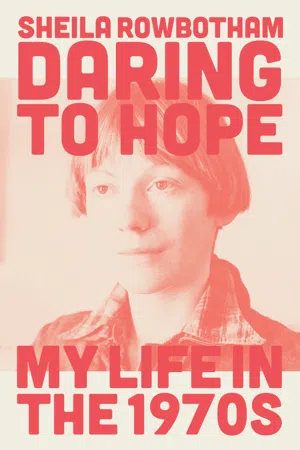
In this powerful memoir Sheila Rowbotham looks back at her life as a participant in the women's liberation movement, left politics and the creative radical culture of a decade in which freedom and equality seemed possible. She reveals the tremendous efforts that were made to transform attitudes and feelings, as well as daily life.
After addressing the first British Women's Liberation Conference at Ruskin College, Oxford in 1970, she went on to encourage night cleaners to unionise, to campaign for nurseries and abortion rights. She played an influential role in discussions of socialist feminist ideas and her books and journalism attracted an international readership.
Written with generosity and humour Daring to Hope recreates grassroots networks, communal houses and squats, bringing alive a shared impetus to organise collectively and to love without jealousy or domination. It conveys the shifts occurring in politics and society through kernels of personal experience. The result is a book about liberation in the widest sense.
- 336 pages
- English
- ePUB (mobile friendly)
- Available on iOS & Android
eBook - ePub
About this book
Information
1
January to June 1970
An unexpected letter dated ‘Horrible Friday’ arrived at 12 Montague Road in Hackney, enthusing about Women’s Liberation and the New Politics. It came from a member of the International Socialism group, David Widgery. Our previous encounters during the late sixties had been scratchy; indeed I had marked him out as an arrogant, dismissive male chauvinist. So how come he was expressing such empathy with my observations on women’s undercover communication through gossip and my conflicted feelings about wearing mascara? Perhaps all was not as it seemed. This was evidently not a normal Trotskyist.
I should have been peering more resolutely through the colourful nude montages of the ‘Underground’ magazine Oz, in which David’s articles appeared. I would then have noticed how David clutched at words for signs the eye often passed over. Impatient with the conventional casings of communication, his appetite for inspiration and ideas was unbounded. I had recoiled at the sardonic, staccato style, but had overlooked a laconic Romantic lyricism that was also there in his rhythmic prose. At the core of both idioms, anger and compassion melled.
The letter was addressed to ‘Dear Shelia’ – David’s spelling was somewhat erratic and especially so with my name. After the beguiling praise came a lightning flash through Wilhelm Reich, William Wordsworth, E.P. Thompson and Raymond Williams, before David, then a medical student, exited with ‘I must go and remove wombs and embryos.’1
Next I was invited to a meal at the flat David rented with his friend Dave Phillips, up several flights of steps at 2 Chapel Market, Islington. David and Dave had met because they had both been in love with the same woman, and had ended up as flat mates because Dave had nowhere to live in London. While David combined his medical studies with vehement literary sputtering in one room, Dave, in the other, was reserved and self-contained, wrestling with a PhD at LSE in which he sought to critique the foundational theories behind social psychology. Despite the contrast in temperament, or perhaps because of it, they became staunch friends. Their shared first name caused confusion, which sometimes led to them being addressed by their surnames; David became ‘Widgery’ or ‘Widg’ while Dave was ‘Phillips’.
The entrance to their flat was in an alleyway by the Salmon and Compass pub. Though the market bustled by day, when I arrived at night it was deserted and somewhat desolate. I am not sure whether I was invited in order to discuss my pamphlet or my departure from the International Socialism group. Nor do I recall what we ate, though I suspect it was something spaghetti-like. But we talked and talked first in the tiny kitchen and then in David’s room, which consisted of book shelves, his bed, a desk and a large, old-fashioned filing cabinet with many small drawers containing crucial thoughts and potentially useful information for future articles. Its brown wood offset David’s bright flowery shirts hanging from a shelf in a corner.
Hours passed, night fell and the last bus had long gone when a chivalric David walked me home to Montague Road and then turned round and walked all the way back to Islington. When I got to know him better I learned that he did not usually opt for six-mile treks. One of his legs had been permanently damaged by childhood polio, leaving him with a limp and a tense refusal of pain – or at least the overt acknowledgement of pain.
In turn I invited him to dinner in the somewhat chaotic communal house where I lived. I had settled in Hackney by chance in 1964 and had bought the house near Dalston Lane two years later. We all paid into a communal fund that covered its running costs but not repairs, which thus tended to be postponed indefinitely. In the late sixties, neighbours called us ‘the hippy house’.
When David came round I was living in the basement in a room with a deep red wall. Though books lined the long white corridor which led to the kitchen, wooden orange boxes – scavenged from our local market, Ridley Road, when I first came to the area – were piled up precariously with the overflow. I had replaced my old purple curtains with some seconds from Ridley Road – William Morris Liberty designs, which, miraculously, have survived.
This time there was less talk, chivalry went out of the window, and as we rolled from bed to the floor I flashed into ecstasy and an intense moment of realization. This was not just a sexy encounter; it was love.
During January 1970 David missed his medical lectures and my research in the British Museum Library stalled. I even stopped updating the journal in which I sporadically chronicled various states of misery. This new wild happiness was far more difficult to express. Only terse notes on scraps of paper hint at how I danced my way into his body and his face wrinkled with pleasure and an elaborate gentleness. Enveloped by his body I felt invulnerable.
Nevertheless I could not evade every aspect of external reality. My material circumstances were precarious. Aware that my advance from Penguin was dwindling and that the Workers’ Educational Association classes I was teaching were coming to an end, I scanned the columns of the Evening Standard and found several small advertisements for night-club hostesses. True, these contrasted with the part-time teaching I had done so far, but at twenty-six I considered myself an adaptable woman of the world well able to pick up new skills. The prospects looked favourable; I could read in the library by day and earn money by night.
My first interview was discouraging – far too old for the job. I tried another telephone number. At the second interview the place looked more seedy, and to my dismay I learned they did not actually pay wages. Earnings depended upon persuading men to buy champagne. This was a serious blow. I have never been any good at persuading anyone to do anything they were not inclined to do. Moreover I was likely to lapse into unconsciousness before I earned any pay at all, since one pint of Tetley’s bitter was my alcohol limit. Remembering old films in which heroines slipped their champagne into convenient pot plants, I looked desperately around. No pot plants. It also occurred to me that going home at two or three in the morning presented a problem. Then there was David. When would we meet if I had to spend my nights plying random men with champagne? That decided it.
Neil Middleton, my editor at Penguin, rescued me from an uncertain fate with an advance on my advance, and by February David and I had managed to disentangle ourselves – during the daytimes at least – so I was back in the British Museum reading about the French women who had participated in the revolutions of the nineteenth century. I was preparing my talk for the first ever British Women’s Liberation Conference, which was due to be held at Ruskin College at the end of the month.
The French historian Edith Thomas had been an exciting revelation. I had come across her account of women in the 1871 Paris Commune, The Women Incendiaries, in translation and been surprised to see that in 1963 she had observed not only that history was largely written by men, but that ‘the history of half the human species, which has almost always been enacted on the fringes of History, raises its own questions, peculiar to itself’.2 I found a copy of her Les femmes de 1848, written as a tribute to women in the French Resistance, in the British Museum Library, and this led me to the newspaper library at Colindale. Travelling there on the Northern line, I used to lower my gaze to examine the big black boots of the police trainees heading off to their Hendon College.
Colindale was a desolate spot, especially in winter, and the library itself emitted a spare austerity, as if to inculcate would-be scholars into the rigours of archival sacrifice. But there, bound in brown leather, to my great delight, I discovered copies of the newspapers the insurgent French women had produced in 1848 demanding social and economic rights for working women.
Even as I was making the long journey from Hackney to Colindale, in my home city of Leeds around thirty thousand clothing workers, mostly women, were going from factory to factory in spontaneous mass pickets bringing workers in the clothing factories out. I was astounded to read of such militant direct action in Leeds. After the National Union of Tailors and Garment Workers had agreed to an increase of 5 (old) pence an hour for women and 6 for men, the Leeds workers rejected this and demanded an extra shilling (12 old pence) for everyone. A pent-up anger against the employers and the trade union had erupted onto the streets, and crowds of women were photographed waving joyfully outside the factories. A small, astute clothing worker, Gertie Roche, along with her husband Jim, played a key role once the unofficial strike began.
I had been introduced to Gertie the previous year at a gathering of the left-wing Institute for Workers’ Control, by my friend Ben Birnbaum, a trade unionist in the clothing industry.3 Born in 1912, Gertie had learned her Marxism in the vast garment factories and the anti-fascist movement of the thirties and had joined the Communist Party. Committed but questioning, she had come to know intellectuals in the CP, including Dorothy and Edward Thompson.
In 1956, after the Soviet leader Nikita Khrushchev’s secret speech denouncing Joseph Stalin and Moscow’s subsequent suppression of the Hungarian uprising, Gertie’s outraged dissidence had resulted in her expulsion from the Communist Party, whereupon she became part of the attempt to create a New Left, in Yorkshire. The Thompsons observed that the Communists had lost many thoughtful working-class members like Gertie in 1956, though predictably it would be mainly the intellectuals who were remembered. As a trade unionist, she identified particularly with women workers, describing herself proudly as a ‘shop stewardess’.4
Gertie was adept at expressing complex ideas in direct language, a skill she shared with Audrey Wise, then an official in the shop workers’ union, and both women inspired many of us in women’s liberation. I had come to know Audrey through Dorothy and Edward, and she, too, used to attend the Institute for Workers’ Control conferences. Audrey was twenty years younger than Gertie and her early political awareness had been shaped by Trotskyism before she became active in the Labour Party. She once told me that Gerry Healy, the bombastic leader of the Trotskyist group, the Socialist Labour League, had admonished her when, as a young woman, she had decided to marry – ‘You’ll be lost to the socialist movement.’ Audrey resolved to prove him wrong and to work out her own political views.
Inspired by the Ford women’s strike at Dagenham for equal grading, from 1968 she had been involved with other trade unionists in the National Joint Action Campaign Committee for Women’s Equal Rights (NJACCWER).
Audrey’s great skill lay in translating assumptions she heard around her into far-reaching aspirations. When I had asked her to write about equal pay in the 1969 issue of Black Dwarf I edited on women’s liberation, she had turned the idea of women’s rights into something much bigger. ‘We must ask ourselves … equality with what? Do men have such idyllic lives that we want the same for ourselves? In a world where people are valued as economic units rather than as people, to be an equal economic unit must not be the height of our ambition.’5 Audrey remarked how women workers often emphasized the importance of human needs at work over pay.6 Instead of dismissing this, she dug down to the radical implications it held.
At our planning meeting in London for the forthcoming Ruskin Women’s Liberation Conference, I pressed for Audrey to be a speaker and for us to reach out to trade union women organizing through NJACCWER. We had no clear idea who exactly would turn up, nor indeed how many.
Over the course of 1969 small groups had been springing up in London, loosely linked through the Women’s Liberation Workshop (WLW), which had acquired an office. Local groups started to send a representative to a central meeting there and we agreed that each of these would take turns in producing our paper, Shrew – an arrangement that worked fine until there were too many of us! We used the term ‘Workshop’ because, like the Ruskin History Workshop and other left cultural groupings who adopted it, we sought a non-hierarchical approach. Reacting against the vanguardism of the small left groups of the time, we wanted everyone to contribute equally and were wary of direction.
Scattered clusters of women’s liberationists had also cohered in several towns and cities, and the Trotskyist-influenced Socialist Woman magazine, based in Nottingham, had appeared. I was in touch with the Leeds Women’s Liberation Group, through a friend from university, Gloden Dallas, who always used to laugh when socialist men asked her how she had ‘recruited’ members. ‘They just appeared’, she would reply. And it was true, groups emerged simply through women talking with one another. While many of us had been affected by left ideas, women also came along because of immediate dissatisfactions in their daily lives. We gathered in one another’s homes, listing addresses and telephone numbers in Shrew or other local publications.
We had heard about ‘consciousness raising’ in the US radical movement and were committed to talking about personal life. This enabled us to explore how we were oppressed and to think through what to do about it. It also helped to secure an atmosphere of mutual trust. No longer isolated, private hurts found collective expression in the small women’s liberation groups. Feelings of inadequacy, and the all-consuming rage that left a sullen exhaustion in its wake, were not simply relieved by being communicated. Startling realizations arose from the fusion of energy that could result.
Initially, consciousness-raising groups seemed to offer an alternative type of politics open to all women. They appeared to me as definitely preferable to either Labour Party or International Socialism meetings, where personal life was allocated to talking in the pub after the ‘official’ meeting ended. However, I wanted to help make material changes as well as alter consciousness. Many women shared a similar impatience, but we were not sure how to combine internal and external transformation.
In 1969 I had joined a women’s group meeting in Islington where we mixed consciousness raising with going about giving talks on women’s liberation and attempting to secure more nursery provision. On returning from my summer holiday I learned that the group, having been forced to move from their regular meeting place, had transferred to my bedroom in Hackney.
During 1970 this group kept growing in numbers and, as new women piled in, we ‘veterans’ found ourselves destined to repeat over and over again what women’s liberation was about. This was frustrating on two counts: ideas could not develop further, and it smacked of a hidden hierarchy in which those ‘in the know’ appeared to resemble the dreaded ‘leaders’. Steeped in the clear certainties of the pamphlets circulating from American women’s liberationists, it took us a while to realize that consciousness raising, rather than being the answer, was simply a different form of organizing which had both strengths and snags. But events were moving faster than theoretical ponderings.
On 26 February, several hundred women converged on Ruskin College, Oxford for our first Women’s Liberation Conference. The weather was cold and we were bundled up in the scraggy fur coats we had rifled from grannies’ mothballed cupboards or bought second hand. Several maxi-length coats were also in evidence, some acquired in Army and Navy surplus stores. Many of us still had long flowing sixties scarves and hair too. But the mood had changed; we were not standing on the sidelines, or on display. A year afterwards, I recalled:
I’d never seen so many women looking so confident before. The night we arrived they kept pouring into Ruskin College with bags and babies. The few men around looked rather like women look at most large predominantly male meetings – rather out on a limb.7
Far more people came than we had anticipated. I recorded around 500, approximately 400 women, sixty children and forty men, but some other estimates put the numbers even higher.
As I sat listening to the introductory session in the familiar hall that evening, I found the reports on groups and activities electrifying. This was unlike any conference I had ever known. It was not just the words I was hearing women say, but how they were expressin...
Table of contents
- Cover Page
- Halftitle Page
- Title Page
- Copyright Page
- Contents
- List of Illustrations
- Acknowledgements
- Introduction
- 1. January to June 1970
- 2. July to December 1970
- 3. 1971
- 4. 1972
- 5. 1973
- 6. 1974
- 7. 1975
- 8. 1976
- 9. 1977
- 10. 1978
- 11. 1979
- Abbreviations
- Notes
- Index of Names
- Index of Organizations
Trusted by 375,005 students
Access to over 1.5 million titles for a fair monthly price.
Study more efficiently using our study tools.
Frequently asked questions
Yes, you can cancel anytime from the Subscription tab in your account settings on the Perlego website. Your subscription will stay active until the end of your current billing period. Learn how to cancel your subscription
No, books cannot be downloaded as external files, such as PDFs, for use outside of Perlego. However, you can download books within the Perlego app for offline reading on mobile or tablet. Learn how to download books offline
Perlego offers two plans: Essential and Complete
- Essential is ideal for learners and professionals who enjoy exploring a wide range of subjects. Access the Essential Library with 800,000+ trusted titles and best-sellers across business, personal growth, and the humanities. Includes unlimited reading time and Standard Read Aloud voice.
- Complete: Perfect for advanced learners and researchers needing full, unrestricted access. Unlock 1.5M+ books across hundreds of subjects, including academic and specialized titles. The Complete Plan also includes advanced features like Premium Read Aloud and Research Assistant.
We are an online textbook subscription service, where you can get access to an entire online library for less than the price of a single book per month. With over 1.5 million books across 990+ topics, we’ve got you covered! Learn about our mission
Look out for the read-aloud symbol on your next book to see if you can listen to it. The read-aloud tool reads text aloud for you, highlighting the text as it is being read. You can pause it, speed it up and slow it down. Learn more about Read Aloud
Yes! You can use the Perlego app on both iOS and Android devices to read anytime, anywhere — even offline. Perfect for commutes or when you’re on the go.
Please note we cannot support devices running on iOS 13 and Android 7 or earlier. Learn more about using the app
Please note we cannot support devices running on iOS 13 and Android 7 or earlier. Learn more about using the app
Yes, you can access Daring to Hope by Sheila Rowbotham in PDF and/or ePUB format, as well as other popular books in Social Sciences & Social Science Biographies. We have over 1.5 million books available in our catalogue for you to explore.