Soil organic matter (SOM) is the primary determinant of soil functionality. Soil organic carbon (SOC) accounts for 50% of the SOM content, accompanied by nitrogen, phosphorus, and a range of macro and micro elements. As a dynamic component, SOM is a source of numerous ecosystem services critical to human well-being and nature conservancy. Important among these goods and services generated by SOM include moderation of climate as a source or sink of atmospheric CO2 and other greenhouse gases, storage and purification of water, a source of energy and habitat for biota (macro, meso, and micro-organisms), a medium for plant growth, cycling of elements (N, P, S, etc.), and generation of net primary productivity (NPP). The quality and quantity of NPP has direct impacts on the food and nutritional security of the growing and increasingly affluent human population.
Soils of agroecosystems are depleted of their SOC reserves in comparison with those of natural ecosystems. The magnitude of depletion depends on land use and the type and severity of degradation. Soils prone to accelerated erosion can be strongly depleted of their SOC reserves, especially those in the surface layer. Therefore, conservation through restorative land use and adoption of recommended management practices to create a positive soil-ecosystem carbon budget can increase carbon stock and soil health.
This volume of Advances in Soil Sciences aims to accomplish the following:
Present impacts of land use and soil management on SOC dynamics
Discuss effects of SOC levels on agronomic productivity and use efficiency of inputs
Detail potential of soil management on the rate and cumulative amount of carbon sequestration in relation to land use and soil/crop management
Deliberate the cause-effect relationship between SOC content and provisioning of some ecosystem services
Relate soil organic carbon stock to soil properties and processes
Establish the relationship between soil organic carbon stock with land and climate
Identify controls of making soil organic carbon stock as a source or sink of CO2
Connect soil organic carbon and carbon sequestration for climate mitigation and adaptation
1 Enhancing Fertilizer Use Efficiency by Managing Soil HealthEmerging Trends
Amit Roy
DOI: 10.1201/9781003102762-1
Contents
List of Abbreviations
1.1 Introduction
1.2 Fertilizers
1.2.1 What Is a Fertilizer?
1.2.1.1 Nitrogen
1.2.1.2 Phosphates
1.2.1.3 Potassium
1.2.2 Use Efficiency of Fertilizers
1.2.3 Options to Improve Fertilizer Use Efficiency
1.2.3.1 Product
1.2.3.2 Practice
1.2.3.3 Policy
1.3 Soils
1.3.1 Conservation Agriculture
1.3.2 Integrated Soil Fertility Management
1.4 Africa and Integrated Soil Fertility Management
1.5 Fertilizer Policies and Nutrient Use Efficiency
1.6 Conclusions
References
List of Abbreviations
B:
Boron
CA:
Conservation agriculture
Cl:
Chlorine
Cu:
Copper
DAP:
Diammonium phosphate
FAO:
Food and Agriculture Organization of the United Nations
Fe:
Iron
FUE:
Fertilizer use efficiency
GHG:
Greenhouse gases
IFA:
International Fertilizer Association
IFAD:
International Funds for Agricultural Development
IFDC:
International Fertilizer Development Center
IPNI:
International Plant Nutrition Institute
ISFM:
Integrated soil fertility management
K:
Potassium
MAP:
Monoammonium phosphate
Mn:
Manganese
Mo:
Molybdenum
N:
Nitrogen
NPK:
Nitrogen-phosphorus-potassium
NUE:
Nitrogen use efficiency
P:
Phosphorus
PFP:
Partial factor productivity
SOM:
Soil organic matter
SSP:
Single super phosphate
SSNM:
Site-specific nutrient management
TSP:
Triple super phosphate
UNIDO:
United Nations Industrial Development Organization
USDA:
US Department of Agriculture
WFP:
World Food Programme
WHO:
World Health Organization
Zn:
Zinc
1.1 Introduction
The quality of man’s life is directly dependent upon that thin layer of the earth’s crust we refer to as “soil.” Soil supports our food and fiber production and, thus, the welfare of the world’s inhabitants. Our management of the soil determines its productivity over the long term. Management has many facets including enhancing soil fertility, ensuring an adequate supply of plant nutrients for use by growing plants, etc. What we know as plant nutrients comprises 16 chemical elements that are generally found in the soil, but their supply can be depleted with year-after-year of growing crops. Also, some nutrients are lost by natural processes. Farmers, ranchers, and growers use chemical fertilizers to supplement depleted nutrients for optimum crop production.
Plant nutrients usually are grouped into three categories: primary, secondary, and micronutrients. The primary nutrients are nitrogen (N), phosphorus (P), and potassium (K). Secondary nutrients are calcium (Ca), magnesium (Mg), and sulfur (S). Micronutrients are boron (B), chlorine (Cl), copper (Cu), iron (Fe), manganese (Mn), molybdenum (Mo), and zinc (Zn); these are needed in much smaller amounts than other nutrients. Carbon (C), hydrogen (H), and oxygen (O) round out the 16.
Over the coming decades, global population growth, coupled with dietary changes, will drive a substantial increase in food demand. By 2050, we need to produce enough food to feed about 9.8 billion people—2.2 billion more than today. By 2100, Africa and South Asia will be home to nearly 9 billion of the 11 billion on the planet (FAO 2018).
Agricultural growth has been a key factor in the rapid decline of global poverty since the 1950s (Roser and Ortiz-Ospina 2013). The development and adoption of improved, high-yielding seed varieties and fertilizers, combined with agronomic management, were the drivers for dramatic increases in agricultural productivity in the US and Europe during the 1950s and in Asia and Latin America during the 1960s and 1970s. Between 1960 and 2000, Green Revolution seed and fertilizer technologies were responsible for yield increases of 208% for wheat, 109% for rice, 157% for maize, 78% for potatoes, and 36% for cassava across Asia and Latin America. In many regions, Green Revolution-driven intensification also saved new land from conversion to agriculture and allowed marginal lands to be spared from agricultural use (Pingali 2012).
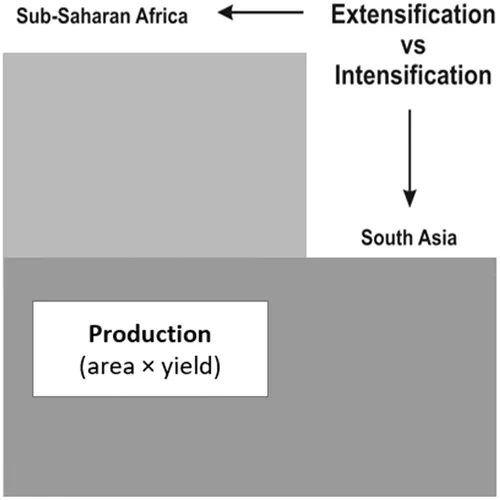
As demand for food grows so does the application of fertilizers. Global fertilizer consumption has expanded rapidly to the current level of about 190 million metric tons of fertilizer nutrients that were used for crop production, with China, India, Brazil, and the US accounting for about 50% of the total amount of nutrients applied through fertilizers in the world (FAO 2019). Fertilizer consumption and, consequently, food production has increased in most countries but not in sub-Saharan Africa where per capita food production has decreased since the 1970s. Compared with 160 kg nutrients per hectare (kg/ha) in South Asia, 158 kg/ha in the European Union, 127 kg/ha in North America, and 140 kg/ha in Latin America and the Caribbean, sub-Saharan Africa uses only 18 kg of nutrients per hectare (FAO 2019). Sub-Saharan Africa (SSA) uses merely 2.2% of the world’s fertilizers (IFASTAT 2019). This low rate of application of fertilizers, coupled with poor soil fertility in SSA, is a major contributor to low productivity and poverty, where nutrient balances for many farming systems are negative, i.e., the crops grown are extracting more nutrients than are returned to the soil through inorganic and organic fertilizers. Increases in food production still come primarily from the expansion of agriculture onto new, often marginal lands, and yield gaps remain high (Klucas 2015) (Figure 1.1).
FIGURE 1.1 Comparison of factors causing increases in cereal production in Southeast Asia and Sub-Saharan Africa.
After decades of progress, the number of malnourished people globally is beginning to increase; in 2019 it was 688 million, and it is projected to reach 841 million by 2030 (Table 1.1) (FAO et al. 2020). More than 50% of the world’s malnourished live in Asia. Another third of the hungry are in sub-Saharan Africa, where undernourishment is increasing rapidly particularly in regions affected by drought and conflict. The outlook for 2030 for Africa is alarming, and the continent is significantly off track to achieve the Zero Hunger target of the Sustainable Development Goals, even without considering the impact of COVID-19.
TABLE 1.1 Prevalence of Malnutrition in the World with Projections to 2030
Number of Malnourished People (Millions)
2005
2016
2019
2030*
WORLD
825.6
657.6
687.8
841.4
AFRICA
192.6
224.9
250.3
433.2
Northern Africa
18.3
14.4
15.6
21.4
Sub-Saharan Africa
174.3
210.5
234.7
411.8
ASIA
574.7
381.7
381.1
329.2
Central Asia
6.5
2.1
2
N.R.
Eastern Asia
118.6
N.R.
N.R.
N.R.
Southeast Asia
97.4
63.9
64.7
63
Southern Asia
328
256.2
257.3
203.6
Western Asia
24.3
29.2
30.8
42.1
N.R., Not Reported.
Do Not Reflect the Potential Impact of COVID-19 Pandemic (Roser and Ortiz-Ospina 2013).
The global agricultural systems are strained due to rising food demands and climate change coupled with limited land, water, and declining soil fertility. The COVID-19 pandemic’s projected impact on the food system will further strain ...
Table of contents
Cover
Half-Title
Series
Title
Copyright
Contents
Foreword
Editor
Contributors
Chapter 1 Enhancing Fertilizer Use Efficiency by Managing Soil Health: Emerging Trends
Chapter 2 Conservation Agriculture: Carbon and Conservation Centered Foundation for Sustainable Production
Chapter 3 Relating Soil Organic Carbon Fractions to Crop Yield and Quality with Cover Crops
Chapter 4 Global Spread of Conservation Agriculture for Enhancing Soil Organic Matter, Soil Health, Productivity, and Ecosystem Services
Chapter 5 The Effects of Soil Organic Matter and Organic Resource Management on Maize Productivity and Fertilizer Use Efficiencies in Africa
Chapter 6 Cover Cropping for Managing Soil Organic Carbon Content
Chapter 7 Fertilizer Use in the North China Plains for Improving Soil Organic Matter Content and Crop Yield
Chapter 8 Managing Rain-fed Rice Farms for Improving Soil Health and Advancing Food Security: A Meta-Analysis
Chapter 9 Soil Organic Matter: Bioavailability and Biofortification of Essential Micronutrients
Chapter 10 Raising Soil Organic Matter to Improve Productivity and Nutritional Quality of Food Crops in India
Chapter 11 Role of Legumes in Managing Soil Organic Matter and Improving Crop Yield
Chapter 12 Managing Soil Organic Carbon in Croplands of the Eastern Himalayas, India
Chapter 13 Soil Organic Carbon Restoration in India: Programs, Policies, and Thrust Areas
Chapter 14 No-Till Farming in the Maghreb Region: Enhancing Agricultural Productivity and Sequestrating Carbon in Soils
Chapter 15 No-Till Farming for Managing Soil Organic Matter in Semiarid, Temperate Regions: Synergies, Tradeoffs, and Knowledge Gaps
Index
Trusted by 375,005 students
Access to over 1.5 million titles for a fair monthly price.
Study more efficiently using our study tools.
Frequently asked questions
Yes, you can cancel anytime from the Subscription tab in your account settings on the Perlego website. Your subscription will stay active until the end of your current billing period. Learn how to cancel your subscription
No, books cannot be downloaded as external files, such as PDFs, for use outside of Perlego. However, you can download books within the Perlego app for offline reading on mobile or tablet. Learn how to download books offline
Perlego offers two plans: Essential and Complete
Essential is ideal for learners and professionals who enjoy exploring a wide range of subjects. Access the Essential Library with 800,000+ trusted titles and best-sellers across business, personal growth, and the humanities. Includes unlimited reading time and Standard Read Aloud voice.
Complete: Perfect for advanced learners and researchers needing full, unrestricted access. Unlock 1.5M+ books across hundreds of subjects, including academic and specialized titles. The Complete Plan also includes advanced features like Premium Read Aloud and Research Assistant.
Both plans are available with monthly, semester, or annual billing cycles.
We are an online textbook subscription service, where you can get access to an entire online library for less than the price of a single book per month. With over 1.5 million books across 990+ topics, we’ve got you covered! Learn about our mission
Look out for the read-aloud symbol on your next book to see if you can listen to it. The read-aloud tool reads text aloud for you, highlighting the text as it is being read. You can pause it, speed it up and slow it down. Learn more about Read Aloud
Yes! You can use the Perlego app on both iOS and Android devices to read anytime, anywhere — even offline. Perfect for commutes or when you’re on the go. Please note we cannot support devices running on iOS 13 and Android 7 or earlier. Learn more about using the app
Yes, you can access Soil Organic Matter and Feeding the Future by Rattan Lal in PDF and/or ePUB format, as well as other popular books in Technology & Engineering & Biology. We have over 1.5 million books available in our catalogue for you to explore.