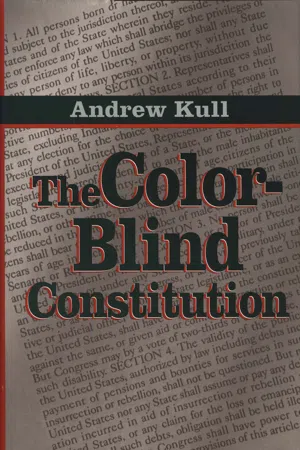
From 1840 to 1960 the profoundest claim of Americans who fought the institution of segregation was that the government had no business sorting citizens by the color of their skin. During these years the moral and political attractiveness of the antidiscrimination principle made it the ultimate legal objective of the American civil rights movement. Yet, in the contemporary debate over the politics and constitutional law of race, the vital theme of antidiscrimination has been largely suppressed. Thus a strong line of argument laying down one theoretical basis for the constitutional protection of civil rights has been lost.
Andrew Kull provides us with the previously unwritten history of the color-blind idea. From the arguments of Wendell Phillips and the Garrisonian abolitionists, through the framing of the Fourteenth Amendment and Justice Harlan's famous dissent in Plessy, civil rights advocates have consistently attempted to locate the antidiscrimination principle in the Constitution. The real alternative, embraced by the Supreme Court in 1896, was a constitutional guarantee of reasonable classification. The government, it said, had the power to classify persons by race so long as it acted reasonably; the judiciary would decide what was reasonable.
In our own time, in Brown v. Board of Education and the decisions that followed, the Court nearly avowed the rule of color blindness that civil rights lawyers continued to assert; instead, it veered off for political and tactical reasons, deciding racial cases without stating constitutional principle. The impoverishment of the antidiscrimination theme in the Court's decision prefigured the affirmative action shift in the civil rights agenda. The social upheaval of the 1960s put the color-blind Constitution out of reach for a quartercentury or more; but for the hard choices still to be made in racial policy, the colorblind tradition of civil rights retains both historical and practical significance.
eBook - PDF
The Color-Blind Constitution
About this book
Information
Publisher
Harvard University PressYear
2009Print ISBN
9780674142930
9780674142923
eBook ISBN
9780674039803

Constitution’s
tolerance
for
racial
discrimination
held
but
limited
interest
for
anyone.
When
the
federal
compact
was
altered,
and
the
reach
of
federal
power
into
the
states’
domestic
policy
or
internal
regulations
could
no
longer
be
questioned,
the
putative
color
blindness
of
the
Constitution
became
incomparably
more
significant
and
correspondingly
more
difficult
to
uphold.
It
was
relatively
easy,
after
all,
to
maintain
that
the
Constitution
“knew
nothing
of
white
or
black
men”
so
long
as
the
federal
authority
knew
nothing—or
almost
nothing—of
the
sphere
of
government
in
which
racial
distinctions
were
typically
drawn.
The
question,
ironically
enough,
was
whether
the
Constitution’s
pristine
color
blindness
could
survive
the
Reconstruction
Amendments.
A
Glorious
Liberty
Document
21
Table of contents
- Cover
- Title Page
- Copyright
- Dedication
- Preface
- Contents
- Introduction
- Chapter 1. A Glorious Liberty Document
- Chapter 2. The Lynn Petition
- Chapter 3. Sumner and Shaw
- Chapter 4. The Reconstruction Amendments of Wendell Phillips
- Chapter 5. The Thirty-ninth Congress
- Chapter 6. The Judicial Assessment
- Chapter 7. Plessy v. Ferguson
- Chapter 8. Separate but Equal
- Chapter 9. Brown v. Board of Education
- Chapter 10. The Road Not Taken
- Chapter 11. Benign Racial Sorting
- Notes
- Index of Cases
- General Index
Trusted by 375,005 students
Access to over 1.5 million titles for a fair monthly price.
Study more efficiently using our study tools.
Frequently asked questions
Yes, you can cancel anytime from the Subscription tab in your account settings on the Perlego website. Your subscription will stay active until the end of your current billing period. Learn how to cancel your subscription
No, books cannot be downloaded as external files, such as PDFs, for use outside of Perlego. However, you can download books within the Perlego app for offline reading on mobile or tablet. Learn how to download books offline
Perlego offers two plans: Essential and Complete
- Essential is ideal for learners and professionals who enjoy exploring a wide range of subjects. Access the Essential Library with 800,000+ trusted titles and best-sellers across business, personal growth, and the humanities. Includes unlimited reading time and Standard Read Aloud voice.
- Complete: Perfect for advanced learners and researchers needing full, unrestricted access. Unlock 1.5M+ books across hundreds of subjects, including academic and specialized titles. The Complete Plan also includes advanced features like Premium Read Aloud and Research Assistant.
We are an online textbook subscription service, where you can get access to an entire online library for less than the price of a single book per month. With over 1.5 million books across 990+ topics, we’ve got you covered! Learn about our mission
Look out for the read-aloud symbol on your next book to see if you can listen to it. The read-aloud tool reads text aloud for you, highlighting the text as it is being read. You can pause it, speed it up and slow it down. Learn more about Read Aloud
Yes! You can use the Perlego app on both iOS and Android devices to read anytime, anywhere — even offline. Perfect for commutes or when you’re on the go.
Please note we cannot support devices running on iOS 13 and Android 7 or earlier. Learn more about using the app
Please note we cannot support devices running on iOS 13 and Android 7 or earlier. Learn more about using the app
Yes, you can access The Color-Blind Constitution by Andrew Kull in PDF and/or ePUB format, as well as other popular books in Law & Law Theory & Practice. We have over 1.5 million books available in our catalogue for you to explore.