This book provides a synthesis of current research and international best practice in the emerging field of creative tourism. Including knowledge, insights, and reflections from both practitioners and researchers, it covers types of creative tourist, trends, designing and implementing creative tourism products, embedding activities in a community and place, and addressing sustainability challenges. Applying lessons learned from the CREATOUR project and other initiatives, the editors present key information in an actionable manner best suited to people working on the ground. The book: - Addresses important issues such as local economic benefit, social and collaborative economy, community engagement, social inclusion, youth empowerment, cross-cultural exchange, and responsible travel. - Provides a core, introductory text plus a wide range of cases examining creative tourism development in practice in the following 15 countries: Austria, Brazil, Canada, Colombia, Denmark, Finland, Kenya, Namibia, Portugal, the Netherlands, New Zealand, Slovenia, Spain, Thailand, and the USA. - Includes colour photos, diagrams, text boxes, and call-out quotations throughout to help guide and engage readers. A vital resource for tourism agencies, practitioners, planners and policymakers interested in developing creative tourism programmes and activities, this book will also be of interest to cultural and creative tourism researchers, students, and teachers of tourism and culture-based development.
eBook - ePub
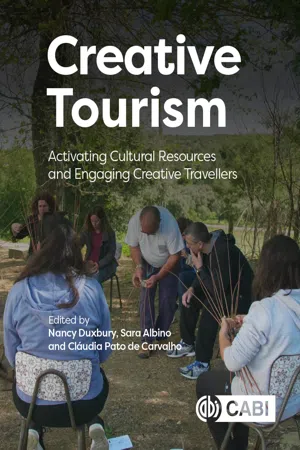
Creative Tourism
Activating Cultural Resources and Engaging Creative Travellers
- 296 pages
- English
- ePUB (mobile friendly)
- Available on iOS & Android
eBook - ePub
Creative Tourism
Activating Cultural Resources and Engaging Creative Travellers
About this book
Information
1 An introduction to creative tourism development: Articulating local culture and travel
NANCY DUXBURY,a* CLÁUDIA PATO CARVALHO,a AND SARA ALBINOb
aCentre for Social Studies, University of Coimbra, Portugal; bCIDEHUS, University of Évora, Portugal

*Corresponding author: [email protected]
Creative tourism is a dynamic tourism niche that has emerged both as a development of cultural tourism and in opposition to the emergence of ‘mass cultural tourism’. On the one hand, creative tourism demand is driven by travellers seeking more active and participative cultural experiences in which they can use and develop their own creativity. On the other hand, creative tourism provides avenues for communities’ desire to accentuate their distinctive elements and develop new value-added initiatives for local benefit.
Responding to these demands and striving to provide alternative approaches to tourism development, interest in creative tourism has been rising in many places, both urban and rural. Through the CREATOUR® creative tourism research-and-application project in Portugal (see Box 1.1), which was the impetus for the current book, we observed that creative tourism is an inspiring trajectory for agencies, organizations, and entrepreneurs involved in advancing local culture-based development and cultural tourism.
Box 1.1. About CREATOUR®
CREATOUR® is a large, multidisciplinary research-and-application project that has been encouraging experimental practices and pilot trials to more fully understand the issues and potential of creative tourism in small cities and rural contexts in Portugal. Interlinking culture, tourism, and local development perspectives and methodologies, the project catalysed and researched creative tourism in small cities and rural areas. The project enabled and empowered an array of bottom-up development approaches and initiatives across the Algarve, Alentejo, Centro, and Norte regions of Portugal.
The initial phase of CREATOUR® operated from November 2016 to June 2020. It was funded by the Portuguese Foundation for Science and Technology (FCT/MEC) through national funds and was co-funded by FEDER through the Joint Activities Programme of COMPETE 2020 and the Regional Operational Programmes of Lisbon and Algarve. It was an ambitious experiment, involving five research centres and 30 researchers – from the Centre for Social Studies (CES), University of Coimbra (coordinator); Laboratory of Landscapes, Heritage and Territory (Lab2PT), University of Minho; Interdisciplinary Centre for History, Culture and Societies (CIDEHUS), University of Évora; Centre for Spatial and Organizational Dynamics (CIEO), University of Algarve; and Centre for Socioeconomic and Territorial Studies (DINÂMIA’CET-ISCTE), ISCTE – Instituto Universitário de Lisboa – working with 40 participating ‘pilot’ organizations, including art, culture, environmental, local, and regional development associations; science and education organizations; municipalities; and entrepreneurs.
CREATOUR® promoted an integrated approach – crossing regions, disciplines, sectors, and organizational types, with the imperative to bridge research and practice made central to the project. Within this framework, the diversity of perspectives among CREATOUR® participants fostered knowledge exchanges, provided important learning moments, and sparked new ways of understanding and interpreting developments. Through this collaborative and experimental approach, we found that insights from front-line experiences are invaluable to advance knowledge about development strategies for creative tourism in smaller places, to better understand the dynamics of creative tourism as a field of practice, and to foster culturally sensitive and place-based initiatives that benefit both local communities and visitors.
Among the project’s findings, we learned that creative tourism development outside large cities is feasible. We also found that creative tourism has significant potential for inspiring new ideas for revitalizing local culture and heritage resources, reimagining community self-representation for tourism, and providing social, cultural, and economic added value for smaller places. However, challenges of distributed geography and the diversity of small-scale initiatives require significant attention to capacity building, training, and mentorship; dedicated resources for collective marketing; and time to deepen knowledge networking and the development of partnerships.
For further information, visit: www.creatour.pt (accessed 26 April 2021).
(Adapted from Duxbury and Silva, 2020.)
The original definition of creative tourism put forward by Greg Richards and Crispin Raymond in 2000 continues to resonate in the field: ‘Tourism which offers visitors the opportunity to develop their creative potential through active participation in learning experiences which are characteristic of the holiday destination where they are undertaken’ (p. 18). While commonly associated with traditional crafts, creative tourism encompasses a wide array of creative experiences. In this vein, it can be seen as an approach rather than set types of activities. With a diverse range of activities encompassed within creative tourism, one can view its ‘transversality’ as a strength, which can complement and extend other types of tourism (Gonçalves et al., 2020, Chapter 31).1
Based on an extensive review of definitions of creative tourism, the CREATOUR® project defined creative tourism as active creative activity encouraging personal self-expression and interaction between visitors and local residents, inspired by local endogenous resources (place and people), and designed and implemented by local residents. This approach to creative tourism highlighted four dimensions: active participation, learning, creative self-expression, and community engagement, all underlined by an immersive connection to place (Bakas et al., 2020; see also Scherf, 2021).
Today, creative tourism is situated among an array of locally focused alternatives-to-mass-tourism that have been emerging in recent years, such as relational tourism, conscious travel, situated tourism, and community-based tourism. It is viewed as a type of sustainable and responsible form of travel that functions on a small scale and focusses on local actors. It provides an avenue for rethinking and reconfiguring visitor relations with an eye to local benefits. It provides a platform for developing new initiatives based on local cultural resources and specificities, both tangible and intangible. And, beyond this, creative tourism can be used to pursue broader societal and sustainable development goals.
Yet creative tourism is a young field and there are few books available about it, with most directed towards an academic audience. Recently, a few publications directed towards practitioners have emerged: Creating Creative Tourism Toolkit (Richards et al., 2019), Creative Tourism: The CREATOUR Recipe Book (Gonçalves et al., 2020), and Creative Tourism: Guide for Practitioners (Vinagre de Castro et al., 2020). However, our experiences in the CREATOUR® project highlighted that there is a general lack of accessible knowledge available to practitioners about types of creative tourists, trends in creative tourism, how to design and implement a creative tourism product, embedding creative tourism activities in a community and place, and addressing challenges of innovation and sustainability. These key topics inspired and informed this book, which was developed with the input of the participating pilot organizations involved in the CREATOUR® project and further elaborated by the editors in collaboration with colleagues in Colombia, Brazil, and elsewhere.
This book brings together current research and leading practices internationally in creative tourism and travelling, offering perspectives and reflections from both practitioners and researchers. It includes 32 chapters, featuring 46 authors, writing about creative tourism initiatives in 15 countries: Austria, Brazil, Canada, Colombia, Denmark, Finland, Kenya, Namibia, Portugal, The Netherlands, New Zealand, Slovenia, Spain, Thailand, and the United States. The book is intended for entrepreneurs and public agencies interested in developing creative tourism activities and programmes, with a complementary interest expected from students and researchers in creative tourism, cultural tourism, and community-based tourism fields.
The book aims to offer theoretical approaches as well as to inform practical implementation, presenting a wide range of examples, experience-based insights, and advice. It offers guidance for practitioners in planning, operationalizing, and iteratively improving their creative tourism projects and adapting them to changing local situations. The book also aims to situate creative tourism within local development, and to show how it can contribute to local economic benefit, community engagement, social inclusion, empowerment, cultural vitality and sustainability, cross-cultural exchange, and responsible travel.
To contextualize the collection, a few words about the book’s approach to creative tourism entrepreneurship and its subtitle elements – activating cultural resources and engaging creative travellers – are in order. In this introductory chapter, we present insights relating to these themes, woven together from the contributions to this volume. We then provide an overview of the six parts of the book (summaries of the individual chapters are included in an introduction in each section). In closing, we offer some thoughts on how community-engaged creative tourism can foster broader local impacts.
Creative tourism entrepreneurship
Creative tourism presents ‘an encouraging opportunity for entrepreneurs with low entry hurdles’ (see Zuluaga and Guerra, Chapter 2, p. 105), but successfully developing and managing a creative tourism initiative requires attention to many planning and operational aspects, dynamic opportunities, and contextual challenges. To inform creative tourism development in a wide variety of situations, this book provides strategies and processes that have been used to design and implement creative tourism initiatives in Thailand (Chapter 12), Slovenia (Chapter 13), Colombia (Chapter 14), and Brazil (Chapter 24), as well as case study accounts of creative tourism projects in Portugal (Chapters 16, 17, 21, 26, and 28), Denmark (Chapter 18), the United States (Chapter 22), Kenya (Chapter 23), Namibia (Chapter 27), and Lapland, Finland (Chapter 30).2
The approaches and pathways innovated in each situation were developed out of particular contexts and circumstances. This book uniquely brings together these multiple perspectives and experiences to guide entrepreneurs and agencies in developing their own situationally relevant and locally resonant approaches to creative tourism. We note that the elaboration of these practice-based accounts also valuably informs creative tourism research, addressing a lack of information on the concrete processes undertaken in conceiving, planning, and operationalizing creative tourism initiatives.
The book also acknowledges the important roles that public agencies and municipalities can take as ‘public entrepreneurs’. Public entities such as regional development agencies and municipalities can play key roles in facilitating local and regional networks of independent actors, supporting new ideas and initiatives, and (re)positioning tourism to pursue diverse public benefits (see Gato et al., Chapter 29). Two examples are provided in this book in some detail: the Santa Fe Creative Tourism Initiative in New Mexico, USA (Chapter 22 by Sabrina V. Pratt) and Loulé Criativo in Portugal (Chapter 21 by Marília Lúcio). These public initiatives both created the conditions and propelled the development of multifaceted creative tourism programmes. Related to this, in Chapter 31 Gonçalves et al. outline public policy recommendations to nurture and support creative tourism development in small cities and rural areas, based on findings from the CREATOUR® project.
Understanding how to implement creative tourism initiatives in specific contexts requires deep understanding of local scenes and dynamics (see Marques, Chapter 23). Local contextual and ‘how-to’ knowledge is essential for effective and meaningful implementation and development (Isar, 2013). The degree of social embeddedness, generally defined as ‘the nature, depth, and extent of an individual’s ties into a community’, also plays an important role (see Bakas, Chapter 28, p. 218).
Four key dimensions of creative tourism – active participation, learning, creative self-expression, and community engagement – served as a useful framework for developing creative tourism activities in the CREATOUR® project. Jutamas (Jan) Wisansing’s experiences with the DASTA creative tourism project in Thailand (see Chapter 12) placed accents on the 3Ss – story and storytelling, senses, and sophistication – and drew attention to the design of the spaces in which the activities are realized. Altogether, these aspects collectively contribute to meaningfully engaging travellers through in situ creative experiences immersed in the place where they are realized. Some insights on these dimensions, pulled from chapters in this book, are presented in Box 1.2.
Box 1.2. Key dimensions of creative tourism
Active participation. Not just watc...
Table of contents
- Cover
- Half Title
- Title
- Copyright
- Contents
- List of tables
- List of figures
- Acknowledgements
- Contributors
- 1 An introduction to creative tourism development: Articulating local culture and travel
- Part I: Types of creative travellers
- Part II: Trends in creative tourism
- Part III: Designing and managing creative tourism products
- Part IV: Embedding creative tourism activities within a community
- Part V: Addressing challenges of impact and sustainability
- Part VI: Concluding remarks
- Index
- Cabi
- Back
Trusted by 375,005 students
Access to over 1.5 million titles for a fair monthly price.
Study more efficiently using our study tools.
Frequently asked questions
Yes, you can cancel anytime from the Subscription tab in your account settings on the Perlego website. Your subscription will stay active until the end of your current billing period. Learn how to cancel your subscription
No, books cannot be downloaded as external files, such as PDFs, for use outside of Perlego. However, you can download books within the Perlego app for offline reading on mobile or tablet. Learn how to download books offline
Perlego offers two plans: Essential and Complete
- Essential is ideal for learners and professionals who enjoy exploring a wide range of subjects. Access the Essential Library with 800,000+ trusted titles and best-sellers across business, personal growth, and the humanities. Includes unlimited reading time and Standard Read Aloud voice.
- Complete: Perfect for advanced learners and researchers needing full, unrestricted access. Unlock 1.5M+ books across hundreds of subjects, including academic and specialized titles. The Complete Plan also includes advanced features like Premium Read Aloud and Research Assistant.
We are an online textbook subscription service, where you can get access to an entire online library for less than the price of a single book per month. With over 1.5 million books across 990+ topics, we’ve got you covered! Learn about our mission
Look out for the read-aloud symbol on your next book to see if you can listen to it. The read-aloud tool reads text aloud for you, highlighting the text as it is being read. You can pause it, speed it up and slow it down. Learn more about Read Aloud
Yes! You can use the Perlego app on both iOS and Android devices to read anytime, anywhere — even offline. Perfect for commutes or when you’re on the go.
Please note we cannot support devices running on iOS 13 and Android 7 or earlier. Learn more about using the app
Please note we cannot support devices running on iOS 13 and Android 7 or earlier. Learn more about using the app
Yes, you can access Creative Tourism by Nancy Duxbury, Sara Albino, Cláudia Pato de Carvalho, Nancy Duxbury,Sara Albino,Cláudia Pato de Carvalho in PDF and/or ePUB format, as well as other popular books in Business & Industria dell'ospitalità e del turismo. We have over 1.5 million books available in our catalogue for you to explore.