- 282 pages
- English
- ePUB (mobile friendly)
- Available on iOS & Android
eBook - ePub
About this book
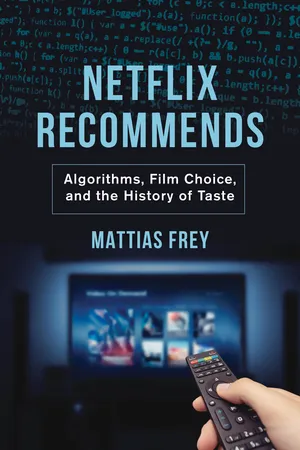
Algorithmic recommender systems, deployed by media companies to suggest content based on users’ viewing histories, have inspired hopes for personalized, curated media but also dire warnings of filter bubbles and media homogeneity. Curiously, both proponents and detractors assume that recommender systems for choosing films and series are novel, effective, and widely used. Scrutinizing the world’s most subscribed streaming service, Netflix, this book challenges that consensus. Investigating real-life users, marketing rhetoric, technical processes, business models, and historical antecedents, Mattias Frey demonstrates that these choice aids are neither as revolutionary nor as alarming as their celebrants and critics maintain—and neither as trusted nor as widely used. Netflix Recommends brings to light the constellations of sources that real viewers use to choose films and series in the digital age and argues that although some lament AI’s hostile takeover of humanistic cultures, the thirst for filters, curators, and critics is stronger than ever.
Information
Publisher
University of California PressYear
2021Print ISBN
9780520382046
Edition
1eBook ISBN
9780520382022
ONE
Why We Need Film
and Series Suggestions
WHY DO RECOMMENDER SYSTEMS EXIST in audiovisual culture? What social needs do they seek to satisfy? What are their fundamental technological forms and their providers’ key business models and cultural promises? To what extent are they novel, and how do they borrow from legacy recommendation forms? These are the central questions that chapter 1 and chapter 2 begin to answer. The following pages begin by demonstrating how, in general, recommendation mitigates a basic problem of films and series: their status as experiential consumer products. I then go on to contextualize VOD recommender systems within a longer history of information regimes that seek to focus consumers’ attention and direct their decision-making. The second part of the chapter shows how recommendations—and recommender systems—have become especially necessary in a digital age in which barriers to production are low and content proliferates. Overall, I argue that we should recognize VOD recommender systems as mitigators of risk and agents of surplus. There has always been a need for gatekeepers, filters, attention focalizers (including promotions and publicity), curators, and recommenders, because overproduction is the “rational organizational response” of the entertainment industries’ “nobody-knows” principle.1 Algorithmic VOD recommender systems, as a part of a larger spectrum of cultural recommendation sources, speed up, personalize, automate, and scale the suggestion of audiovisual goods, for which taste varies greatly from user to user. Arbiters of qualitative risk and quantitative excess, they base their tips on putatively objective aggregations of user behaviors, rather than the pronouncements of human experts.
FILMS AND SERIES AS RISKY PROTOTYPES
Despite contentions that algorithmic recommender systems are fundamentally novel, we can learn much about their basic social functions and instrumental uses by examining the long tradition of research that has been conducted on legacy cultural recommendation forms. Indeed, a whole slew of theory and empirical findings in film and media studies, sociology of art, marketing, and other disciplines has sought to account for the role of suggestions in selecting cultural goods. A long strand of social psychology and cultural economics dictates that because every film and series is essentially unique and because taste for audiovisual products is particularly fickle, recommendations remain crucial.
This distinction becomes clear when comparing films and series to other major types of consumer products. In general, search goods (such as laundry detergent or cameras or cars, etc.) are those that can be easily evaluated before purchase and essentially substituted by brand or model.2 Every bottle of Persil (or Tide or any other brand) is identical and consumers put themselves in little economic jeopardy by sampling one of the relatively few varieties or another. In contrast, audiovisual storytelling is by most measures an experience good: each and every film or series is a prototype without a reliable indication of its capacity to please its viewer. The ability to predict quality in advance of consumption, in other words, is notoriously difficult; theoretically, each exemplar must be consumed in order to be properly judged. Of course, media producers attempt to reduce risk with reboots, sequels, adaptations of familiar and proven intellectual property, or by employing staff whose track records demonstrate success in satisfying viewers. (There is a reason, after all, that they resurrect Avengers and Star Wars and Batman year after year, whereas first-time filmmakers must beg, usually unsuccessfully, for production funds.) And yet they must build an audience for each new title. Scholars speak of a “symmetrical ignorance”: neither producer nor consumer, neither seller nor buyer can reliably assess the success of the product before the transaction and reception.3
Furthermore, films and series pose special risks because consumption motivations and evaluation criteria can differ wildly from consumer to consumer. To wit, almost all consumers use laundry detergent for their washing and will evaluate it as effective if their clothes smell, feel, and look fresh after use. In stark contrast, films and series are used to entertain, educate, fantasize, pass the time, socialize with others, inhabit different perspectives, explore new cultures, and for a whole host of other reasons.4 Media industries, as Janet Wasko and Eileen R. Meehan write, “produce commodities that convey narratives, arguments, visions, symbolic worlds, and imagined possibilities.”5 Whereas differentiation between two bottles of the same laundry detergent would be grounds for concern and complaint (and many people use the same brand and type week after week, year after year), consumers expect and enjoy originality and novelty across films and series, which many will only view once.6 The prevailing uniqueness, however, results in a fundamental consumer ignorance regarding the quality of the product that they have not yet consumed. “The uniqueness, which cultural goods must demonstrate according to convention,” Joëlle Farchy states, “leads to uncertainty about their quality, which in turn unsettles the consumers’ traditional selection processes. The appropriate means to limit this uncertainty is for the consumer to acquire information.”7
This information has traditionally inhabited three general forms across three different sets of recommendation sources: first, advertisements (including posters, trailers, television and online spots); second, the interventions of public intermediaries (especially experts, critics, and journalists) in the form of essays, reviews, interviews, and other contributions; and, third, peer word of mouth, including overheard comments and direct tips from friends, family, acquaintances, and strangers.8 Each of these information sources and means of suggestion will possess varying amounts of credibility with consumers, who will negotiate between one or multiple forms of recommendation based on their preferences in general or in relation to the individual content and potential portal (cinema, television, VOD, and so on). For example, some studies differentiate between “lay” and “expert” reviewers, determining that while consumers more readily accept the opinions found in lay reviews of search goods (like household appliances), they tend to be more skeptical of non-professional online reviews of experience goods such as films or music albums.9 Other studies show how, in general, word of mouth trumps critical reviews in terms of box-office influence.10
Moreover, individual viewers will seek out and use recommendation sources differently according to their level of media consumption, as well as their personality. Numerous audience studies, conducted from the 1950s until as recently as 2014 in a variety of European countries and in North America, have repeatedly demonstrated a statistically significant difference in the attention paid to various types of information sources according to frequent and occasional users.11 Those who consume fewer films and series valued television information (television ads, coverage, publicity) and above all word of mouth in deciding whether to see a film and attended much less to considerations such as critics’ reviews, newspaper coverage, festival prizes, and the name of the director. In contrast, heavy users—a decided minority (roughly 10–25%), namely, frequent cinemagoers, TV junkies, festival attendees, and cinephiles—maintained the opposite habits, tending to engage more with production news and critical reviews.12 These results are confirmed in a plethora of other studies over the years, which suggest that there are fundamental distinctions to how various sorts of consumers respond to different kinds of recommendations.13 Still further studies have revealed differences in how consumers react to positive vs. negative recommendations. Certain types of viewers, especially light users, are more likely to be influenced by negative recommendations—in particular, negative word of mouth—whereas heavy users ignore word of mouth and tend to follow their own initial impressions and judgments, deferring only to select, trusted critics.14 In turn, social psychologists and behavioral economists have discerned how personality types and choice heuristics further inflect these truisms about cultural recommendation: media users with a “maximizer” personality will scour long lists of films and series, and multiple recommendation forms, to find appropriate content. In contrast, “satisficers” make little effort when choosing, because they are more apt to be content with adequate, rather than perfect, selections.15
Furthermore, the evidence overwhelmingly suggests that the precise role of recommendations will differ according to source and also according to the type, experience, and sophistication of the audience. These conclusions already begin to cast some doubt on the more extreme filter-bubble arguments, which imply that indecipherable, and thereby pernicious, algorithms uniformly lead the blind masses astray. They beg the question of whether light consumers of audiovisual storytelling will value recommender systems more highly and follow them more closely. In this context it is also important to consider another observation made in several areas of the research: that those consumers who undergo a “learning process”—not only about the particular exemplar but regarding similar products (e.g., other films and series; other films and series of that particular genre, type, or style; or other works by the creators of the product in question)—will be better able to predict the quality of the exemplar before consumption.16 Indeed, computer scientists envision recommender systems to have different uses for consumers according to their level of media literacy, and aim them primarily “toward individuals who lack the sufficient personal experience or competence in order to evaluate the potentially overwhelming number of alternative items” on offer.17 It is intriguing to speculate on how recommender systems mimic and systematize this learning process, possessing a well of knowledge (i.e., huge stores of data) to which otherwise only the learned film critic or a culture-vulture friend would be privy. The purposes and uses of recommendation could thus differ according to where a user stands in the learning process: although more sophisticated or frequent consumers may be more heavily engaged in media consumption preferences and thus more attentive to recommendation forms, light users may equally be engaged in intensive information searches, because of their general caution and selectivity in consumption.18 We will begin to see more concrete answers to these questions in chapter 5, which tests these theories with an empirical audience study.
To sum up a mountain of research over decades: recommendations have a fundamental, constitutive, valuable, and unique role in the consumption of films and series, precisely because of the special qualities of audiovisual products. A consumer may decide on a laundry detergent brand once or vary his or her choice each month according to the price; he or she may take great pains to decide which camera or car to buy but will only purchase such an item once every several years. In contrast, films and series maintain vastly more variety and most people consume them much more frequently. Recommendations help us reduce the considerable uncertainty related to the quality of cultural products before their consumption; they also reduce the considerable effort that we would otherwise need to research, and thus better judge, the good.19 Indeed, there is evidence that in early years computer programmers considered these opportunity costs for item searches—the stuff of research behind critics, advertising, and other recommendation instances—while assembling their applications.20
Some of the preceding scholarship was conducted in the pre-digital age, a time when start-ready films and series streaming over the internet seemed like science fiction, a futuristic luxury worth much more than $10 per month. When Farchy was writing in the early 1990s, the functions, roles, institutions, means of connection with, and social attitudes toward “experts and critics” were different. The local or national newspaper, specialist magazine, or trusted guidebook has yielded to unprecedented access to a whole host—some would say glut—of (professional and amateur) critics and reviews of various quality online.21 An information-poor environment in which we might have assessed eating at a restaurant in an unfamiliar city by such primitive measurements as the number or brand of cars in the parking lot has given way to an overload of readily available aggregated opinions from sometimes thousands of prior users on TripAdvisor, Yelp, or any of the dozens of similar apps. The old “lemon problem”—the asymmetry of information between buyer and seller by which the latter could easily pass off a dud used car on the former—has been replaced by a deluge of available indicators from which to pick and choose. In turn, the sources of “word of mouth”—traditionally conceived as “informal communications between private pa...
Table of contents
- Subvention
- Title Page
- Copyright
- Contents
- Acknowledgments
- Introduction
- 1 • Why We Need Film and Series Suggestions
- 2 • How Algorithmic Recommender Systems Work
- 3 • Developing Netflix’s Recommendation Algorithms
- 4 • Unpacking Netflix’s Myth of Big Data
- 5 • How Real People Choose Films and Series
- Afterword: Robot Critics vs. Human Experts
- Appendix: Designing the Empirical Audience Study
- Notes
- Selected Bibliography
- Index
Trusted by 375,005 students
Access to over 1.5 million titles for a fair monthly price.
Study more efficiently using our study tools.
Frequently asked questions
Yes, you can cancel anytime from the Subscription tab in your account settings on the Perlego website. Your subscription will stay active until the end of your current billing period. Learn how to cancel your subscription
No, books cannot be downloaded as external files, such as PDFs, for use outside of Perlego. However, you can download books within the Perlego app for offline reading on mobile or tablet. Learn how to download books offline
Perlego offers two plans: Essential and Complete
- Essential is ideal for learners and professionals who enjoy exploring a wide range of subjects. Access the Essential Library with 800,000+ trusted titles and best-sellers across business, personal growth, and the humanities. Includes unlimited reading time and Standard Read Aloud voice.
- Complete: Perfect for advanced learners and researchers needing full, unrestricted access. Unlock 1.5M+ books across hundreds of subjects, including academic and specialized titles. The Complete Plan also includes advanced features like Premium Read Aloud and Research Assistant.
We are an online textbook subscription service, where you can get access to an entire online library for less than the price of a single book per month. With over 1.5 million books across 990+ topics, we’ve got you covered! Learn about our mission
Look out for the read-aloud symbol on your next book to see if you can listen to it. The read-aloud tool reads text aloud for you, highlighting the text as it is being read. You can pause it, speed it up and slow it down. Learn more about Read Aloud
Yes! You can use the Perlego app on both iOS and Android devices to read anytime, anywhere — even offline. Perfect for commutes or when you’re on the go.
Please note we cannot support devices running on iOS 13 and Android 7 or earlier. Learn more about using the app
Please note we cannot support devices running on iOS 13 and Android 7 or earlier. Learn more about using the app
Yes, you can access Netflix Recommends by Mattias Frey in PDF and/or ePUB format, as well as other popular books in Social Sciences & Computer Science General. We have over 1.5 million books available in our catalogue for you to explore.