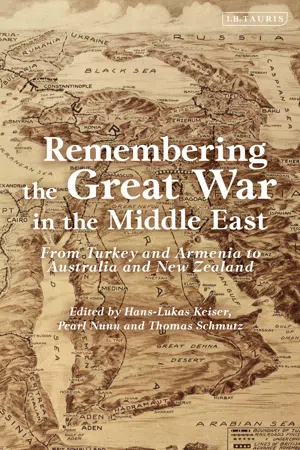
This book addresses the conflicts, myths, and memories that grew out of the Great War in Ottoman Turkey, and their legacies in society and politics. It is the third volume in a series dedicated to the combined analysis of the Ottoman Great War and the Armenian Genocide.
In Australia and New Zealand, and even more in the post-Ottoman Middle East, the memory of the First World War still has an immediacy that it has long lost in Europe. For the post-Ottoman regions, the first of the two World Wars, which ended Ottoman rule, was the formative experience. This volume analyses this complex configuration: why these entanglements became possible; how shared or even contradictory memories have been constructed over the past hundred years, and how differing historiographies have developed. Remembering the Great War in the Middle East reaches towards a new conceptualization of the "long last Ottoman decade" (1912-22), one that places this era and its actors more firmly at the center, instead of on the periphery, of a history of a Greater Europe, a history comprising – as contemporary maps did – Europe, Russia, and the Ottoman world.
eBook - ePub
Remembering the Great War in the Middle East
From Turkey and Armenia to Australia and New Zealand
- 320 pages
- English
- ePUB (mobile friendly)
- Available on iOS & Android
eBook - ePub
Remembering the Great War in the Middle East
From Turkey and Armenia to Australia and New Zealand
About this book
Information
Part One
History Writing and the Politics of Commemoration
1
Turkish History Writing of the Great War: Facing Ottoman Legacy, Mass Violence and Dissent1
Alexandre Toumarkine
Is there a Turkish memory of the First World War? Indeed, one can rightly speak of a ‘Turkish’ memory of the First World War, since the Armenian and Greek remembrance are either overshadowed by, or reduced to, a genocide scheme and the Greek–Turkish exchange of populations in 1923 and 1924. However, while speaking of a Turkish memory, one must keep in mind that the common recollection of the First World War is largely overdetermined by the official Turkish narrative. It is only here and there that traces of old song texts composed at the time and transmitted from one generation to another can be found. Particularly the mobilization (seferberlik) in 1914, the defeat of Sarıkamış in mid-January 1915 and the victory of Gallipoli in January 1915 are objects of – mainly elegiac – local folkloric and national songs (türkü). Concerning the Battle of Gallipoli, the türkü of Çanakkale, whose origins are still uncertain, is probably the most famous one. Completely different from the usual chauvinist tirades, it tells stories of the pain of separation of young drafted men from their loved ones, of the youth lost and of the cruelty of the war, the abominable scenes of mass murder, and finally the inconsolable grief afflicting the ones left behind. The memory of particularly hard or victorious campaigns lasted for generations in family memory, creating a deep, personal attachment to the memory of the battles. The veterans of the Battle of Gallipoli thus appear to have written its history, evoking a feeling of pride transmitted to their descendants. The memory of the War is hence also that of the soldiers shoved around from one frontline to another, one landscape to another, being tantamount to a tragic odyssey. The return of the surviving soldiers in 1918 and 1919 extended over a period of several months. Mostly carried out on foot, their return home turned the roads of Anatolia into a sea of people, resembling what the Russians experienced after 1917.
National commemorations began during the Interwar period, that is, during the founding years of the Republic (1923–1938), but they unsurprisingly mainly concentrated on the Battle of Gallipoli, linking it with the great battles of the Independence War (1919–1922) and thereby overshadowing and even eliding the Balkan Wars and the other battles of the First World War. These commemorations addressed the very audience of the military, the veterans and their relatives. Civilian commemorative tourism only began when the southern part of the peninsula of Gallipoli was made into a park for national history in 1973. The boom of national tourism during the 1990s marked the beginning of a new upswing of commemoration in the park.
Shifting from memory to historiography2 of the Great War, one may assume that the Turkish historiography produced in Turkey, with rare but notable exceptions, was and remains national. It seldomly uses Western primary and secondary sources, neither sources in other languages of the Ottoman Empire than Turkish. Turkish historians working on the Ottoman front and the First World War in general tended to read very few publications penned by their foreign colleagues. Furthermore, Turkish translations of books on the war have become available since the 1990s and only to a limited extent. On the other side, this historiography, and specifically the writing of the history of the Ottoman front, has often been neglected by Western compendia on the First World War.3
Furthermore, Turkish historiography narrates an imperial history as if it was a national one, rarely and poorly considering non-Muslims and minorities of the late Empire (for instance in topics like conscription, desertion and forced labour, see infra). Moreover, these narratives tend to ‘Turkify’ Ottoman patriotic sentiments present among the Muslims and sometimes the non-Muslims of the Empire. The focus on military operations in Anatolia (the Battle of Gallipoli, the war theatre of Eastern Anatolia) at the expense of other Ottoman territories in the Arab provinces constitutes another characteristic. Finally, the narrative created by Turkish historiography is an often nationalist and Manichean history frequently used as a tool for ideological mobilization.
Beginning with the question of the role of the military and of Kemalism in framing the historiography of the Great War, I will introduce in this chapter the presumably specific geographical and chronological characteristics of the Ottoman fronts, before mapping the emergence of new sources, fields, actors and approaches in Turkish historiography. Then I will discuss to what extent it impacts the writing of the history of the war, and finally, I will focus on the major development that occurred in the last decades: the break with the culture of denial in Turkey and in Turkish historiography.
The Historiographical Narrative established by the Military and Kemalism
Connecting the Military History with the ‘Armenian Question’
As shown by Mesut Uyar’s chapter in this volume, the Ottoman and Turkish military history of the First World War has been, until recently, mainly written by and for the Turkish military. Few interactions have developed with the existing Turkish civilian literature on the War. This pattern changes clearly after the 1980 Coup. The narratives on two historical events – the Armenian Genocide, and then the Battle of Gallipoli, both related to the year 1915 – made this change visible. Steadily, the latter one became instrumentalized through public discourse and commemorations, not only for the purpose of boosting Turkish patriotism, but to overshadow the first one.
From 1983 on, what is called in Turkey the ‘Armenian question’ became addressed regularly in generalized publications by the General Staff, not directly in line with the Great War.4 However, between this issue and the historiography of the Ottoman fronts during the Great War, an obvious connection is to be found not among Turkish Military Historians, but through the substantial and valuable work of Edward J. Erickson, a retired American naval officer who had served in Turkey during a NATO mission in the 1990s.
His first book, Ordered to Die: A History of the Ottoman Army in the First World War, was published in 2001.5 Though he explains his motivation for writing this monograph to have been the lack of English books on the Turks in the Great War, he confesses in his acknowledgements that he was also strongly encouraged by his Turkish colleagues. The book’s preface was written by the Turkish Head of Staff at the time, General Hüseyin Kıvrıkoğlu, who had been Erickson’s superior during the mission and a close friend ever since. According to Erickson, Kıvrıkoğlu’s position granted him privileged access to military sources (at ATASE). Erickson’s book focuses on the martial qualities of the Ottoman Army and implicitly adopts a denialist stance on the question of the Armenian genocide. In 2003, Vahakn Dadrian, a historian, legal expert and director of research on the genocide at the Zoryan Institute (in Cambridge, Massachusetts and in Toronto, Canada), published a devastating critique of Erickson’s work, accusing him of being a spokesperson for the Turkish General Staff. Mehmet Beşikçi, a Turkish historian who wrote his dissertation on the mobilization during the war, repeated Dadrian’s criticism without denouncing Erickson’s stance on the genocide.6 Erickson’s book was translated into Turkish and published as early as 2003.7 His second work, Ottoman Army Effectiveness in World War I was published in 2007 and translated into Turkish in 2009.8 It was followed by his third monograph Gallipoli: The Ottoman Campaign, published in English in August 2010 and in Turkish in 2012.9. In 2014, Erickson published ...
Table of contents
- Cover
- Half-Title Page
- Title Page
- Contents
- Notes on Contributors
- Acknowledgements
- Introduction
- Part One History Writing and the Politics of Commemoration
- 1 Turkish History Writing of the Great War: Facing Ottoman Legacy, Mass Violence and Dissent
- 2 National Remembrance and Anzac Day in Australia and New Zealand, 1916–2015
- 3 April 24. Formation, Development and Current State of the Armenian Genocide Victims Remembrance Day
- 4 Unremembering Gallipoli: A Complex History of World War I Memorialization and Historical Remembrance in Turkey
- Part Two National Narratives in the former Ottoman World
- 5 Official and Individual Lenses of the Remembrance of the First World War: Turkish Official Military Histories and Personal War Narratives
- 6 National Narratives Challenged: Ottoman Wartime Correspondence on Palestine
- Part Three Australians’ Embrace of Gallipoli
- 7 From Unspeakable to Honourable: The Great War and Australian Narratives of the Turks
- 8 ‘Strong and friendly bonds … out of shared tragedy’? The Gallipoli / Canakkale battles in Canberra’s City Planning and Architecture of Memory
- 9 Gallipoli in Diasporic Memories of Sikhs and Turks
- Part Four Contested Memories: New Zealand, Turkey and Armenians
- 10 ‘To Have and to Hold’: Chunuk Bair and the Foundations of New Zealand’s Gallipoli Imagining
- 11 New Zealand and the Armenian Genocide: Myths, Memory and Lost History
- 12 Can the Survivor Speak?
- Afterword
- Select Bibliography
- Index
- Copyright
Trusted by 375,005 students
Access to over 1.5 million titles for a fair monthly price.
Study more efficiently using our study tools.
Frequently asked questions
Yes, you can cancel anytime from the Subscription tab in your account settings on the Perlego website. Your subscription will stay active until the end of your current billing period. Learn how to cancel your subscription
No, books cannot be downloaded as external files, such as PDFs, for use outside of Perlego. However, you can download books within the Perlego app for offline reading on mobile or tablet. Learn how to download books offline
Perlego offers two plans: Essential and Complete
- Essential is ideal for learners and professionals who enjoy exploring a wide range of subjects. Access the Essential Library with 800,000+ trusted titles and best-sellers across business, personal growth, and the humanities. Includes unlimited reading time and Standard Read Aloud voice.
- Complete: Perfect for advanced learners and researchers needing full, unrestricted access. Unlock 1.5M+ books across hundreds of subjects, including academic and specialized titles. The Complete Plan also includes advanced features like Premium Read Aloud and Research Assistant.
We are an online textbook subscription service, where you can get access to an entire online library for less than the price of a single book per month. With over 1.5 million books across 990+ topics, we’ve got you covered! Learn about our mission
Look out for the read-aloud symbol on your next book to see if you can listen to it. The read-aloud tool reads text aloud for you, highlighting the text as it is being read. You can pause it, speed it up and slow it down. Learn more about Read Aloud
Yes! You can use the Perlego app on both iOS and Android devices to read anytime, anywhere — even offline. Perfect for commutes or when you’re on the go.
Please note we cannot support devices running on iOS 13 and Android 7 or earlier. Learn more about using the app
Please note we cannot support devices running on iOS 13 and Android 7 or earlier. Learn more about using the app
Yes, you can access Remembering the Great War in the Middle East by Hans-Lukas Kieser, Thomas Schmutz, Pearl Nunn, Hans-Lukas Kieser,Thomas Schmutz,Pearl Nunn in PDF and/or ePUB format, as well as other popular books in Politics & International Relations & Middle Eastern History. We have over 1.5 million books available in our catalogue for you to explore.