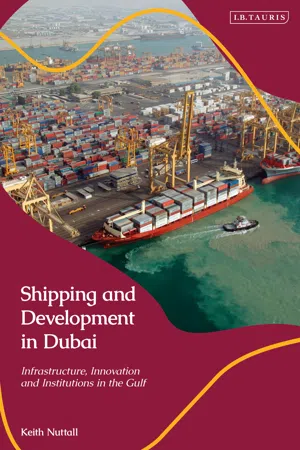
A small town on a sandy creek half a century ago, Dubai is now the largest trading, commercial, leisure and transport entrepot in the Gulf and wider region. This book explains the reasons for the emergence of Dubai and its distinctive development trajectory, arguing that the decision, in the 1970s, to invest in infrastructure made possible by shipping containerization laid the foundations for its future expansion.
The book shows that in contrast to its competitors' hydrocarbon rentier economic model, Dubai's creation and expansion of ports and airports, together with 'value-added' logistics and business-friendly enhancements, were used to out-compete regional rivals. Drawing on a range of primary and secondary sources, including interviews with logistics business-people, government records, memoirs, it fills a significant lacuna in the history of Dubai's development and emergence as a global trade hub.
eBook - ePub
Shipping and Development in Dubai
Infrastructure, Innovation and Institutions in the Gulf
- 232 pages
- English
- ePUB (mobile friendly)
- Available on iOS & Android
eBook - ePub
Shipping and Development in Dubai
Infrastructure, Innovation and Institutions in the Gulf
About this book
Information
Chapter 1
Dubai
Origins and emergence (1833–1958)
It is difficult to overstate the role of the ocean in the rise of the modern world-system.1
Beginnings
When some members of the Bu Falasah (Bani Yas) tribe determined in 1833 on hijra, or migration,2 to leave Abu Dhabi, as a result of internal feuds and establish themselves about 150 km north, up the Arabian Gulf coast in Dubai, Dubai was still only a small participant in the commerce of the region. This exodus had a sizeable impact, ‘doubling the town’s population’3 to around 2000 people. The new arrivals, like the established inhabitants, lived around the sheltered, though shallow sandy creek relying on fishing, supplemented by dates, with some goats and camels supplying milk and meat – and pearling as the only source of revenue. However, the Gulf itself was part of a long-established pattern of pragmatic trade and tolerance of other cultures, and for centuries, links between port settlements in the Indian Ocean littoral had flourished, including trading for necessities between themselves and goods from larger centres further afield. Indeed, ‘from 1500 the Indian Ocean emerged . . . as the locus of early modern trade between Africa, Asia and Europe. Global historians increasingly acknowledge the Indian Ocean international system as “ground zero” for early modern globalization’.4 We should not therefore lose sight of the fact that the rise of Dubai and its economic liberalism is far from an aberration, more a return to an example of the multifaceted diversity of contacts and trading that had flourished in the region for centuries.
Regional specialists, such as Fuccaro, Potter, Sheriff5 and Villiers,6 have established that, owing to poor inland communications through difficult terrain and weak overall control by colonial Ottoman or Persian overlords, Gulf port towns and their trades were orientated outwards. Until the age of steam in the mid-nineteenth century, trade was dependent on the monsoon winds and, as Potter emphasizes, ‘it is quite clear that the prosperity of Gulf ports was built on commerce . . . the seaborne trade with China, India and East Africa’.7 Dependent on the sea for their very existence, these Gulf settlements – even small centres like Dubai – included cosmopolitan inhabitants from all the societies and peoples surrounding the Indian Ocean and the Gulf, who could and would move if conditions were felt to be better or more secure elsewhere (security and stability were particularly important). As with anywhere else in the world, conditions did change, trading routes altered, and political factors intervened. Those centres that were flexible and adaptable survived and prospered best.
For trading and commerce, in the middle of the nineteenth century, the Gulf coastline of the Arabian Peninsula was still economically of little interest (apart from the inner Gulf pearling-centre island of Bahrain), with the major trading ports being in Southern Persia and Basrah (Mesopotamia – now Iraq). Dubai was still an insignificant, now independent, small town, having succeeded in precariously balancing itself between its erstwhile overlords in Abu Dhabi and the powerful Qawasim of Ras al Khaimah. There were two main reasons how it had succeeded in doing so. The first reason was that the Qawasim who had been the major maritime power in the region had lost most of their military strength, as a result of clashes with the British, as shown for example by Fuccaro.8 It therefore suited the chastened and weakened Qawasim, though still controlling land territories covering much of the northern and eastern parts of the peninsula (stretching down to Sharjah town just north of Dubai), as well as large swathes of the southern coast of Persia including ports such as Lingah, to have a small and unthreatening, independent Dubai divorced from Abu Dhabi, as a buffer between them and their rival power. Although disputes continued for decades with tribal and regional alliances changing regularly, Dubai managed to retain its separate status.
The second reason that Dubai survived independently was that the British defeat of the Qawasim and the destruction of their fleet in 1819 was followed by the first of a series of truces (from January 1820), in which the local rulers agreed to ‘a cessation of plunder and piracy on land and sea for ever’.9 This truce, agreeing to stop hostilities, was followed by a second in 1835 during the (vital) pearling season, signed by the rulers of Sharjah, Ajman, Abu Dhabi – and Dubai, with a third for ten years, agreed in 1843. Such was the success of these measures that in May 1853 the ‘Perpetual Maritime Truce’ was signed by the rulers of Abu Dhabi, Dubai, Ajman, Ras al Khaimah and Umm al Quwain agreeing that ‘from this date and hereafter, there shall be a complete cessation of hostilities at sea between our respective subjects and dependents, and a perfect maritime truce shall endure between ourselves and between our successors, respectively for evermore’.10 Dubai was therefore now also being treated as a separate entity in the agreements with the de facto new regional overlords, the British, and was a signatory to treaties designed to prevent further hostilities – a message certainly not escaping the notice of its rulers as they assessed the changing political and economic landscape. As Glen Balfour-Paul highlights, there was another significant result of the truces as ‘the outcome of Britain’s treaties with whatever Shaikhs they found locally in charge at the time (was that) their separate authority was legitimized and perpetuated’.11
Dubai’s strategy was already beginning to take shape and can be summed up as taking three discernible directions, as outlined by Andrea Rugh.12
1. Maintain independence from other regional powers (e.g. between the Qawasim and Al Nayan of Abu Dhabi).
2. Exploit outside opportunities, if possible, to boost the economy.
3. Keep family challenges under control and keep good relations with the British (who would therefore be more inclined to intervene favourably if required).
These sensible policies were to be maintained for the next 150 years.
With British power having secured the ‘pacification’ treaties and established the ‘Trucial Coast’ in place, and by so doing, preserving the independence of fledgling Dubai, the reasons for the British being in the region at all and their impact need to be reviewed.
The English, later British, East India Company (EIC), having established themselves in Shiraz and Isfahan in 1617, first set up a ‘factory’ (warehouse/trading post) in the Gulf at Gombroon (now Bandar Abbas) in Persia in 1623, having assisted the Persians to re-take Portuguese ports or strongholds at the mouth of the Gulf in 1622. Political and economic uncertainty provoked the establishment of a replacement EIC headquarters in Basrah in 1723, but subsequently a ‘British Resident’ representative was based in Bushire on the Persian coast – the entry port for the caravan routes into the interior of Iran. From 1763 (until transferred to Bahrain in 1946), the primary British representative in the Gulf was based in Bushire, reflecting the commercial and political importance of the country (compared with the ‘barren wastes’ on the other Gulf coast) – particularly as the Persian Imperial firman (edict) of 1763 confirming the residency gave the EIC ‘a monopoly on the import of woollens into Persia, freedom from taxes and a promise that no other European nation would be allowed to establish a trading station there’.13 Dominating the most economically important sectors in the Gulf, the British were therefore in a strong commercial and political position and these factories, and that at Basrah in Mesopotamia from 1635, administered from Bombay, ‘formed the basis of British economic activities in the Gulf for a hundred and fifty years’.14
Persian naval resources were meagre, having no maritime tradition, depending on coastal Arabs for manpower and shipbuilding knowledge and having to import timber from the Caucasus. The Qawasim, however, based in Ras al Khaimah on the Arabian side of the Gulf, were a far from negligible maritime power and also controlled the territory inhabited by Arabic-speaking people of Arab descent on the eastern part of the south coast of Persia, in towns such as Lingah, Sinas and Charak, ruled by a Qawasim Shaikh, under only nominal control from Tehran.
HH Shaikh Sultan al Qasimi (the current ruler of Sharjah) and a direct successor of the ‘Qawasim’ (plural of ‘Qasimi’) is quite clear that “In my view the East India Company was determined to increase its share of the trade of the Gulf by all possible means”,15 challenging the orthodox view that EIC/British antipathy towards the Qawasim was because of their piracy and attacks on British ships. Certainly, it appears that almost every incident affecting British or EIC ships was reported to London as being attributed to Qawasim predations, accurately or otherwise, as Belgrave admits.16
J.B Kelly’s more standard approach accepts that though the (Trucial States) coast was known as the ‘Pirate Coast’ due to the exploits of the Qawasim, ‘it must be said that their reputation was largely earned as a result of incidents arising out of their protracted struggles with the rulers of Muscat’ (but that it was hardly surprising if they had resorted to piracy), ‘in view of the harshness and poverty of their lives’.17 Additionally, they appear to have been influenced by Wahabis who, emerging from the central Arabian deserts around 1800, but without any maritime presence, reached an agreement with the Qawasim two years later for joint action against their Omani enemies, as Potts records.18 The Wahabis were fundamentalist, conservative and intolerant of foreigners – and other Muslims who did not comply with their austere interpretation of Islam.
It is also likely that Qawasim trading activity, focussed on Qishm (Kish) island in Southern Persia, would have had some impact on the effective duopoly enjoyed by the British/Persian centre in Bushire. However, as highlighted by Frauke Heard-Bey, by the end of the eighteenth century, they had already lost much of their earlier dominance due to British competition, inter-Arab warfare (against Oman) with a major impact on trade and particularly pearling revenues. ‘Having a much narrower economic base than their Omani enemies they relied more and more on the supplies captured from Omani trading vessels . . . eventually this behaviour . . . led the Qawasim to attack and capture even ships flying British colours.’19
Certainly, British concerns in the early decades of the nineteenth century were now primarily focussed on the fact that one of the routes to, ‘jewel in the crown’, India from Great Britain passed through the Gulf (via the Mediterranean, Syria and Iraq) and though the regional disputes clearly involved elements of trade competition, intra-regional power struggles – and presumably at least some attacks on merchant vessels by ‘pirates’ – it was essential that the sea-lanes to and from India were protected. As Noura al Mazrouei has emphasized in the context of relations with Saudi Arabia, ‘before the oil era Britain focused mainly on the coastal areas . . . and intervened . . . in cases impacting on the stability of the coast’.20 Accordingly, in December 1819, after the failure of ‘reconciliation’ efforts in 1806, and further, smaller ‘warning-shot’ punitive expeditions in 1809 and 1816, Ras al Khaimah, the capital of Qawasim power, was attacked and destroyed by a flotilla assembled in Bombay comprising several warships accompanied by 3500 sepoys (native Indian soldiers). Supported by around 4000 Omani troops, who were only too anxious to assist in the removal of a major regional rival, the joint force also burnt or removed the Qawasim fleet and as part of the campaign, destroyed Qawasim ships and fortifications along the coast as far as Sharjah and in the Qawasim possessions in Southern Persia, as highlighted by Shaikh Sultan Al Qasimi.21 Sir William Keir, in command of the expeditionary force, having won the battle, realized that his instructions did not extend to what action should be taken once the Qawasim were defeated and so, after working on the problem for a month, he put together the first of the truces (treaties of peace) signed by the local rulers in January 1820. As Charles Davies’ investigation into Qasimi piracy in this period concludes, ‘the eventual political settlement was in many ways (an) extempore production . . . it would be difficult to argue that there was an effective, overall and conscious stratagem or concerted policy behind Britain’s experiences in the Gulf during these years . . . the evidence seems to point to piecemeal even ad hoc development’.22
With the Qawasim removed as a threat, for the British, the Gulf was now mare nostrum and would remain so for the next century and a half.
We can draw several conclusions from the political and economic environment in the Gulf in the mid-nineteenth century after the destruction of the Qawasim and the signing of the various peace agreements. Firstly, that the British arrived in the Gulf as traders, supplicants clinging to small trading posts, initially in the form of the East India Company early in the seventeenth century then, after 1858, represented and directed by the Government of India on behalf of the British Crown. By the end of the eighteenth century, they had outlasted and ousted their European competitors (with European politics having an impact) and...
Table of contents
- Cover
- Half-Title
- Dedication
- Title
- Contents
- List of figures
- Acknowledgements
- Introduction
- Chapter 1 Dubai: Origins and emergence (1833–1958)
- Chapter 2 Take-off: Creek, containerization and connectivity (1958–71)
- Chapter 3 Exogenous impacts and the logistics revolution (1971–90)
- Chapter 4 Success: Good luck or good management? (1990–2004)
- Chapter 5 The new challenges of the twenty-first century (2004–present day)
- Conclusion
- Notes
- Bibliography
- Index
- Copyright
Trusted by 375,005 students
Access to over 1.5 million titles for a fair monthly price.
Study more efficiently using our study tools.
Frequently asked questions
Yes, you can cancel anytime from the Subscription tab in your account settings on the Perlego website. Your subscription will stay active until the end of your current billing period. Learn how to cancel your subscription
No, books cannot be downloaded as external files, such as PDFs, for use outside of Perlego. However, you can download books within the Perlego app for offline reading on mobile or tablet. Learn how to download books offline
We are an online textbook subscription service, where you can get access to an entire online library for less than the price of a single book per month. With over 1.5 million books across 990+ topics, we’ve got you covered! Learn about our mission
Look out for the read-aloud symbol on your next book to see if you can listen to it. The read-aloud tool reads text aloud for you, highlighting the text as it is being read. You can pause it, speed it up and slow it down. Learn more about Read Aloud
Yes! You can use the Perlego app on both iOS and Android devices to read anytime, anywhere — even offline. Perfect for commutes or when you’re on the go.
Please note we cannot support devices running on iOS 13 and Android 7 or earlier. Learn more about using the app
Please note we cannot support devices running on iOS 13 and Android 7 or earlier. Learn more about using the app
Yes, you can access Shipping and Development in Dubai by Keith Nuttall in PDF and/or ePUB format, as well as other popular books in History & Development Economics. We have over 1.5 million books available in our catalogue for you to explore.