Written by experienced coaching supervisors, this book offers a kaleidoscope of wisdom drawn from a complex professional field. Theoretical concepts, practitioner research, models and techniques are brought alive here through the lived experience of the authors.
As coaching supervisors continue to develop their practice, those wishing to extend their skills into group work step into a new context which stretches and strengthens their own learning, as well as that of supervisees, in this mutual, intentional learning environment. Coaching supervisors are encouraged to begin with the inner journey, developing their own knowledge as each chapter offers a new perspective, enabling readers to gain a philosophical understanding of the process, which will guide them on their journey through the unpredictable terrain of group work.
Coaches, mentors and other practitioners looking for a Supervision Group experience will gain insights into the range of opportunities available, opening myriad possibilities for furthering personal and professional learning.
In endeavouring to provide an overview and generic footprint for a coaching supervision group, I soon became acutely aware of the impossibility of the task!
As you move through the following chapters, you will notice that each group is shaped by the person opening the space, by the people in the group, the processes that play out within it and the situational context in which it takes place.
How then might I draw out the essential components of a coaching supervision group – taking account of the specific requirements of our profession, as coaches and coaching supervisors, and the contexts in which we work?
I turn first to the essence of coaching supervision, which can be found in Seven Simple Rules (Birch & Gardiner, 2019). Drawn from a small research study with 24 experienced practitioners, these systemic behaviours characterise coaching supervision at its best. They are general enough to be applied in every supervision situation and specific enough that every person can make them their own, applicable moment-to-moment in each supervision encounter. None of the Simple Rules stand alone: they are interdependent, applying to the entire system – supervisors and supervisees, equally and differently, according to their role in the encounter.
Simple Rules are neither simple, not rules – the two words constitute a linguistic term that describes a set of behaviours already present in a system. These are not abstract ideals to be enforced; rather they are descriptors of current practitioner behaviour (Birch and Gardiner p. 26).
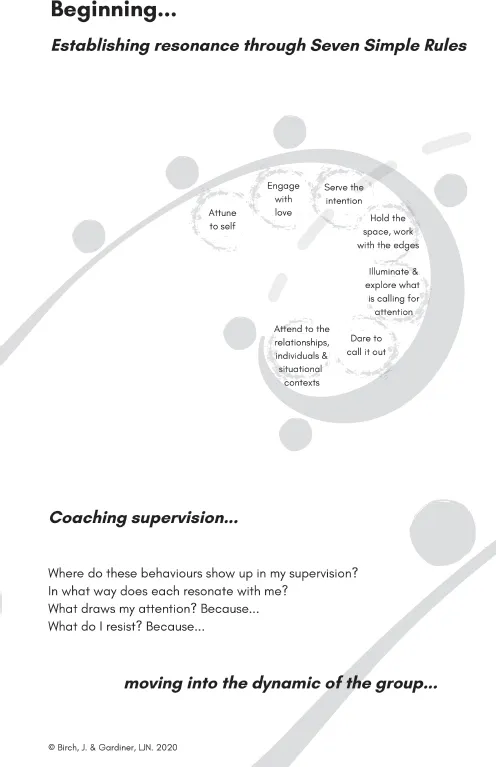
Attune to self – being present to your experiencing, self-awareness, centering.
Engage with love – bringing kindness, care and compassion to the engagement.
Serve the intention – honouring the contract and the agreed purposes in each encounter, being explicit, checking in with each other as necessary.
Hold the space, work with the edges – the quality of the reflective space. Interwoven with explicit contracting, acknowledging the boundaries as they come into view, holding and/or adapting where necessary.
Illuminate and explore what is calling for attention – focussing on what is present, reflecting moment-to-moment, offering wider reflections, noticing distractions.
Dare to call it out – reflecting what is present, in stories, cases, responses, relationships, dynamics and more, is not always comfortable, yet can provide the basis for fruitful exploration.
Attend to the relationships, individuals and situational context – taking a systemic approach, attending to the ‘whole, part and greater whole’ (Eoyang & Holladay, 2013).
It is in the Simple Rules that the quality and standards of coaching supervision are held. In both individual and group supervision we look for self-awareness; expect the engagement to be clearly defined by purpose; the container for the work held by boundaries and consideration given to ethical codes, competencies and contractual agreements. In the work of supervision, we give attention to what is present, even if we bring a case from the past; we offer different perspectives and notice newness and, finally, we attend to the multiple relationships and external factors at play influencing our work.
As we move specifically into coaching supervision in groups, the Simple Rules remain central, whether the groups are facilitated or peer-led, open or closed, short or long-term. They are illustrated in the following pages, held within a dynamic image, folding in to create a distinct space for the work of coaching supervision in groups. A dotted line symbolises the flow out of the space, taking our learning about ourselves back into our work.
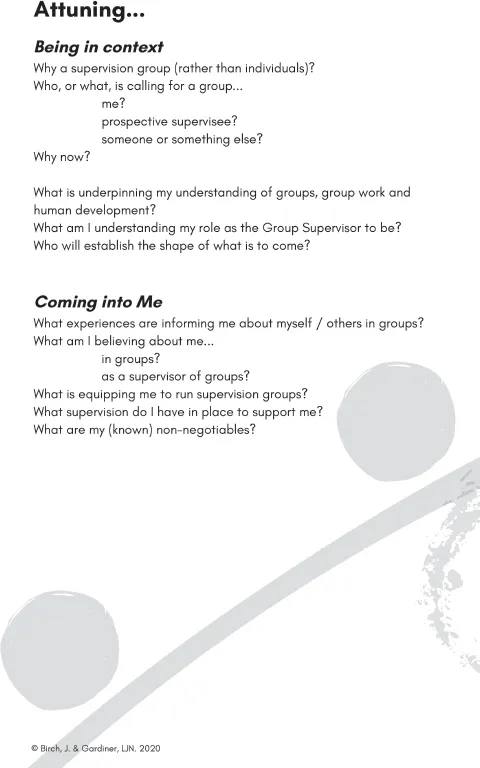
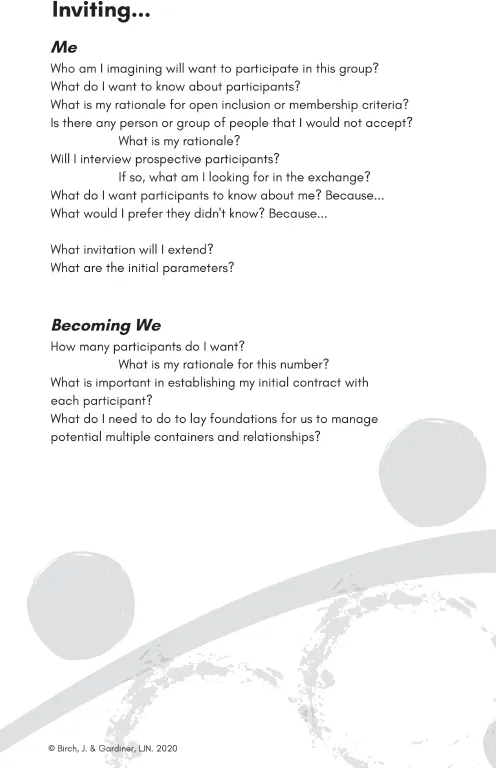
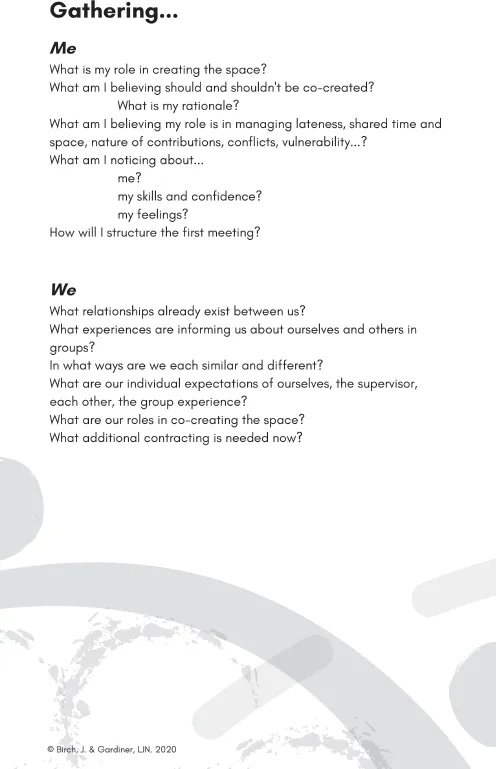
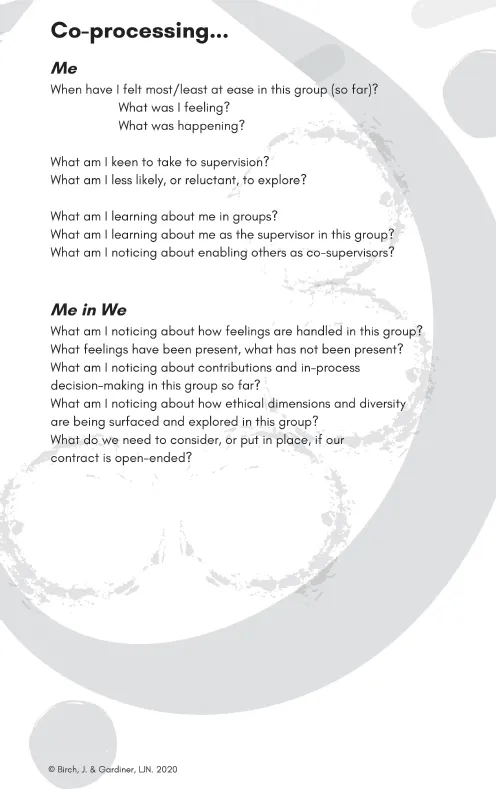
Six discrete sections emerge from the frame, flowing into the space for the group experience: beginning, attuning, inviting, gathering, co-processing and closing. Each section raises questions for the prospective group supervisor. These are designed to peel back layers of awareness, searching underneath the surface for new insights, enabling the potential for more choice-ful decision-making; a quicker return to ‘centre’ after being triggered and, therefore, more dexterity in handling the complex dynamics at play in all groups.
The ‘Beginning’ section is an invitation to the supervisor to establish resonance with their existing practice through the Seven Simple Rules. These considerations remain the core purpose of a Coaching Supervision experience and serve as a point of reference as the group process unfolds.
Many of the subsequent questions reflect the balance between ‘the supervisor role’ and the desire for co-creation.
This exploration can be profound, touching on the supervisor’s feelings and beliefs regarding power, control and collaboration. Being able to bring a clear awareness into view at different stages in the process, to hold power without harm and to hold the boundaries when necessary are essential skills of the group supervisor.
The inner reflections of the supervisor are generally offered as ‘Me,’ with ‘We’ acknowledging the collective co-created space of supervisor and group members. In peer groups every member might hold the inner reflective and collective questions as roles move and develop.
Everything we are; our experiences with groups and the beliefs we hold about ourselves, others and groups, have the potential to affect the process that unfolds between us. Much of what we think and feel about groups lies out of our conscious awareness with no obvious need for surfacing in our everyday lives – although, I suggest, it is always influencing our behaviour. As we embark as supervisor on a group experience, it serves us to explore unconscious factors at play as those that remain out of view are potentially disruptive.
These are not the only questions you will encounter. Subsequent chapters will raise issues; later, in your supervision groups, moment-to-moment decision-making and group process manifestations will surface, calling to be addressed or taken to your own supervision.
Here, however, within the following seven pages you will find essential catalysts to help you shape your evolving personal and professional philosophy of your practice as a supervisor working, in this case, with groups. The journey of discovering ‘self’ in groups is likely to be a life-long commitment for the group supervisor.
Figure 1.1 Coaching supervision in groups: Framing the encounter
Figure 1.2 Coaching Supervision in groups: Beginning
Figure 1.3 Coaching Supervision in groups: Attuning
Figure 1.4 Coaching Supervision in groups: Inviting
Figure 1.5 Coaching Supervision in groups: Gathering
Figure 1.6 Coaching Supervision in groups: Co-processing
Figure 1.7 Coaching Supervision in groups: Closing
Acknowledgements
The author would like to acknowledge Louie J N Gardiner for creative and editorial support.
References
Birch, J., & Gardiner, L. J. N. (2019). Seven Simple Rules: An Alternative Lens. In Coaching Supervision: Advancing Prac...
Table of contents
Cover
Half Title Page
Title Page
Copyright Page
Dedication Page
Contents
List of Contributors
Acknowledgements
Foreword
Introduction
1 Coaching supervision in groups: framing the encounter
2 Group supervision with executive coaches: a psychodynamic approach
3 No way is the only way
4 Meaning-making encounters: the strength of peer supervision
5 The terror and transformation of coaching supervision groups
6 Nature as dynamic co-partner in group supervision
7 Moving bodies: countering digital disembodiment
8 Virtual small group supervision – research informing practice and practice being the research
9 Using creative approaches in group supervision
10 Group supervision using the Mirror model
11 Linking learning: a peer supervision chain
12 Tastes of supervision
13 Fifty-plus years of supervision: individual, group, peer and community, the development of a distinct profession
Index
Trusted by 375,005 students
Access to over 1.5 million titles for a fair monthly price.
Study more efficiently using our study tools.
Frequently asked questions
Yes, you can cancel anytime from the Subscription tab in your account settings on the Perlego website. Your subscription will stay active until the end of your current billing period. Learn how to cancel your subscription
No, books cannot be downloaded as external files, such as PDFs, for use outside of Perlego. However, you can download books within the Perlego app for offline reading on mobile or tablet. Learn how to download books offline
Perlego offers two plans: Essential and Complete
Essential is ideal for learners and professionals who enjoy exploring a wide range of subjects. Access the Essential Library with 800,000+ trusted titles and best-sellers across business, personal growth, and the humanities. Includes unlimited reading time and Standard Read Aloud voice.
Complete: Perfect for advanced learners and researchers needing full, unrestricted access. Unlock 1.5M+ books across hundreds of subjects, including academic and specialized titles. The Complete Plan also includes advanced features like Premium Read Aloud and Research Assistant.
Both plans are available with monthly, semester, or annual billing cycles.
We are an online textbook subscription service, where you can get access to an entire online library for less than the price of a single book per month. With over 1.5 million books across 990+ topics, we’ve got you covered! Learn about our mission
Look out for the read-aloud symbol on your next book to see if you can listen to it. The read-aloud tool reads text aloud for you, highlighting the text as it is being read. You can pause it, speed it up and slow it down. Learn more about Read Aloud
Yes! You can use the Perlego app on both iOS and Android devices to read anytime, anywhere — even offline. Perfect for commutes or when you’re on the go. Please note we cannot support devices running on iOS 13 and Android 7 or earlier. Learn more about using the app
Yes, you can access Coaching Supervision Groups by Jo Birch in PDF and/or ePUB format, as well as other popular books in Business & Mentoring & Coaching. We have over 1.5 million books available in our catalogue for you to explore.