Awakening: An Introduction to the History of Eastern Thought provides the reader with a thorough and valuable overview of the historical development of the major Eastern religious and philosophical traditions, primarily in India, China, and Japan. The book is written in an engaging style that contains a variety of anecdotes, analogies, definitions, and supporting quotes from primary and secondary sources. Awakening helps the reader to recognize the interrelationships that exist among the various traditions, to appreciate the relevance of these traditions to the concerns of modern times, and to understand the major issues of interpretation regarding these traditions. The primary focus of Awakening is Hinduism and Buddhism, and they serve as the broad umbrellas that include a number of specific schools, each of which is treated individually. Other schools–such as Confucianism, Daoism, and Shinto–are included at the appropriate place.
Awakening is for all students and interested readers, whether new to the study of Eastern thought or not.
New to the Seventh Edition: - A new Introduction - A clearer definition and explanation of "Yoga" (throughout Part 1) - A rewrite of the Aryan Migration section in Chapter 1, bringing it in line with current research - An added sub-chapter to Chapter 6, dealing with Kundalini Yoga - Further clarification of the meaning of Anatman in Chapter 10 - Emphasis on the contribution of Daoism to Chan Buddhism - Clearer presentation of the Life of Buddha (Legend vs. Reality) - Updated Study Questions - Two new videos added to the companion website
Key Features: - An historical overview that attempts to show the development of Eastern philosophies, both within the individual traditions as well as within a broad but loosely unified system of thought - Abundantly uses stories in chapter overviews to engage student readers and to better explain Eastern thought - No background in Asian studies, philosophy, or religious studies is presumed, allowing any student to greatly benefit from reading this book - A functional, visually attractive web site www.patrickbresnan.comwithauthor-produced videos on the content of the book, scores of pictures, and a comprehensive section on meditation
Part IHinduism and Related Traditions of South Asia
DOI: 10.4324/9781003223559-1
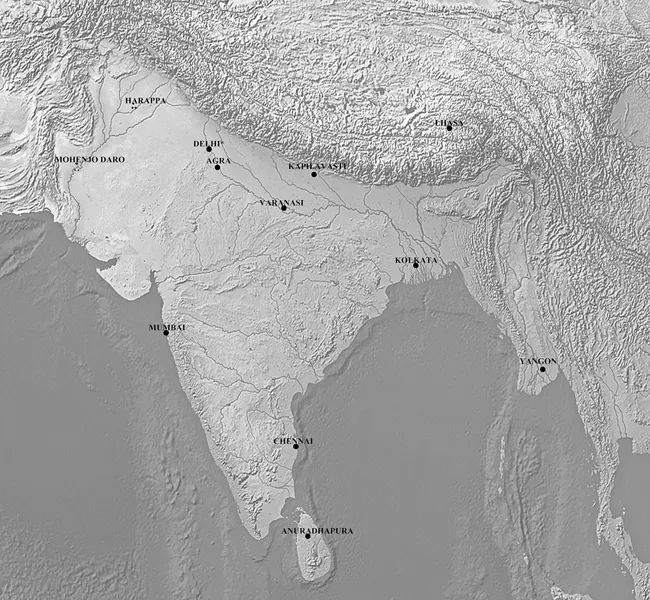
FigureI.1 Map of South Asia.
Source: Map reprinted with permission of Kappa Publishing Group Inc.
Hinduism is a hard word to pin down. It refers to far more than a specific religion or philosophy. Some argue that the word Hinduism refers to the entire culture and traditional way of life of the people of India. For our purposes, the word Hinduism designates that tradition of thought that arises from and accepts the sacred authority of the Vedas, the earliest spiritual and philosophical compositions of Indian civilization. That leaves room for other “non-Hindu” traditions within the history of Indian thought, and we shall examine the most important of these in Chapter 6. The largest part of the story, though, concerns the evolving tradition that began in the Vedas and progressed through stages to the sublime mystic philosophy expressed in the Upanishads and the Bhagavad Gita. In Part I, we will concentrate on that main line of development.
Chapter 1 India before the Vedas
DOI: 10.4324/9781003223559-2
Veda is a powerful word. It is derived from the early Sanskrit word vid, which means “to know,” as in the sense of knowing the truth. Veda thus means knowledge of truth. More specifically, it refers to a sacred, infallible truth, available to only a gifted few, who transmit that knowledge for the benefit of all.
In ancient times the Brahmin priests were the custodians of Veda; it was their responsibility to preserve that sacred knowledge and to use it for the well-being of the entire community. To a large degree, that was accomplished through the performance of religious ritual. Over time those ritual celebrations grew to include long chants which came to be known as the Vedas, religious compositions that expressed the essential truths of Veda. The Vedas, composed more than 3,000 years ago, are the earliest recorded expressions of the Indian tradition. They were, nonetheless, the product of a culture that was far older still.
The earliest evidence of urban civilization in India appeared approximately 5,000 years ago and even that grew out of still older roots. Of course, history knows little of what was going on in those early days. Our historical knowledge of that emerging tradition starts with the Vedas, and it is thus with the Vedas that our study properly begins. But before we get to that, though, it would be valuable to travel back in time and take a somewhat closer look at the background out of which the Vedas took form and that influenced them in many important ways. Most fundamental of all is the physical character of the Indian subcontinent—the stage, so to speak, on which the great drama would take place. And that is where we shall begin.
The Lay of the Land
The huge subcontinent of India appears on the map to hang gracefully from the southern flank of Eurasia. Its generally triangular shape extends for a thousand miles (1,609 km) into the Indian Ocean, dividing that sea into the Arabian Sea on the west and the Bay of Bengal to the east. Just off the southern tip of India, and almost connected to it by a land bridge, is the beautiful teardrop-shaped island of Sri Lanka. For centuries known as Ceylon in the West, Sri Lanka has always been closely connected geographically and culturally with India.
Approximately one-half the size of the United States, the Indian subcontinent is effectively isolated by geography from the rest of the Eurasian continent. In the south India confronts the sea. The vast Himalaya and their associated ranges stretch out across the entire northern frontier from west to east. On a map the northern mountains have the appearance of a great curtain gracefully draped across the entire reach of the Indian subcontinent. The mountains and the sea have defined India geographically and have, to a degree, isolated it from the rest of the world.
India has not always been a part of the Eurasian continent. Many millions of years ago all of the present-day continents were joined into one great landmass. At that time India was an integral part of what would eventually become the separate continents of Africa, Antarctica, and Australia. The ceaseless movement of the plates that form the earth’s crust eventually broke loose the land we know as India, just as today the great rift system of East Africa is evidence that the slow process of plate movement is again separating another piece of that continent from the mainland.
Over millions of years the Indian plate moved in a generally northward direction, eventually colliding with the southern flank of Asia. There were no great mountains then, but as the Indian plate pressed relentlessly against the Asian plate the upper layers at the interface began to slowly fold and crumple into nascent mountain ridges, while the lower part of the Indian plate (many geologists believe) tunneled under the Asian plate, and the land began to rise.1 In time, the high plateau of Tibet took form. The leading edge of what had once been a low coastal plain was eventually thrust almost 30,000 feet (9,144 m) into the sky. Over the ages, the forces of erosion have sculpted that geology into the magnificent chain of mountains we know as the Himalaya, which literally means “abode of snow.”
1 The Great Indian Ocean earthquake and tsunami of 2006 were dramatic evidence that the plate movement is still going on.
Where there are great mountains there are great rivers. Many rivers flow out of the northern mountains. Eventually they merge into two great river systems. In the west is the Indus system, from which India derives its name. Several rivers gather in the northwest to form the Indus, which then flows to the south emptying into the Arabian Sea near the modern city of Karachi. In modern times the Indus flows almost entirely within the nation of Pakistan.
The other great river system is the Ganges, “Ganga” as the people of India call it. The Ganges gathers several major tributaries and flows in a generally eastward direction across the north of India, finally meeting the sea not far from the modern city of Kolkata (formerly known as Calcutta). For more than 1,500 miles (2,414 km) that great river winds its way through the fertile plain of North India. It is in the enormous Ganges plain that much of the history and most of the people of India are to be found. The Ganges, “Mother Ganga,” is a sacred river in the Hindu tradition. Along its banks are to be found many hallowed sites in the history of Hinduism, including the holy city of Varanasi.
For more on this subject, go to the video “VARANASI” on the companion website for this book (www.patrickbresnan.com).
The great Ganges basin is known to geographers as the North Indian Plain. South of it the land rises somewhat, becoming a hilly plateau that extends for a thousand miles all the way to the southern tip of India. That plateau, which encompasses almost all of southern India, is called the Deccan. It rises gently in elevation from east to west extending almost all the way to the west coast, near which the Deccan abruptly erupts into a long line of low coastal mountains known as the Western Ghats.
India is, for the most part, a tropical country. It knows great heat. In the south the environment is lushly tropical and hot, but in the mountainous north a totally different environment is to be found. In fact, just about every kind of climate is to be found somewhere in India, but tropical heat is definitely the most common environment. From June to October, the wet monsoon winds from the south bring almost constant rainfall to much of India, but during the rest of the year dry winds from the north are the rule.
After merging with Eurasia, India became an integral part of its geology. For many millions of years that varied and beautiful subcontinent evolved in a perfect state of nature. Every conceivable kind of flora and fauna flourished in that land—every kind but one; and in the course of time that one too would come to India and establish itself there.
South Asia before the Vedic Age
No one knows when the first of our human ancestors entered India. Over the ages there must have been many waves of migrations. Eventually, a more or less stable human population took form. Aboriginal Indian culture was undoubtedly made up of many discrete groupings with different customs and distinctly different languages. One large language family, though, known as Dravidian, became widely distributed in the subcontinent, and hence it is often used as a label for the entire original Indian culture.
The one exception referred to above was indeed impressive. In the western part of the subcontinent, in the Indus and associated river valleys, social evolution did not languish at the level of the small farming community. Here, urban life germinated; genuine cities took form. Beginning in the 1920s, archaeologists have been uncovering numerous urban sites, not only in the vicinity of the Indus and its tributaries, but also along the banks of the Sarasvati River, east of the Indus. The Sarasvati, now almost entirely dried up, was a great river in ancient times, and is mentioned prominently in the Vedas. It is customary to lump all of these sites together, referring to the whole as the Indus Civilization.
What is most exciting to the historian about those Indus Valley cities is the time when they came into being; they were among the earliest in human history! Much is known about early civilization in the Tigris-Euphrates Valley of Mesopotamia and in the nearby Nile Valley of Egypt. City life and the accompanying elements of civilization had taken shape in Mesopotamia before 3000 BCE and somewhat later in Egypt. Archaeological excavations in the Indus River Valley at such sites as Mohenjo-daro and Harappa are now revealing that early civilization in the Indus Valley was contemporaneous with those of Mesopotamia and Egypt. Mesopotamia is often referred to as the “cradle of civilization”; Egypt joined it in the cradle very early on. We are now discovering that there was a third baby in that cradle, the early civilization of the Indus Valley.
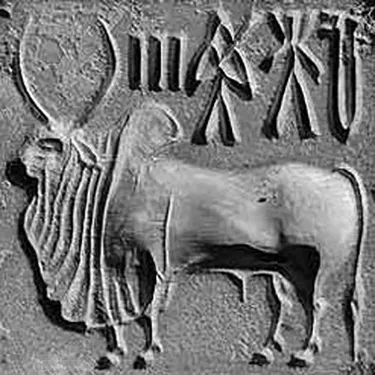
The excavations at Mohenjo-daro and Harappa give us a fascinating glimpse into the culture of those people, but only a glimpse. They did possess a pictographic form of writing, but it stubbornly, and maddeningly, resists being deciphered. Nevertheless, some things are clear. Their cities, constructed mostly of mud brick and fired brick, were marvels of engineering. They were especially clever in the technology of water management including municipal drainage systems that surpassed anything the world would see again until Roman times. The streets were broad and brick paved and laid out in a way that divided the city into an efficient pattern of blocks. It seems that the standard of living was generally high. Many decorative pieces have been recovered from these sites. A few of them suggest yogic themes that would become important later on in Indian history. The Indologist Romila Thapar makes reference to:
…cities with a grid pattern in their town plan, extensive mud-brick platforms as a base for large structures, monumental buildings, complex fortifications, elaborate drainage systems, the use of mud bricks and fired bricks in buildings, granaries, or warehouses, a tank [sacred pool] for rituals, and remains associated with extensive craft activity related to the manufacturing of copper ingots, etched carnelian beads, the cutting of steatite seals, terracotta female figurines thought to be goddesses, and suchlike.
(Thapar, 110)
Figure1.1 An Indus seal (No. 1) showing the mysterious pictographs.
Photo by the author
It is a sad fact of history that this exciting and promising beginning in the Indus Valley eventually declined and died out. Civilization in the Middle East continued to flourish and spread, but in the Indus Valley it declined, and by the end of the third millennium BCE the once great cities were mostly abandoned and disintegrating. What happened? There are many possible explanations for that decline. One of the more plausible theories concerns the slow but relentless destruction of the natural environment by the generations of people who lived in those cities and towns. As the population continuously grew, and the resources of the environment were plundered without being restored, the time must eventually have come when urban life would no longer have been tenable. (Sound familiar?)
The decline of the Indus Civilization (also referred to as the Harappan Period) was apparently accompanied by a deep cultural depression, but it was to be relatively short-lived. A new age was about to dawn in North India, and its defining feature would be the composition of the Vedas. The cities of the Harappan Age Period were in their final stage of decline around 1900 BCE. Scholars are in pretty general agreement that the composition of the Vedas began sometime around 1500 BCE (though, it should be noted that some would put that date as late as 1200 BCE).
For an excellent tour of the Mohenjo-daro site, check out https://www.youtube.com/watch?v=FweuwWu5cCU.
The Aryan Migrations
The decline of the Indus Civilization (also referred to as the Harappan Period) was apparently accompanied by a deep cultural depression. The cities of the Harappan Age were in their final stage of decline around 1900 BCE. Eventually all traces of the once great cities would be lost.
Scholars are in pretty general agreement that the composition of the Veda...
Table of contents
Cover
Half Title Page
Title Page
Copyright Page
Table of Contents
List of Figures
Acknowledgments
Introduction to the Seventh Edition
Part I Hinduism and Related Traditions of South Asia
Part II Shakyamuni Buddha and the Early Development of Buddhism
Part III Non-Buddhist Traditions of East Asia
Part IV Buddhism in China and Japan
Works Cited
Index
Trusted by 375,005 students
Access to over 1.5 million titles for a fair monthly price.
Study more efficiently using our study tools.
Frequently asked questions
Yes, you can cancel anytime from the Subscription tab in your account settings on the Perlego website. Your subscription will stay active until the end of your current billing period. Learn how to cancel your subscription
No, books cannot be downloaded as external files, such as PDFs, for use outside of Perlego. However, you can download books within the Perlego app for offline reading on mobile or tablet. Learn how to download books offline
Perlego offers two plans: Essential and Complete
Essential is ideal for learners and professionals who enjoy exploring a wide range of subjects. Access the Essential Library with 800,000+ trusted titles and best-sellers across business, personal growth, and the humanities. Includes unlimited reading time and Standard Read Aloud voice.
Complete: Perfect for advanced learners and researchers needing full, unrestricted access. Unlock 1.5M+ books across hundreds of subjects, including academic and specialized titles. The Complete Plan also includes advanced features like Premium Read Aloud and Research Assistant.
Both plans are available with monthly, semester, or annual billing cycles.
We are an online textbook subscription service, where you can get access to an entire online library for less than the price of a single book per month. With over 1.5 million books across 990+ topics, we’ve got you covered! Learn about our mission
Look out for the read-aloud symbol on your next book to see if you can listen to it. The read-aloud tool reads text aloud for you, highlighting the text as it is being read. You can pause it, speed it up and slow it down. Learn more about Read Aloud
Yes! You can use the Perlego app on both iOS and Android devices to read anytime, anywhere — even offline. Perfect for commutes or when you’re on the go. Please note we cannot support devices running on iOS 13 and Android 7 or earlier. Learn more about using the app
Yes, you can access Awakening by Patrick S. Bresnan in PDF and/or ePUB format, as well as other popular books in Theology & Religion & Philosophy History & Theory. We have over 1.5 million books available in our catalogue for you to explore.