eBook - ePub
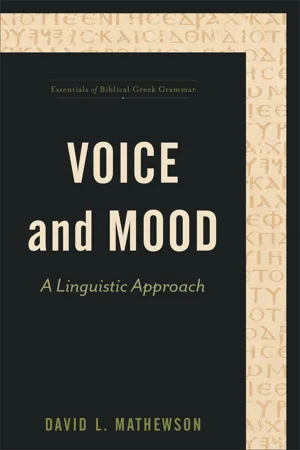
Voice and Mood (Essentials of Biblical Greek Grammar)
A Linguistic Approach
- 208 pages
- English
- ePUB (mobile friendly)
- Available on iOS & Android
eBook - ePub
Voice and Mood (Essentials of Biblical Greek Grammar)
A Linguistic Approach
About this book
A recognized expert in Greek grammar examines two features of the Greek verb: voice and mood. Drawing on his years of teaching experience at a leading seminary, David Mathewson examines these two important topics in Greek grammar in light of modern linguistics and offers fresh insights. The book is illustrated with examples from the Greek New Testament, making it an ideal textbook for the intermediate Greek classroom. This is the first volume in a new series on Greek grammar edited by Stanley E. Porter.
Information
Topic
Theology & ReligionSubtopic
Biblical ReferencePart 1: Voice
1
Recent Scholarship on Voice
Introduction
Voice is a significant but frequently underdeveloped feature of the Greek verbal system. Yet it can be very important for interpreting the Greek New Testament. To illustrate voice, the following two English sentences are semantically similar in their content and what they describe as taking place; they differ, however, in their perspective on the way the action is portrayed as taking place and how the participants are involved in or affected by the action within the clause:
The student purchased the book.
The book was purchased by the student.
In simple terms, in the first sentence the subject, “the student,” is responsible for initiating the action of purchasing, with “book” being the object or recipient of the action. However, in the second sentence “the book” is now the grammatical subject, but it is still the recipient of the action of purchasing. In the second sentence the entity responsible for initiating the action of purchasing, the agent of the action (“student,” which is the subject in the first sentence), is now indicated by the prepositional phrase “by the student.” The grammatical feature that deals with this phenomenon is voice, specifically how the subject relates to the action of the verb. The former sentence is an example of an English active voice construction, and the latter a passive voice construction. As already noted, Greek indicates voice through the use of a series of verb endings. In addition to the active and passive voices illustrated in the above examples, Greek also exhibits a third voice not represented in English: the middle.
The first chapter of this section will consider contemporary treatment of voice in the Greek of the New Testament. It will discuss voice as it is explained in recent Greek grammars and then consider three specialized studies of voice in ancient and New Testament Greek. The next chapter will lay out the linguistic model followed in this part of the book on voice. I will argue that Systemic Functional Linguistics (SFL) provides a workable model for understanding the Greek voice system, once the difference between the voice system in Greek and English is understood. The third and final chapter of this section will consider the meaning of voice in Greek, followed by a treatment of each of the individual voices as well as deponency and the interpretive significance of voice.
Recent Treatments of Voice in New Testament Greek Grammars
Ancient Greeks referred to voice as διάθεσις (diathesis), referring to the disposition of the subject to the action of the verb.1 Both ancient and modern grammars have theorized on the meaning and function of voice in the ancient Greek language. Here we will consider only some of the more recent attention given to the voice system in the Greek of the New Testament. The lack of attention to voice is beginning to be rectified with some important work on the Greek voice system (see below). In this first portion of this chapter we will consider the treatment of voice in intermediate-level and reference-type Greek grammars. Modern-day New Testament Greek grammars frequently treat voice in somewhat abbreviated fashion, often as part of a general introduction to the Greek verb or in connection with other elements of the Greek verb (e.g., person and number), and with little theoretical reflection on the voice system in Greek.2 Usually grammars include a very brief definition and discussion of voice, followed by (with few exceptions) a fairly standard list of labels that ostensibly classify the variety of voice usages in context. To illustrate the typical treatment of voice in Greek grammatical discussion, we will consider and summarize only a selection of the most recent grammars.
Stanley E. Porter, in his Idioms of the Greek New Testament, defines voice as “a form-based semantic category used to describe the role that the grammatical subject of a clause plays in relation to an action.”3 Despite his rather informed treatment of Greek voice covering eleven pages, Porter admits that there is much more work to be done on voice in New Testament Greek. In his treatment of the specific voices, Porter states that for the active voice “the agent . . . is the grammatical subject of the verb.”4 In relationship to the other voices, it is the least semantically weighty. He discusses the active voice in relation to its use with verbs of perception, its use with verbs of motion, and its usage with the accusative case functioning adverbially. For the passive voice, the grammatical subject is the object or recipient of the verbal process, placing attention on the grammatical subject as the recipient of the action. Porter discusses the passive voice in relation to specified and unspecified agency, and the role of the accusative case objects. Finally, the middle voice, rather than carrying a reflexive meaning, expresses more direct participation, specific involvement, or some form of benefit of the grammatical subject.5 The middle is the most semantically weighty of the three voices. Rather than relying on the typical labels used by other grammars (see below), Porter discusses translating the middle voice, important usages in the New Testament, and the issue of deponency. On deponency, Porter is ambiguous about its value and concludes that the interpreter might be justified in finding middle meaning in all deponent verbs.6
Richard A. Young devotes three and a half pages to voice.7 He defines voice as “a morphological feature that conveys the relation of the subject to the action of the verb.”8 In general, the active voice means the subject performs the action, the middle voice indicates the subject participates in the results of the action, and the passive voice means the subject is the recipient of the action. He then proposes the following labels (a mixture of semantic and functional notions) for their various usages in context: active—simple, causative, reflexive; middle—direct (reflexive, which is rare), indirect, permissive, reciprocal, deponent; passive—thematizing the subject, omitting the agent, emphasizing the agent, passive with a middle sense, deponent passive. Deponent verbs, according to Young, have middle or passive forms but are active in meaning.9
In his important study on the Greek verb, Kenneth L. McKay devotes a separate chapter to voice, covering six pages.10 His treatment of voice is from the perspective of the relationship of the grammatical subject to the action of the verb. McKay postulates three voices in Greek: active, passive, and middle. Basically, the active voice represents the subject as engaging in the action of the verb; the passive voice, the subject being acted upon; and the middle voice, the subject as acting on, for, or toward itself.11 Because he sees it as differing little from its English counterpart, the active voice requires little explanation, though sometimes the active can be used when the agent has someone else act for him or her. For the middle voice, McKay says that it “is characterized by a reflexive idea”12 and then reverts to some of the typical labels for describing its function in different conte...
Table of contents
- Cover
- Half Title Page
- Series Page
- Title Page
- Copyright Page
- Contents
- Series Preface
- Acknowledgments
- Introduction
- Part 1: Voice
- Part 2: Mood
- Conclusion
- Bibliography
- Author Index
- Scripture Index
- Subject Index
- Back Cover
Trusted by 375,005 students
Access to over 1.5 million titles for a fair monthly price.
Study more efficiently using our study tools.
Frequently asked questions
Yes, you can cancel anytime from the Subscription tab in your account settings on the Perlego website. Your subscription will stay active until the end of your current billing period. Learn how to cancel your subscription
No, books cannot be downloaded as external files, such as PDFs, for use outside of Perlego. However, you can download books within the Perlego app for offline reading on mobile or tablet. Learn how to download books offline
Perlego offers two plans: Essential and Complete
- Essential is ideal for learners and professionals who enjoy exploring a wide range of subjects. Access the Essential Library with 800,000+ trusted titles and best-sellers across business, personal growth, and the humanities. Includes unlimited reading time and Standard Read Aloud voice.
- Complete: Perfect for advanced learners and researchers needing full, unrestricted access. Unlock 1.5M+ books across hundreds of subjects, including academic and specialized titles. The Complete Plan also includes advanced features like Premium Read Aloud and Research Assistant.
We are an online textbook subscription service, where you can get access to an entire online library for less than the price of a single book per month. With over 1.5 million books across 990+ topics, we’ve got you covered! Learn about our mission
Look out for the read-aloud symbol on your next book to see if you can listen to it. The read-aloud tool reads text aloud for you, highlighting the text as it is being read. You can pause it, speed it up and slow it down. Learn more about Read Aloud
Yes! You can use the Perlego app on both iOS and Android devices to read anytime, anywhere — even offline. Perfect for commutes or when you’re on the go.
Please note we cannot support devices running on iOS 13 and Android 7 or earlier. Learn more about using the app
Please note we cannot support devices running on iOS 13 and Android 7 or earlier. Learn more about using the app
Yes, you can access Voice and Mood (Essentials of Biblical Greek Grammar) by David L. Mathewson, Porter, Stanley E., Stanley E. Porter in PDF and/or ePUB format, as well as other popular books in Theology & Religion & Biblical Reference. We have over 1.5 million books available in our catalogue for you to explore.