- 227 pages
- English
- ePUB (mobile friendly)
- Available on iOS & Android
eBook - ePub
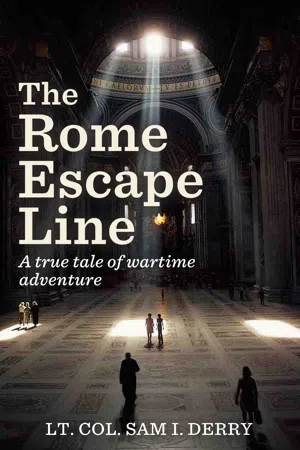
The Rome Escape Line
About this book
The Rome Escape Line, first published in 1960, is the firsthand World War II account of British Army officer Sam Derry, who, himself an escaped prisoner-of-war, remained in Rome to help other escaped POWs remain in hiding or to safely flee Italy altogether. With the help of Right Rev. Monsignor Hugh O'Flaherty, an official in the Vatican's Holy Office, Derry is given the assignment of overseeing the escape operation, obtaining money, papers, food, and lodging for the escapees. Unfortunately, there were traitors and leaks to deal with, and the German response following round-ups of captured POWs was often brutal. Overall,
The Rome Escape Line provides valuable insight into a remarkable operation, reported in a humble, matter-of-fact manner by a true war-hero.
Information
Subtopic
European HistoryIndex
History1. Road to Rome
This is madness, I thought, as the carriage door whipped open, and I plunged from the speeding prisoner-of-war train out into the Italian morning sunshine. I had jumped on the spur of the moment, and I still wince when recalling how the stony track rushed up to hit and bounce me, and then rose to hit me again, fearsomely close to the deafening roar and clanking of the carriage wheels. The air was blasted from my lungs in a sudden, overwhelming flash of multicolored pain.
I first touched the ground in an ungainly crouch, pitched forward, skidded cm all fours, and, after an eternity of seconds, scraped to a spread-eagled halt, flat as a deflated inner tube.
I lay waiting to be shot.
Incredibly, inexplicably, the shots never came. Maybe if the German guards fired at all they did so while I was hurtling through the air and bouncing along the ballast. The north-bound train, with its nailed-in cargo of British prisoners-of-war, raced on towards Germany, the terrifying clatter of the iron wheels faded rapidly into a confused rumble, and then to blessed silence. Still only half aware of reality, but satisfied that I remained in one piece, I could scarcely believe my good fortune. I had broken every rule in the escape-book, and should have broken every bone in my body.
Train-jumping was the gateway to freedom for many British prisoners during the Second World War, but it was a hazardous business from which satisfactory results came rarely if the rules were not carefully observed. I was better placed than most to know them, and if I had stopped to think before jumping I should probably not have chosen the moment when the crowded prison-train was blundering through the Apennine foothills at rather more than thirty miles an hour, but would have waited for it to slacken speed on a gradient; nor would I have jumped in the broad daylight of morning, with the friendly cloak of night still far ahead; nor while the train was in a deep cutting, with steep hanks on either side, and no possibility of a dash for cover.
Moreover, I was inadequately dad for escape, without food, money, documents, maps, or even any dear idea where I was, and—final folly—I had jumped from the wrong side of the train—that is, the side from which guards, leaning through windows, could the more easily raise their carbines and fire back along the line.
By all the rules, if I avoided breaking my neck, I should have been peppered with bullets, or failing that, the best to expect was that the train would be stopped, and a detachment of unsympathetic guards sent to reclaim me. As it was, I was so grateful for my luck that I could overlook the hammer-blow pains and a violent stabbing sensation in the right leg. For the second time since falling into the German bag in February, the previous year, I was free again. I could hardly refrain from laughing aloud.
After the night in a dim and airless railway compartment, the glare of the summer sun hurt, and I had to screw up my eyes, and shied them with an unsteady hand. I looked back along the track towards Sulmona, northward along the track towards Germany which I had said I would never reach, and along the tops of the embankments. Nowhere was there any sign of life or movement.
Content in spite of the nagging pain in my leg, I dragged myself up the steep bank, and surveyed the Italian landscape, yellow and dusty green under a blue sky. It was farmland, but scrubby, and studded with the stony outcrops of the foothills, and, although I knew little of the Italian rural economy, it was fairly obvious that it would not be densely populated. The combination of few people and a certain amount of cover, in the form of rocks, bushes, and occasional copses, was promising, for while I was grateful to find myself in one piece, I realized that I was in no condition to travel far. With more bruises than I had ever collected on the pre-war rugby field, I felt rather as though I had been charged by a rhinoceros.
Consequently the two miles of Italy over which I crawled in the next hour and a half were the longest I ever knew. The urge to stop and rest was almost irresistible, yet prison-camp caution prevailed, and I was never quite satisfied with the cover that presented itself. It seemed an age before I reached a small but relatively dense wood, which offered not only reasonable cover but also an interesting view of a little group of squat, flaking buildings, forming the center of a peasant smallholding, on the rising pound above. Where there are people there is food; but escape is always largely a waiting game, so I settled as comfortably as possible among the prickly bushes, watched, and waited.
So far as I had a plan at all, it was to head southward and link up with the Allied forces which had already landed in the toe of Italy. I thought I was on the road to reunion with the Allies, with the Gunners, and, perhaps, at length with my wife, Nancy, at home in Nottinghamshire. I supposed I would be posted ‘missing’ again, and wondered what she would think—she, to whom I had so recently written plaintively, “What an end of three years’ fighting, to be captured, especially after my luck...But the road on which I had embarked so impetuously that morning did not take me either towards the front line or towards Nancy; I was on a strange road to Rome.
In the scrubby wood, with sunny shafts slanting like theatrical spotlights down through the branches on to the leggy ants that marched and counter-marched with pointless determination round where I lay, my only desires for the immediate future were food, drink, and a bottle of embrocation. To plan further ahead was useless, but I had ample time to reflect as I lay and waited for the sunlight to surrender to the dusk; escapers are creatures of the night.
As a Territorial officer in the Royal Artillery, I had gone to France with the woefully inadequate British Expeditionary Force on the outbreak of war, and, thanks to the gallantry of big men with little ships and my own good fortune, had emerged unscathed through Dunkirk. After the fall of France the only land front on which Britain remained in engagement with the enemy was North Africa, so I was not surprised to find myself a Desert Rat. In the early days, before General Rommel’s Afrika Korps joined the unwarlike Italians, there was a peculiar swashbuckling charm about the way in which a little British Army fought its way up and down the narrow coastal strip that confined the ebb and flow of the desert war. But as 1941 wore on, the increasing number of Germans on the sand added a new element of grimness to the North African campaign, and at the beginning of 1942, after a misunderstanding with the infantry ‘screen,’ my battery was overrun, and I found myself ‘in the bag.’
It was my first experience of being a prisoner, and I did not care for it, but escape proved almost too easy. Probably the Germans had never expected to make such an impressive haul of prisoners at one go, and consequently supervision of the depressed Englishmen herded together near the edge of a wadi—an ancient river gorge, long dried up—was well below the usual Nazi standards of efficiency. Since I was the officer who had chosen that site as a defense point, I had a pretty thorough knowledge of the local geography, and it seemed that if I could only get into the deep wadi there would be a sporting change of escaping.
After obliging a questioning German intelligence officer with my rank and name, I worked my way through the group of prisoners, almost inch by inch, as near as I could to the edge of the ravine, and then made a dash for it. My luck held good, and although the guards opened fire, there was enough desert scrub to provide cover, and in 200 yards I had reached the steep edge, and was over. Rolling and sliding down the slope, I reached the bottom in a flurry of sand and small stones—right beside the barely visible entrance of a tiny cave. I shot into it like a rabbit, squeezed all six-foot-three of me into its comforting darkness, and lay there panting, and feeling pretty pleased with myself. The Germans could not send vehicles down, and if they spared a few of their infantry guards there was still a good chance of evading discovery. In fact, the Germans lost interest in me with unflattering rapidity, and the spasmodic rifle-fire and shouting from above ceased almost before I had regained my breath.
I remained until dusk, and then, guided by the stars, jog-trotted along the wadi and over the desert for eighteen miles before catching up with the Allied rearguard and coming close to being shot by an alert Scottish highlander. If this is escape there is not much to it, I thought, but I was to learn that it is not always so simple. For, after a few more minor battles, I was captured again the following July, when we were overtaken by a German motorized unit while foot-slogging back to the last-ditch defense line at El Alamein. This time my luck had gone off duty, because we had seen the vehicles from afar, and had taken cover behind boulders, but the Germans had decided to camp near by for the night—and to dig their latrines right in the middle of the group.
Bundled into a captured British ambulance, I was confronted by a blue-scarfed German officer, who remarked in surprisingly good English, “I seem to have seen you before—weren’t you near Derna a few months ago?” This was the sort of question often posed in an attempt to extract information, but my routine noncommittal reply produced a sardonic grin of disbelief from the German.
“Oh, yes, you were,” he retorted. “You are Major Derry, of the First Field Regiment.”
There was no point in further denial, for five months after my first capture, 800 miles away, I had been retaken by the very same German unit, and was now being interrogated by the same intelligence officer.
We spent the rest of the time in the ambulance, chatting quite cozily, for he had spent most of his pre-war summers in the Isle of Man, as a T.T. rider for one of the German motorcycle manufacturers.
We drove, eventually, northwest to Matruh, and hopes of making another dash for liberty declined when I was put into a strong prisoner-of-war cage, which we ourselves had built earlier, and as, stage by stage, we moved towards the west, escape chances seemed hourly to become slimmer. Finally, in an ancient transport aircraft, a number of us were flown across to the Italian mainland. We were not provided with parachutes, and it was an unnerving experience for British officers, who knew how thoroughly Royal Air Force Hurricanes and Beaufighters were sweeping the narrow sea-lane between Africa and Sicily. Ironically, at a time when hardly any of the German supply planes were getting through to the hard-pressed General Rommel, this ancient transport machine, with its load of unproductive mouths for the Axis to feed, waddled safely to Lecce, in Southern Italy. Since I had not been prepared to wager on our making landfall at all, I was happy enough to have both feet on the ground again, even on enemy soil.
On the other hand, escape now was clearly going to present considerable problems, and although I could not discover the ghost of an opportunity at the transit camp at Bari, I was delighted to discover on arrival at the enormous P.G.21 at Chieti that I need no longer be a lone wolf. The camp, the largest of its kind in Italy, contained 1200 officers, and most of them seemed to be engaged in some form of activity aimed at escape. They were linked together in a remarkable organization, which could provide anything from cash, clothing, and ‘official’ passes to iron rations and train timetables. The versatility of the organization sprang from the wide range of experience and interest of its vast membership, which represented a complete cross-section of British life—spiced by the inclusion of a few celebrities like Freddie Brown, the England Test captain and manager, and Tony Roncoroni, the English Rugby international, and Phillip Gardner, London’s first V.C. of the war.
Eventually, I became a member of the escape committee, which co-ordinated all the getaway plans, and was assigned the task—an incongruous one for a large gunner with a civilian background of building and water-engineering—of securing the provision of rations for escapers and tunnel-builders. This work involved the construction, from condensed milk, biscuits, chocolate, and other unlikely ingredients discovered in Red Cross parcels, of small hard-tack cakes, which were as tough as teak, and tasted like sweetened sawdust, but were so high in nutriment that a man could carry food for a fortnight in one pocket. It was unfamiliar work, but it brought me into touch with many aspects of escape organization that I had never dreamed existed, and it did not take long to learn that escaping from Europe involved much more than making a dash for it, and setting a hopeful course under the stars.
I might have remained a minor and insignificant member of the organization but for an unexpected development in the spring of 1943. The entire population of the camp was turned out on parade in the middle of the night. At first nobody was much concerned, since that sort of thing had happened before, sometimes because the guards were in a panic and wanted to make a snap roll-call, and sometimes, we suspected, merely for the pure hell of it. On this occasion a disconcerting difference became clear when the Italian guard commander read out a list of the names of officers who were to be transferred from the camp in an hour’s time—a list that included most of the senior officers and all the principal members of the escape committee.
Still relatively the new boy, I was not named, and immediately after roll-call the Senior British Officer, Colonel Marshall, sent for me, and commanded, “Derry, I want you to take over the escape committee as from now. You’ve only got an hour to find out all you need to know from the others, so you’d better get cracking.”
“Very good, sir,” I replied, feeling the situation was anything but that
In a flurried fifty minutes I chased round all the members of the shattered committee as they gathered together their blankets and biscuit-tins full of the pathetic possessions that in a prison camp become a man’s greatest treasures and the sole surviving indications of his individuality.
As the dust settled behind the departing lorries I was left with a nagging worry, for the membership of the escape committee was something that the Italians would have been unlikely to discover unaided: somewhere among Chieti’s caged hundreds there must be a traitor. It was unwise to permit major escape activity until this leak had been checked, so I asked the new committee to direct all its immediate efforts towards the unmasking of treachery. The inquiry continued for weeks, and we were never wholly successful, although all investigations seemed to lead to the camp sick-quarters, where several non-commissioned Allied prisoners were employed.
My own suspicion fell most heavily on the small dark frame of a multi-lingual private named Joe Poliak, a Cypriot of Czech extraction, who was frequently in animated conversation with the Italian guards, and was apparently on good terms with them. Poliak, who mixed little with the other prisoners, probably knew that he was under observation, but remained always enigmatic and inscrutable—and continued to chat with the guards in his flawless Italian. Apart from that, he never put a foot wrong, so we had to treat the whole of the hospital as a potential hot-bed of spies, and issued firm instructions that no information about escape activity, however trivial, should be allowed to drift in that direction.
That done, the committee set about the complete reorganization of the camp’s escape system. The basic plan was one of mass-production, and from that time there were never fewer than six escape tunnels under construction at a time. Whenever the probing guards discovered the beginnings of one, as they did occasionally, in spite of the ingenuity of sapper officers in creating concealed entrances, another was started at once.
As the work progressed I became convinced that the natural corollary to mass-production was mass-escape, for obviously the discovery of one successful tunnel after a breakout would jeopardize all the others that were near completion. So the orders went out to the sweating teams of troglodytes, who spent their days entombed, scraping at the dry earth with primitive tools or even with their hands, that work on each tunnel was to be stopped at the point where it could open up on the far side of the walls and the wire at short notice. The theory was that if half a dozen tunnels could burst through the surface simultaneously a large number of prisoners might be able to make their way to freedom before the alarm was raised.
At one stage I became hopeful that the tunnels, with all their appalling difficulties for men below and above the ground—we had to cultivate enormous vegetable gardens to dispose of the excavated earth—might never be needed at all, for over the secret radio-receiver, maintained by the organization in one of them, came the welcome news that the Allies had overrun Sicily, invaded Italy, and precipitated the fall and arrest of Mussolini, the Fascist dicta...
Table of contents
- Title page
- Table of Contents
- Author’s Foreword
- 1. Road to Rome
- 2. Cabbages and Colonnades
- 3. Two Tall Monsignors
- 4. Underground Army
- 5. No Red Tabs
- 6. New Year Nightmare
- 7. Ghost of the Vatican
- 8. Homing Pigeon and Caged Lion
- 9. Ides of March
- 10. Denunciation
- 11. Thrust and Parry
- 12. Open City
- 13. Liberation
Trusted by 375,005 students
Access to over 1.5 million titles for a fair monthly price.
Study more efficiently using our study tools.
Frequently asked questions
Yes, you can cancel anytime from the Subscription tab in your account settings on the Perlego website. Your subscription will stay active until the end of your current billing period. Learn how to cancel your subscription
No, books cannot be downloaded as external files, such as PDFs, for use outside of Perlego. However, you can download books within the Perlego app for offline reading on mobile or tablet. Learn how to download books offline
Perlego offers two plans: Essential and Complete
- Essential is ideal for learners and professionals who enjoy exploring a wide range of subjects. Access the Essential Library with 800,000+ trusted titles and best-sellers across business, personal growth, and the humanities. Includes unlimited reading time and Standard Read Aloud voice.
- Complete: Perfect for advanced learners and researchers needing full, unrestricted access. Unlock 1.5M+ books across hundreds of subjects, including academic and specialized titles. The Complete Plan also includes advanced features like Premium Read Aloud and Research Assistant.
We are an online textbook subscription service, where you can get access to an entire online library for less than the price of a single book per month. With over 1.5 million books across 990+ topics, we’ve got you covered! Learn about our mission
Look out for the read-aloud symbol on your next book to see if you can listen to it. The read-aloud tool reads text aloud for you, highlighting the text as it is being read. You can pause it, speed it up and slow it down. Learn more about Read Aloud
Yes! You can use the Perlego app on both iOS and Android devices to read anytime, anywhere — even offline. Perfect for commutes or when you’re on the go.
Please note we cannot support devices running on iOS 13 and Android 7 or earlier. Learn more about using the app
Please note we cannot support devices running on iOS 13 and Android 7 or earlier. Learn more about using the app
Yes, you can access The Rome Escape Line by Sam Derry in PDF and/or ePUB format, as well as other popular books in History & European History. We have over 1.5 million books available in our catalogue for you to explore.