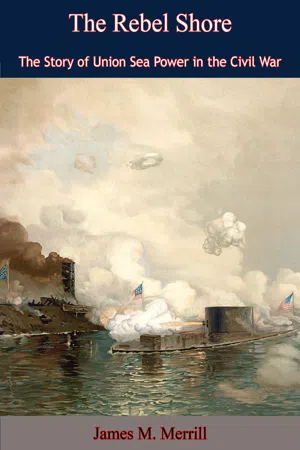
First published in 1957, this book details the important part that the sea power played in winning the Civil War.
"IN the past few decades there has been a resurgence of interest in the Civil War reflected in an avalanche of Civil War novels, biographies, and monographs. The writers responsible for this torrent have for the most part focused attention on the battlefields, the halls of Congress, the economics of war, and the actors, big and small. The role of sea power has been minimized. The best work on Civil War naval operations is still Boynton's two-volume work published in 1867. No author to date has sifted the countless number of official naval dispatches or unearthed personal correspondence of Yankee bluejackets and attempted to evaluate the importance of Lincoln's forces afloat. The reason is not difficult to find. The Civil War generation—a generation weaned on the marching armies of the Mexican War and the American West—read column after column in its newspapers and listened to politicians in and out of Congress raving about the military achievements or defeats. Misunderstood by the Lincoln Administration, the war correspondents, and the public at large, the operations of the Union sea arm were given scant publicity.
"Union amphibious attacks spearheaded the offensive. They were, perhaps, more significant than the blockade itself. Old Abe's Armada carried the flag first into the South, secured needed bases for the blockading squadrons, wiped out Confederate coastal commerce, scotched privateering activities, precipitated the ruckus between the secessionist states and the Confederate Government, and, throughout the first year of the conflict, while the Union Army licked its wounds after Bull Run, buoyed up a sagging Northern spirit and strengthened the belief that the Union could crush the rebellion."
- 181 pages
- English
- ePUB (mobile friendly)
- Available on iOS & Android
eBook - ePub
About this book
Information
Subtopic
19th Century HistoryIndex
HistoryCHAPTER I—UNCLE GIDEON UPS ANCHOR
THE White House watchman shook the President from a sound sleep. Lincoln, wide-awake, without bothering to put on a robe, ran down the dark halls, entered the Cabinet Room, and shook hands with Gus Fox, who had just arrived from the Navy Department. After an excited exchange, the President suddenly grasped his adviser, jumping around the room in his nightshirt and dancing a jig. Naval gunboats had just won the first Union victory of the Civil War. Across town bleary-eyed editors cleared the front pages and telegraph operators drummed out the official report: Federal triumph at Hatteras Inlet, North Carolina, many captured, 30 cannon, a brig, sloop, schooner, 150 bags of coffee, whiskey, and quantities of onions.
The next morning, 1 September 1861, two months after the blood-spattered headlines had reported the Yankee disaster at Bull Run, the shouts of newsboys hawking extras pierced the gloom of Northerners. In Boston, the Journal dubbed the victory an entering wedge. In Washington, amid bands blaring “Hail to the Chief,” massive Ben Butler, his eighteen brass buttons glittering in the torchlight, strutted to the National Hotel, where he babbled to the cheering crowd: “Oh, it was glorious to see...the arm of the Union stretched out against its rebellious children.”
Across the Potomac River behind Southern lines, street-corner orators yelled until they were red in the face, denouncing the Hatteras fiasco; officials, state and national, scrambled to deflect blame; panicky residents along the Carolina coast stuffed valuables into saddlebags and hurried inland to safety, a few not stopping until they reached Kentucky. Citizens of Beaufort County verbally castigated the Confederate Government and threatened revolt. Raleigh was plunged into confusion. At New Orleans, a wild-eyed editor scared the daylights out of readers by warning: “Our coasts to be ravaged...defenseless women and children to be murdered.” The Confederacy’s Secretary of the Navy suffered a sick stomach when he heard the news. An irate Congress demanded intelligence on the collapse of the forts.
The huzzahs, the trumpet blasts, the red, white, and blue bunting which engulfed the North after this first conquest relieved Lincoln and his Administration from the increasing pressure of whispers, rumors, and criticism. Only five months before, the American nation, rocked by the slavery controversy, had blundered into a civil war when Confederate artillery in Charleston Harbor forced the Union garrison inside Fort Sumter to hoist the surrender flag.
Shortly after Lincoln had been elected President of the United States in November 1861, South Carolina had cleared out of the Union, pulling Florida, Georgia, Alabama, Mississippi, and Louisiana after her. Meeting at Montgomery, Alabama, delegates from the six states hatched a provisional constitution for the Confederate States of America and pushed Jefferson Davis of Mississippi into the executive chair. This government promptly pounced on Federal arsenals, forts, and installations in the South, including the navy yard at Pensacola. When Lincoln announced on 6 April 1861 that Union naval forces would relieve Fort Sumter, the Confederate Government ordered the guns leveled and fired.
At 5 P.M. on 12 April the telegraph wires crackled with news from Charleston Harbor. The war had begun! It was quiet at the Navy Department that afternoon. On the second floor of this unpretentious brick building, Secretary Gideon Welles, riffling through official correspondence, shivered a little at what he read. The sea arm of the Union was flabby. Welles counted a total of ninety vessels. Fifty were sailing ships—frigates, sloops, and brigs—which, splendid vessels in their day, were now obsolete in the age of steam. Gunboats rotted in navy yards. Many were too worm-eaten to get under way. Rigged for peacetime pursuits, the thirty-eight-ship steam fleet was in deplorable condition. The engines of five were so decrepit that black gangs were unable to turn them over. The side-wheeler Michigan patrolled in the Great Lakes. Three steamers were unserviceable. The Union’s five frigates, Merrimac. Wabash, Minnesota, Roanoke, and Colorado, ships which formed the main element of American naval strength, were laid up in ordinary.
These were a new class of frigates built in the 1850s. Their hulls were long in proportion to their breadth; their bows were sharp; stems were rounded. Typical of this class, Minnesota measured 269 feet in length, 51 in breadth, and was armed, in 1863, with one 150-pounder rifled cannon, four 100-pounder rifles, one 11-inch rifle, and forty-two 9-inch rifles. Most formidable frigates afloat, these American warships could have far outmatched a British ship of the same class.
The Navy Department soon discovered that the rivers, sounds, and inlets along the Southern coast and inland waters were too shallow, too tortuous to admit these massive vessels. None of them was to perform any service in the Civil War proportionate to its size and strength except in coastal bombardments.
The twenty-four steamers in commission were scattered across the Seven Seas on foreign stations. The 4500-ton, heavily armed sloop-of-war Niagara was somewhere in the Pacific, returning to New York from Japan. The five first-class screw sloops, San Jacinto, Lancaster, Brooklyn, Hartford, and Richmond; the side-wheel steamers, Susquehanna Powhatan, Saranac, Pulaski, and Saginaw; the eight second-class screw sloops, Mohican, Narragansett, Iroquois, Wyoming, Dacotah, Pocahontas, Seminole, and Pawnee; and the third-class screw steamers Mystic and Sumter were cruising on station in Mediterranean, African, South American, Pacific, and Gulf waters. Only three steamers and twenty-one guns of the home squadron were ready to fight a war in the Atlantic and blockade more than thirty-five hundred miles of enemy coast: the third-class screw steamers Mohawk and Crusader in New York, and the screw sloop Pawnee in Washington.
The naval establishment was snafued. Secretary Welles totaled only 207 enlisted men in all the ports and receiving ships on the Atlantic coast. Naval bureaus in Washington were hopelessly bogged down in wartime red tape. Officers, sympathetic to the Rebel cause, were entrenched at the Bureau of Ordnance and at the Naval Observatory. Many resigned. Welles could not tell friend from foe. The handful of officers who remained—“worn-out men without brains,” one lieutenant described them—most of them pigheaded and top-heavy with gold braid, clogged the higher echelons of the Navy and demanded top commands at sea.
The arrangement of the Navy List failed to meet the essential conditions of readiness. The long years of peace, the unbroken course of seniority promotion filled the top grades with gallant but sluggish veterans, unfit for active service afloat. Alert, able commanders and lieutenants stagnated in subordinate positions. The vicious system of promotion by seniority permitted every officer who lived long enough, unless a fool or degenerate, to go to the top of the list. As promotion never varied, there was no inducement to effort. Officers grown old by inaction exercised little, if any, volition. The tendency of the Navy in 1861 was to preserve tradition, to repress individuality. Men thought alike, talked alike, acted alike, and, in a few instances, looked alike.
The Navy was unprepared for its task. The Union was unprepared to use naval superiority. This was a new generation in 1861, weaned on a marching army: a generation that witnessed the Army conquering Mexico, the Army shooting down Indians and winning the American West; a generation which, by avoiding entangling alliances, had scant need for a Navy. Northerners and Southerners hardly noticed that they had already swapped sail for steam, side-wheelers for screw propellers, and soon would replace wooden with iron ships, and smoothbores with rifled guns.
Naval architecture and ordnance had undergone little change during the century preceding 1840. With only a few refinements, men-of-war differed little in appearance, structure, propulsion, rigging, and armament from those of a hundred years before. The massive two-and three-decked sailing warships were the symbols of sea power, strong and awe-inspiring. Smoothbore cannon and solid shot prevailed in ordnance.
Toward the mid-nineteenth century the substitution of steam for sail marked the beginning of a new era, an era of rapid far-reaching developments. The sailing frigate, her mission accomplished, gave way first to the paddle-wheeler, then to propeller-driven vessels. Gunnery experts exchanged shot for shell, increased calibers, and adopted rifling and breech-loading. Despite this revolution in naval ordnance, the Union Navy during the Civil War depended chiefly upon the 9-, 10-, and 11-inch smoothbore, muzzle-loading Dahlgren guns.
Naval power was little understood by Americans. At a Washington dinner party, the dapper new Secretary of State, William Seward, shocked a British correspondent when he whispered that none of the Cabinet knew anything about a navy. To blockade the South, Simon Cameron, the wizened, white-haired chief of the War Department, advised Lincoln that he needed only a few coasting vessels armed with pop guns. New York shipping bosses estimated that thirty sailing schooners would do the trick. The old fogies of the Navy, remembering the glorious days of 1812, visualized fleet collisions and men battling hand-to-hand on the open decks. Change was ignored by those marine fossils, the Navy brass, who toasted the Good Old Days with champagne and claimed that wooden ships and sail were good enough. Northerners, finding no precedents, no landmarks to consult, had no clear idea of what was necessary to fight a war at sea.
Ignorant of naval principles, its ships deteriorating at the wharves, the nation launched a spending spree to collect all craft that floated. First-class steamers, Staten Island ferryboats, “floating barns,” whalers, yachts, coal barges, garbage scows, tugs, fishing smacks, and rowboats were stamped “U.S. Navy” and towed off to shipyards for overhaul. From these sources the Navy Department established the blockade of the Southern coast and met the vast demands of the Army for troop transportation. Once converted, many of these steamers, some armed with eight g-inch guns, others with a 100-pounder rifle, proved formidable warships.
When Secretary Welles set out to build a steam navy, he faced obstacles. The two dozen machine shops from Maine to Maryland lacked the tools and skilled workmen requisite for the production of marine machinery. The War Department drew heavily upon these resources. The locomotive and tool-making shops found it impossible to meet the demands. Raw materials were scarce. Iron, copper, tin, and coal had to be mined and manufactured. The nation called for hundreds of steamers and locomotives, shops full of tools, and tons of metal. Nothing on hand answered the call. Inexperienced labor could not be converted into highly trained mechanics overnight.
Despite such handicaps, the Navy Department contracted builders to fabricate twenty-three 90-day gunboats for work in the shallow waters of Southern rivers and sounds. These 500-ton, schooner-rigged vessels had a maximum speed of nine knots and carried one 11-inch pivot gun and three 24-pounder howitzers.
Once these gunboats were launched, the Department ordered the construction of sloops-of-war, efficient ocean cruisers of about 1000 tons each, armed with two 11-inch guns and four 32-pounder smoothbores. These were designed to chase and capture the nimble Confederate privateers and blockade-runners.
Experiments proved that the screw steamers were worthless in the crooked channels of Confederate rivers. They could not back, go ahead, and retire in the same line. To withdraw, these single-screws had to turn, which was impossible in the narrow channels. The Department ordered twelve 850-ton side-wheelers. Under fire, these craft failed to live up to expectations, Welles then contracted for twenty-seven double-enders, whose wheels and engines were in such a position that the crafts backed and went ahead with equal facility.
While beefing up the fleet with steamships, the Secretary changed the unrealistic system of officer promotion and, by acts of Congress, gradually retired all officers at the age of sixty-two, created the rank of Rear Admiral, and promoted promising officers. But the habits of forty years could not easily be altered.
To lure more officers into the sea service, the Department watered down the course at the Naval Academy and pledged fancy bonuses to merchant skippers, ferryboat captains, pilots, and mates with experience if they exchanged freighters for fighting ships. The Navy dug deep to find enlisted personnel. State and local authorities paid huge bounties for enlistment in the Army. Transfers between the two services were not authorized by law. To meet the competition and recruit seamen, the Department offered monetary inducements which ran as high as $1000.
Country bumpkins and hardened mariners, hotel clerks and river boatmen, the honest and dishonest joined up. At stations scattered throughout the East, recruits underwent a quick medical examination, pocketed 3¢-per-mile travel money, made out allotments for families, and learned that their pay was $12 a month for three years. At the receiving ship, North Carolina, the decrepit wooden two-decker moored at the Brooklyn Navy Yard, storekeepers handed the new seaman a pea jacket, blue cloth trousers, flannel shirts, woolen drawers, a mattress, two blankets, a seamless cap, and a black handkerchief. The recruits, 2000 strong on North Carolina, sometimes waited months for assignments to the squadrons.
Night after night Welles toiled at the Navy Department, his flat-topped desk littered with papers and charts, Neptune Welles, the Old Man of the Sea, chief of the Bureau of Provisions and Clothing in the 1840s, had little tactical know-how, still less of overall naval strategy. As a sop to New England, Lincoln had appointed this ex-Democrat, small town politician, and editor from Hartford to his inner circle. Welles looked more like a weather-beaten Santa Claus than a Cabinet officer. With his flowing gray-white beard, his unkempt but massive toupee, and his iron-rimmed spectacles, Grandfather Welles appeared much older than his fifty-nine years. Cautious and methodical, irritable and critical, an indefatigable worker who thrived on red tape, this Connecticut Yankee had qualities that attracted respect if not much personal popularity.
Another New Englander, Gustavus Vasa Fox, son-in-law of Lincoln’s Postmaster General, Montgomery Blair, was appointed Assistant Secretary. Well connected, “smart as Hell” on naval matters, he offset Welles’s limitations. This little man—“about five feet nothing”—with balding head and a tattoo was a real seaman. Gus Fox had served eighteen years in the Navy, surveying American coasts, commanding mail steamers in the West Indies, blockading in Mexican waters, and witnessing British naval operations in the Mediterranean. He had turned in his one stripe to become a cotton-mill executive in Massachusetts. He planned rather than executed, always ready to chuck timeworn tactics for novel schemes, always ready to postpone action, to put off operations until the last possible moment. Aggressive, endowed with excessive energy, he was utterly unable to sit long at his desk. As the war progressed, he took to drinking large quantities of whiskey punch, which put bags under his eyes and gave him a pasty-faced, dissipated appearance. These two men, Welles and Fox, piloted the destiny of the Yankee Navy.
The rickety and barnacle-encrusted Union fleet was opposed by a few privateers, merchantmen, and the Confederate Navy Department in Richmond. Added strains rupture the belligerent which flounders on the seas. To keep armies in the field, arms and ammunition must be produced or imported. The Southerners with only a phantom navy lacked capital, labor, and facilities to turn out war essentials and relied on England to clear the sea lanes. “Why, creation!” a North Carolinian boasted to an English reporter. “If you let the Yankees shut up our ports, the whole of your darned ships will go to rot.”
To protect vast reaches of Rebel coast from an aggressive sea power would have drained men and guns from the battlefields to coastal zones. The Confederates were impaled on the horns of a dilemma: pull out troops from in front of Federal armies or expose the seaboard. If they stripped the shores of protection, state governors, unwilling to trust the “common defense” and fearing repercussions from an angry citizenry, might defy the overall war effort and reroute state troops from the Virginia firing line to their own beaches; cotton-and food-producing areas might be occupied by Union troops; Confederates on the far-flung battlefronts might focus attention on the defense of their home shores.
Blissfully ignorant, Lincoln and his Cabinet w...
Table of contents
- Title page
- TABLE OF CONTENTS
- DEDICATION
- PREFACE
- CHAPTER I-UNCLE GIDEON UPS ANCHOR
- CHAPTER II-“GLORY! GLORY! GLORY!”
- CHAPTER III-“FOR GOD’S SAKE, SURRENDER!”
- CHAPTER IV-CAT-AND-MOUSE
- CHAPTER V-“THE CONFEDERACY IS A GONE COON!”
- CHAPTER VI-WELLES UNLEASHES OLD BULLDOG
- CHAPTER VII-STEEL CORSETS GET UNHOOKED
- CHAPTER VIII-SUBMARINES, CIGAR BOATS, AND INFERNAL MACHINES
- CHAPTER IX-“SIXTEEN BELLS!”
- CHAPTER X-“THE SMARTEST DAMN RASCAL THAT EVER LIVED”
- CHAPTER XI-REPULSE AND FINAL VICTORY
- BIBLIOGRAPHICAL ESSAY
- REQUEST FROM THE PUBLISHER
Trusted by 375,005 students
Access to over 1.5 million titles for a fair monthly price.
Study more efficiently using our study tools.
Frequently asked questions
Yes, you can cancel anytime from the Subscription tab in your account settings on the Perlego website. Your subscription will stay active until the end of your current billing period. Learn how to cancel your subscription
No, books cannot be downloaded as external files, such as PDFs, for use outside of Perlego. However, you can download books within the Perlego app for offline reading on mobile or tablet. Learn how to download books offline
Perlego offers two plans: Essential and Complete
- Essential is ideal for learners and professionals who enjoy exploring a wide range of subjects. Access the Essential Library with 800,000+ trusted titles and best-sellers across business, personal growth, and the humanities. Includes unlimited reading time and Standard Read Aloud voice.
- Complete: Perfect for advanced learners and researchers needing full, unrestricted access. Unlock 1.5M+ books across hundreds of subjects, including academic and specialized titles. The Complete Plan also includes advanced features like Premium Read Aloud and Research Assistant.
We are an online textbook subscription service, where you can get access to an entire online library for less than the price of a single book per month. With over 1.5 million books across 990+ topics, we’ve got you covered! Learn about our mission
Look out for the read-aloud symbol on your next book to see if you can listen to it. The read-aloud tool reads text aloud for you, highlighting the text as it is being read. You can pause it, speed it up and slow it down. Learn more about Read Aloud
Yes! You can use the Perlego app on both iOS and Android devices to read anytime, anywhere — even offline. Perfect for commutes or when you’re on the go.
Please note we cannot support devices running on iOS 13 and Android 7 or earlier. Learn more about using the app
Please note we cannot support devices running on iOS 13 and Android 7 or earlier. Learn more about using the app
Yes, you can access The Rebel Shore by James M. Merrill in PDF and/or ePUB format, as well as other popular books in History & 19th Century History. We have over 1.5 million books available in our catalogue for you to explore.