Originally published in 1939, this broad history of East Africa, down to its partition in 1885-1990, forms the third volume in Reginald Coupland's study of East Africa in the nineteenth century, following on from Kirk on the Zambesi (1928) and East Africa and Its Invaders (1938).
This latest instalment is divided into two parts: the first describes the overthrow of the slave trade based on Zanzibar. The second, and longer, part is concerned again with the Invaders of East Africa—the Europeans who divided the country up into spheres of influence, protectorates, and colonies for themselves.
Though Kirk no longer appears in the title of the book, he is its leading figure, working patiently, and in the end victoriously, to compass the destruction of the slave trade; then working, no less patiently but this time without success, for a British protectorate over the Sultanate of Zanzibar and the whole of East Africa.
"Coupland shows us very plainly that in this instance [exploitation] was often accompanied by well-directed and constructive idealism. It remained his firm conviction that the destruction of the slave trade was an essential pre-requisite of orderly evolution in the twentieth century."—Jack Simmons
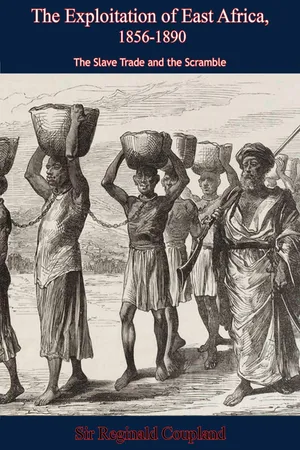
eBook - ePub
The Exploitation of East Africa, 1856-1890
The Slave Trade and the Scramble
- 499 pages
- English
- ePUB (mobile friendly)
- Available on iOS & Android
eBook - ePub
About this book
Trusted by 375,005 students
Access to over 1.5 million titles for a fair monthly price.
Study more efficiently using our study tools.
Information
Subtopic
African HistoryIndex
HistoryPART ONE—THE END OF THE ARAB SLAVE TRADE
I—SEYYID SAID IN EAST AFRICA
1
In the second half of the nineteenth century the Colonial Powers of Europe took possession of almost all mid-Africa—the tropical belt between the Sahara and the Zambesi. East and West, it was an equally easy achievement. Nowhere were there any forces, other than those of Nature, which could offer serious or sustained resistance to the wealth and equipment of European nations. Their only substantial difficulty arose from their own rivalry, from quarrels, flaming up nearly at times but never quite into war, about their respective shares of African soil. But, if it was roughly the same story everywhere, there was one great difference in the way it was unfolded in East Africa and in West. On the west coast Europe had only Africans to deal with. On the east coast she found that Asia had forestalled her and was already in possession. She was confronted with the Arab state of Zanzibar.
This state was the creation of a great Arab, Said-bin-Sultan. In 1806, when he started his remarkable career by usurping the sovereignty of Muscat, mid-East Africa was almost unknown outside the orbit of the western Indian Ocean. Arabs and Indians had traded there from the dawn of history, and the Arab colonies planted along the coast from the beginning of the eighth century A.D. onwards had once been thriving little ‘city-states’, exporting African products to Arabia, Persia and India and importing manufactured goods therefrom. But their prosperity had been blighted in the sixteenth century by subjection to the political control and economic monopoly of the Portuguese; and when after some hundred and fifty years of decline and decay the Portuguese Empire in the East collapsed, they had regained their independence north of Mozambique but little else. Ruined walls and forts and mosques, deserted sites of once populous towns now fast going ‘back to the jungle’, bore witness to a standard of wealth and civilisation that was lost beyond recovery. Never again would Arab travellers write, for all the learned world to read, about the fine houses and gardens, the crowded harbours, the gold and silver and silken garments of Arab East Africa. Even the independence of the Arab colonies was not quite as complete as it once had been. The Imam of Muscat who, backed by the fierce sea-faring folk of Oman, had taken the lead in their deliverance from the Portuguese, had asserted his own overlordship and levied tribute as the price of his protection: and his successors had claimed, though they had not effectively or regularly exercised, the same rights of suzerainty.
It was by enforcing these rights that Said acquired his East African ‘dominions’, as they were termed in the language of international diplomacy. Having spent the first half of his reign in securing his position in south-east Arabia—as far as it was possible to secure it against such militant or predatory neighbours as the Wahabi of the desert or the Jawasmi of the Persian Gulf—he spent the second half in establishing a new political and economic system in East Africa. By force or guile he obtained the submission of all the Arab towns along the coast and on the adjacent islands between Warsheikh in the north and Cape Delgado in the south. At the more important of them he appointed Governors as his personal representatives, supported by little garrisons from his small mercenary army. But the rights of intervention or control implicit in Said’s overlordship were never defined, and in practice the Arab townsmen were allowed as a rule to manage their local affairs under their own traditional sheikhs or sultans. Apart from an occasional interference in disputes or a reference to Said’s ultimate judicial authority, the Governors did little more than collect the quota which Said levied on the customs-dues collected at each port. But the substantial measure of autonomy thus conceded was only local. Just as Said’s overlordship protected the Arab towns from external attack, so it precluded them from any independent relationship with foreign States.
Except in the north, in Somaliland, the subjects of this over-lordship, the townsmen of the coast, were Arabs or Swahili—the name of the mixed Arab and African race, which now far outnumbered the dwindling remnant of pure Arabs, and of the similarly mixed language which had long taken the place of Arabic along the maritime belt. But in the north, at Barawa, Merka and Mogadishu, the original Arab colonies had been dominated and in course of time absorbed by the warlike Somali tribesmen of the countryside. In blood and speech, in custom and character, their inhabitants in Said’s day were predominantly Somali; and among such martial and free-spirited folk the acceptance of Said’s suzerainty was more a matter of acquiescence or convenience than submission: he could never have enforced it. But the Somali and their southern neighbours, the Galla, were, broadly speaking, the only formidable African peoples on the coast. The dreaded Masai dwelt near Mounts Kenya and Kilimanjaro on the western side of the Nyika, the arid thorn-covered wilderness which lies between the maritime belt and the interior. The primitive Bantu tribes along the coast, amongst whom the blood and speech and Moslem faith of the Swahili were steadily spreading, had never been strong enough to question the right of Asiatics from oversea to invade and colonise their country. The Arabs for their part made no attempt to govern them. They sold cloth and wire and beads to them and bought their foodstuffs. They employed them as porters for their caravans. Otherwise they left them more or less alone, since most of their need for labour was met by slaves obtained from the interior. Only one tribe or group of tribes had sufficient political coherence and organisation to deal with the Arabs on anything like equal terms. In the course of its expansion the kingdom of Usambara, centred in a range of mountains some fifty miles from the sea, had extended its control over the people of the coast opposite Pemba island. A conflict between African and Arab might well have resulted: but neither Said nor Kimweri, the capable paramount-chief of the Shambaa at that time, desired to exercise complete sovereignty over that small area. By tacit agreement Kimweri appointed his officials and tax-collectors for the villages and Said his customs-officers at the ports.
Government, in fact, was only a secondary factor in Said’s East African régime. He was a brave but unsuccessful soldier. His methods of administration were of almost patriarchal simplicity. It was to commerce, to the enrichment of himself and his realm, that he gave most of his subtle and sagacious mind: he was, above all else, a merchant-prince. He attempted, therefore, to exercise over his dominions only that minimum of political control which was required for the maintenance of his economic system. The success of that system, far more than any triumphs of diplomacy or statesmanship, won him the place he holds in history.
There were six main threads in his economic policy. In the first place he amplified the monetary system by the introduction of a small copper coinage from India to supplement the existing silver currency—‘Maria Theresa’ dollars and Spanish crowns.{1} Secondly, he simplified the customs system. All imports into his African dominions were charged a regular duty of 5%. There were no export duties, and practically no other form of taxation. Thirdly, he exploited the high fertility of Zanzibar and Pemba islands by encouraging, almost indeed enforcing, the plantation of cloves. Fourthly, he revivified and greatly extended the old Arab caravan-trade with the African interior by means of which African products, especially ivory and slaves, were obtained, partly, as in the case of slaves, to supply the local demand at Zanzibar and the Arab coast towns, but mainly for export at a high profit oversea. Fifthly, he warmly welcomed the first incursions of the western business-world into the East African backwater it had consistently ignored and avoided since the early days of the Portuguese Empire. He concluded commercial treaties with the United States in 1833, with Great Britain in 1839, and with France in 1844, which, except along a stretch of the coast opposite Zanzibar known as the Mrima, granted to the merchants of those countries the same freedom of trade at all Said’s African ports as that enjoyed by his own subjects and provided for the establishment of consulates at Zanzibar. Similar encouragement was given to German enterprise, though a commercial treaty with the Hanseatic States was not concluded till after Said’s death. Last, but not least, he fostered the growth of the Indian community at Zanzibar not only by giving them complete religious, social and economic freedom but also by personal relationships with some of their ablest men and the use of their services in administration and finance. And this he did for the good reason that the Arabs in general lacked the aptitude and the industry needed for the management of business. Indeed in Said’s day, and probably for many generations before it, nearly all the business of Arab East Africa—the banking, the financing of commercial enterprise, the wholesale and even most of the retail trade—was in Indian hands.
Such in outline was the policy which Said pursued in East Africa between 1830 and 1856. Its results were impressive. His primary objective was triumphantly attained: he multiplied his African revenue ten times. Zanzibar grew from an insignificant little town, rarely visited by shipping except for taking in water and provisions, to be the principal port on the western shores of the Indian Ocean, the chief entrepôt for Afro-Asiatic trade, the source of almost all the world’s supply of cloves, the place where more ivory and gum-copal could be bought than any-where else, the biggest slave-market in the East, a focus, finally, if only as yet in a minor degree, of international interest where the consuls of three great western peoples flew their flags and the merchants of four maintained their houses of business. This growth of Zanzibar in wealth and importance was not, of course, the outcome, except as regards the clove-trade, of its own insular resources. It was mainly due to the rapid and far-reaching penetration of the African mainland. The old trade-routes into the interior had been extended farther westwards and new ones opened up. By 1856 Arab caravans, much more numerous now and larger and better equipped, had reached the Great Lakes—Nyasa, Tanganyika and Victoria Nyanza; and adventurous traders were pressing on beyond them in quest of ivory or slaves towards the upper reaches of the Congo and the Nile. Since expeditions of such length meant an absence of two years or more from the coast, little inland settlements had been established at central points or crossways of trade. On the great route from Bagamoyo to Lake Tanganyika there was a regular Arab colony or township at Tabora, substantial permanent trade-posts at Masansa and Ujiji, and lesser ones at intervals on the way up from the coast. All this meant a wide extension of Said’s authority. The itinerant Arab merchants did not annex the country they passed through. As on the coast, so in the interior, their relations with the Africans were primarily commercial. They might make friends with a tribe in order to buy ivory and slaves from it or attack a tribe in order to enslave it; but otherwise they left the natives to their own devices. Nevertheless, armed as they were with muskets, they were usually, if not quite always, the masters of the country through which they marched or in which they set up their trade-posts: and, since they all acknowledged allegiance to their overlord at Zanzibar, it might be held that Said had extended his dominions, in this somewhat tenuous and elastic manner, from the maritime belt to the Great Lakes. It was significant, for example, that the European explorers and missionaries, who in Said’s later years were just beginning to invade the East African hinterland, invariably asked for Said’s blessing on their ventures and obtained from him what was virtually a passport—a letter of recommendation to ensure, as it always did ensure, that the bearer was welcomed and aided on his way by all Arabs or Swahili he might meet inland.
As the result of this highly successful essay in ‘economic imperialism’, Seyyid Said became one of the leading figures in the Arab world. But his power was not as great as his prestige. The stronger he had grown in East Africa, the weaker he had grown in Oman. To maintain his authority in both fields at the same time was a difficult task, especially since the voyage between them, one way for half the year and the other way for the other half, was made almost impossible for sailing ships by the prevailing winds. He had seen the difficulty at the outset and chosen to face it. So determined was he to pursue his African ambitions that, for that reason first and foremost among several, he had actually shifted his seat of government from Muscat to Zanzibar. That was in 1840, and by 1856 the result was plain. In East Africa his authority was normally unquestioned, but in Oman his long absences had consistently meant trouble. At regular intervals he had been summoned back from Zanzibar to save his throne and homeland from external attack or internal intrigue and disaffection. More than once, indeed, he would not have saved them if the British Government in India had not come to his help; and when he did recover his grip of Oman unaided, it was more by prestige than power: his personal authority was unique; and it may well have been his realization of that fact that determined him to arrange for the partition of his swollen realm at his death between two of his sons. Which section he himself preferred was obvious enough. Before he died Said was already much more Sultan of Zanzibar than of Muscat.
2
It remains to consider the international position of Said’s dominions.
The downfall of the Portuguese Empire had not freed the Asiatic States on the coasts of the western Indian Ocean from the menace of European imperialism. Dutchmen, Frenchmen and Englishmen were soon at work in the field vacated by the Portuguese. In course of time the Dutch had concentrated their energies on the East Indies, leaving France and Britain to fight for supremacy in India and on the seas around it. Between 1756 and 1815, as the outcome of three wars, the issue was decided. Britain established her command of the seas and fortified it by the acquisition of Cape Colony, Ceylon, Île de France (renamed Mauritius) and the Seychelles. But the French were not excluded, as they could have been excluded, from this area. The settlement of 1814-15 left them in possession of a foothold on the western coast of India at Mahé and, more important, the island of Bourbon (renamed Reunion in 1848) and two or three trading-pos...
Table of contents
- Title page
- TABLE OF CONTENTS
- PREFACE
- ILLUSTRATIONS
- PART ONE-THE END OF THE ARAB SLAVE TRADE
- PART TWO-THE INTERNATIONAL SCRAMBLE
- ABBREVIATIONS USED IN THE FOOTNOTES
- REQUEST FROM THE PUBLISHER
Frequently asked questions
Yes, you can cancel anytime from the Subscription tab in your account settings on the Perlego website. Your subscription will stay active until the end of your current billing period. Learn how to cancel your subscription
No, books cannot be downloaded as external files, such as PDFs, for use outside of Perlego. However, you can download books within the Perlego app for offline reading on mobile or tablet. Learn how to download books offline
Perlego offers two plans: Essential and Complete
- Essential is ideal for learners and professionals who enjoy exploring a wide range of subjects. Access the Essential Library with 800,000+ trusted titles and best-sellers across business, personal growth, and the humanities. Includes unlimited reading time and Standard Read Aloud voice.
- Complete: Perfect for advanced learners and researchers needing full, unrestricted access. Unlock 1.5M+ books across hundreds of subjects, including academic and specialized titles. The Complete Plan also includes advanced features like Premium Read Aloud and Research Assistant.
We are an online textbook subscription service, where you can get access to an entire online library for less than the price of a single book per month. With over 1.5 million books across 990+ topics, we’ve got you covered! Learn about our mission
Look out for the read-aloud symbol on your next book to see if you can listen to it. The read-aloud tool reads text aloud for you, highlighting the text as it is being read. You can pause it, speed it up and slow it down. Learn more about Read Aloud
Yes! You can use the Perlego app on both iOS and Android devices to read anytime, anywhere — even offline. Perfect for commutes or when you’re on the go.
Please note we cannot support devices running on iOS 13 and Android 7 or earlier. Learn more about using the app
Please note we cannot support devices running on iOS 13 and Android 7 or earlier. Learn more about using the app
Yes, you can access The Exploitation of East Africa, 1856-1890 by Sir Reginald Coupland in PDF and/or ePUB format, as well as other popular books in History & African History. We have over 1.5 million books available in our catalogue for you to explore.