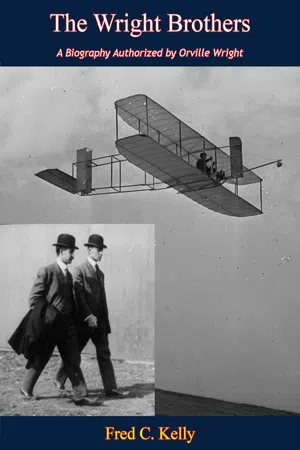
On December 17, 1903, in a fragile little plane which they had built at home for less than $1,000, Wilbur and Orville Wright made the first powered flights in the history of mankind—and opened the Air Age.
Why did these two brothers, mechanics by trade, succeed where trained scientists—working with unlimited funds and the backing of great institutions—had repeatedly failed?
In this biography, authorized by Orville Wright and first published in 1943, Fred Kelly separates fact from legend and recreates the dramatic achievements of two men, self-taught inventors, who solved the "impossible" problem of flight.
The Wright Brothers is a story of total adventure—the sharp physical adventure of flight in perilously frail machines, and the breathtaking intellectual adventure of minds discovering through tireless research and sudden, brilliant hunches the solution to the "impossible" problem of flight.
Fred Kelly is recognized as one of the world's foremost authorities on the Wright brothers—their growth, their struggles, their disappointments and their ultimate triumph. For more than thirty years he was a personal friend of Orville Wright and talked with him daily while writing this book. The result is a vivid recreation of the birth and pioneer days of aviation and an intimate, affectionate portrait of two men whose inventive genius changed the world.
"A gripping book on a fascinating subject..."—Boston Globe
- 226 pages
- English
- ePUB (mobile friendly)
- Available on iOS & Android
eBook - ePub
About this book
Information
Subtopic
American Civil War HistoryIndex
HistoryXIX—WHY THE WRIGHT PLANE WAS EXILED
WHY WAS the original Wright airplane, the first flying-machine in the world capable of flight, deposited in the Science Museum at South Kensington, London, England, rather than in the United States National Museum, administered by the Smithsonian Institution, at Washington? Why should Exhibit A of one of the greatest of all American scientific achievements have been in exile?
For the answer to these questions, puzzling to a vast number of patriotic Americans, we must trace events back a number of years.
It will be remembered that Dr. Samuel P. Langley, while Director and Secretary of the Smithsonian, with a $50,000 government fund at his disposal for experiments (besides $20,000 from the Hodgkins fund), had failed in his attempts to build a successful man-carrying flying-machine. At each trial, in 1903, his machine promptly fell from its launching platform into the Potomac. Doubtless Langley’s failure was a bitter disappointment to him—all the more so because he was derided in the public press for having even tried what was commonly believed to be impossible. But when the Wrights flew, only nine days after Langley’s final unsuccessful trial, they in a measure saved the Langley reputation. No one could any longer say that he was a “crank.” The Wrights had vindicated his belief that man could fly.
Langley uttered no word to minimize the importance of the Wrights’ feat. Nor was anything unfriendly toward Langley ever said by either of the Wrights. On the contrary, the Wrights more than once gave Langley credit for having been a source of inspiration to them, from the simple fact that he, an eminent scientist, considered human flight possible. Indeed, the Wrights took advantage of an opportunity to save the Langley name from being made ridiculous. After Dr. Langley’s death, the Smithsonian Regents ordered the erection in the Smithsonian building of a tablet in his memory. The plan was to inscribe on the tablet the “Langley Law,” as Langley’s chief contribution to aeronautical science. Dr. Charles D. Walcott, who succeeded Dr. Langley as Secretary of the Smithsonian, sent the proposed inscription to the Wrights for their opinion of it. Wilbur Wright replied that it would be both unwise and unfair to Langley to rest his reputation in aerodynamics especially on that so-called Langley Law or upon the computations which gave rise to it. The Wrights knew at that time, as all aeronautical engineers know today, that the Langley Law was simply a mistake and not true. Because of what Wilbur Wright pointed out in his letter, the Langley Law was omitted from the memorial tablet. But, having eliminated the discredited Law that was Langley’s, Dr. Walcott then put in its place on the tablet an inscription crediting Langley for a discovery that was not his! The inscription claimed for Langley that he had “discovered the relations of speed and angle of inclination to the lifting power of surfaces moving in the air.” (His tables of air pressures had been antedated by both Duchemin and Lilienthal.)
This tendency to claim for Langley what was not his was destined to show itself in a more pernicious form in later acts of Dr. Walcott. If Langley had lived, the relations between the Smithsonian and the Wrights would doubtless have continued to be marked by mutual respect and consideration. But after Dr. Langley’s death, the attitude of the Smithsonian began to change. The Institution started a subtle campaign to belittle the Wrights, to try to take from them much of the credit for having both produced and demonstrated the first machine capable of flight, and for having done the original research that made the machine possible. Indeed, the Institution even went so far as to issue false and misleading statements.
One of these was in connection with the first award of a Langley medal, publicly presented to the Wrights in February, 1910. In referring to that presentation, the Annual Report for the year 1910 (page 23), by the Secretary of the Institution, quoted Wilbur Wright as making a statement not made by him on that occasion at all, but used in a different connection at another time. The improper use of that quotation helped to create a false impression over the world that the Wrights had acknowledged indebtedness to Langley’s scientific work. The truth was that Wilbur Wright had in a private letter mentioned indebtedness to Langley, not for scientific data but for the fact that it was encouraging to know that the head of a scientific institution believed human flight to be possible. (Langley’s published work in the field of aerodynamics dealt with measurements of air pressures on flat surfaces only—and later experiments proved even that to be incorrect.)
The Smithsonian has more than once mentioned the award of the Langley medal to the Wrights as a proof of the Institution’s disposition to honor them. But the truth is that the Langley medal was established to honor Langley, not the Wrights. Neither in the award nor in the presentation of the medal to the Wright Brothers was there any suggestion that the Wrights were the first to fly.
In 1910, Dr. Walcott made it evident that the Institution actually did not want the original Wright plane of 1903 as an exhibit. This could be seen in letters he sent to Wilbur Wright in the spring of 1910. The first of these, dated March 7, said:{18}
The National Museum is endeavoring to enlarge its collections illustrating the progress of aviation and, in this connection, it has been suggested that you might be willing to deposit one of your machines, or a model thereof, for exhibition purposes.
The great public interest manifested in this science and the numerous inquiries from visitors for the Wright machine make it manifest that if one were placed on exhibition here it would form one of the most interesting specimens in the national collections. It is sincerely hoped that you may find it possible to accede to this request.
Wilbur Wright replied as follows:
My Dear Dr. Walcott:...If you will inform us just what your preference would be in the matter of a flier for the National Museum we will see what would be possible in the way of meeting your wishes. At present nothing is in condition for such use. But there are three possibilities. We might construct a small model showing the general construction of the aeroplane, but with a dummy power plant. Or we can reconstruct the 1903 machine with which the first flights were made at Kitty Hawk. Most of the parts are still in existence. This machine would occupy a space 40 feet by 20 feet by 8 feet. Or a model showing the general design of the latter machine could be constructed.
The peculiar attitude of the Smithsonian then began to appear. In his next letter to Wilbur Wright, dated April 11, 1910, Dr. Walcott wrote:
...The matter of the representation of the Wright airplane has been very carefully considered by Mr. George C. Maynard, who has charge of the Division of Technology in the National Museum. I told him to indicate what he would like for the exhibit, in order that the matter might be placed clearly before you and your brother. In his report he says:
“The following objects illustrating the Wright inventions would make a very valuable addition to the aeronautical exhibits in the Museum:
“1. A quarter-size model of the aeroplane used by Orville Wright at Fort Myer, Virginia, in September, 1908. Such a model equipped with a dummy power plant, as suggested by the Wrights, would be quite suitable.
“2. If there are any radical differences between the machine referred to and the one used at Kitty Hawk, a second model of the latter machine would be very appropriate.
“3. A full-sized Wright aeroplane. Inasmuch as the machine used at Fort Myer{19} has attracted such worldwide interest, that machine, if it can be repaired or reconstructed, would seem most suitable. If, however, the Wright brothers think the Kitty Hawk machine would answer the purpose better, their judgment might decide the question.
“4. If the Wright brothers have an engine of an early type used by them which could be placed in a floor case for close inspection that will be desirable.”
The engine of the Langley Aerodrome is now on exhibition in a glass case and the original full-size machine is soon to be hung in one of the large halls. The three Langley quarter-size models are on exhibition. The natural plan would be to install the different Wright machines along with the Langley machines, making the exhibit illustrate two very important steps in the history of the aeronautical art.
The request of Mr. Maynard is rather a large one, but we will have to leave it to your discretion as to what you think it is practicable for you to do.
Sincerely yours,
CHARLES D. WALCOTT,
Secretary.
If Dr. Walcott’s suggestions, that the Wrights provide a reproduction in model size of their 1908 plane and the 1908 plane itself, had been accepted, then the proposed exhibits in the National Museum of models and full-size machines by Langley and the Wrights could easily have been of a nature to give a wrong impression. Surely a good many uninformed visitors to the museum would hardly have known, or stopped to think, that it is one thing to build and fly a small model plane, but an altogether different problem to build and fly a plane, of the same design, large enough to carry a man. Small models of flying-machines were flown by the Frenchman, Pénaud, as early as 1871. But a larger machine of the same design could not be flown—as the Wrights themselves in early boyhood had found out. Likewise, the fact that Langley flew a steam-driven model in 1896, and a gas-driven model in 1903, would not indicate to anyone who understands such matters that a full-size machine of the same design as either of the models could support itself in the air. Langley’s own experiments had proved how great is the gap between success with a model and with a larger machine. His full-size machine of 1903, of the same design as the model flown earlier that year, collapsed the moment it was launched. But suppose an uninformed visitor noticed, side by side, a Langley model plane of 1903, and a reproduction in model size of the Wright machine flown with a pilot in 1908. If he hadn’t read the labels carefully, or if the labels didn’t go into enough detail to make the facts clear, couldn’t he easily have received the false impression that Langley had been at least five years ahead of the Wrights? And if the visitor didn’t know that the Langley full-size machine of 1903 never flew, wouldn’t the sight of it, alongside the Wright machine flown in 1908, have seemed to confirm the wrong impression? Perhaps, however, that was the impression Dr. Walcott wanted museum visitors to receive!
The Walcott letter said, it may be noted, that if there were “any radical differences” between the first Wright machine and the one flown in 1908, then a “model” of the first machine might be appropriate. But since there were no radical differences ...
Table of contents
- Title page
- TABLE OF CONTENTS
- I-BOYHOOD
- II-BACKGROUND
- III-PRINTING-AND BICYCLES
- IV-FIRST THOUGHTS OF FLIGHT
- V-GLIDING AT KITTY HAWK
- VI-FIRST POWER FLIGHT
- VII-AFTER THE EVENT
- VIII-EXPERIMENTS OF 1904-’05
- IX-IT STILL WASN’T “NEWS”
- X-U.S. ARMY NOT INTERESTED
- XI-EUROPE DISCOVERS THE WRIGHTS
- XII-THE WRIGHTS IN EUROPE
- XIII-A DEAL WITH THE U.S.
- XIV-END OF DISBELIEF
- XV-WHEN WILBUR WRIGHT WON FRANCE
- XVI-FURTHER ADVENTURES IN 1909
- XVII-IN AVIATION BUSINESS
- XVIII-PATENT SUITS
- XIX-WHY THE WRIGHT PLANE WAS EXILED
- REQUEST FROM THE PUBLISHER
Trusted by 375,005 students
Access to over 1.5 million titles for a fair monthly price.
Study more efficiently using our study tools.
Frequently asked questions
Yes, you can cancel anytime from the Subscription tab in your account settings on the Perlego website. Your subscription will stay active until the end of your current billing period. Learn how to cancel your subscription
No, books cannot be downloaded as external files, such as PDFs, for use outside of Perlego. However, you can download books within the Perlego app for offline reading on mobile or tablet. Learn how to download books offline
Perlego offers two plans: Essential and Complete
- Essential is ideal for learners and professionals who enjoy exploring a wide range of subjects. Access the Essential Library with 800,000+ trusted titles and best-sellers across business, personal growth, and the humanities. Includes unlimited reading time and Standard Read Aloud voice.
- Complete: Perfect for advanced learners and researchers needing full, unrestricted access. Unlock 1.5M+ books across hundreds of subjects, including academic and specialized titles. The Complete Plan also includes advanced features like Premium Read Aloud and Research Assistant.
We are an online textbook subscription service, where you can get access to an entire online library for less than the price of a single book per month. With over 1.5 million books across 990+ topics, we’ve got you covered! Learn about our mission
Look out for the read-aloud symbol on your next book to see if you can listen to it. The read-aloud tool reads text aloud for you, highlighting the text as it is being read. You can pause it, speed it up and slow it down. Learn more about Read Aloud
Yes! You can use the Perlego app on both iOS and Android devices to read anytime, anywhere — even offline. Perfect for commutes or when you’re on the go.
Please note we cannot support devices running on iOS 13 and Android 7 or earlier. Learn more about using the app
Please note we cannot support devices running on iOS 13 and Android 7 or earlier. Learn more about using the app
Yes, you can access The Wright Brothers by Fred C. Kelly in PDF and/or ePUB format, as well as other popular books in History & American Civil War History. We have over 1.5 million books available in our catalogue for you to explore.