- 327 pages
- English
- ePUB (mobile friendly)
- Available on iOS & Android
eBook - ePub
The 84th Infantry Division in The Battle of Germany
About this book
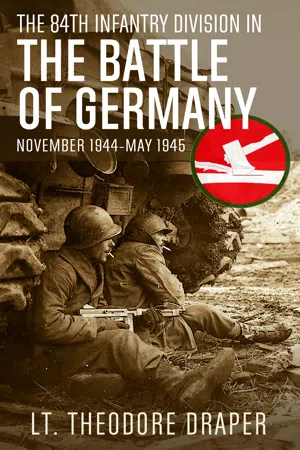
The 84th Division in the Battle of Germany, November 1944 – May 1945, first published in 1946, is the account of the combat experiences of the noted "The Railsplitter Division" of the U.S. Army in the later days of World War II. Based on numerous interviews conducted immediately after each movement or encounter with the enemy, the book provides an in-depth look at the experiences of U.S. infantrymen as they moved into Germany in the face of often fierce resistance and muddy and freezing conditions. The Division fought at the Battle of the Bulge, was in the lead to cross the Roer and Rhine Rivers and the taking of the large city of Hannover, quickly followed by the successful crossing of the Elbe River. Along the way, the Division captured more than 70,000 German soldiers, liberated several concentration and internment camps, and met-up with Russian forces advancing from the east to form a critical part of the Allied victory. Included are 18 pages of maps and nearly 80 photographs and illustrations.
Information
Subtopic
European HistoryIndex
HistoryPART ONE — The Siegfried Line
I. The Big Picture
Every big battle is made up of little battles, but it is not always clear what relation the little ones have to the big one. Sometimes the big battle seems to have a life of its own and the little ones do not add up. You have to stand off from the parts and try to see them as a whole before they make sense and fall into a distinct pattern. Much of the fighting in the North African desert was like that.
But there are times when you cannot know what the battle was really like until you get down to the battalions, the companies, or even the platoons. The little battle is like a perfectly clear pool in which you can see the “big picture” at the bottom. Above all, there is one immense advantage in paying the closest attention to the “little picture.” Everything becomes more concrete, more realistic. It is not so easy to make vague and sweeping generalities.
What is little and what is big in a battle depends, of course, on where you happen to be looking from. In the battle of Germany, in which many armies were involved, the story of a single division was relatively little.’ No division can claim to tell the whole story or even a major part of it. But there were several divisions which played a role that was a red thread through the entire campaign. The 84th Infantry Division was one of them.
In general, the battle of northern Germany passed through four major phases:
The Siegfried Line (November-December 1944)
The Ardennes (December 1944-January 1945)
From the Roer to the Rhine (February-March 1945)
From the Rhine to the Elbe (April-May 1945)
The 84th was in every one of these phases from beginning to end. Its experiences were always typical, sometimes crucial. It is possible, therefore, to see the continuous line of the battle in the story of a single division.
June to November
Before the battle of Germany, there was the battle of France. The 84th was not involved in the French campaign, but some things may be clearer if the background is sketched in.
The first Allied landings in Normandy were made on June 6, 1944. Five days later, a firm beach was established. For about five weeks, the struggle from the beachhead through the hedgerows as far as St. Lô, halfway down the peninsula, was slow, painful, and costly. At the end of July, the narrow corridor between St. Lô and the sea was broken through. As far as the Seine, the enemy still tried to fight delaying actions but he was driven back irresistibly. Paris fell August 25. The wild ride through the rest of France and Belgium began. The war became a race to the German frontier. Automatically American supply lines stretched thinner and thinner, the German lines shortened. Out of gas, American units had to make the last few miles to the border on foot.
The German frontier was crossed south of Aachen on September 12. First the Allies tried to avoid a direct assault on .the Siegfried Line by launching a daring, outflanking movement around the northern Netherlands end. The attempt to cross the Rhine at Arnhem, then turn east into northern Germany, just barely failed by the first week of October. It was necessary to bore through the line when it could not be turned. The first step was at Aachen. The better part of a month was spent on the encirclement and strangulation of the city. When it fell on October 21, a slim foothold on German soil was won. The main job of cracking or crunching the Siegfried Line was ahead.
The victory at Aachen was the work of the XIX Corps and VII Corps of the First Army. It was clear that the new Allied front on the German border was so long that it had to be filled in with new forces. In the last week of October, the Ninth Army, commanded by Lieutenant-General William H. Simpson, which was first tried out at Brest, was brought to the Dutch province of Limburg, or, as it is better known in military history, the “Maastricht appendix.” The XIX Corps, commanded by Major-General Raymond S. McLain, was transferred to the Ninth Army. The XIII Corps, commanded by Major-General Alvan C. Gillem, Jr., also attached to the new army, was made up of two divisions which had arrived only recently in Europe. One was the 102nd Infantry Division, commanded by Major-General Frank A. Keating. The other was the 84th Infantry Division, commanded by Major-General Alexander R. Bolling. The Ninth Army was wedged in between the British 2nd Army on the left and the American First Army on the right. Roughly the Ninth was in a position to attack toward the lower Rhine, the First Army toward the middle Rhine, and the Third Army the upper Rhine.
Meanwhile, the enemy was wasting no time. Soon after the Allied landings in Normandy, in July, the Gestapo chief, Heinrich Himmler, became Germany’s manpower dictator. By widening the army’s age limits, by combing industry for every man who could be spared and many who could not, by cutting the huge training system to the bone, Himmler attempted to make up for losses suffered in the exhausting struggle in Normandy and the headlong retreat to the German frontier. By November, about 50 new infantry divisions and a dozen panzer brigades were formed. At least five panzer divisions and five parachute divisions were reorganized. Probably half of these new forces were sent to the western front to bolster up the Siegfried Line. The enemy was at last fighting on his own soil and he was less than 50 miles from his chief source of supplies, the Ruhr. We were more than 400 miles from Cherbourg, our only port for supplies that had to come as much as 4000 miles, and our men had to throw themselves against the most formidable fortifications in the world. Therefore, the battle of the Siegfried Line, which opened in November, was far from unequal. Once the rout in France was finished, the Nazi regime was able to inflate German morale by promising that the western allies could be bled white in futile assaults on the Siegfried Line and could be forced to come to terms.
Such was the general position on the eve of the 84th’s entrance into the battle (Map 1). From a distance, the European war was practically finished in November 1944. To the men who came to Germany in November, however, it was just the beginning.
Field Order No. 3
Every time a major action is planned, a “field order” is issued. By its very nature, very few men ever get to see one. It originates at division level in the G-3 (Operations) section and goes only as far down the line as regiment. The regiments issue their own field orders to their battalions. The regimental order is based on the division order, the division order on the corps order, the corps order on the army order, and so on. A field order is a battle on paper, probably the most momentous piece of paper a headquarters can issue. It is the thing that sends men into combat.
The division’s Field Order No. 1 sent the 84th from Normandy to Holland. Field Order No. 2 sent us into an assembly area around Palenberg and Ubach, Germany. Field Order No. 3 sent us into our first battle. It was issued at 1 p.m., November 12. It was one portion of the master plan for the first great assault on the Siegfried Line in the sector north of Aachen.
It is surprising how simple and clear the grand lines of strategy usually are. This one was no exception. The mission of the Ninth Army’s offensive in November was to break through the Siegfried Line to the Roer River and establish bridgeheads at the towns of Linnich and Jülich. Linnich was 10 miles east of Geilenkirchen. To get to Jülich, it had to push a little farther. What it was trying to do was not very complicated but, of necessity, how it was going to do so was.
This operation was planned to involve three Corps, XIX, XIII, and 30 (British) Corps (Map 2). The main effort was assigned to the XIX Corps which had three veteran divisions, the 2nd Armored Division, the 30th Infantry Division, and the 29th Infantry Division, all outstanding in the Normandy campaign and in the breakthrough west of St. Lô. As planned, the XIX Corps would open the offensive by jumping off to establish a bridgehead at Jülich. The 29th and 30th Divisions were to make a combined attack on Jülich itself, the 29th in the center of the corps aiming at the town itself, the 30th on the southern flank below it. On the corps’ northern flank, the 2nd Armored would push north and northeast to Gereonsweiler and Barmen. By going as far as Gereonsweiler, the 2nd Armored would stop about 2 miles from Linnich. At that point, the XIII Corps was to pass through the XIX Corps to take Linnich itself.
The mission of the 2nd Armored Division created an interesting problem. At Immendorf toward the north, our lines bent westward very sharply, forming a salient with the tip at Geilenkirchen. By striking in the direction of Gereonsweiler, the 2nd Armored was bound to exaggerate this salient, which was suspended like a dagger in the back of the XIX Corps. The elimination of this salient was, therefore, essential to the drive toward Gereonsweiler and Linnich; the farther the drive to the bridgehead, the more dangerous the salient. The mission of clearing the Geilenkirchen salient was given to the 84th Infantry Division and the 43 (British) Division. While the 84th was striking at the snout of the salient from the south, the 43rd would smash at its side from the west.
To sum up, the mission of the XIX Corps was to establish the bridgehead at Jülich and to advance within striking distance of Linnich. The mission of the XIII Corps was to pass through the XIX Corps to establish the bridgehead at Linnich. The mission of the 30 (British) Corps was to facilitate the movements of the XIX and XIII Corps by reducing the Geilenkirchen salient.
Although the 84th was attached to the XIII Corps, it was placed initially under the operational control of the 30 (British) Corps, commanded by Lieutenant-General B. G. Horrocks. Actually, only about two-thirds of the division represented the 84th in the first eight days because the 335th Combat Team,* which included the 909th Field Artillery, was still attached to the 30th Infantry Division. At this point, the 84th received the 557th AAA Battalion and the 638th Tank Destroyer Battalion as attachments. Both stayed with us to the end and every action of the division involved a portion of these two units.
[* Note: A “combat team” is like a division in miniature. It is generally organized around an infantry regiment and an artillery battalion but has attached units such as a medical company, an engineer platoon, etc.]
It was a matter of some satisfaction that the 84th was thrown into the battle on a major mission no more than three weeks after its arrival in France. New divisions usually were placed in a relatively quiet sector to give them the experience of enemy fire with a minimum of danger. The 84th was one of the few exceptions to the rule.
The Siegfried Line
After the collapse of German arms in France, the fierce, prolonged defense of Aachen was important to the enemy in at least two ways. It encouraged him to think that all hope of stubborn, extended resistance inside Germany was not gone. The myth of the “inner fortress” was born. Although Aachen itself had to be given up, it was a moral shot in the arm. If every city and town in Germany had to be taken the way Aachen was taken, the war was far from over. But Aachen was also important strategically. Behind Aachen, north and south, was the Siegfried Line. After the mad chase across France, it was necessary for the enemy to win a breathing space to man the elaborate chain of fortifications and to reorganize his tired, disorganized forces behind the line. Aachen was the gong which opened the battle of Germany.
The depth of the Siegfried Line varied but it was never quite as deep as German propaganda had hinted. In the Geilenkirchen area, which interested us primarily, the main works of the Siegfried Line were placed between two rivers, the Würm and the Roer. The Würm, a relatively slender stream from 16 to 33 feet wide and from 2-1/2 to 5 feet deep, was not a major obstacle but it was the main terrain feature near the frontier. Geilenkirchen, about 5 miles from the frontier, was cut in half by the Würm, which became the first natural obstacle around which the outposts of the Siegfried Line were organized. East of Geilenkirchen, the enemy was able to fall back to another river line and a much more formidable one than the Würm. This was the Roer, in most places three times as wide as the Würm. Although the Roer was still too far away to hold our main attention at the time, it was destined to become the chief bogey of the campaign in northern Germany.
Between the Würm and the Roer, the Geilenkirchen area is relatively flat, lacking any well-defined ridge system. As a result, apart from the two rivers, the defenses had to be organized around towns, villages, and fragments of villages. By carefully placing his gun positions, pillboxes, and other defense works, the enemy was able to take advantage of sweeping fields of fire which needed practically no clearing. On the other hand, even our observation posts were frequently exposed to direct fire from the enemy. This meant that there were times, many times, when we had to cross 2000 or more yards of perfectly open ground while the enemy was waiting for us on and behind a slight rise in ground which gave him all the trumps. It was bad tank country, because the tanks were always too exposed, and it was bad infantry country, because the infantry had to take over most of the burden.
The defense works of the Siegfried Line on the western side of the Roer were much more elaborate and much deeper than those on the eastern side. At Geilenkirchen, the distance from the Würm to the Roer was about 7 miles. On the eastern side of the Roer, the fortifications did not extend in depth for more than 3 miles. At this point, then, the effective depth of the Siegfried Line was approximately 10 miles. Farther back toward the Rhine, the defense works were much more superficial, more scattered, and gave the impression of a good deal of improvisation. As far as the 84th was concerned, the decisive phase of the battle of Germany was fought out between the Würm and the Roer.
Just before the Battle
In the attack on the Siegfried Line, some days stand out more than others. The first was November 16, a Thursday. That afternoon, at 12:45 p.m., three of the divisions in the attack, the 30th, 29th, and ...
Table of contents
- Title page
- TABLE OF CONTENTS
- DEDICATION
- Foreword
- The Infantry Division
- The Units
- Introduction
- PART ONE - The Siegfried Line
- PART TWO - The Ardennes
- PART THREE - To The Rhine
- PART FOUR - To the Elbe
- APPENDIX I - Commendations and Citations
- MAPS
- ILLUSTRATIONS - Part I. The Siegfried Line
- ILLUSTRATIONS - Part II. The Ardennes
- ILLUSTRATIONS - Part III. To the Rhine
- ILLUSTRATIONS - Part IV. To the Elbe
Trusted by 375,005 students
Access to over 1.5 million titles for a fair monthly price.
Study more efficiently using our study tools.
Frequently asked questions
Yes, you can cancel anytime from the Subscription tab in your account settings on the Perlego website. Your subscription will stay active until the end of your current billing period. Learn how to cancel your subscription
No, books cannot be downloaded as external files, such as PDFs, for use outside of Perlego. However, you can download books within the Perlego app for offline reading on mobile or tablet. Learn how to download books offline
We are an online textbook subscription service, where you can get access to an entire online library for less than the price of a single book per month. With over 1.5 million books across 990+ topics, we’ve got you covered! Learn about our mission
Look out for the read-aloud symbol on your next book to see if you can listen to it. The read-aloud tool reads text aloud for you, highlighting the text as it is being read. You can pause it, speed it up and slow it down. Learn more about Read Aloud
Yes! You can use the Perlego app on both iOS and Android devices to read anytime, anywhere — even offline. Perfect for commutes or when you’re on the go.
Please note we cannot support devices running on iOS 13 and Android 7 or earlier. Learn more about using the app
Please note we cannot support devices running on iOS 13 and Android 7 or earlier. Learn more about using the app
Yes, you can access The 84th Infantry Division in The Battle of Germany by Lt. Theodore Draper in PDF and/or ePUB format, as well as other popular books in History & European History. We have over 1.5 million books available in our catalogue for you to explore.