This is the first book to challenge the "broken-windows" theory of crime, which argues that permitting minor misdemeanors, such as loitering and vagrancy, to go unpunished only encourages more serious crime. The theory has revolutionized policing in the United States and abroad, with its emphasis on policies that crack down on disorderly conduct and aggressively enforce misdemeanor laws.
The problem, argues Bernard Harcourt, is that although the broken-windows theory has been around for nearly thirty years, it has never been empirically verified. Indeed, existing data suggest that it is false. Conceptually, it rests on unexamined categories of "law abiders" and "disorderly people" and of "order" and "disorder," which have no intrinsic reality, independent of the techniques of punishment that we implement in our society.
How did the new order-maintenance approach to criminal justice--a theory without solid empirical support, a theory that is conceptually flawed and results in aggressive detentions of tens of thousands of our fellow citizens--come to be one of the leading criminal justice theories embraced by progressive reformers, policymakers, and academics throughout the world? This book explores the reasons why. It also presents a new, more thoughtful vision of criminal justice.
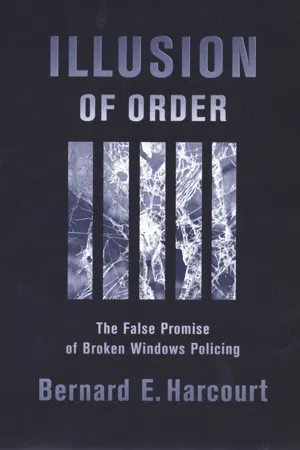
- 305 pages
- English
- PDF
- Available on iOS & Android
eBook - PDF
About this book
Information
Publisher
Harvard University PressYear
2009Print ISBN
9780674015906
9780674004726
eBook ISBN
9780674038318
Topic
SozialwissenschaftenSubtopic
KriminologieTable of contents
- Cover
- Title Page
- Copyright
- Dedication
- Contents
- Acknowledgments
- Chapter 1. Punishment and Criminal Justice at theTurn of Century
- Chapter 2. The Order-Maintenance Approach
- Part I. Empirical Critique
- Part II. Theoretical Critique
- Part III. Rhetorical Critique
- Part IV. Rethinking Punishment and Criminal Justice
- Notes
- Bibliography
- Index
Trusted by 375,005 students
Access to over 1.5 million titles for a fair monthly price.
Study more efficiently using our study tools.
Frequently asked questions
Yes, you can cancel anytime from the Subscription tab in your account settings on the Perlego website. Your subscription will stay active until the end of your current billing period. Learn how to cancel your subscription
No, books cannot be downloaded as external files, such as PDFs, for use outside of Perlego. However, you can download books within the Perlego app for offline reading on mobile or tablet. Learn how to download books offline
Perlego offers two plans: Essential and Complete
- Essential is ideal for learners and professionals who enjoy exploring a wide range of subjects. Access the Essential Library with 800,000+ trusted titles and best-sellers across business, personal growth, and the humanities. Includes unlimited reading time and Standard Read Aloud voice.
- Complete: Perfect for advanced learners and researchers needing full, unrestricted access. Unlock 1.5M+ books across hundreds of subjects, including academic and specialized titles. The Complete Plan also includes advanced features like Premium Read Aloud and Research Assistant.
We are an online textbook subscription service, where you can get access to an entire online library for less than the price of a single book per month. With over 1.5 million books across 990+ topics, we’ve got you covered! Learn about our mission
Look out for the read-aloud symbol on your next book to see if you can listen to it. The read-aloud tool reads text aloud for you, highlighting the text as it is being read. You can pause it, speed it up and slow it down. Learn more about Read Aloud
Yes! You can use the Perlego app on both iOS and Android devices to read anytime, anywhere — even offline. Perfect for commutes or when you’re on the go.
Please note we cannot support devices running on iOS 13 and Android 7 or earlier. Learn more about using the app
Please note we cannot support devices running on iOS 13 and Android 7 or earlier. Learn more about using the app
Yes, you can access Illusion of Order by Bernard E. Harcourt in PDF and/or ePUB format, as well as other popular books in Sozialwissenschaften & Kriminologie. We have over 1.5 million books available in our catalogue for you to explore.