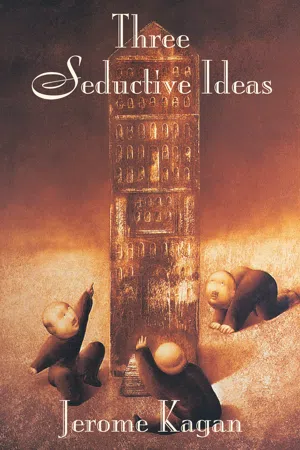
Do the first two years of life really determine a child's future development? Are human beings, like other primates, only motivated by pleasure? And do people actually have stable traits, like intelligence, fear, anxiety, and temperament? This book, the product of a lifetime of research by one of the founders of developmental psychology, takes on the powerful assumptions behind these questions—and proves them mistaken. Ranging with impressive ease from cultural history to philosophy to psychological research literature, Jerome Kagan weaves an argument that will rock the social sciences and the foundations of public policy.
Scientists, as well as lay people, tend to think of abstract processes—like intelligence or fear—as measurable entities, of which someone might have more or less. This approach, in Kagan's analysis, shows a blindness to the power of context and to the great variability within any individual subject to different emotions and circumstances. "Infant determinism" is another widespread and dearly held conviction that Kagan contests. This theory—with its claim that early relationships determine lifelong patterns—underestimates human resiliency and adaptiveness, both emotional and cognitive (and, of course, fails to account for the happy products of miserable childhoods and vice versa). The last of Kagan's targets is the vastly overrated pleasure principle, which, he argues, can hardly make sense of unselfish behavior impelled by the desire for virtue and self-respect—the wish to do the right thing.
Written in a lively style that uses fables and fairy tales, history and science to make philosophical points, this book challenges some of our most cherished notions about human nature.
eBook - PDF
Three Seductive Ideas
About this book
Information
Publisher
Harvard University PressYear
2009Print ISBN
9780674001978
9780674890336
eBook ISBN
9780674039254
Table of contents
- Cover
- Title Page
- Copyright
- Contents
- Prologue
- Chapter 1. A Passion for Abstraction
- Chapter 2. The Allure of Infant Determinism
- Chapter 3. The Pleasure Principle
- Epilogue
- Notes
- Acknowledgments
Trusted by 375,005 students
Access to over 1.5 million titles for a fair monthly price.
Study more efficiently using our study tools.
Frequently asked questions
Yes, you can cancel anytime from the Subscription tab in your account settings on the Perlego website. Your subscription will stay active until the end of your current billing period. Learn how to cancel your subscription
No, books cannot be downloaded as external files, such as PDFs, for use outside of Perlego. However, you can download books within the Perlego app for offline reading on mobile or tablet. Learn how to download books offline
Perlego offers two plans: Essential and Complete
- Essential is ideal for learners and professionals who enjoy exploring a wide range of subjects. Access the Essential Library with 800,000+ trusted titles and best-sellers across business, personal growth, and the humanities. Includes unlimited reading time and Standard Read Aloud voice.
- Complete: Perfect for advanced learners and researchers needing full, unrestricted access. Unlock 1.5M+ books across hundreds of subjects, including academic and specialized titles. The Complete Plan also includes advanced features like Premium Read Aloud and Research Assistant.
We are an online textbook subscription service, where you can get access to an entire online library for less than the price of a single book per month. With over 1.5 million books across 990+ topics, we’ve got you covered! Learn about our mission
Look out for the read-aloud symbol on your next book to see if you can listen to it. The read-aloud tool reads text aloud for you, highlighting the text as it is being read. You can pause it, speed it up and slow it down. Learn more about Read Aloud
Yes! You can use the Perlego app on both iOS and Android devices to read anytime, anywhere — even offline. Perfect for commutes or when you’re on the go.
Please note we cannot support devices running on iOS 13 and Android 7 or earlier. Learn more about using the app
Please note we cannot support devices running on iOS 13 and Android 7 or earlier. Learn more about using the app
Yes, you can access Three Seductive Ideas by Jerome Kagan in PDF and/or ePUB format, as well as other popular books in Psychology & Developmental Psychology. We have over 1.5 million books available in our catalogue for you to explore.