Provides instructors and students with clear guidance on best practices for clinical skills education
Veterinary Clinical Skills provides practical guidance on learning, teaching, and assessing essential clinical skills, techniques, and procedures in both educational and workplace environments. Thorough yet concise, this evidence-based resource features sample assessments, simple models for use in teaching, and numerous examples demonstrating the real-world application of key principles and evidence-based approaches.
Organized into nine chapters, the text explains what constitutes a clinical skill, explains the core clinical skills in veterinary education and how these skills are taught and practiced, describes assessment methods and preparation strategies, and more. Contributions from expert authors emphasize best practices while providing insights into the clinical skills that are needed to succeed in veterinary practice. Presenting well-defined guidelines for the best way to acquire and assess veterinary skills, this much-needed resource:
Describes how to design and implement a clinical skills curriculum
Identifies a range of skills vital to successful clinical practice
Provides advice on how to use peer teaching and other available resources
Covers veterinary OSCE (Objective Structured Clinical Examination) topics, including gowning and gloving, canine physical examination, and anesthetic machine setup and leak testing
Includes sample models for endotracheal intubation, dental scaling, silicone skin suturing, surgical prep, and others
Emphasizing the importance of clinical skills in both veterinary curricula and in practice, Veterinary Clinical Skills is a valuable reference and guide for veterinary school and continuing education instructors and learners of all experience levels.
1 College of Veterinary Medicine, The Ohio State University, Columbus, OH, USA
2 Bristol Veterinary School, University of Bristol, Bristol, UK
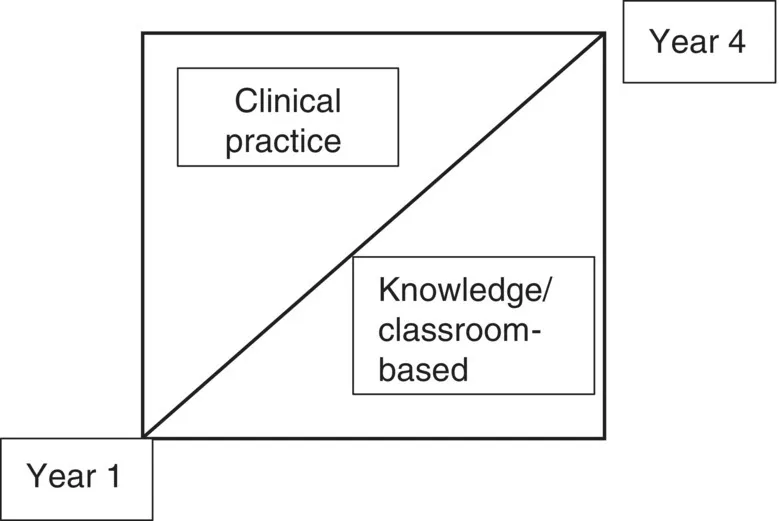
Historically in veterinary medicine, degree programs have been based upon the Flexner model described in medical education, with two basic blocks: two to three years of preclinical training and one to two years of clinical training (Flexner, 1910). Approximately 10–15 years ago, a trend developed in veterinary education to include more hands‐on training during veterinary programs, often beginning in the start of the first year, with an emphasis on teaching day‐one skills necessary for success in practice (Hubbell et al., 2008; Doucet and Vrins, 2009; Welsh et al., 2009; Smeak et al., 2012; Dilly et al., 2017 RCVS, 2020;). The idea of moving clinical training earlier in the program and further emphasizing integration of knowledge and other skills into the clinical workplace led to current veterinary programs being more like two inverse wedges rather than two blocks placed one on top of the other as separate units of the same program (Figure 1.1).
Formal veterinary clinical skills training programs, which emphasized the use of models and simulators and constructed dedicated clinical skills centers for teaching, began in the early to mid‐2000s as a way to accommodate this need for earlier training (Baillie et al., 2005; Scalese and Issenberg, 2005; Pirkelbauer et al., 2008; Read and Hecker, 2013; Dilly et al., 2017). Reports of objective structured clinical examinations (OSCEs) that are used to assess learners' hands‐on skills, and descriptions of best practices for implementing skills curricula, began to follow (Smeak, 2007; Rhind et al., 2008; May and Head, 2010; Hecker et al., 2010; Read and Hecker, 2013; Dilly et al., 2017).
Concurrently, over the last 10 years, there has been a recognition of the need to incorporate more professional skills training (NAVMEC, 2011; Cake et al., 2016). Today's employers are not only searching for confidence and technical competence in new graduates but good communication abilities as well (Perrin, 2019). Rather than simply being competent in one's hands‐on skills alone, effective integration of professional communication and technical skills performance is crucial for successful practice (NAVMEC, 2011; Rhind et al., 2011). Other “marketable skills” described in a recent report of the characteristics most often sought by employers posting job advertisements in the United Kingdom included enthusiasm, special interest, communication, all‐rounder, client care, team player, autonomous, caring, ambitious, and high clinical standards (Perrin, 2019). These “skills” are important to employers and are key to minimizing dissonance and dissatisfaction for the graduates as well (May, 2015; Perrin, 2019).
Figure 1.1 Flexner model (with separation between preclinical and clinical blocks) versus the more recent curricular models that are more like inverse wedges introducing clinical content earlier into the start of the curriculum.
The Royal College of Veterinary Surgeons (RCVS) Day One Competences and the American Association of Veterinary Medical Colleges’ (AAVMC) North American Veterinary Medical Education Consortium (NAVMEC) report are both recognized as early frameworks that defined competencies across a number of areas that lead to graduate success (NAVMEC, 2011 RCVS, 2020;). More recently, there have been other developments toward employability of new graduates and improved teaching of professional skills. The VetSet2Go project represents an international collaboration of educators (https://www.vetset2go.edu.au), who surveyed employers, clients, new graduates, and other stakeholders before combining this information with what was already published in the literature. The resulting white paper and framework have been used to guide development of resources, as well as tools for educators and learners (Cake et al., 2016; Hughes et al., 2018). This framework highlights professional identity formation, skills needed for practice career longevity, and development of resilience. More recently, outcomes‐based frameworks have been described (Bok et al., 2011; Molgaard et al., 2019; Matthew et al., 2020). The AAVMC's competency‐based veterinary education (CBVE) framework is currently being considered and implemented across multiple international veterinary schools simultaneously, which brings exciting opportunities for conducting comparative analysis of students and graduates across schools. Having a shared framework of competencies, entrustable professional activities, milestones, and terminology is critical for training educators, comparing learners, and generalizing results across programs (Molgaard et al., 2018a; Molgaard et al., 2018b; Salisbury et al., 2019). With schools historically only focusing on their own programs, this opportunity has not existed in veterinary medicine to date.
In the strictest sense, veterinary clinical skills are psychomotor tasks that can be assessed in a simulated environment (satisfying “shows how” on Miller's pyramid of clinical competence) or within the actual clinical workplace (satisfying “does” on Miller's pyramid of clinical competence, see Figure 5.1) (Miller, 1990). Obvious examples might include donning and doffing a surgical gown, suturing skin, performing venipuncture, safely restraining a patient, or performing a complete physical examination. But what about interpreting herd records, observing animal behavior, or designing an isolation facility? Recently, authors have argued that the pinnacle of Miller's pyramid of clinical competence is not just related to technical skill competence as Miller originally described but is actually “is trusted” (to perform on one's own) (ten Cate et al., 2020) or “is” (to incorporate the development of professional identity) (Cruess et al., 2016).
During curriculum development or program revision to incorporate further clinical skills training, there can be heated debate among educators and practitioners about what skills are the most necessary to teach, or even about what constitutes a “clinical skill.” Before the more recent rise of competency‐based education, some educators and practitioners used Delphi‐like processes and developed lists of skills to be taught in veterinary programs such as Day 1 Skills, first published in 2002 (RCVS, 2020). These practitioners ...
Table of contents
Cover
Table of Contents
Title Page
Copyright Page
Acknowledgments
List of Contributors
Preface
About the Companion Website
1 What Is a Clinical Skill?
2 Clinical Skills Curricula: How Are They Determined, Designed, and Implemented?
3 How Are Clinical Skills Taught?
4 How Are Clinical Skills Practiced?
5 How Do I Know if I am Learning What I Need to?
6 How Do I Prepare for Assessment and How Do I Know I Am Being Assessed Fairly?
7 How Can I Best Learn in a Simulated Environment?
8 How Do I Make Use of Peer Teaching?
9 What Other Skills Are Vital to Successful Clinical Practice?
Appendix 2: Recipes for Making Clinical Skills Models
Index
End User License Agreement
Trusted by 375,005 students
Access to over 1.5 million titles for a fair monthly price.
Study more efficiently using our study tools.
Frequently asked questions
Yes, you can cancel anytime from the Subscription tab in your account settings on the Perlego website. Your subscription will stay active until the end of your current billing period. Learn how to cancel your subscription
No, books cannot be downloaded as external files, such as PDFs, for use outside of Perlego. However, you can download books within the Perlego app for offline reading on mobile or tablet. Learn how to download books offline
Perlego offers two plans: Essential and Complete
Essential is ideal for learners and professionals who enjoy exploring a wide range of subjects. Access the Essential Library with 800,000+ trusted titles and best-sellers across business, personal growth, and the humanities. Includes unlimited reading time and Standard Read Aloud voice.
Complete: Perfect for advanced learners and researchers needing full, unrestricted access. Unlock 1.5M+ books across hundreds of subjects, including academic and specialized titles. The Complete Plan also includes advanced features like Premium Read Aloud and Research Assistant.
Both plans are available with monthly, semester, or annual billing cycles.
We are an online textbook subscription service, where you can get access to an entire online library for less than the price of a single book per month. With over 1.5 million books across 990+ topics, we’ve got you covered! Learn about our mission
Look out for the read-aloud symbol on your next book to see if you can listen to it. The read-aloud tool reads text aloud for you, highlighting the text as it is being read. You can pause it, speed it up and slow it down. Learn more about Read Aloud
Yes! You can use the Perlego app on both iOS and Android devices to read anytime, anywhere — even offline. Perfect for commutes or when you’re on the go. Please note we cannot support devices running on iOS 13 and Android 7 or earlier. Learn more about using the app
Yes, you can access Veterinary Clinical Skills by Emma K. Read, Matt R. Read, Sarah Baillie, Emma K. Read,Matt R. Read,Sarah Baillie in PDF and/or ePUB format, as well as other popular books in Medicine & Veterinary Medicine. We have over 1.5 million books available in our catalogue for you to explore.