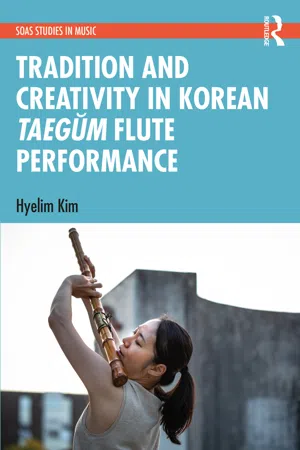
Tradition and Creativity in Korean Taeg?m Flute Performance describes the taeg?m as a representation of Korean culture in the contemporary world. Through the development and performance of creative works, this horizontal bamboo flute reflects both tradition and contemporary creativity. The first part of the book outlines the historical background of the taeg?m. The author illuminates the potential future of the Korean flute in a globalised world through the analyses of three musical works for taeg?m. The second part of the book draws on approaches of Practice Research within ethnomusicology and sociology to examine the ways in which the taeg?m tradition interacts with, and responds to, different genres in performance. Documenting collaborative encounters with musicians from three musical cultures: jazz, Western art and electroacoustic music, the result is an innovative exploration of the musical and social relationships between composers, performers and audiences in intercultural performances, contrasting traditional uses of the taeg?m with perspectives on its use today.
- 184 pages
- English
- ePUB (mobile friendly)
- Available on iOS & Android
eBook - ePub
Tradition and Creativity in Korean Taegŭm Flute Performance
About this book
Information
1Introduction
DOI: 10.4324/9781351216746-1
The taegŭm, a horizontal bamboo flute, is considered one of the most representative of Korea’s traditional instruments. The etymology of the name, taegŭm,1 is a literal description of the instrument in the Korean language: ‘tae’ means ‘big’ and ‘-gŭm’ means ‘bamboo’. First mentioned in the Unified Shilla period (668–935), it has often been considered by Koreans as an exemplar of Korean beauty. As a symbol of the nation, the flute is highlighted in the Samguk Yusa (Memorabilia of the Three Kingdoms), compiled in the late 13th century. This is a significant indigenous source documenting the history of the Korean Three Kingdoms (traditional dates, 57 bc–ad 668), which recounts a myth of the origin of the taegŭm, ‘Manp’a shik chŏk’, based on records of the Kamŭn temple and other sources.
King Shimun (r. 681–692) of the Shilla kingdom heard that a floating island in the Eastern Sea was approaching the Kamŭn temple, which he had erected. Being curious, the King asked his astrologer, Kim Ch’un’gil, about the island and was told it was a valuable gift from the king’s father, King Munmu, who had been reborn as a great dragon in the sea and a respectable general, Kim Yushin, who was reincarnated as a god of Heaven. After investigation into the island, the servant reported that there were two bamboo stems that separated in daytime and fused into one at night. When the king went to see the bamboo tree, a dragon appeared. The king asked, ‘What is the reason that the bamboo is split and combined again?’ The dragon replied, ‘this is similar to the fact that when you clap with one hand no sound comes out. You need two hands to make a sound when you clap. Likewise, the bamboo only produces sound when both sides come together. It is a signal of great fortune indicating that you will rule the kingdom by means of sound. The entire world will be peaceful if you make a flute out of the bamboo’. After that, the king ordered the plant be cut and a flute made out of the mystical bamboo. The sound of the flute had the power to repulse attacks by foreigners, to attract rain during droughts, and to heal illnesses. Acknowledged as a sacred flute, the instrument was named as ‘manp’a shik chŏk’ (the flute to soothe 10,000 waves).(After Iryŏn, Samguk Yusa 2: 25–30, my translation, based on a modern Korean version)
This account presents the taegŭm as a magically auspicious instrument that brings peace and harmony. Moreover, its sound protects the nation from external threats and helps to calm the minds of people who were suffering from everyday hardships. In a way, the myth has come to reflect and configure the instrument’s role in history and how it has been used in contemporary music.
Being a native Korean, playing the taegŭm beyond the shores of Korea has always forced me to confront certain issues. There is, centrally, the inner conflict of wishing to preserve musical heritage as a Korean as opposed to working generally with music as a creative artist and academic. My attempts to find a way to connect these two dimensions have led me to travel abroad to expand my worldview. This inner conflict resembles aspects in the legend of the flute, in which a single bamboo plant is split in two. To resonate with the symbolic sound that once emanated from the united bamboo, in this book I endeavour to bring together two issues for exploration.
Firstly, the tradition applying to the taegŭm that I was taught when learning the instrument contrasts with the way that the tradition is applied in the 21st century. This ambivalence causes confusion in understanding the ancient instrument today. It is timely to explore the definition of heritage and the effect that heritage has in the contemporary world, given the UNESCO-led desire to define and understand heritage throughout much of the world.
Secondly, the regional association of the taegŭm as a purely Korean instrument is widened by the ongoing internationalisation and globalisation of traditional arts. Korean identity is increasingly reflected through images of the culture in ways that non-Koreans appreciate, which affects the modernisation of music for the instrument. The modernisation process is demonstrated by technical expressions in compositions, which will be explored through musical analyses in this book. Through analyses, I will show different conceptual levels of ‘Koreanness’ by adopting socio-cultural approaches. The concept of ‘Koreanness’ here is generally identified as South Korean, since North Korea modified the Korean tradition (including the music and musical instruments such as the taegŭm) significantly after its division with South Korea and developed its own national identity; all references to ‘Korean’ in this study therefore exclude North Korea. As a native South Korean playing traditional Korean music, a type of music that has come to be considered iconic of Korean identity, my own role as an artist is an important issue for me – within Korea I am told I am playing a very Korean instrument, and outside Korea I am told the same. What does this actually mean? The study will explore this, starting with the observation that the transnational perception of the instrument brings about both positive and negative changes and, in a sense, the ‘deterritorialisation’ (using the term after Deleuze and Guattari, 1987 [1980]) of national inheritance.
Mirroring the complex position that the instrument plays in Korean musicology, this book is divided into two parts: the first part focuses on the historical background and contemporary development of the flute. More specifically, the core parts of this section include the history of the taegŭm (Chapter 2), its contemporary practices (Chapter 3) and an analysis of the appropriation of the flute the this modern era (Chapter 4, 5 and 6). These chapters provide ideas about how the instrument can be accepted as a tool for creating new music through the analysis of specific composers who contributed to the contemporary repertoires of the taegŭm. The composers’ musical lives are contextualised by the historical, social and cultural backgrounds provided in the previous chapters. There has been a preconception in the history of music biography that this writing genre is often based on facts gathered by positivist scholars and that positivism is shunned in musicology (Wiley and Watt, 2009: 188). This is a reason why this writing genre has been excluded from the specialist area of music history (Wiley and Watt, 2009: 187–8). In line with Lee’s observation in her book Biography: A Very Short Introduction (2009: 12–14) of biography ‘as a form of history’, the series of chapters tackling composers’ compositions and texts are contextualised in their historical, social and cultural milieu.
The first musical analysis is in Chapter 4. Youngdong Kim [Kim Yŏngdong] (b.1951) is a taegŭm player and composer who has devoted himself to the popularisation of the Korean flute and has written a wide spectrum of compositions ranging from orchestral pieces to New Age songs. Among them, the representative piece of what became the New Age scene in Korea, ‘Sŏn’ (1989), is investigated, drawing on Murray Schafer’s soundscape theory. In addition, the traditional piece ‘Manp’a shik chŏk’ (2000) is analysed on the basis of its connection with the origin myth of the taegŭm as well as on the other provenance theories of Korean music introduced in the Akhak kwebŏm (1493), a treatise of music written during the Chosŏn dynasty. Chapter 5 corresponds with a component of the previous chapter, namely in the analysis of ‘Manp’a’ (1981), which takes the same myth (Manp’a shik chŏk) as inspiration. The composer focused on in this chapter, Sukhi Kang (1934–2020), is a composer of Western art music who uses techniques drawn from European contemporary music to compose structural forms that capture the timbre of the Korean flute. Chapter 6 considers one of the Korean composers of a younger generation who is devoted to creative music for Korean traditional music, Sngkn Kim (b.1967). Thanks to his musical upbringing and education, Kim achieves a skillful balance of the respective idioms of Western art music and Korean traditional music. His composition, ‘Taegŭm Quartet 2006’ (2006), draws on elements from the traditional piece ‘Sujech’ŏn’, dating from the Chosŏn dynasty. This ancient source is revived in a way that uses tradition as a technical source of creativity to express modernity.
The second part of the book takes the form of practice research to question how I, as a practitioner, have created new sound worlds for the taegŭm, fusing it with jazz (Chapter 7), Western art music (Chapter 8) and electroacoustics (Chapter 9), to link the antiquity of the taegŭm with contemporary creativity. For each collaborative encounter, I provide a background and theoretical frame before considering certain issues. Chapter 7 reflects on the historical appropriation of jazz on Korean soil, outlines previous experiments in which Korean traditional musicians have used jazz as an agent of globalisation, and then describes my collaboration with the Australian jazz drummer Simon Barker (b.1969). Chapter 8 considers the process of creation and performance of music combining Korean traditional and Western art elements. To achieve this, I commissioned Dae-seong Kim (b.1967), a prominent Korean composer, to write two compositions for the taegŭm and Western instruments. In line with the modernisation and appropriation of the Korean flute explored in Chapter 3, the transition towards Western art music seen in the performance settings and notation systems are shown to bring about different interpretations of convention in my taegŭm performance. To show this, I explore the representative technique of nongŭm, which I call ‘a gesture of adjustable tradition’. Chapter 9 explores the future of Korean traditional music through an electronic music project conducted with the Australian composer Leah Barclay (b.1985). Through collaborations in the Sori Art project in 2009 and 2010, I explored how electronic soundworlds could be an effective tool for capturing the nuances of traditional music. This collaboration took Schechner’s performance theory a step further through the use of multi-media, involving three elements: live performance, visual imaging and electroacoustics. Improvisation functioned as a method to connect the junctions among the different contexts and provided content that could be shared between the three elements. Chapter 10 brings my collaborations together in a recontextualised form to discuss a recording session conducted in December 2012 for BBC Radio 3’s Late Junction.
In summary, the second part of the book explores contemporary practices of the taegŭm through three strands. Firstly, the taegŭm is explored as a distinct language in a globalised environment, represented by jazz; secondly, adjusting to Western instrumentation and staff notation in a contemporary setting for Western art music; and thirdly, providing responses in the context of electroacoustic music borrowing from improvisation and its techniques. The practice research corresponds to the historical and theoretical background presented in the first part of the book. These two parts therefore create a whole, contrasting the ways in which the taegŭm has been used in the past with perspectives on what is done now, and suggesting potential areas for future development.
Throughout the study, I construct my unique academic observations through two different perspectives: as a learner and as a performer. The question is how the outcomes derived from these roles materialise in the contemporary setting, in line with the historical relationship between the two roles. To explore this, I elaborate aspects of each position below. I believe the similarities and differences between these roles can be brought together, to coincide in a compact entity.
Learner’s position
Historically, Korean music, in particular the court music tradition, has emphasised training. This tendency appears to be reflected in the thoughts of Korean educators throughout history, whether directly or indirectly, including the c. 4th century statesman Wang Sanak of the Koguryŏ dynasty, the c. 6th century musician Urŭk of the Shilla dynasty, both of whom were written about in fascicle 32 of Samguk sagi (History of the Three Kingdoms; 1145), and King Sejong (r. 1418–1450) of the Chosŏn dynasty as described in the preface of the Akhak kwebŏm (Guide to the Study of Music; 1493). All of these educators tried to establish a training system to regulate music and the musicians, referred to as ‘ye’ak’ (courteous music), as a tool to discipline elite apprentices. They focused on two beliefs: ye (propriety) as a social code of law, order, virtues or ethics and ak (music), as a self-disciplining standard of generosity and spirituality harmoniously contained in a single personality (Howard, 2006b: 181). The training dictated by ‘ye’ak’ equipped students with maturity both socially and individually. Like most other East Asian cultures, music in Korea has been used as a mode of self-discipline alongside other scholarly achievement.
These educational aims were followed by national institutes to preserve mainly court music, such as the Ŭmsŏngsŏ (Office for Music) in the Unified Shilla, according to the Shilla pon’gi section in the first fascicle of Samguk sagi (History of the Three Kingdoms), and the Chŏnaksŏ (Office for Ritual Music) in the Koryŏ dynasty. The Chŏnaksŏ had different names at different times. For instance, the Koryŏsa (History of Koryŏ; 1451: fascicle 39–45) documented that during the reign of King Kongmin (1351–1374), the office was renamed as the Taeaksŏ in 1356, reverted back to Chŏnaksŏ in 1356, was then called the Taeaksŏ again in 1369 and finally the Chŏnaksŏ in 1372. During the Chosŏn dynasty (1392–1897) the relevant institutes included the Kwansŭp tokam (Office for Customs) and A’aksŏ ...
Table of contents
- Cover
- Half-Title Page
- Series Page
- Title Page
- Copyright Page
- Contents
- List of figures, tables and notations
- Acknowledgements
- Editorial notes/romanisation
- 1 Introduction
- 2 History and background of the taegŭm
- 3 The contemporary practices of the taegŭm
- 4 Music analysis I: Youngdong Kim
- 5 Music analysis II: Sukhi Kang
- 6 Music analysis III: Sngkn Kim
- 7 Performance I: Jazz
- 8 Performance II: Western art music
- 9 Performance III: Electroacoustics
- 10 Conclusion
- Interviews
- Bibliography
- Chronicles/annals
- Discography
- Index
Trusted by 375,005 students
Access to over 1.5 million titles for a fair monthly price.
Study more efficiently using our study tools.
Frequently asked questions
Yes, you can cancel anytime from the Subscription tab in your account settings on the Perlego website. Your subscription will stay active until the end of your current billing period. Learn how to cancel your subscription
No, books cannot be downloaded as external files, such as PDFs, for use outside of Perlego. However, you can download books within the Perlego app for offline reading on mobile or tablet. Learn how to download books offline
Perlego offers two plans: Essential and Complete
- Essential is ideal for learners and professionals who enjoy exploring a wide range of subjects. Access the Essential Library with 800,000+ trusted titles and best-sellers across business, personal growth, and the humanities. Includes unlimited reading time and Standard Read Aloud voice.
- Complete: Perfect for advanced learners and researchers needing full, unrestricted access. Unlock 1.5M+ books across hundreds of subjects, including academic and specialized titles. The Complete Plan also includes advanced features like Premium Read Aloud and Research Assistant.
We are an online textbook subscription service, where you can get access to an entire online library for less than the price of a single book per month. With over 1.5 million books across 990+ topics, we’ve got you covered! Learn about our mission
Look out for the read-aloud symbol on your next book to see if you can listen to it. The read-aloud tool reads text aloud for you, highlighting the text as it is being read. You can pause it, speed it up and slow it down. Learn more about Read Aloud
Yes! You can use the Perlego app on both iOS and Android devices to read anytime, anywhere — even offline. Perfect for commutes or when you’re on the go.
Please note we cannot support devices running on iOS 13 and Android 7 or earlier. Learn more about using the app
Please note we cannot support devices running on iOS 13 and Android 7 or earlier. Learn more about using the app
Yes, you can access Tradition and Creativity in Korean Taegŭm Flute Performance by Hyelim Kim in PDF and/or ePUB format, as well as other popular books in Media & Performing Arts & Ethnomusicology. We have over 1.5 million books available in our catalogue for you to explore.