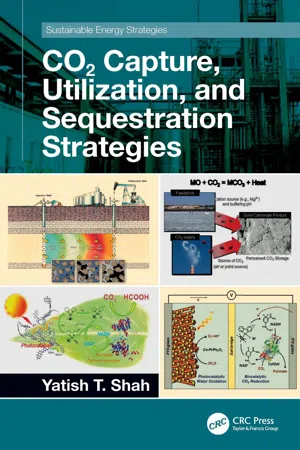
CO2 Capture, Utilization, and Sequestration Strategies
eBook - ePub

CO2 Capture, Utilization, and Sequestration Strategies

  1. 436 pages
  2. English
  3. ePUB (mobile friendly)
  4. Available on iOS & Android
eBook - ePub

CO2 Capture, Utilization, and Sequestration Strategies

About this book

Offering practical treatment strategies for CO2 emission generated from various energy-related sources, CO2 Capture, Utilization, and Sequestration Strategies emphasizes carbon capture, utilization, and sequestration (CCUS) with special focus on methods for each component of the strategy. While other books mostly focus on CCS strategy for CO2, this book details the technologies available for utilization of CO2, showing how it can be a valuable renewable source for chemicals, materials, fuels, and power instead of a waste material damaging the environment.


  • Highlights current and potential future commercially viable CCUS strategies


  • Discusses applications for direct and the more complex indirect utilization of CO2 streams


  • Examines viability of the mineral carbonation process and biological treatments to convert CO2 into useful biochemicals, biomaterials, and biofuels


  • Explores heterogeneous catalysis for thermal and electrochemical conversion and solar energy-based thermal, photo-thermal, and photocatalytic conversion of CO2


  • Presents the rapidly growing concept of plasma-activated catalysis for CO2 conversion

CO2 Capture, Utilization, and Sequestration Strategies is a valuable reference for researchers in academia, industry, and government organizations seeking a guide to effective CCUS processes, technologies, and applications.

Frequently asked questions

Yes, you can cancel anytime from the Subscription tab in your account settings on the Perlego website. Your subscription will stay active until the end of your current billing period. Learn how to cancel your subscription.
At the moment all of our mobile-responsive ePub books are available to download via the app. Most of our PDFs are also available to download and we're working on making the final remaining ones downloadable now. Learn more here.
Perlego offers two plans: Essential and Complete
  • Essential is ideal for learners and professionals who enjoy exploring a wide range of subjects. Access the Essential Library with 800,000+ trusted titles and best-sellers across business, personal growth, and the humanities. Includes unlimited reading time and Standard Read Aloud voice.
  • Complete: Perfect for advanced learners and researchers needing full, unrestricted access. Unlock 1.4M+ books across hundreds of subjects, including academic and specialized titles. The Complete Plan also includes advanced features like Premium Read Aloud and Research Assistant.
Both plans are available with monthly, semester, or annual billing cycles.
We are an online textbook subscription service, where you can get access to an entire online library for less than the price of a single book per month. With over 1 million books across 1000+ topics, we’ve got you covered! Learn more here.
Look out for the read-aloud symbol on your next book to see if you can listen to it. The read-aloud tool reads text aloud for you, highlighting the text as it is being read. You can pause it, speed it up and slow it down. Learn more here.
Yes! You can use the Perlego app on both iOS or Android devices to read anytime, anywhere — even offline. Perfect for commutes or when you’re on the go.
Please note we cannot support devices running on iOS 13 and Android 7 or earlier. Learn more about using the app.
Yes, you can access CO2 Capture, Utilization, and Sequestration Strategies by Yatish T. Shah in PDF and/or ePUB format, as well as other popular books in Technology & Engineering & Environmental Management. We have over one million books available in our catalogue for you to explore.

1 Sources of Carbon Dioxide Emission and Possible Treatment Strategies

DOI: 10.1201/9781003229575-1

1.1 Introduction

Carbon emission in the environment is a major societal issue because it is closely linked to the global warming and resulting in negative impacts on weather patterns and sea level rise. Two major carbon compounds emitted into the atmosphere by human activities and other natural causes are carbon dioxide and methane [1]. While methane can be more problematic greenhouse gas (24–130 times more harmful than carbon dioxide), it is emitted in a lesser volume and it eventually gets converted to carbon dioxide by atmospheric reactions. Once captured, the utilization of methane is much less challenging because methane is very reactive and can be easily used for power or the productions of other chemicals and fuels. Sources of methane are not all human made; a significant amount of methane is produced from animal manure, agricultural sources, leakage of methane hydrates, etc. Methane leakage from oil and gas industry (commonly called associated gas or gas flares), from landfill gas, or from other biomass waste treatment facilities is being captured and put to useful utilization. Since the major issue with methane emission is its capture, this book will not address the treatment of methane emission.
The emission of carbon dioxide is more human made. As demands for energy have increased globally, CO2 levels have risen sharply, from pre-industrial levels of 280 ppm a century ago to over 400 ppm since 2013. These levels also include emissions generated from other, nonenergy sources, including steel, aluminum, and cement production; fermentation; chemical production; and other industrial sources. Continued economic and population growth drives the increase in CO2 emissions, and the levels of emissions, if left unchecked, are projected to exceed 530 ppm by 2100. Goals for stabilizing CO2 levels at ≤450 ppm were set in 2007 to avoid serious impacts on the environment and health [2]. To meet these goals, however, requires substantial improvements in energy efficiency, increased deployment of renewable and nuclear energy, and the development of new technologies for mitigating CO2 emissions arising from the use of fossil fuels and other anthropogenic sources [3].
In 2014, the global carbon emissions from fossil-derived fuel combustion were estimated to be 9,855 million metric tons of carbon, or nearly 36 gigatons (Gt) of CO2 [4]. About a quarter of these emissions come from mobile sources, such as automobiles and other forms of transportation. Much of the remainder comes from point sources—plants used for generation of electricity and heat for industry, business, and home use, as well as industrial production processes. It is these so-called point sources that are the focus of technologies for mitigating global CO2 emissions. Efforts are being made to reduce carbon emission from vehicles by replacing internal combustion engine-driven vehicles with hybrid and electric vehicles.
Carbon dioxide is a very stable molecule, and it is emitted at a significantly large scale. According to a national academy report [1], approximately 10,000 teragrams (Tg) of waste gas carbon is emitted globally each year (see Table 1.1), representing a large volume of potential inputs for carbon treatment technologies. However, these gaseous waste streams are heterogeneous in their composition, are emitted from a wide range of geographically distributed sources, and are not always easily transported from their sources to locations where they can be processed. This heterogeneity poses challenges for carbon dioxide treatment. As shown in Figure 1.1, sources of GHG include fossil fuel combustion, natural gas systems, coal mining, waste incineration, etc. Energy-related activities are the primary sources of U.S. anthropogenic greenhouse gas emissions, accounting for 83.8% of total greenhouse gas emissions on a carbon dioxide (CO2) equivalent basis in 2016. Energy-related CO2 emissions alone constituted 78.9% of national emissions from all sources on a CO2 equivalent basis, while the non-CO2 emissions from energy-related activities represent a much smaller portion of total national emissions (4.9% collectively). Emissions from fossil fuel combustion comprise the vast majority of energy-related emissions, with CO2 being the primary gas emitted (see Figure 1.1). Globally, approximately 32,294 million metric tons (MMT) of CO2 were added to the atmosphere through the combustion of fossil fuels in 2015, of which the United States accounted for approximately 15%.
TABLE 1.1 Chronological Increase in Carbon Emission [1]
Year Carbon Emission (Tg)
1900 About 600
1942 About 1,200
1956 About 2,000
1966 About ...

Table of contents

  1. Cover
  2. Half Title
  3. Series Page
  4. Series Preface
  5. Title Page
  6. Copyright Page
  7. Table of Contents
  8. Preface
  9. Author
  10. Chapter 1 Sources of Carbon Dioxide Emission and Possible Treatment Strategies
  11. Chapter 2 Methods for Carbon Dioxide Capture/Concentrate, Transport/Storage, and Direct Utilization
  12. Chapter 3 Carbon Capture by Mineral Carbonation and Production of Construction Materials
  13. Chapter 4 Biological Conversion of Carbon Dioxide
  14. Chapter 5 CO2 Conversion to Fuels and Chemicals by Thermal and Electro-Catalysis
  15. Chapter 6 Carbon Dioxide Conversion Using Solar Thermal and Photo Catalytic Processes
  16. Chapter 7 Plasma-Activated Catalysis for CO2 Conversion
  17. Index