From the UK Poet Laureate and bestselling translator, a spirited book that demystifies and celebrates the art of poetry today
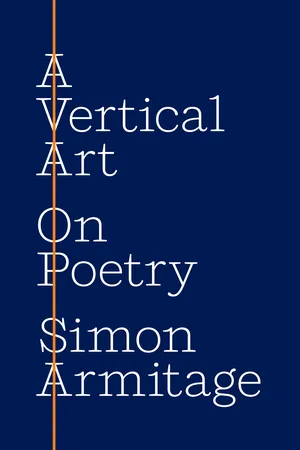
In A Vertical Art, acclaimed poet Simon Armitage takes a refreshingly common-sense approach to an art form that can easily lend itself to grand statements and hollow gestures. Questioning both the facile and obscure ends of the poetry spectrum, he offers sparkling new insights about poetry and an array of favorite poets.
Based on Armitage's public lectures as Oxford Professor of Poetry, A Vertical Art illuminates poets as varied as Emily Dickinson, Walt Whitman, Marianne Moore, W. H. Auden, Ted Hughes, Thom Gunn, A. R. Ammons, and Claudia Rankine. The chapters are often delightfully sassy in their treatment, as in "Like, Elizabeth Bishop," in which Armitage dissects—and tallies—the poet's predilection for similes. He discusses Bob Dylan's Nobel Prize, poetic lists, poetry and the underworld, and the dilemmas of translating Sir Gawain and the Green Knight. Armitage also pulls back the curtain on the unromantic realities of making a living as a contemporary poet, and ends the book with his own list of "Ninety-Five Theses" on the principles and practice of poetry.
An appealingly personal book that explores the volatile and disputed definitions of poetry from the viewpoint of a practicing writer and dedicated reader, A Vertical Art makes an insightful and entertaining case for the power and potential of poetry today.
- 376 pages
- English
- ePUB (mobile friendly)
- Available on iOS & Android
eBook - ePub
About this book
Information
Topic
LittératureSubtopic
Critique littéraire anglaiseThe Parable of the Solicitor and the Poet
To help resolve a protracted and escalating insurance claim following a collision between his car and another motor vehicle, a poet employs the services of a local solicitor. The case requires four or five personal visits to the solicitor’s office, during the course of which – and despite never having been asked directly or volunteering details of his day-to-day activities – it occurs to the poet that he has been recognised.
Words and phrases begin to enter the solicitor’s conversation, delivered with a grin and a wink, and sometimes within air quotes; phrases such as ‘Apologies for the mixed metaphor’ or ‘If you, of all people, will excuse the pun.’ Eventually, on what is scheduled to be the final appointment, the solicitor utters the one sentence his client had hoped not to hear: the dreaded ‘Actually, I’m a bit of a poet myself.’ Later that day, the poet drives home. On the passenger seat next to him are the finalised, signed-off legal documents, bound in a pink ribbon. And outweighing them by several kilos are two shoeboxes full of poems: poems handwritten on legal foolscap in green ink, which the poet, being a poet, has of course agreed to read and comment on. It is a service he will provide for nothing, such was the unspoken expectation, even though the other document riding next to him in the vehicle is the solicitor’s bill for several hundred pounds, to be settled within ten working days.
It is, then, with a familiar sense of resigned obligation that the poet sits down some days later to dig through the strata of accumulated verse, and then with a growing sense of hubris and sympathy, as he realises after the third or fourth villanelle that the poems were written out of loss, following the death of the solicitor’s sister. The poems themselves, though cliché-ridden and sentimental (cliché and sentimentality being the dual-frequency carrier signal of the inexperienced poet), are painfully sincere. It reminds the chastised poet of many of the affirming statements he has made over the years – about poetry as the ultimate democratic art form, requiring little more than pen and paper and a working knowledge of the alphabet, and how poetry offers a natural refuge for self-expression during times of emotional disturbance. He is also reminded of some of the poems that proved so pivotal and persuasive when he was first exposed to poetry; when discovering how much power and force could be stored in – and retransmitted by – such compact shapes. Poems as the Duracell batteries of language, though ones which defy some basic Newtonian principle in the sense that, with the best ones at least, their potential energy seems to increase over time.
‘Methought I saw my late espousèd saint,’ begins John Milton, ‘seeing’, in his blind state, his deceased wife appear in a form of visitation not unlike the dream vision experienced by the speaker of the medieval poem Pearl a quarter of a millennium earlier, also a ‘pale and faint’ female figure, also ‘vested all in white, pure as her mind’. Trusting to an autobiographical reading, Milton’s evocation and near-beatification of either Katherine Woodcock, his second wife, or his first wife Mary Powell (who died the year Milton was said to have lost his sight completely), is one such miracle fuel-cell poem, one that Dr Johnson dismissed as a ‘poor sonnet’, suggesting that former students of Oxford University are not always correct in their judgements. The mournful tone and lovelorn voice of ‘Sonnet 23’, as it tends to be designated, appealed to me as a determinedly gloomy young man, moping around post-industrial northern England in a willed state of post-punk melancholia. Looking at it again in the plainer days of middle age, what strikes me about it now is the not-so-subtle preferment of the self, the promotion of the bereaved over the deceased. We meet ‘me’, ‘I’ and ‘my’ within the first line alone, then ‘me’ again in line two, then an emphatic, capitalised ‘Mine’ trumpeting the commencement of line five, given further emphasis by the indenting of preceding and following lines. And although poor Katherine, probably, or poor Mary, possibly, is given her due through the middle and later passages of the poem – as it transitions from octave to sestet, and from pagan to Christian imagery – it is the poet again, in the closing line, who has the final say. ‘I waked, she fled, and day brought back my night’ (my italics). Abandonment might be too strong a word to describe the concluding sentiment, but there is definitely a good old helping of one of poetry’s staple ingredients: self-pity. And to my mind, the poem is more convincing because of it, or perhaps more honest, or more real, or indeed more confessional – exquisite emptiness being a truer representation of loss than the idealising or pedestalisation of the lost. It’s something our solicitor hadn’t really considered, judging by his own offerings, which were more eulogy than elegy, green in more than just their ink.
A suite of remembrance poems written over three hundred years after ‘Sonnet 23’ testifies to the idea that, while poetic styles evolve and bifurcate in many radical and unexpected directions, poetry’s core subjects tend to remain the same. Douglas Dunn’s collection Elegies is dedicated to his late wife, Lesley Balfour Dunn, and although the phrase ‘does exactly what it says on the tin’ wasn’t in common usage when the book appeared in 1985, it is a useful indication of its contents. The collection is pertinent to this lecture’s eventual subject – poetry’s position in the actual world – in as much as Elegies transcended the usual reception afforded a poetry collection, even a very good one, winning the overall Whitbread Book of the Year award. That prize has since morphed into the Costa Book of the Year, a gentrifying act that has shifted its association from the tavern to the coffee house, though it’s still a beverage-endorsed honour run by the same parent company. The award meant that Elegies was deemed not only the best book of poems in the country that year, but better than the best biography, the best children’s book and – holy of holies – the best novel. Maybe it was deemed as readable and comprehensible as its competitors in those other categories, with the judges responding to its unusual approachability, possibly in comparison with other poetry of the same vintage.
Elegies is, in many ways, the classic slim paperback as we came to think of it in the eighties: a pocket-sized book, eight inches high by five inches wide; three ounces in weight; the trademark Faber & Faber livery framing an elegant woodcut or etching; card covers enclosing sixty-four printed pages on matt paper, carrying a pre-sentiment of ageing, with most poems fitting comfortably within a single page. Of which the poem ‘Birch Room’ strikes me as especially typical. ‘She was four weeks dead,’ Dunn begins the second stanza, somewhat tersely. He goes on:
before that firstGreen haunting of the leaves to come, thickeningThe senses with old hopes, an uncoercedSurrender to the story of the Spring.
From their second floor, husband and wife once sat watching nature ‘create a furnished dusk’. And later, confined by illness to an even higher storey in the building, already ascending into a more ethereal realm, his wife wishes she could still see the trees – ‘our trees’ – trees belonging to the couple as a shared possession and belonging to the real world; living organisms, rooted in earth. ‘“If only I could see our trees,” she’d say.’
Presented within inverted commas as reported speech, pedants and detractors might wonder at the poet’s wife’s aptitude for talking in syllable-perfect iambs, and might wonder the same again when she next speaks, two lines later; just as counter-pedants might find within the penultimate line a justification for such prosody in the apparent invitation to rearrange for the sake of decoration:
‘If only I could see our trees,’ she’d say,Bed-bound up on our third floor’s wintry height.‘Change round our things, if you should choose tostay.’I’ve left them as they were, in the leaf-light.
Note the courageous reverse foot in that last phrase, a sudden about-face against the steady iambic progression, as if the poet has broken the fourth wall of the poem through a shift in stress, spinning around to address us directly, the abrupt metrical confrontation serving as a reconstruction of his own exposure to the sudden dappled brightness. Also, the narrow confines of the page have forced the typesetter to carry over the word ‘stay’ onto a line of its own, and the term takes on an unintentional poignancy when presented as a solitary expression in physical isolation, as either invitation or imperative (or both). A further consequence of that ‘turn-over’ is the shunting of the final line into its own space, privileging the griever over the departed once again: Dunn the last figure on stage in the final scene, like Milton, before the curtain comes down; Dunn spotlit by daylight, Milton forsaken for the night, both poems of the ‘methought’ variety.
The next poem in Elegies is ‘Writing with Light’, on the facing page. Open the book between pages twenty-two and twenty-three, and sunlight reactivates these two poems of shadow and illumination, of black marks against a white (or by now yellowing) page. Close the book to entomb them once again. It’s a kind of satisfying materiality that the Kindle has never managed to replicate, despite the inflammatory promise of its name. Ditto the Kindle’s superior model, the equally non-combustible Kindle Fire, whereas the Paperwhite Kindle seems to have conceded these limitations and gone back to the drawing board. (Other electronic readers are available, and similarly two-dimensional.)
Returning to our parable, the poet compiles a long letter thanking the solicitor for sharing his work, commenting on his brave and heartfelt verses, and gently addressing some of the shortcomings of the poems through positive criticism and suggested reading, including Milton, Dunn, the Pearl poet and others. He posts his letter, and receives in reply … no thanks whatsoever – not even an acknowledgement of receipt – though five months later, an envelope does fall onto his doormat bearing the name and logo of the practice, with a note from the solicitor pointing out that, due to an earlier miscalculation, there are outstanding charges relating to the insurance claim, and for the sake of balancing the books could the poet please send a cheque at his earliest convenience for the sum of three pounds and eleven pence. Still in possession of the two shoeboxes full of poems, and with winter coming on, the poet makes his first visit of the year to his wood-burning stove. Let us consider that, just for a few heart-warming and hand-warming minutes, the books were indeed balanced.
One of my themes – I say this almost two thousand words in – is the situation of poetry, its standing in this world, which, after almost thirty years as a practising poet (practising in the Gravesian sense of being forever apprenticed to an unachievable goal), I’m still as curious and concerned about as I was at the outset. However I range back and forth in these lectures – from Milton to Douglas Dunn, from Chaucer to the latest T. S. Eliot Prize winner – it will be a recurring theme of my appointment here at Oxford. Four years from now, if I’m still here (if I haven’t disgraced myself to the point of dismissal, or expired in the meantime), it’s my intention to be still pursuing this question, puzzling over the position that poetry and poets might occupy in the early phases of the twenty-first century, and positions they have occupied in the past. Some of you, with your brilliant degrees, will be well into marvellous, well-remunerated careers by then – in the City perhaps, or even as solicitors. You’ll be standing in the nose cone of the Gherkin, or at the pinnacle of the Shard, or in a high office in Inner Temple, looking north-west along the vector of the M40; or you might be flying over Oxford in the business class section of the plane, in front of the grey retractable veil that separates two worlds, where the seats are a little wider and the crew a little more obliging. It will be 2019, a Tuesday afternoon in Trinity term, and you’ll look yonder or look down and suddenly think, I wonder if he’s still there, in that big hall, banging on about it.
Poetry: it beguiles and perplexes. The Monday after my election to this position was announced, I was in Liverpool Lime Street Station, waiting for a train back across the Pennines, and decided to conduct a little non-scientific market research in W. H. Smith. Liverpool: European Capital of Culture in 2008, a city extrovert in nature, characterised by an overt interest in the humanities and the arts, revelling in dialogue, and relishing the playfulness and possibilities of words; a city proud and practised in linguistic self-expression. W. H. Smith: the nation’s foremost high street newsagent, and, although not exactly a Waterstones or a Hatchards or a Blackwell’s, still a vendor of books as far as the general public are concerned, and this particular branch located in a station, servicing passengers about to spend time in a relatively distraction-free environment – i.e. a captive audience in a cornered market. Forgetting whatever trite, centre-justified, italicised platitudes were printed within the dozens of cellophane-wrapped greetings and sympathy cards, I can report that on the shelves of that shop there was not a single book, magazine, periodical or journal that carried any contemporary poetry, despite a selection that covered some pretty niche territories. (In fact, if the titles on offer were anything to judge by, subjects more popular than poetry include wood-turning, bus-spotting and practical pig-keeping.) The remaining unsold copy of Literary Review contained no published poetry, nor did it review any that month.
Poetry: it intrigues and bemuses. As a subject, it thinks a great deal of itself and takes itself incredibly seriously, but the status and regard it affords itself rarely seem to be reflected in the civilian population.
Poetry: it compels and repels. Collections are published to universal indifference, and yet the very number of people in this venue today says something about its abiding importance. It was presumptuous of me to have written that sentence in advance, I admit, but if there had been only three people in this room I would have used the attendance figure to make the same point, namely that to the vast majority of people – even to the majority of readers – it seems an irrelevance or, occasionally, a joke.
Two recent performances by the actor Ralph Fiennes illustrate the point. In the Wes Anderson film The Grand Budapest Hotel, Fiennes plays the dandified concierge and occasional gigolo Monsieur Gustave H., whose habit of quoting ornate rhetorical verse at moments of high drama draws scowls and yawns from allies and enemies alike. In his portrayal of Jack Tanner in last year’s National Theatre production of Shaw’s Man and Superman, the boot was on the other foot: this time it was Fiennes’s turn to scowl and yawn, as the bandit Mendoza quoted reams of vapid romantic verse composed for his true love Louisa. ‘[He recites, in rich soft tones, and in slow time]’ is Shaw’s stage direction, before Mendoza declares,
Louisa, I love thee.I love thee, Louisa.Louisa, Louisa, Louisa, I love thee.One name and one phrase make my music, Louisa.Louisa, Louisa, Louisa, I love thee.Mendoza thy lover,Thy lover, Mendoza,Mendoza adoringly lives for Louisa.There’s nothing but that in the world for Mendoza.Louisa, Louisa, Mendoza adores thee.
Shaw writes, ‘TANNER [all but asleep, responds with a faint groan.]’ Mendoza summarises the situation: ‘Doggerel to all the world: heavenly music to me!’
Poetry: it enriches and it embarrasses. If I had a pound for every time someone had sent me the Gary Larson-style greeting card depicting a bookish man in an armchair and another man bound and gagged at his feet, above the caption ‘ON WEDNESDAYS, FRANK WOULD EXPLAIN HIS POETRY TO ME’ (with ‘FRANK’ replaced by ‘Simon’), I would be sitting at the front of the plane, on the other side of the all-important retractable veil.
And if the over-earnest and self-interested poet is an easy target for satirists, poetry itself is often portrayed as an elevated and abstruse concoction that would mock those not worthy of its complexities, as Detective David Mills finds out in the David Fincher film Seven. Following a hunch that a serial killer is modelling his modus operandi on ancient texts, and having crossed ...
Table of contents
- Cover Page
- By the Same Author
- Title Page
- Copyright Page
- Contents
- Introduction
- 1. The Parable of the Solicitor and the Poet
- 2. Mind the Gap: Omission, Negation, and ‘A Final Revelation of Horrible Nothingness’
- 3. On Lists
- 4. Access All Areas: Poetry and the Underworld
- 5. We Need to Talk About Robert: Bob Dylan and the Nobel Prize in Literature
- 6. The Hawks and the Doves: Raptors and Rapture in the Poems of Thom Gunn and Ted Hughes
- 7. Like, Elizabeth Bishop
- 8. Winter Words in Various Moods and Metres
- 9. Damned if He Does and Damned if He Doesn’t? Dilemmas and Decisions in Sir Gawain and the Green Knight
- 10. ‘Undisfigured by False or Vicious Ornaments’: Clarity and Obscurity in the Age of Formlessness
- 11. ‘When I Heard the Learn’d Astronomer’
- Coda. Ninety-five Theses: On the Principles and Practice of Poetry
- Notes
- Acknowledgements
Trusted by 375,005 students
Access to over 1.5 million titles for a fair monthly price.
Study more efficiently using our study tools.
Frequently asked questions
Yes, you can cancel anytime from the Subscription tab in your account settings on the Perlego website. Your subscription will stay active until the end of your current billing period. Learn how to cancel your subscription
No, books cannot be downloaded as external files, such as PDFs, for use outside of Perlego. However, you can download books within the Perlego app for offline reading on mobile or tablet. Learn how to download books offline
Perlego offers two plans: Essential and Complete
- Essential is ideal for learners and professionals who enjoy exploring a wide range of subjects. Access the Essential Library with 800,000+ trusted titles and best-sellers across business, personal growth, and the humanities. Includes unlimited reading time and Standard Read Aloud voice.
- Complete: Perfect for advanced learners and researchers needing full, unrestricted access. Unlock 1.5M+ books across hundreds of subjects, including academic and specialized titles. The Complete Plan also includes advanced features like Premium Read Aloud and Research Assistant.
We are an online textbook subscription service, where you can get access to an entire online library for less than the price of a single book per month. With over 1.5 million books across 990+ topics, we’ve got you covered! Learn about our mission
Look out for the read-aloud symbol on your next book to see if you can listen to it. The read-aloud tool reads text aloud for you, highlighting the text as it is being read. You can pause it, speed it up and slow it down. Learn more about Read Aloud
Yes! You can use the Perlego app on both iOS and Android devices to read anytime, anywhere — even offline. Perfect for commutes or when you’re on the go.
Please note we cannot support devices running on iOS 13 and Android 7 or earlier. Learn more about using the app
Please note we cannot support devices running on iOS 13 and Android 7 or earlier. Learn more about using the app
Yes, you can access A Vertical Art by Simon Armitage in PDF and/or ePUB format, as well as other popular books in Littérature & Critique littéraire anglaise. We have over 1.5 million books available in our catalogue for you to explore.