This book provides professors and their graduate teaching assistants—those at the front line of interactions with students—with techniques and approaches they can use in class to help at-risk students raise their skills so that they can successfully complete their studies.
eBook - ePub
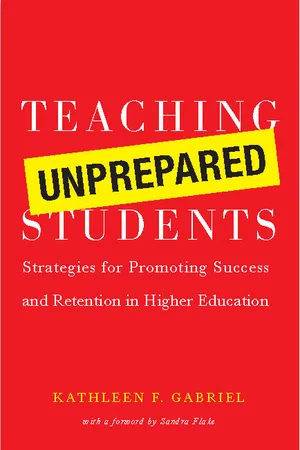
Teaching Unprepared Students
Strategies for Promoting Success and Retention in Higher Education
- 160 pages
- English
- ePUB (mobile friendly)
- Available on iOS & Android
eBook - ePub
Teaching Unprepared Students
Strategies for Promoting Success and Retention in Higher Education
About this book
Information
Topic
EducationSubtopic
Higher Education1
UNPREPARED AND AT-RISK COLLEGE STUDENTS
Not everything that is faced can be changed. But nothing can be changed until it is faced.
—James Baldwin
The number of academically unprepared and at-risk students enrolling in colleges and universities is increasing. In a national survey of college professors conducted by the Chronicle of Higher Education, 44% of college faculty members reported that their students ‘‘are ill prepared for the demands of higher education’’ (Sanoff, 2006, p. 1). Results from the American College Testing Program (ACT) in 2006 support the professors’ perception. These results show that 49% of high school graduates do not have the reading skills they need to succeed in college (Kuh, Kinzie, Schuh, Whitt, & Associates, 2005, p. 1). For those who attend college, about 25% of first-time students at 4-year colleges and universities require at least 1 year of remedial courses (Adelman, 2004; Horn & Berger, 2004; Kuh et al., 2005, p. 1).
These statistics may be surprising, but they do not fully describe the attitude of many of today’s college students. As Weimer (2002) explains,
Students now arrive at college less well prepared than they once did. They often lack solid basic skills and now work many hours to pay for college and sometimes a car. . . . Many students lack confidence in themselves as learners and do not make responsible learning decisions. . . . Having little self-confidence and busy lives motivates many students to look for easy educational options, not ones that push them hard. . . . Obviously, these descriptions are not characteristic of all students, but most faculty quickly agree that teaching college students today is far more challenging than it once was. (pp. 95–96)
For at-risk or unprepared students with inadequate reading and writing skills, college placement tests serve as a barrier to registering for the college English and math classes needed for general education requirements, thus forcing the students to take remedial courses to prepare them for these college-level classes. However, at many institutions, these same students are not prevented from enrolling in social science, humanities, and some science courses, where they can quickly falter. When assessing all students’ abilities and attitudes in several specific areas, ‘‘faculty members say that students are inadequate writers, have trouble understanding difficult materials, fall short in knowledge of science and math, have poor study habits, and lack motivation’’ (Sanoff, 2006, p. 1).
While reforms at the high school level have been proposed, many universities and colleges have already established summer programs that target academically at-risk students, first-generation students, and others who traditionally have had low levels of retention and/or college graduation rates. These summer programs seek to set these students on the right path for succeeding in college since ‘‘most student attrition occurs during the first year of college’’ (Wankat, 2002, p. 173). Many colleges have increased their tutoring center services, hired retention specialists, offered developmental courses for unprepared students, and expanded first-year experience programs that target the incoming students.
Still, the statistics of success rates for at-risk students are bleak. Kuh et al. (2005) report ‘‘seventy percent of students who took at least one remedial reading course in college do not obtain a degree or certificate within eight years of enrollment’’ (p. 1). They also report the following:
More than one-fourth of 4-year college students who have to take three or more remedial classes leave college after the first year (Adelman, Community College Survey of Student Engagement (CCSSE) 2005; National Research Council 2004). In fact, as the number of required developmental courses increases, so do the odds that the student will drop out (Burley, Butner, & Cejda 2001; CCSSE). (Kuh et al. 2005, p. 2)
Many of the at-risk students are doomed to failure either because they are academically disqualified by university officials or because they decide to leave the university with a low grade point average. The cost of losing these students can be high for the students, their families, and the universities that lose them. When universities lose students to academic failure, they not only lose human potential but also real dollars and cents in the form of lost tuition monies, additional resources expended on recruiting replacement students, and so on.
As colleges and universities have examined which students are and are not completing degree programs, the resulting studies reveal that for historically underserved students, graduation rates are significantly lower.
Although greater numbers of minority students are entering college than in previous years, fewer continue to earn degrees compared with non-minorities. Poor college completion rates and the racial-ethnic gap in graduation rates mean that too many students are not acquiring the desired knowledge, skills, and competencies needed for the 21st century. (Kuh, Kinzie, Cruce, Shoup, & Gonyea, 2007, p. 5)
The cost of losing students is worrisome to college officials. In response to the revolving-door scenario, many colleges and universities have added retention coordinators and specialists, and increased academic support beyond the traditional tutoring and writing centers.
Even though the odds are against at-risk and unprepared students, there are those who do make it. Not only have academic support programs improved the chances of success for at-risk students, but so have the actions of individual faculty members. In his study Blose (1999) notes that in selective institutions where faculty and staff have high levels of expectations for all their students, then ‘‘regardless of individuals’ prior academic history . . . students tend to respond and behave as the faculty expected in a kind of self-fulfilling prophecy’’ (p. 84). When professors ‘‘treated the students as academically capable, and held them to high standards’’ (p. 84) in an environment of respect, students—all students, even those who were admitted as underachieving or unprepared students—achieve an increased level of performance (p. 84). Thus, low retention and graduation rates for unprepared and at-risk students can be improved, and faculty can have a major impact on accomplishing this.
How professors teach and interact with at-risk students makes the difference. There is a relationship between students’ intellectual development and student and faculty interaction (Halawah, 2006). Professors can develop a rapport with their students both in and out of the classroom, and have a ‘‘significant positive influence’’ on students’ intellectual and personal development (Halawah, 2006, p. 677). And, as most professors already know, posting office hours and waiting for students to come is not enough. In their study of educationally effective colleges, Kuh et al. (2005) found that ‘‘the most successful schools balance academic challenges with various types of support so that students are not left to fend on their own to figure out how to succeed’’ (p. 181).
As educators, we have an obligation to all of our students, including those who arrive unprepared. As members of an institution and as individual professors, we must use a myriad of actions that will provide unprepared students with real opportunities for success. If we do not, we are simply setting these students up for failure and, at the same time, only pretending we have somehow fulfilled a moral obligation of providing opportunities to our diverse population in today’s society. Astin (1999) writes,
The education of the so-called ‘‘remedial’’ students is the most important educational problem in America today, more important than educational funding, affirmative action, vouchers, merit pay, teacher education, financial aid, curriculum reform and the rest. . . . I would argue that providing effective ‘‘remedial’’ education would do more to alleviate our most serious social and economic problems than almost any other action we could take. (p. 10)
While most institutions have academic support centers that strive to ameliorate the problems of low retention rates of at-risk students, many professors are looking for answers to address the growing number of unprepared and at-risk students who are enrolled in their courses, who underperform, and who are reluctant to seek help. ‘‘Much of the existing literature focuses on developing general theoretical models of help-seeking, but few offer concrete suggestions for interventions’’ (Chung & Hsu, 2006, p. 254). The purpose of this book is to provide professors (and their graduate teaching assistants) with teaching strategies and methods that will promote student engagement and improve performance for all the students in their classes, but especially for those who are at risk or unprepared, without sacrificing high standards or expectations.
Overview
In chapter 2, ‘‘Philosophical Foundations,’’ I explain that articulating a teaching philosophy can help clarify beliefs and principles about teaching. After a teaching philosophy is established, it can be used as the guiding principle for developing teaching goals for each course that we teach. In this chapter, I describe the five guiding principles that constitute the foundation of my teaching philosophy, wherein my ultimate goal is to provide opportunities for success for all college students, focusing particularly on giving unprepared students a real chance to make it.
In chapter 3, ‘‘The First Week of Class,’’ I discuss how we can augment students’ enthusiasm and motivation by clearly explaining and identifying the goals and objectives of the class and the specific procedures and expectations that students must meet to succeed. As professors, we must do this in the first week of class. Our message should be communicated verbally and in writing (e.g., the syllabus) so that our students, as well as ourselves, can refer to the expectations throughout the semester. Chapter 3 addresses the various components of a learner-centered syllabus and how it can be used as a guide for student success. If a positive and interactive tone is set during the first week of the semester, the benefits will be reaped throughout the rest of the course.
Providing opportunities for interactions with your students and among your students (i.e., student-to-student contact) is another important ingredient for retention. Chapter 3 also deals with creating an atmosphere for promoting appropriate and engaging behavior and discusses techniques for creating a positive classroom environment that embraces diversity and promotes inclusion and respect for all. A variety of methods that professors and graduate teaching assistants can use to help students appreciate the benefits of diversity in our society are included.
In chapter 4, ‘‘Begin With Consistent Contact,’’ the connection between attendance and retention is examined. Retention begins with a student’s success in his or her courses, and achieving success is tied to regular attendance. Several studies show that students who go to class regularly earn higher grades and are more likely to stay in college. This chapter discusses six steps that we as faculty can easily implement that will increase class attendance of all students, regardless of how prepared they may be for college. Furthermore, the ways these steps reinforce Chickering and Gamson’s (1987) Seven Principles for Good Practice in Undergraduate Education are examined.
Chapter 5, ‘‘Learning Styles and the Science of Learning,’’ sets forth several types of learning style inventories students can take that will help shed light on individual learning style preferences. This chapter covers three specific models. Such knowledge can empower students and increase their sense of responsibility in the learning process as they discover new study techniques and methods for different types of learners. In addition I discuss learning approaches and science of learning research. Knowledge of learning styles, learning approaches, and the principles from the science of learning not only helps students but professors also, as we too can evaluate our own teaching styles and make sure that we have a variety of approaches and assessments that play to various student’s respective needs.
Chapter 6, ‘‘Embracing Learner-Centered Education,’’ familiarizes readers with learner-centered environments. As community colleges and 4-year institutions seek ways to improve their retention and graduation rates, many have recognized that shifting the pedagogy focus from professor centered to learner centered can benefit all students, especially those who are at risk. This chapter defines learner-centered teaching and lists specific steps professors can take to become learner-centered teachers, including establishing course goals, developing desired learning outcomes, creating a learnercentered syllabus, preparing for resistance, and establishing a learning community.
These initial steps will guide professors as they plan lessons and activities that will engage students so that they can fully participate in achieving the desired learning outcomes. This chapter stresses the importance of considering students’ prior knowledge or lack of knowledge. ‘‘If we ignore or avoid prior knowledge, it will hinder our teaching’’ (Zull, 2002, p. 108). To help students connect with new material, they must make connections that make sense to them. This chapter not only discusses ways to spark such connections, but it also suggests strategies for helping students find ways to catch up to the new material being presented.
Chapter 7, ‘‘Interweaving Assessment and Teaching,’’ describes the benefits of ongoing assessments. As professors, we often ask our students if they have any questions. Usually, the response is silence. Yet, after the first exam is over, professors and students may be disappointed or frustrated with poor results. However, by using different types of assessment techniques and activities before (and in between) exams, professors and students can receive specific feedback on whether students are grasping the material, and on the students’ progress in applying, analyzing, synthesizing, or transferring the ideas of the course content. An early warning of problems allows the teacher to intervene quickly to avoid discouraging at-risk students. Chapter 7 also reviews the importance of using different types of activities that not only engage students and increase their participation in class, but also give the professor and students feedback as students prepare to demonstrate what they are learning.
In chapter 8, ‘‘Techniques for Promoting Academic Integrity and Discouraging Cheating,’’ I present new ways to combat cheating and improve one’s grading systems. During class many professors have encountered the question, ‘‘Is it going to be on the test?’’ While most professors find this question frustrating (or infuriating), it also shows that many students are obsessed with their grades. Because of this obsession, the students appear to be focused on doing well on tests and not necessarily on learning the material. In addition, professors have to contend with cheating on tests and/or students who plagiarize papers. This chapter covers a variety of issues related to grading student performances and, at the same time, provides suggestions for discouraging cheating. By using rubrics, Universal Design strategies, and introducing a vocabulary strategy that can help our students—and particularly those at risk—improve their reading and listening comprehension, we can help students improve the way they prepare for tests, write their papers, and complete other summative assignments. At the same time, we will be promoting student engagement and academic integrity.
Conclusion
I have tried to make this book ‘‘professor friendly’’ for both the veteran and beginner teacher. You can choose the chapters that will best fit your needs, or you can read the book in its entirety. Each chapter offers specific tools and interaction techniques specifically for at-risk or unprepared students relating to the specific subtopic. The table of contents is intended to guide your selections. This book is not a panacea for all problems presented by atrisk and unprepared students, but it is hoped that the concepts and ideas will support your efforts in reaching out to these students. Take the ideas you like, and tweak the ones that don’t quite...
Table of contents
- Cover
- Half-title Page
- Title Page
- Copyright
- Dedication
- Contents
- Acknowledgments
- Foreword
- 1. Unprepared and At-Risk College Students
- 2. Philosophical Foundations
- 3. The First Week of Class
- 4. Begin with Consistent Contact
- 5. Learning Styles and the Science of Learning
- 6. Embracing Learner-Centered Education
- 7. Interweaving Assessment and Teaching
- 8. Techniques for Promoting Academic Integrity and Discouraging Cheating
- Epilogue: Final Thoughts
- Appendix A Checklist for Possible Course Syllabi Items
- Appendix B Performance Prognosis Inventory for Analytical Chemistry
- Appendix C Preparing for Three Different Groupings
- Appendix D Vocabulary Strategy Steps
- References
- Index
- Backcover
Trusted by 375,005 students
Access to over 1.5 million titles for a fair monthly price.
Study more efficiently using our study tools.
Frequently asked questions
Yes, you can cancel anytime from the Subscription tab in your account settings on the Perlego website. Your subscription will stay active until the end of your current billing period. Learn how to cancel your subscription
No, books cannot be downloaded as external files, such as PDFs, for use outside of Perlego. However, you can download books within the Perlego app for offline reading on mobile or tablet. Learn how to download books offline
Perlego offers two plans: Essential and Complete
- Essential is ideal for learners and professionals who enjoy exploring a wide range of subjects. Access the Essential Library with 800,000+ trusted titles and best-sellers across business, personal growth, and the humanities. Includes unlimited reading time and Standard Read Aloud voice.
- Complete: Perfect for advanced learners and researchers needing full, unrestricted access. Unlock 1.5M+ books across hundreds of subjects, including academic and specialized titles. The Complete Plan also includes advanced features like Premium Read Aloud and Research Assistant.
We are an online textbook subscription service, where you can get access to an entire online library for less than the price of a single book per month. With over 1.5 million books across 990+ topics, we’ve got you covered! Learn about our mission
Look out for the read-aloud symbol on your next book to see if you can listen to it. The read-aloud tool reads text aloud for you, highlighting the text as it is being read. You can pause it, speed it up and slow it down. Learn more about Read Aloud
Yes! You can use the Perlego app on both iOS and Android devices to read anytime, anywhere — even offline. Perfect for commutes or when you’re on the go.
Please note we cannot support devices running on iOS 13 and Android 7 or earlier. Learn more about using the app
Please note we cannot support devices running on iOS 13 and Android 7 or earlier. Learn more about using the app
Yes, you can access Teaching Unprepared Students by Kathleen F. Gabriel in PDF and/or ePUB format, as well as other popular books in Education & Higher Education. We have over 1.5 million books available in our catalogue for you to explore.