For Black women faculty members and student affairs personnel, this book delineates the needed skills and the range of possible pathways for attaining administrative positions in higher education.This book uses a survey that identifies the skills and knowledge that Black women administrators report as most critical at different stages of their careers as a foundation for the personal narratives of individual administrators' career progressions. The contributors address barriers, strategies, and considerations such as the comparative merits of starting a career at an HBCU or PWI, or at a public or private institution.Their stories shine light on how to develop the most effective leadership style, how to communicate, and the importance of leading with credibility. They dwell on the necessity of listening to one's inner voice in guiding decisions, of maintaining integrity and having a clear sense of values, and of developing a realistic sense of personal limitations and abilities. They illustrate how to combine institutional and personal priorities with service to the community; share how the authors carved out their distinct and purposeful career paths; and demonstrate the importance of the mentoring they received and provided along the way. A theoretical chapter provides a frame for reflecting on the paths traveled. These accounts and reflections provide enlightenment, inspiration, and nuggets of wisdom for all Black women who want to advance their careers in higher education.
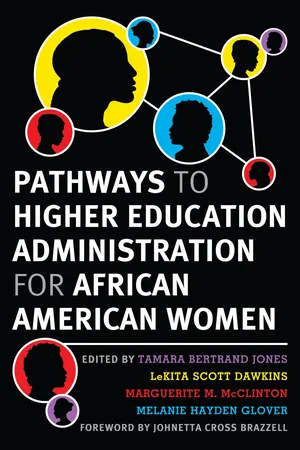
eBook - ePub
Pathways to Higher Education Administration for African American Women
- 156 pages
- English
- ePUB (mobile friendly)
- Available on iOS & Android
eBook - ePub
Pathways to Higher Education Administration for African American Women
About this book
Information
Topic
EducationSubtopic
Higher Education1
EXISTING PATHWAYS
A Historical Overview of Black Women in Higher Education Administration
Melanie Hayden Glover
“It is in the vision of the leaders that we see embodied the image of what is possible, what we can ourselves become. Leadership is a way of life for African American women. From Harriet Tubman, Sojourner Truth, and countless, nameless enslaved women, we have inherited a legacy which stretches from the days of bondage into the next century.”
(Brown, 1998, p. 16)
Black women have long been trailblazers in the fight for racial and gender equity. Throughout history, they have experienced and continue to face personal and professional barriers that attempt to impede their success. Of these barriers, racism, sexism, and classism are often cited as three salient forms of oppression that bruise self-confidence and shatter dreams (Collins, P. H., 2000; Gregory, 2001). Despite these obstacles, Black women armed with vision, courage, resilience, and leadership remain determined to create a better life for themselves, their children, and future generations.
This tradition of leadership and service among Black women has helped to increase educational opportunities for other Black women. Furthermore, Black females holding administrative leadership positions within higher education have helped to improve the enrollment and persistence of Black students, particularly at predominantly White institutions (PWIs) (Patitu & Hinton, 2003). As a result, the number of Black women pursuing and earning undergraduate, graduate, and professional degrees is far greater now than it was three decades ago. For example, in 1970 less than 6% of all Black females age 25 and older had completed a bachelor’s degree or higher. By 2005, this rate of educational attainment had increased to 19% among Black women (National Center for Education Statistics [NCES], 2006). This upward trend in enrollment and graduation is linked to the increase in the number of Black female faculty members and administrators working in higher education institutions. Yet, their numbers are still disproportionately underrepresented when compared with those of Black men, White women, and White men in these same professions (Holmes, 2003).
Black women continue their struggle to acquire positions of leadership within the academy. Clearly, the limited numbers of Black women in these positions reflect the fact that they are not often hired for mid- to senior-level administrative careers in which they would be responsible for developing policies that create institutional and social change. Instead, they are offered positions where they simply implement policies or programs that others have created (Konrad & Pfeffer, 1991). From those women who do attain these positions of leadership there are lessons to be learned that would be valuable to those who aspire to these positions.
Examination of the journey of administrative leadership for Black women from a historical perspective illustrates that Black women have made progress in certain segments of higher education administration (Holmes, 2003; Jackson, 2006; Patitu & Hinton, 2003). Their progress inspires others to pursue their goal of joining the ranks of administrative leadership. Moreover, their success highlights specific pathways to higher education administration that will benefit other Black women.
The purpose of this chapter is to provide a context for the discussion of Black women in higher education administration. To achieve this goal, two areas are covered: (a) a broad historical overview of Black women administrators at colleges and universities in U.S. higher education, and (b) the current status of these women in higher education administration. The chapter concludes with a timeline of Black female “firsts” in education, teaching, and administration.
Black Women Administrators in American Educational Institutions
The history of Black women in higher education administration must begin with a discussion of the education of Black people in the United States. Education has historically served as a means to liberate and empower Black men and women. However, the opportunity to receive a formal education was not always afforded to them. The institution of slavery deprived them of opportunities to expand their knowledge and develop their intellectual abilities (Collins, A. C., 2001).
Prior to the Civil War, it was illegal to educate enslaved individuals of African descent. These men and women learned how to read and write in secrecy through the assistance of religious leaders, abolitionists, their slave owners, or freed Blacks who had already mastered these skills. Furthermore, Blacks were prohibited from attending any type of formal educational or learning institution. White Americans believed that it was useless to provide a formal education to individuals whom they considered to be intellectually and culturally inferior (Collins, P. H., 2000; Wolfman, 1997). Several significant milestones, however, slowly changed the landscape of American education.
The end of the Civil War marked a pivotal time in the country and in the lives of newly emancipated Blacks. Many Blacks who were educated—particularly women—decided to travel to the South to educate other free men and women. Many religious leaders also felt compelled to help educate these individuals and end the pattern of disenfranchisement. Schools were designed to provide basic academic skills and religious teaching to Blacks to help them become productive citizens in society (Wolfman, 1997). There was also support for extending higher education in America. Through the Morrill Act of 1862, the federal government gave land to states for the development of public higher education institutions that would focus on agricultural, mechanical, and military training. Cornell University (New York), Virginia Polytechnic Institute and State University (Virginia), and Penn State University (Pennsylvania) were among the institutions funded by these land grants. Another piece of federal legislation, the Morrill Act of 1890, mandated that federal funding be distributed fairly for Black and White higher education institutions. The beneficiaries of this second act would include institutions such as South Carolina State University (South Carolina) and the University of Arkansas—Pine Bluff (Arkansas) (Solomon, 1985; Trow, 1993).
Even with these provisions, however, secondary and postsecondary schooling for Blacks was still separate and unequal (Hine, Brown, & Terborg-Penn, 2005). Some of the secondary educational institutions were funded with the assistance of federal tax-supported contributions, but this assistance did not adequately support the needs of the teachers and students in secondary schools. The secondary facilities were of such poor quality that they were often forced to close for long periods of time, interrupting the children’s learning process and leaving teachers without jobs (Hine et al., 2005).
Similarly, Black higher education institutions suffered financially from this segregated system. Students’ inability to pay tuition and limited state appropriations placed a fiscal burden on these colleges. Yet despite these challenges, historically Black colleges were able to offer positive educational experiences to men and women (Schuh, 2003).
Higher Education Degrees Awarded to Black Women
For a period in U.S. history there was a long-standing belief that women should not be educated beyond a basic understanding of how to read and write. Women’s place was in the home tending to more domestic responsibilities. Eventually, this paradigm shifted and a movement arose to educate women. In time, Black women would benefit from the efforts to build an educated society. Christian missionaries and White women who helped establish schools for Black women advanced the idea that if these women received an education and developed other skills, they could pass their knowledge along to their children. For this reason, the curriculum taught at these schools focused on moral development, cultural and social refinement, and home economics. The ultimate goal was to improve and uplift the Black race (Brown, 1998; Collins, A. C., 2001).
Although these “grooming schools” for Black women were sufficient for a season, they would not be intellectually stimulating enough for those who desired to further their education. In 1837, Oberlin College (Ohio), recognized as having a more liberal-minded administration at the time, extended higher education opportunities to Black women, nearly three decades after admitting White women. In 1850, Lucy Sessions obtained a literary degree from Oberlin, which made her the first Black woman to earn a college degree in the United States. Mary Jane Patterson was the first Black woman to earn a bachelor’s degree from an American college, graduating from Oberlin in 1862 (Collins, A. C., 2001; Evans, 2007).
This marked a turning point in the history of Black women in higher education. Other Black women would pursue advanced degrees and follow in the footsteps of Sessions and Patterson. Fanny Jackson Coppin was the second Black woman to earn a bachelor’s degree from Oberlin, in 1865 (Collins, A. C., 2001). With great determination and diligence, Black women also earned graduate and professional degrees. In 1865, Rebecca Lee Crumpler was the first and only Black woman to earn a Doctress of Medicine from the New England Female Medical College (Massachusetts). By 1867, Rebecca J. Cole became the second Black woman to become a physician by earning her medical degree at the Women’s Medical College of Pennsylvania (Pennsylvania). In 1921, Saddie Turner Mossell Alexander was the first woman to earn a PhD, receiving her degree in economics from the University of Pennsylvania (Pennsylvania). Approximately eight years later, in 1929, the first Black woman in the United States to earn a PhD in education was Jan Ellen McAlister (Hine et al., 2005; Williams-Burns, 1982).
Significant numbers of Black women also earned postsecondary degrees from historically Black colleges and universities. For example, Fisk University (Tennessee), Howard University (Washington, D.C.), and Wilberforce University (Ohio) were among the coeducational historically Black colleges that educated Black women. Atlanta Baptist Female Seminary (Georgia) was founded in 1881 as an all women’s college. This institution became Spelman College and now holds the distinction of being the oldest historically Black college for women in the country (Evans, 2007). Bennett College (North Carolina) was founded as a coeducational institution in 1873 but was restructured as a women’s college in 1926 (Brown, 1998). Additionally, Hartshorn Memorial College (Virginia) was established in 1883 as the first Black women’s college in the United States to confer bachelor’s degrees. Although Hartshorn is no longer in existence, the components of that institution became part of Virginia Union University (Virginia) (Solomon, 1985).
Although Black women were eventually able to pursue their educational goals at various institutions, they still experienced tremendous adversity. They had limited access to the campus library and other student services. In the classroom, they were often forced to sit in the back or separate sections of the room that impaired their ability to see, hear, and engage in class discussions with other students (Patterson, 2001). Disappointingly, some Black men and other women criticized them for pursuing an education (Wolfman, 1997). Despite these challenges, Black women proceeded to explore new frontiers in higher education.
Black Women as Teachers and Administrators
As more Black women earned degrees, they made a commitment to improve Black communities by teaching and establishing schools for others who wanted to learn. Teaching was a respectable profession for Black women. This method of service to present and future generations was an opportunity to enlighten others (Collins, A. C., 2001; Solomon, 1985; Wolfman, 1997).
Typically, Black women served dual roles as teachers and principals or administrators. They developed the curriculum for training and secondary schools while serving as teachers for classes. In fact, Mosley (1980) contends that the first Black female teacher and administrator can be traced back to 1793. At that time, Catherine Ferguson established Katy Ferguson’s School for the Poor (New York City). Although Ferguson had no higher education background, she wished to influence significantly the lives of others through education (Mosley, 1980). Other women would pursue similar interests. In 1820, Sarah Douglass opened a coeducational school for Blacks in Philadelphia. She was a fearless leader in the fight to end slavery. Later in her life, she served others as a teacher at Cheney State College (Pennsylvania) (Solomon, 1985; Wolfman, 1997).
Black women also held teaching and administrative positions at the collegiate level. Although teaching continued to be their primary job responsibility, those women who demonstrated promise and potential to lead were given additional administrative duties. Furthermore, some Black women found themselves in these positions because their husbands were administrators or faculty members at these institutions (Wolfman, 1997).
Significant legislative policies also impacted higher education and helped to increase the numbers of Black females entering administrative leadership positions (Rusher, 1996). Namely, Title XI of the Civil Rights Act of 1964 was designed to improve hiring practices and college admissions opportunities for women, as well as for racial and ethnic minorities. This legislation, now referred to as affirmative action, was instrumental in institutions diversifying the student, faculty, and administrative populations. More important, the policy was intended to create environments that would be welcoming and more reflective of the U.S. population. Title IX was another major legislative policy that prohibited sex discrimination among students at institutions receiving federal assistance (Geiger, 1999;Mosley, 1980;Rusher, 1996).
As the needs of the campuses changed, personnel were required to coordinate academic departments and units, as well as deal with activities of the students. Black female administrators pursued positions in two areas of college and university administration: academic affairs and student affairs. Academic affairs administration includes the positions of president, academic dean, department chair, and provost. Student affairs includes positions such as vice president for student affairs and dean of students (Jackson, 2001).
Academic Affairs Administrators
The career paths of faculty members or administrative personnel may lead them into other positions within the university including academic affairs administrators. In these leadership roles, individuals are responsible for developing and implementing policies and programs related to the academic mission of the institution (Walton & McDade, 2001). Black women were among the individuals in these leadership positions at colleges and universities even in the early years of their acceptance at these institutions.
At Wilberforce University (Ohio) in 1866, Sarah Woodson Early was “...
Table of contents
- Cover Page
- Title Page
- Copyright Page
- Dedication
- CONTENTS
- ACKNOWLEDGMENTS
- FOREWORD
- INTRODUCTION
- 1 EXISTING PATHWAYS
- 2 ESSENTIAL SKILLS FOR THE LEADERSHIP PATH
- 3 DIRECTION ALONG THE PATH
- 4 SERVICE ON THE ADMINISTRATIVE PATHWAY
- 5 LEVELING THE PATHWAY
- 6 INFLUENCING PATHWAYS
- 7 THE COMMUNITY-ENGAGED PROFESSIONAL
- 8 THE TIES THAT BIND
- 9 DECISIONS TO MAKE (OR NOT) ALONG THE CAREER PATH
- 10 MAKING LIFE/CAREER CHOICES
- 11 THE PATHWAY TO YOUR DREAMS IN ACADEMIA
- 12 CONNECTING THE PATHS
- APPENDIX ORGANIZATIONS FOR BLACK WOMEN ADMINISTRATORS
- ABOUT THE EDITORS AND CONTRIBUTORS
- INDEX
Trusted by 375,005 students
Access to over 1.5 million titles for a fair monthly price.
Study more efficiently using our study tools.
Frequently asked questions
Yes, you can cancel anytime from the Subscription tab in your account settings on the Perlego website. Your subscription will stay active until the end of your current billing period. Learn how to cancel your subscription
No, books cannot be downloaded as external files, such as PDFs, for use outside of Perlego. However, you can download books within the Perlego app for offline reading on mobile or tablet. Learn how to download books offline
Perlego offers two plans: Essential and Complete
- Essential is ideal for learners and professionals who enjoy exploring a wide range of subjects. Access the Essential Library with 800,000+ trusted titles and best-sellers across business, personal growth, and the humanities. Includes unlimited reading time and Standard Read Aloud voice.
- Complete: Perfect for advanced learners and researchers needing full, unrestricted access. Unlock 1.5M+ books across hundreds of subjects, including academic and specialized titles. The Complete Plan also includes advanced features like Premium Read Aloud and Research Assistant.
We are an online textbook subscription service, where you can get access to an entire online library for less than the price of a single book per month. With over 1.5 million books across 990+ topics, we’ve got you covered! Learn about our mission
Look out for the read-aloud symbol on your next book to see if you can listen to it. The read-aloud tool reads text aloud for you, highlighting the text as it is being read. You can pause it, speed it up and slow it down. Learn more about Read Aloud
Yes! You can use the Perlego app on both iOS and Android devices to read anytime, anywhere — even offline. Perfect for commutes or when you’re on the go.
Please note we cannot support devices running on iOS 13 and Android 7 or earlier. Learn more about using the app
Please note we cannot support devices running on iOS 13 and Android 7 or earlier. Learn more about using the app
Yes, you can access Pathways to Higher Education Administration for African American Women by Tamara Bertrand Jones, LeKita Scott Dawkins, Melanie Hayden Glover, Marguerite M. McClinton in PDF and/or ePUB format, as well as other popular books in Education & Higher Education. We have over 1.5 million books available in our catalogue for you to explore.