This book is intended for scholars, researchers, and academic leaders who have a passion to share their knowledge outside their classroom, laboratory, or institution; who want to make a difference; and who believe that the information they possess and ideas they offer are important for a wider public. Pitch Perfect is a practical guide to communicating your knowledge and research to broader audiences. How do you get yourself heard amid the volume of news and information in today's 24-hour news cycle, and get your message across in an environment where blogs and Twitter vie with traditional media? To break through, you need to amplify your ideas and make them relevant for a wider public audience.Bill Tyson – who has been successfully advising scholars and academic leaders on media relations for over 30 years – shows you how to undertake early and thoughtful communications planning, understand the needs and workings of the media, both traditional and digital, and tell your story in a way that will capture your audience. Bill Tyson is strategic in his advice, no less so when discussing how to engage with such social media as blogs, Facebook, Twitter, YouTube, podcasts or wikis.Whether you are working on research or a new initiative that has public implications, or have a story that deserves wide telling; whether you want to address funders' requests for communications plans to promote the programs they are supporting, or whether you want to know how to publicize your new book; this practical guide offers insider advice – complete with case studies – on how to communicate your message. An appendix lists key media in North America, Australia, and the UK.
eBook - ePub
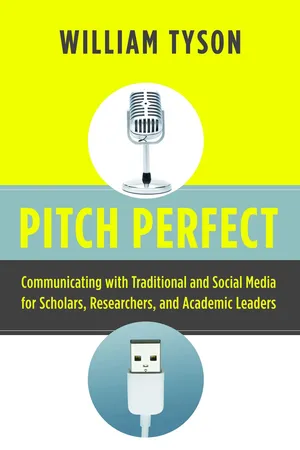
Pitch Perfect
Communicating with Traditional and Social Media for Scholars, Researchers, and Academic Leaders
- 256 pages
- English
- ePUB (mobile friendly)
- Available on iOS & Android
eBook - ePub
Pitch Perfect
Communicating with Traditional and Social Media for Scholars, Researchers, and Academic Leaders
About this book
Information
Topic
EducationSubtopic
Public RelationsCHAPTER ONE
Telling Your Story
IS IT A GOOD REPORT IF IT’S NOT READ?
Thousands of scholarly papers and books are written each year. Many have value to audiences beyond the academy and the institutions supporting these efforts. Yet most new works and their ability to influence change go unheard. “Ideas no longer score points,” says one university professor. “Their impact must be amplified to be noticed in an increasingly complicated world.”
This book is written for scholars, researchers, and academic leaders who have a passion to share their knowledge outside the classroom, laboratory, or institution. They want to make a difference and believe the value of the information they possess and ideas they offer have a public importance. Pitch Perfect is a practical guide to communicating knowledge and ideas to broader audiences.
Dust settles quickly on many scholarly compositions, the knowledge they offer buried within their pages. Communicating new ideas and findings are often afterthoughts for many scholars and researchers. They assume or hope their published works will rise to the top of conversation among their peers and the public. They rest in the belief that their reports, scholarly papers, or books, often deep in jargon, will find their way to key audiences, will be read with anticipation, and enter into professional and public discourse. Often the reality is disappointment in the lack of awareness and impact their work achieves. “Knowing what you know doesn’t get you anywhere. Telling people what you know does,” said Kay McClenney, director of the Center for Community College Student Engagement at The University of Texas at Austin. McClenney’s strong media outreach has generated important national discussions about higher education quality and access.
Scholars and researchers increasingly are being asked by funders to develop communication plans for programs receiving support. These organizations and institutions recognize that the value of a scholar’s work lies not only in the new findings but also in communicating the implications of this knowledge to key audiences and the public. Without good communication, many important works do not achieve the desired effects of advancing knowledge and creating new dialogue.
Whether your goal is to reach specific target audiences or the broader public, early and thoughtful communication planning is essential to having your story heard. And the key to a strong communication plan is knowing how to present your work to the media. Good media coverage connects you to important audiences and the public. It broadens awareness and understanding of your messages. It amplifies your voice and further validates your good work.
My work in the field of communications and media relations spans more than 30 years. It began in Hawaii where I developed advertising campaigns for a major newspaper. Returning to the mainland, I entered the health care field as a consultant, writing marketing and press material to support hospital building programs, and codirecting campaigns. Having had success in these efforts, I was asked to direct a capital campaign that helped lead to the opening of a regional university in New England. I was witnessing in my career that the value of defining a strong story and communicating it to key audiences was essential to creating meaningful change. I also saw the media’s huge influence in this process. Choosing between development and communications, I opted for the latter and entered the field of national media relations as a consultant and then became owner of a leading firm serving colleges, universities, policy institutes, and foundations. Over many years, I have worked with hundreds of professors, researchers, directors, and presidents, helping them shape and tell their stories, which have informed the public, advanced dialogue, and created important and meaningful change.
Coming to Terms
Some scholars believe it is inappropriate for them to take an active role in advancing their work outside academic circles, particularly to and through the mainstream media. “I don’t care about marketing and PR,” they say with pride. They see such actions as spin, a presentation of their work in a biased or distorted fashion. This view puts negative connotations on terms that in their true sense are quite different. Simply put, true marketing and PR means thoughtful, honest communications that reach key audiences. It is giving greater voice to your messages, creating awareness and deeper understanding of issues, building trust, and promoting action.
Others feel modest and are hesitant to be seen as self-promoters. As a friend occasionally reminds me, “Get over yourself.” If your work has a broader public importance or you can help interpret local, national, or world events, or offer expert opinion on matters of professional and public importance or interest, share your thoughts. Instill knowledge. It does not need to be about you but rather the importance of your insight and information.
This is not a new concept. You are “the world’s eye” and “the world’s heart,” said Ralph Waldo Emerson in his 1837 address, “The American Scholar,” which he delivered in Cambridge, Massachusetts, to the Phi Beta Kappa Society.(1) “Emerson envisioned the American scholar as a person who would do whatever possible to communicate ideas to the world, not just fellow intellectuals,” wrote Jeffrey R. Di Leo, editor and publisher of the American Book Review.(2)
Thomas Litwin, director of the Smith College Clark Science Center, believes that “faculty members should feel obliged to share what we know with the public.” Litwin retraced the 9,000-mile route of the 1899 E. H. Harriman Expedition scientific voyage along the Alaska coast. This work became the basis of a Public Broadcasting System (PBS) documentary, book, magazine articles, blogs, and classroom instructional guide, giving viewers and readers a deeper understanding of the ecological and societal changes that have occurred in Alaska over the last century. “We as scholars hold important information that can benefit the common good; we should feel obligated to reach the largest audience we can to advance important issues,” Litwin said. An added incentive for many scholars is that by having their work noted, whether in professional journals or in the mainstream media, they are helping to advance the name, recognition, and reputation of their institutions. The public’s positive perception of a college, university, or policy institute often is based on the good work and insight of its researchers, faculty, and scholars whom they observe in the media.
Lee Smith, former Fortune senior writer and chief for the magazine’s Washington and Tokyo bureaus, wrote in a commentary for the Chronicle of Higher Education:
Faculty members are the experts that the news media often cite. The comments and observations of professors in newspapers like the [New York] Times, based on their research and expertise, promote the intellectual resources of their institutions and expand every reader’s knowledge and understanding of the issue at hand. In addition to what colleges and universities owe their students, faculty members protect and promote a body of knowledge for the benefit of society. That body of knowledge includes the current as well as the traditional: The war in Iraq along with the Peloponnesian, the rise of the middle class in China as well as the decline of the Middle Ages in the West, the retreat of the glaciers in Greenland as well as the fundamentals of physics.(3)
Findings from a 2009 survey I conducted of 95 faculty, scholars, and researchers from 21 colleges, universities, and organizations across the country in which I asked them to rate their overall experiences in dealing with the media were overwhelmingly positive.
• Local media: 95% of the respondents who had interaction with the local media found it to be a positive to very positive experience.
• Regional media: 96% of the respondents who had interaction with the regional media found it to be a positive to very positive experience.
• National media: 95% of the respondents who had interaction with the national media found it to be a positive to very positive experience.
Asked why they choose to interact with the media, they gave the following three leading reasons:
• to improve public understanding of their areas of expertise
• to enhance the reputation of their institutions
• to enjoy talking with people who have an interest in their work
Time, Risk, and Rewards
Earning positive media coverage takes time, and often a lot of it. There are no guarantees of success, and when there are results they can be less than what you were hoping for. It is not uncommon to spend an hour or more on the phone answering a reporter’s questions about an issue he or she is covering only to find that you were barely mentioned in the article or not quoted at all. You can generally assume that the reporter did not intend it to be this way. Your contribution to the story may have been well noted in the article before the reporter turned it over to his or her editor who then cut its length so it would fit in the shrinking news space of the publication. Many major newspapers and magazines have made dramatic cuts to their news staffs over the years as well as trimmed the size of their publications, making them narrower, thinner, or both to reduce costs. These actions have resulted in less talent and space to report the news.(4)
Also, good reporting comes from extensive research and choosing the best pieces from a reservoir of data to craft a story. The sum of the information collected informs and directs the reporter, but all the facts, figures, and quotes must then be winnowed for fit and relevance. A good quote is sacrificed for another that the reporter believes can better help tell the story. A quote can be important not only for what is said but also for who is saying it. The person’s degree of closeness to the issue, his or her title, employer, gender, and geographic location are some of the added factors the reporter may have considered when choosing one source over another.
According to the editor of one leading newspaper, except for true break-through research, academics are usually just one ingredient to reporting a story. Reporters usually talk to them to get specific expertise, background, or quotes.
Reporters for the most part are not certain what direction their stories will take until all the reporting is in. Editing decisions are then made, and some quotes, sometimes unfortunately yours, are sacrificed over others.
The faculty you often see quoted know this and are willing to take this chance. They find that over time the success of media coverage outweighs the disappointments. And for some, it is more a matter of educating a reporter about an important issue than it is to be quoted. Their goal is to advance the knowledge of the public through their conversations with the media.
One university professor said he didn’t mind if his name was mentioned in the press or not. As we planned a series of meetings with reporters, editors, and producers, he said it was more important to him that the media begin to write about issues of cost, quality, and access in higher education—issues he felt needed critical public attention. He supported his message with new research and data, and members of the media and the public responded in making these issues their concerns as well.
Media coverage also comes with risk, most notably in being misquoted or seeing your words presented out of context. It is inherent in the process of two people talking with each other: one person misunderstands what the other said or meant. Yet, in my faculty survey noted earlier, 96% of the respondents rated the accuracy of the media as positive to very positive.
All this being said, the rewards of generating meaningful media coverage can be well worth the time and risk involved, especially when the results of your time spent talking with a reporter leads to major news coverage and advances public dialogue about important issues central to your work. “You’re not speaking into an abyss,” said Bill Wolff, a national television executive producer, referring to the impact a person can have when appearing on network or cable television. “If just one of the people watching happens to have a blog, it’s not just your audience of 100,000 people anymore, it’s 100 million people.”(5) The Associated Press (AP) tells us, “On any given day, more than half the world’s population sees news from AP.”(6) Media’s reach and its potential to tell your message is phenomenal.
Administrators of the Bill and Melinda Gates Foundation consider media coverage essential in their efforts to improve global health, spending millions to finance health journalism. PBS News-Hour received a grant from the Gates foundation for $3.5 million to help its correspondents produce 40 to 50 reports on global health issues. The foundation has donated millions of dollars to support other news outlets as well in reporting health-related news.(7)
Over the years, my media relations work with scholars and researchers has led to public awareness and positive, transforming action on such important and diverse matters as U.S. science education, postundergraduate education in developing countries, world hunger awareness, early childhood education, medical training of family practitioners for America’s underserved populations, decreasing infant death, improved teaching and learning in higher education, keeping the night sky dark for astronomers, the Human Genome Project, funding of a national earthquake center, entrepreneurship, economic and cultural student diversity, and communicating/advancing scholarly viewpoints and insights to national and international audiences regarding important matters of science, technology, culture, national and world affairs, business, medicine, health, education, and more.
Astronomer Carl Sagan conveyed “the wonders of the universe to millions of people” through newspaper, magazines, books, and television, developing in many a love for astronomy.(8) Cosmos, his 1980s PBS 13-part series that explored the mysteries of the universe, gave meaning to viewers young and old about such astronomical phenomena as Kepler’s laws of planetary motion, and involved the public in the debate about whether life exists on Mars. He had the democratic belief that all people have the capacity and intere...
Table of contents
- Cover Page
- Title Page
- Copyright Page
- Contents
- Acknowledgments
- Foreword
- 1 Telling Your Story: Is It a Good Report If It’s Not Read?
- 2 How the Media Works
- 3 Getting Started
- 4 Developing a Media Strategy: Prioritizing the Media
- 5 Presenting Your Story in Writing
- 6 Calling the Media
- 7 Media Sessions
- 8 Resources for Contacting the Media
- 9 Presenting New Research Findings
- 10 When a Reporter Calls
- 11 The Media Interview
- 12 Radio and Television Interviews
- 13 Opinion Articles
- 14 Letters to the Editor
- 15 Speeches
- 16 Book Promotion
- 17 Web 2.0 and Beyond
- Conclusion
- Appendix A: Selected Major Television and Radio Programs That Use Guest Interviews
- Appendix B: Canadian Media
- Appendix C: British Media
- Index
Trusted by 375,005 students
Access to over 1.5 million titles for a fair monthly price.
Study more efficiently using our study tools.
Frequently asked questions
Yes, you can cancel anytime from the Subscription tab in your account settings on the Perlego website. Your subscription will stay active until the end of your current billing period. Learn how to cancel your subscription
No, books cannot be downloaded as external files, such as PDFs, for use outside of Perlego. However, you can download books within the Perlego app for offline reading on mobile or tablet. Learn how to download books offline
Perlego offers two plans: Essential and Complete
- Essential is ideal for learners and professionals who enjoy exploring a wide range of subjects. Access the Essential Library with 800,000+ trusted titles and best-sellers across business, personal growth, and the humanities. Includes unlimited reading time and Standard Read Aloud voice.
- Complete: Perfect for advanced learners and researchers needing full, unrestricted access. Unlock 1.5M+ books across hundreds of subjects, including academic and specialized titles. The Complete Plan also includes advanced features like Premium Read Aloud and Research Assistant.
We are an online textbook subscription service, where you can get access to an entire online library for less than the price of a single book per month. With over 1.5 million books across 990+ topics, we’ve got you covered! Learn about our mission
Look out for the read-aloud symbol on your next book to see if you can listen to it. The read-aloud tool reads text aloud for you, highlighting the text as it is being read. You can pause it, speed it up and slow it down. Learn more about Read Aloud
Yes! You can use the Perlego app on both iOS and Android devices to read anytime, anywhere — even offline. Perfect for commutes or when you’re on the go.
Please note we cannot support devices running on iOS 13 and Android 7 or earlier. Learn more about using the app
Please note we cannot support devices running on iOS 13 and Android 7 or earlier. Learn more about using the app
Yes, you can access Pitch Perfect by William Tyson in PDF and/or ePUB format, as well as other popular books in Education & Public Relations. We have over 1.5 million books available in our catalogue for you to explore.