This Assessing and Improving Student Organization (AISO) program is intended as a guide for leaders of student-led college organizations. It is designed to promote the assessment of their organization by leaders and members, help them with planning and improvement, and assist them in responding to reviews by governing bodies and national chapters. Apart from affording their members a structure for engaging with peers in activities of mutual interest, collegiate organizations provide them with hands-on opportunities for enhancing understanding of groups and organizations, and how they operate, and for acquiring and practicing the leadership, communication and collaborative skills that are so important for personal and professional effectiveness throughout life. This Guide provides you with a structure for analyzing the workings of your organization. It will generate insights to help you determine how effectively the organization is functioning, identify strengths and weaknesses, devise priorities and plans for future improvement, and in the process, promote your reflective learning.The AISO process constitutes an ideal laboratory to practice and refine your capabilities for analyzing and improving groups and organizations. Purpose and Elements of the AISO Program
The Assessing and Improving Student Organization (AISO) program is intended as a guide for leaders of student-led college organizations. It is designed to promote the assessment of student organizations by their leaders and their members, to help them with planning and improvement, and assist them in responding to reviews by governing bodies and national chapters. Apart from affording their members a structure for engaging with peers in activities of mutual interest, collegiate organizations provide them with hands-on opportunities for enhancing understanding of groups and organizations, and how they operate, and for acquiring and practicing the leadership, communication and collaborative skills that are so important for personal and professional effectiveness throughout life.In addition, the AISO leadership process – unlike comparable programs – provides students with immediate and authentic feedback to evaluate their leadership, and how they impact their organization, community, and campus. The program consists of three elements: a Guide for Students, a Student Workbook, and a CD-ROM for facilitators.AISO has been developed under the auspices of NACA and ACPA by two authors who are experts in organizational and leadership development, student affairs, and human resources management.This is a unique, easy to use, and effective process that reflects input from student leaders.
An ACPA Publication
eBook - ePub
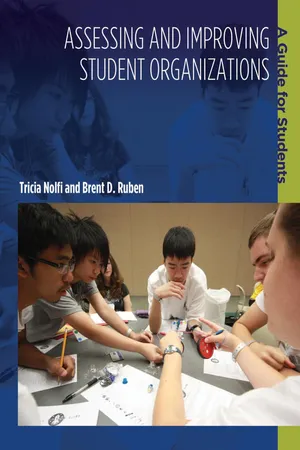
Assessing and Improving Student Organizations
A Guide for Students
- 68 pages
- English
- ePUB (mobile friendly)
- Available on iOS & Android
eBook - ePub
About this book
Information
Topic
EducationSubtopic
Higher Education1 Leadership
In This Section
Organizational Leadership
Campus and Community Leadership and Social Responsibility
The term “leadership” can mean many things. It can refer to the job of individuals in the officer positions in an organization, or it can speak to the processes through which change and growth occur. Effective leadership practices promote organizational and individual change, create a shared sense of mission and vision of the group, and facilitate clear communication to members and the broader university community.
Leadership is the cornerstone of any student organization. Because of the critical role leaders play, an excellent student organization will have processes and initiatives in place to develop students’ leadership and career potential while linking their role and responsibilities to the vision and mission of the organization. Leaders at all levels have the responsibility of guiding the organization and their peers, facilitating the development and implementation of plans and goals, inspiring organizational members, encouraging collaboration and teamwork, and promoting and modeling desired organizational values through their own behavior.
There is no simple formula for student organization or leadership success. However, there is a consensus among leadership scholars as to the dimensions of leadership that are important. These include:
• Creating focus and clarity on the organization’s purpose, vision, values, plans, and goals
• Engaging and motivating members at all levels of the organization
• Promoting teamwork, collaborative problem solving, and a sense of community
• Being an effective advocate for listening carefully to the voices of individuals, groups, and organizations who are served by the organization’s activities, programs, and services, and also for the voices of others outside the organization who can influence the effectiveness and/or success of the organization
• Promoting out-of-classroom learning and professional development
• Developing a climate that encourages analysis, reflection, and continuous improvement
Consider how leadership works in your student organization. How is leadership displayed in weekly meetings, at events, or in interactions with peer organizations? Additionally, consider how leadership ability is promoted, recognized, developed, and rewarded within your organization. Is it an expectation that a small group of people assume active leadership roles, or is broader, more inclusive leadership promoted?
For example, in some organizations the leadership group is small and quite directive in their approach, and a frequent result is that there is little engagement in or commitment to the organization by the members. In organizations where leadership approaches are more collaborative, leaders may well promote active involvement throughout their entire organization. For example, such leaders may hold meetings where all student government members and members of the student body have the opportunity to meaningfully participate and exchange ideas.
When such an approach is adopted, all active members contribute to setting the course of action for the organization, and in so doing are likely to come away from meetings with a much greater commitment to the organization and its success. In most circumstances and for most purposes, collaborative team leadership is the most effective in student organizations. Other good organizational practices are offering orientations for new officers and providing formal leadership development training activities for officers. Additional effective leadership practices in student organizations include publicly recognizing the contributions of members, developing progress for orientating new members, and implementing systematic methods available for helping leaders solicit feedback from the membership so that leaders know how their efforts are being perceived by others.
• Recognizing contributions of individuals within the organization
• Encouraging assessment of the organization’s performance against goals
• Promoting and managing change as a positive and necessary aspect of organizational excellence
• Encouraging and using feedback on their own leadership performance
• Representing the organization effectively with campus and other external groups and organizations
A fundamental tenet of organizational excellence is that leaders are most effective when they are personally and visibly engaged. This demonstrates their commitment to organizational values and principles not only through their verbal communication but also through their behavior. Through their personal actions, leaders have the opportunity to reinforce the importance of listening to and understanding the perspectives of those served by the organization, engaging and valuing colleagues at all levels, and encouraging coordinated leadership throughout the organization. Personal involvement, communication, and consensus building are important. Exemplary leadership also involves a commitment to high standards of integrity, ethical conduct, and social responsibility as well as the sharing of expertise and experience beyond the boundaries of the organization through contributions to campus, community, and professional communities.
1.1. Organizational Leadership
How do your leaders guide the organization; build and sustain consensus on the purpose, vision, values, plans, and goals; and focus the members on understanding and balancing the needs and expectations of the various groups and organizations your organization serves and those with whom you collaborate? Also consider how your leaders use communication and feedback to continually improve leadership.
Areas to Address
A. Organizational Leadership
1. What are your organization’s purpose, vision, values, plans, and goals, and how do leaders create and maintain a focus on these directions and aspirations?
a. How are senior leaders personally and visibly involved in promoting these directions and aspirations?
b. How do senior leaders encourage periodic reexamination and/or refinement of the organization’s purpose, vision, values, and goals?
2. How do your leaders help to create a culture and climate that:
• Engages members?
• Promotes high standards of individual and team achievement?
• Respects differing points of view?
• Encourages initiative and creativity?
• Fosters collaboration, teamwork, and cooperation within the organization and with other groups?
• Advances personal and professional development?
• Values and encourages collaboration among members?
B. Leadership and Governance Effectiveness Review
1. How do officers and other senior leaders assess their individual effectiveness?
• What formal or informal leadership assessment approaches are in place to encourage members to provide comments and suggestions to officers and other leaders?
• How is feedback from advisors solicited and utilized?
2. How is the system of organizational leadership and governance effectiveness assessed?
• How does the leadership group assess its effectiveness as a team?
• What formal or informal assessment approaches are in place to assess the effectiveness of the leadership and governance system and practices of the entire organization—including how officers, committee chairs, and others serving in leadership roles coordinate activities throughout the organization?
• How are assessment feedback, member suggestions, and advisor input utilized to improve leadership practices within the organization?
1.2. Campus and Community Leadership and Social Responsibility
What roles do leaders at all levels in your organization play within the campus, community, state and beyond? How does your leadership and your organization maintain high ethical standards and fulfill social responsibilities to the campus community and the organization’s external communities?
Areas to Address
A. Campus Leadership and Involvement
1. How do leaders share their expertise and experience with the campus through service on college/university committees, projects, task forces, mentoring opportunities, or other initiatives?
2. What are the types and extent of participation?
3. How do you identify key campus groups and organizations, and how do you decide what service areas and activities your organization should undertake?
B. Community Leadership and Involvement
1. How do leaders share their expertise and experience with the community through involvement with community service projects?
2. What are the types and extent of participation?
3. How do you identify key community groups and organizations, and how do you decide what service areas and activities your organization should undertake?
C. Acting with Integrity
1. How do leaders emphasize the importance of integrity and ethical behavior, and how are high standards maintained within your organization?
2. How do you identify and address areas of potential ethical concern for your organization?
a. What are these areas?
b. How do you ensure that high standards of integrity and ethical behavior are maintained in each?
D. Community Responsibility and Concern
1. How does your organization identify and address the impact of its programs and activities on the campus and the surrounding community?
a. What are the probable areas of impact?
b. How are these addressed in a proactive manner?
2. What are the goals and/or legal and regulatory requirements and/or risks associated with your organization’s operations...
Table of contents
- Cover Page
- Title Page
- Copyright page
- Contents
- Acknowledgments
- Personal and Professional Learning in Student Organizations
- Challenges Facing Collegiate Student Organizations
- Framework
- Student Organization Profile
- 1 Leadership
- 2 Strategic Planning
- 3 Constituent Focus
- 4 Assessment and Communication
- 5 Membership and Organizational Climate
- 6 Programs, Activities, and Services
- 7 Outcomes and Achievements
- Suggested Readings
- Glossary
Trusted by 375,005 students
Access to over 1.5 million titles for a fair monthly price.
Study more efficiently using our study tools.
Frequently asked questions
Yes, you can cancel anytime from the Subscription tab in your account settings on the Perlego website. Your subscription will stay active until the end of your current billing period. Learn how to cancel your subscription
No, books cannot be downloaded as external files, such as PDFs, for use outside of Perlego. However, you can download books within the Perlego app for offline reading on mobile or tablet. Learn how to download books offline
Perlego offers two plans: Essential and Complete
- Essential is ideal for learners and professionals who enjoy exploring a wide range of subjects. Access the Essential Library with 800,000+ trusted titles and best-sellers across business, personal growth, and the humanities. Includes unlimited reading time and Standard Read Aloud voice.
- Complete: Perfect for advanced learners and researchers needing full, unrestricted access. Unlock 1.5M+ books across hundreds of subjects, including academic and specialized titles. The Complete Plan also includes advanced features like Premium Read Aloud and Research Assistant.
We are an online textbook subscription service, where you can get access to an entire online library for less than the price of a single book per month. With over 1.5 million books across 990+ topics, we’ve got you covered! Learn about our mission
Look out for the read-aloud symbol on your next book to see if you can listen to it. The read-aloud tool reads text aloud for you, highlighting the text as it is being read. You can pause it, speed it up and slow it down. Learn more about Read Aloud
Yes! You can use the Perlego app on both iOS and Android devices to read anytime, anywhere — even offline. Perfect for commutes or when you’re on the go.
Please note we cannot support devices running on iOS 13 and Android 7 or earlier. Learn more about using the app
Please note we cannot support devices running on iOS 13 and Android 7 or earlier. Learn more about using the app
Yes, you can access Assessing and Improving Student Organizations by Brent D. Ruben, Tricia Nolfi in PDF and/or ePUB format, as well as other popular books in Education & Higher Education. We have over 1.5 million books available in our catalogue for you to explore.