While there is consensus that institutions need to represent their educational effectiveness through documentation of student learning, the higher education community is divided between those who support national standardized tests to compare institutions' educational effectiveness, and those who believe that valid assessment of student achievement is based on assessing the work that students produce along and at the end of their educational journeys. This book espouses the latter philosophy—what Peggy Maki sees as an integrated and authentic approach to providing evidence of student learning based on the work that students produce along the chronology of their learning. She believes that assessment needs to be humanized, as opposed to standardized, to take into account the demographics of institutions, as students do not all start at the same place in their learning. Students also need the tools to assess their own progress. In addition to updating and expanding the contents of her first edition to reflect changes in assessment practices and developments over the last seven years, such as the development of technology-enabled assessment methods and the national need for institutions to demonstrate that they are using results to improve student learning, Maki focuses on ways to deepen program and institution-level assessment within the context of collective inquiry about student learning. Recognizing that assessment is not initially a linear start-up process or even necessarily sequential, and recognizing that institutions develop processes appropriate for their mission and culture, this book does not take a prescriptive or formulaic approach to building this commitment. What it does present is a framework, with examples of processes and strategies, to assist faculty, staff, administrators, and campus leaders to develop a sustainable and shared core institutional process that deepens inquiry into what and how students learn to identify and improve patterns of weakness that inhibit learning. This book is designed to assist colleges and universities build a sustainable commitment to assessing student learning at both the institution and program levels. It provides the tools for collective inquiry among faculty, staff, administrators and students to develop evidence of students' abilities to integrate, apply and transfer learning, as well as to construct their own meaning. Each chapter also concludes with (1) an Additional Resources section that includes references to meta-sites with further resources, so users can pursue particular issues in greater depth and detail and (2) worksheets, guides, and exercises designed to build collaborative ownership of assessment.The second edition now covers:
* Strategies to connect students to an institution's or a program's assessment commitment
* Description of the components of a comprehensive institutional commitment that engages the institution, educators, and students--all as learners
* Expanded coverage of direct and indirect assessment methods, including technology-enabled methods that engage students in the process
* New case studies and campus examples covering undergraduate, graduate education, and the co-curriculum
* New chapter with case studies that presents a framework for a backward designed problem-based assessment process, anchored in answering open-ended research or study questions that lead to improving pedagogy and educational practices
* Integration of developments across professional, scholarly, and accrediting bodies, and disciplinary organizations
* Descriptions and illustrations of assessment management systems
* Additional examples, exercises, guides and worksheets that align with new content
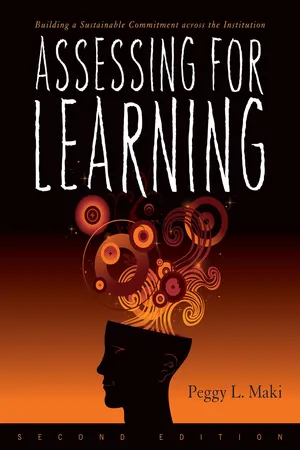
eBook - ePub
Assessing for Learning
Building a Sustainable Commitment Across the Institution
- 356 pages
- English
- ePUB (mobile friendly)
- Available on iOS & Android
eBook - ePub
About this book
Trusted by 375,005 students
Access to over 1 million titles for a fair monthly price.
Study more efficiently using our study tools.
Information
Chapter 1
DEVELOPING A COLLECTIVE INSTITUTIONAL COMMITMENT
If we wish to discover the truth about an educational system, we must look into its assessment procedures. What student qualities and achievements are actively valued and rewarded by the system? How are its purposes and intentions realized? To what extent are the hopes and ideals, aims and objectives professed by the system ever truly perceived, valued, and striven for by those who make their way within it? The answers to such questions are to be found in what the system requires students to do in order to survive and prosper. The spirit and style of student assessment defines the de facto curriculum.
— Derek Rowntree, 1987
OVERVIEW: Driven by intellectual curiosity about the efficacy of collective educational practices, assessment of student learning pursues questions about teaching and learning. This chapter provides an overview of institution- and program-level assessment as a systemic and systematic process of inquiry along the continuum of students' learning to determine over time who learns what, when, where, why, how, and how well. In addition, it presents an anatomy of the process that unfolds more specifically through succeeding chapters and argues for planning the assessment process backward to answer research or study questions about students' abilities to develop sustained learning. Joined to one or more outcomes, these collaboratively agreed-upon questions guide and channel deeper inquiry into the efficacy of pedagogy and other educational practices that students demonstrate in their work, as well as in their own analyses or descriptions of what and how they learn. This first chapter also engages educators in dialogue about an institution's collective commitment to assessing for learning that is anchored in (1) intellectual curiosity about learning and learners; (2) shared institutional principles of commitment; (3) interrelated positions of inquiry in a learning organization among the institution, its students, and its educators; and (4) roles and responsibilities across the institution. Additional Worksheets, Guides, and Exercises at the end of this chapter are designed to deepen educators' commitment to prioritizing assessment as a professional commitment that engages an institution into inquiry into and improvement of the teaching-learning process.
a culture of inquiry
How humans learn is complex. Ask a group of people to identify strategies, contexts, and conditions for how they learn. That list will probably include some of the following responses: repetition; practice in multiple contexts and over multiple times; feedback from peers, colleagues, or trusted others; self-reflection; motivation; risk taking; modeling behavior against that of another; observation; preference for learning in a certain way to ground new learning, such as the need to visualize; and even the instructiveness of failure. More than a process of ingesting information, learning is a multidimensional process of making meaning. This process differs from human being to human being and may even vary within each of our own selves depending on the nature of the task we face. What is easy for one person to learn may be difficult for another.
Insert the complexity of learning into the complexity of what we expect our students to achieve while studying at our colleges and universities. At the undergraduate level we aim to develop complex, higher-order thinking abilities that, in turn, inform or shape behaviors, values, attitudes, and dispositions. We educate individuals to respond to muddy problems within environmental, political, social, technological, scientific, and international contexts or developments. We develop students’ communication skills so that they are versatile in their ability to represent their thoughts in written, oral, and visual forms for different audiences and purposes and through different kinds of media. We prepare students to develop lifelong learning habits of mind and ways of knowing that contribute to their personal and professional development. In addition, we educate our students to become morally and socially responsible citizens who contribute to their local and even global communities, cognizant of the ethical dimensions of their work, decisions, and actions. We also expect students to understand and practice the conventions, behaviors, disciplinary logic, and problem-solving strategies of their major field of study, as they become our future biologists, chemists, accountants, artists, journalists, physicians, researchers, and public figures. Increasingly, we also expect them to be able to apply various disciplinary modes of inquiry or perspectives. For example, arguing that a “sick patient does not represent a biochemistry problem, an anatomy problem, a genetics problem, or an immunology problem,” a Harvard medical dean proposed in 2008 that undergraduates preparing to apply to medical schools should take sequences of interdisciplinary courses that span areas of biology, chemistry, and physics most “germane to advanced medical studies,” as opposed to discrete scientific disciplines,” and “take biologically-relevant quantitative skills and the basic statistics needed to understand scientific literature” (“Harvard Medical Dean,” 2008).
Higher education is also cognizant of projected workforce and societal needs for the 21st century. Specifically, in 2007, the New Commission on the Skills of the American Workforce projected the need for “a very high level of preparation in reading, writing, speaking, mathematics, science, literature, history and the arts” as an “indispensable foundation for everything that comes after for most members of the workforce” (New Commission, 2007, pp. 6-7). “Developing students’ abilities to think creatively, work creatively, and implement solutions should be central educational priorities as well” (Partnership for 21st Century Skills, 2004). Identifying the more advanced skills required of today’s college students, workers, and citizens (which also require new ways of assessing), Elena Silva, senior policy analyst at Educator Sector, identifies “solving multifaceted problems by thinking creatively and generating original ideas from multiple sources of information” as pervasive intellectual demands of the 21st century (Silva, 2008, p. 1).
At the graduate level we educate people to become experts who explore new territories in their fields or professions and question findings, challenge claims, or rethink tradition-bound perspectives on or approaches to issues that lead to new directions in research and lines of inquiry. We educate them to work effectively in teams, to cross or connect disciplinary boundaries, to become “scholar-citizens who connect their work to the needs of society” and understand “ethical conduct as researchers, teachers, and professionals, including issues of intellectual property” (Nyquist, 2002, p. 19). Increasingly, graduate programs, as well, prepare students to think and behave in crossdisciplinary, multidisciplinary, or transdisciplinary ways to bring new knowledge and perspectives to bear on their professional work. For example, Charles Redman, inaugural director of the Schools of Sustainability at Arizona State University, views work in sustainability as “collaborative, transdisciplinary and problem-oriented to address the enmeshed environmental, economic, and social challenges of the 21st century.” He believes that the problems of the world
are to be solved and addressed by people who can make connections and understand cascading implications and do all these things in a rigorous way so they can really make statements and make connections for the future. Otherwise, we’re just trying to add the parts together and we’ve proven that doesn’t work. (Schools of Sustainability, 2009)
How well do we achieve our educational intentions at both the undergraduate and graduate levels of learning? How well do we position our students to integrate, apply, reapply, and deepen their knowledge, understanding, and ways of knowing and behaving, including repositioning or challenging long-held theories or beliefs or attitudes about a subject? How do undergraduate and graduate students construct meaning along the continuum of their learning journey? Even more fascinating are the questions we should now be raising about how our undergraduate and graduate students learn in what Yancey, Cambridge, and Cambridge (2009) describe as “this new world of distributed learning sites . . . that mandates investigation into how learning occurs in these new environments.”
Therein lies the wellspring of an institutional commitment to assessment—intellectual curiosity about what and how well our students learn at both the undergraduate and graduate levels and across professional programs. Assessment is the means of answering those questions of curiosity about our work as educators. This systemic and systematic process of examining student work against our standards of judgment enables us to determine the fit between what we expect our students to be able to demonstrate or represent and what they actually do demonstrate or represent at points along their educational careers. Beyond its role of ascertaining what students learn in individual courses, assessment, as a collective program or institutional process of inquiry, examines students’ learning over time. It explores multiple sources of evidence that enable us to draw inferences about how students make meaning based on our collective educational practices and the classroom, experiential, and web-based or virtual contexts or environments in which they learn.
This book presents a framework, processes, strategies, illustrative campus practices, key resources, guides, worksheets, and exercises that assist institutions offering undergraduate, graduate, and professional programs in developing a sustainable culture of inquiry about students’ learning. This inquiry builds on the successful practices of classroom-based assessment to explore students’ cumulative learning at various points in their educational careers represented in their “texts,” that is, their behaviors, interactions, reactions, reflections, and visual and verbal products or performances that include paper and paperless modes of representation, including those possible now through media technologies. Specifically, this book focuses on assessing how well s...
Table of contents
- Cover
- Title
- Copyright
- Contents
- Acknowledgments
- Preface to the Second Edition
- 1 DEVELOPING A COLLECTIVE INSTITUTIONAL COMMITMENT
- 2 BEGINNING WITH DIALOGUE ABOUT TEACHING AND LEARNING
- 3 MAKING CLAIMS ABOUT STUDENT LEARNING WITHIN CONTEXTS FOR LEARNING
- 4 RAISING AND PURSUING OPEN-ENDED RESEARCH OR STUDY QUESTIONS TO DEEPEN INQUIRY INTO AND IMPROVE STUDENT LEARNING
- 5 IDENTIFYING OR DESIGNING TASKS TO ASSESS THE DIMENSIONS OF LEARNING
- 6 REACHING CONSENSUS ABOUT CRITERIA AND STANDARDS OF JUDGMENT
- 7 DESIGNING A CYCLE OF INQUIRY
- 8 BUILDING A CORE INSTITUTIONAL PROCESS OF INQUIRY OVER TIME
- Index
- Back Cover
Frequently asked questions
Yes, you can cancel anytime from the Subscription tab in your account settings on the Perlego website. Your subscription will stay active until the end of your current billing period. Learn how to cancel your subscription
No, books cannot be downloaded as external files, such as PDFs, for use outside of Perlego. However, you can download books within the Perlego app for offline reading on mobile or tablet. Learn how to download books offline
Perlego offers two plans: Essential and Complete
- Essential is ideal for learners and professionals who enjoy exploring a wide range of subjects. Access the Essential Library with 800,000+ trusted titles and best-sellers across business, personal growth, and the humanities. Includes unlimited reading time and Standard Read Aloud voice.
- Complete: Perfect for advanced learners and researchers needing full, unrestricted access. Unlock 1.4M+ books across hundreds of subjects, including academic and specialized titles. The Complete Plan also includes advanced features like Premium Read Aloud and Research Assistant.
We are an online textbook subscription service, where you can get access to an entire online library for less than the price of a single book per month. With over 1 million books across 990+ topics, we’ve got you covered! Learn about our mission
Look out for the read-aloud symbol on your next book to see if you can listen to it. The read-aloud tool reads text aloud for you, highlighting the text as it is being read. You can pause it, speed it up and slow it down. Learn more about Read Aloud
Yes! You can use the Perlego app on both iOS and Android devices to read anytime, anywhere — even offline. Perfect for commutes or when you’re on the go.
Please note we cannot support devices running on iOS 13 and Android 7 or earlier. Learn more about using the app
Please note we cannot support devices running on iOS 13 and Android 7 or earlier. Learn more about using the app
Yes, you can access Assessing for Learning by Peggy L. Maki in PDF and/or ePUB format, as well as other popular books in Education & Higher Education. We have over one million books available in our catalogue for you to explore.