While many institutions have developed policies to address the myriad needs of Millennial college students and their parents, inherent in many of these initiatives is the underlying assumption that this student population is a homogeneous group. This book is significant because it addresses and explores the characteristics and experiences of Millennials from an array of perspectives, taking into account not only racial and ethnic identity but also cultural background, sexual orientation, and socioeconomic status differences—all factors contributing to how these students interface with academe.In providing a "voice" to "voiceless" populations of African American, Asian American, Bi/Multi-Racial, Latino, Native American, and LGBT millennial college students, this book engages with such questions as: Does the term "Millennial" apply to these under-represented students? What role does technology, pop culture, sexual orientation, and race politics play in the identity development for these populations? Do our current minority development theories apply to these groups? And, ultimately, are higher education institutions prepared to meet both the cultural and developmental needs of diverse minority groups of Millennial college students?" This book is addressed primarily to college and university administrators and faculty members who seek greater depth and understanding of the issues associated with diverse Millennial college student populations. This book informs readers about the ways in which this cohort differs from their majority counterparts to open a dialogue about how faculty members and administrators can meet their needs effectively both inside and outside the classroom. It will also be of value to student affairs personnel, students enrolled in graduate level courses in higher education and other social science courses that explore issues of college student development and diversity, particularly students planning to work with diverse Millennial college students in both clinical or practical work settings.Contributors: Rosie Maria Banda; Fred Bonner, II; Lonnie Booker, Jr.; Brian Brayboy; Mitchell Chang; Andrea Domingue; Tonya Driver; Alonzo M. Flowers; Gwen Dungy; Jami Grosser; Kandace Hinton; Mary Howard-Hamilton; Tom Jackson, Jr.; Aretha F. Marbley; Samuel Museus; Anna Ortiz; Tammie Preston-Cunningham; Nana Osei-Kofi; Kristen Renn; Petra Robinson; Genyne Royal; Victor Saenz; Rose Anna Santos; Mattyna Stephens; Terrell Strayhorn; Theresa Survillion; Nancy Jean Tubbs; Malia Villegas; Stephanie J. Waterman; Nick Zuniga.
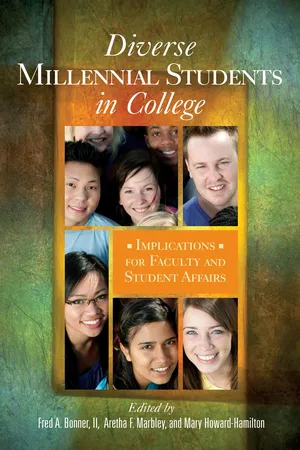
eBook - ePub
Diverse Millennial Students in College
Implications for Faculty and Student Affairs
- 320 pages
- English
- ePUB (mobile friendly)
- Available on iOS & Android
eBook - ePub
Diverse Millennial Students in College
Implications for Faculty and Student Affairs
About this book
Information
Topic
PedagogíaSubtopic
Educación superiorDIVERSE MILLENNIALS IN COLLEGE: A NATIONAL PERSPECTIVE
1
A NATIONAL PERSPECTIVE
Testing Our Assumptions About Generational Cohorts
Introduction
Labeling generations has become a lucrative career line for entrepreneurs, authors, and consultants. Once a generation is labeled, however, there is a tendency for our students to become strangers to us. Rather than testing our own observations and checking our own assumptions, we begin to ask the “experts” to tell us what our students are like. After my review of the material available on contemporary college students, the majority of them labeled Millennials, I can only conclude that the jury is still out on who these students are as a generation. What we do know is that there are some similarities among students who complete secondary school and enter college as a cohort. We also know that these similarities are gleaned, for the most part, from a small survey conducted in an affluent suburb of Washington, D.C., which has “one-third fewer African Americans than the rest of the United States” (Hesel & May, 2007, p. 18).
I became interested in the characteristics of African American Millennials in the spring of 2007, when I spoke to approximately 400 African American students at the Southwest Black Student Leadership Conference at Texas A&M University. To test my assumptions about Millennials and African American students, I engaged the students in discussions about whether the descriptors generally given for Millennials were accurate for them. I was surprised that most of the students had not even heard of the term Millennials. And in most instances, they said the descriptors might apply to White students but not to them.
During my observations of students, in general those who had begun college in 2000 and after, I found that while there were similarities across the board, there were also distinctions between what I call the first-wave Millennials, those who had begun college in 2000, and the second-wave Millennials, those who had begun college in 2004–2005 or after. In talking with these first- and second-wave Millennials, it was obvious that some were able to see they have some characteristics of this generation of students (in college since 2000) and some characteristics of the previous generation of students. More than one person I interviewed who fell within the first wave of Millennials said that they were on the “cusp” of the Millennials with many characteristics of the previous generation of students, referred to as the “Transitional Generation” by Levine and Cureton (1998, p. 156). Transitional Generation did not take hold as a label, so Millennials may be referring to what we called Generation X (or Gen X).
Students who have attended college during the first decade of the 21st century are either undergraduate students now (second-wave Millennials) or they are graduate students, coworkers, employees, or even supervisors. Making the effort to understand characteristics of all our students is a duty and an obligation of every educator. However, it is important to check assumptions and avoid falling into the trap of applying generalizations across the board.
I am convinced it is important that we understand who our students are in order to create a campus climate that supports their learning and success. Knowing who our students are is “more than a notion,” as this generation of students’ great-great grandparents might have said. We must consider the multifaceted identities that characterize our students—including, but certainly not limited to, race, class, gender, and sexual orientation—and how these different identities intersect. We also want to see how this generational cohort is similar across all groups, and how they may differ depending on demographics and particular identities. Beyond this, we need to explore how students relate to their respective colleges or universities. That is, what do they want out of college, what motivates them, and how do they prefer to learn? To answer these questions, we will need more research and we will need to observe and test many of our commonly held assumptions.
Similarities Among All Millennials
According to Levine and Cureton (1998), it is possible to develop a broadbrush understanding of our college student populations mainly because,
Every college generation is a product of its age. The momentous occurrences of its era—from wars and economic shifts to the elections and inventions of its times—give meaning to the lives of the individuals who live through them. They also serve to knit those individuals together by creating a collective memory and a common historic or generational identity. (p. 19)
Through informal conversations with students and new professionals (those who began college in 2000 or later and are now in the workforce), I began to test some of the assumptions regarding the Millennial generation. These conversations took place over a period of 2 years (2007–2009) in my travels to various campuses and conferences across the country. Following are some of the responses given when I asked these students and new professionals what they saw as defining moments for their generation:
1. September 11, 2001
2. Reality television
3. Mobile phones and social networks
4. Virginia Tech and Northern Illinois University mass killings
5. You Tube
6. Recession of 2008
7. Wikipedia and mass collaboration
8. Election of President Barack Obama
Although these events have had an impact on how they see and relate to the world, in the final analysis, as educators we will have to consider each student as an individual. We will need to know how students make sense of their world and what their perspectives are.
Technology
The Millennials, as a group, have been labeled the net generation and the digital generation because of their reliance on and facility with technology. However, all technology is not created equal when it comes to that which is used for social activities or to access information that contributes to learning and success in college. In the NASAP Journal article “African American Millennial College Students: Owning the Technological Middle Passage” (Marbley, Hull, Polydore, Bonner, & Burley, 2007), the authors noted that “African American children own cell phones, iPods and MP3 players, CD and DVD players, and yet … are lagging behind when it comes to having computer tools and Internet access” (p. 12). This is of particular concern for colleges and universities that may make the assumption that all students have access to and facility with online learning. Hawkins and Oblinger (2006), for instance, suggested consideration of the following questions:
1. Do we know whether students have a computer? Do we know their skill level? … Is ownership the same for all students, or are there significant differences between groups? … Are there different needs based on academic discipline?
2. Do we look beyond who has Internet access to consider online skills? What online skills, support, and freedom of use define an appropriate threshold for digital access and use on campus?
3. Do we limit the definition of digital divide to a haves and have-nots dichotomy? … Beyond computer ownership lie issues of Internet access at a reasonable speed, as well as availability of support.
4. How limiting will inadequate online skills be to students? … If students are regularly expected to participate in online discussions or use tools such as wikis, campuses should provide reasonable support to ensure that students can participate effectively and autonomously. (p. 13)
Social Justice, Change, and Service
An African American female student who is among the first wave of Millennials said that many of her peers have deep desires to understand the world and what it will take to make it a place where humans are valued and life is affirmed. To this end, she said that her generation is “hell-bent on change.” Her cohort and the current cohort of Millennials are action oriented, particularly in regard to social justice and environmental issues. One professional who works with student groups concurred, saying, “These students are about action, and they will fight for social justice as they define it based on where they fall on the conservative–liberal continuum.”
The Millennials are particularly known for taking action through service, contributing more hours in this effort than preceding generations (Stone, 2009). An Asian American male, first-wave Millennial commented that second-wave Millennials “don’t have money to give to charity, but they are eager to give their time if the activity taps into their passion.”
Some professionals, while acknowledging the service students provide, have concerns about the amount of time many students commit. These professionals note that some of the best students are overcommitted in their volunteer and out-of-class activities and have high stress levels. In response to an advisor’s caution about the potential negative impact of outside activities on grades, one student responded, “After all, employers don’t look at transcripts!” For this student, service took priority over going to class and getting the best grades.
Professionals also comment on group accountability. One attitude seen among students is that people cannot expect them to be held accountable for all that is expected of them in service positions since they are only volunteering. Some supervisors observe that they seem not to have qualms about the impact on others with whom they are working or the reputation of the organization if they do not fulfill their commitment. Because of this attitude among some Millennials, a professional who gave me written comments about Millennials expressed skepticism about whether the amount of service students did correlated with their degree of altruism. It seems that the reasons for service are not always clear.
Although some of the students who are putting innumerable hours into service projects may not be entirely committed, a number of Millennials, whether first wave or second wave, are choosing careers from among nonprofit, service-oriented fields. Although their reasons for participating in service activities as students might be unclear, student affairs professionals note that some are choosing careers in the areas in which they may have provided service, and these are decidedly different choices from those selected during the previous generation, when “enrollment patterns peaked in careers with a vocational orientation such as business” (Levine & Cureton, 1998, p. 120).
Impact of Parenting
Parents became the focus of attention with the initial class of Millennials. Because parental involvement was a new phenomenon, some administrators saw the involvement of parents as a nuisance, and the best way to deal with it was to find humor in the situation and share these incidents with colleagues. When professionals came together for meetings it was almost a “one-upmanship” atmosphere, where each successive horror story of parental involvement was worse than the previous one. The term helicopter parents became the generally accepted term to describe these parents. Today college educators are much more prepared to collaborate with parents on helping students become successful. Some educators said, “If you can’t beat ’em, join ’em,” while others realized that students really wanted their parents’ continuing involvement in their day-to-day activities. Given the advances in communications technology, this generation of students agrees that they are always connected, and that connection extends to parents.
Experts on Millennials seem to agree that the parents of Millennials were the ones who made the “Baby on Board” sign in cars ubiquitous. This generation is known as the most-loved and the most-wanted generation in history. Howe and Strauss (2000), in Millennials Rising, gave the following examples to describe how the times and parents’ attitudes changed for this new generation of children:
The era of the wanted child had begun.
The era of the protected child had begun.
The era of the worthy child had begun. (pp. 32–33)
The era of the protected child had begun.
The era of the worthy child had begun. (pp. 32–33)
In Generation Me, Jean M. Twenge (2006) wrote that “Parental authority also isn’t what it used to be,” citing a Chicago Sun-Times article in which family studies Professor Robert Billingham notes that “Parents are no longer eager to be parents. They want to love and guide their children as a trusted friend” (p. 30).
It appears that parents really have become their children’s best friends, especially when it comes to discipline. Penn’s (2007) book Microtrends presented the results of a poll in which parents were asked what they would do if their 9-year-old son cursed at them and said he hated them. “Overwhelmingly, the top answers, across age and gender of parents, were ‘sit down and ask him why he feels that way’ and ‘tell him that you’re sorry he feels that way, but that you love him anyway’” (pp. 114–115). Although these responses were consistent across age and gender, they were not compared across ethnicities and racial categories, and perhaps more saliently, across class lines. What is more, when it came to consequences, the poll showed that “barely 2 in 10 parents said they would take the child’s privileges away for at least a week” (Penn, 2007, pp. 114–115).
Perhaps related to this is the lack of respect for older adults and hierarchy that many first-wave Millennials with whom I spoke pointed out about the Millennials who followed them. The first-wave Millennials also said that, more than their cohorts, the second-wave Millennials seemed to think that “their parents would be a constant source of economic and emotional support.”
Work Expectations and Work Ethic
A first-wave Millennial said that she came into the workforce with the expectation of working her way up. By contrast, she sees the second-wave Millennials coming into the workforce wanting to be treated as equals immediately because they have a lot of skills. Noting what she sees as a lack of perspective and interpersonal skills, she said, “They seem to have super high expectations and lack humility.”
This observation is confirmed by Bruce Tulgan (as cited in Jayson, 2009), who stated “The classic thing is they show up on Day One and want to tell you how to change your business” (para. 18). Tulgan is founder of Rainmaker Thinking, a research and management training firm in New Haven, Connecticut, and author of multiple books advising employers about Millennials. He describes this generation as upbeat, self-confident, prone to customizing their work and personal life, and expecting to be “thrilled” by their employers while enjoying a comfortable work environment (Tulgan & Martin, 2001).
In looking at similarities across Millennials, there seems to be a consensus or stereotype that expectations are high. Tulgan and Martin (2001) found that Millennials have lofty goals, and they fully expect to meet those goals: It is not a matter of high hopes, but rather of high expectations. According to Eric Chester, president of the consulting firm Generation Why, these different expectations often lead to misunderstandings in the workplace: “[Millennials] may have skills and are techno-savvy and book-smart and streetwise, but they don’t understand what the big deal is if they’re five minutes late” (quoted in Jayson, 2009, 17).
William Galston of the Brookings Institution in Washington, D.C., stated: “Such attitudes aren’t just about work but rather about hierarchy…. These young people have grown up in very flat, horizontal relationships. So, the idea of deferring to someone older, simply because that person is there, is not part of their makeup” (Jayson, 2009, para. 20).
Some have said that the work ethic is dead with this generation. Millennials reply that they “work to live”; they do not “live to work.” This ethic and the matter of work expectations are both areas that experts note when they label Millennials the “Entitlement Generation.” What are the characteristics that earn Millennials this label?
They are … the upstarts at the office who put their feet on their desks, voice their opinions frequently and loudly at meetings, and always volunteer—nay, expect—to take charge of the most interesting projects. They are smart, brash, even arrogant, and endowed with a commanding sense of entitlement. (Halpern, 2007, para. 3)
Despite this kind of description of our new and future workforce, Michael S. Malone (2009) wrote in The Future Arrived Yesterday that we, as a nation, “need these young people desperately because they are bright, (infinitely) confident, and entrepreneurial” (p. 12). Although previous generations too often concentrate on what they perceive as the negative qualities of those that follow, it is important that we honor in a positive manner what each successive generation offers and use that constructively to facilitate learning. Each generation is “right” for its time, and the Millennials are right for this time. It falls to educators to m...
Table of contents
- Cover Page
- Title Page
- Copyright Page
- Dedication
- CONTENTS
- ACKNOWLEDGMENTS
- INTRODUCTION
- PART ONE: DIVERSE MILLENNIALS IN COLLEGE
- PART TWO: AFRICAN AMERICAN MILLENNIALS IN COLLEGE
- PART THREE: ASIAN AMERICAN MILLENNIALS IN COLLEGE
- PART FOUR: LATINA/O MILLENNIALS IN COLLEGE
- PART FIVE: NATIVE AMERICAN MILLENNIALS IN COLLEGE
- PART SIX: LGBTQ MILLENNIALS IN COLLEGE
- PART SEVEN: BI- AND MULTIRACIAL MILLENNIALS IN COLLEGE
- PART EIGHT: VOICES OF MILLENNIALS IN COLLEGE
- CONCLUSION
- ABOUT THE CONTRIBUTORS
- INDEX
Trusted by 375,005 students
Access to over 1.5 million titles for a fair monthly price.
Study more efficiently using our study tools.
Frequently asked questions
Yes, you can cancel anytime from the Subscription tab in your account settings on the Perlego website. Your subscription will stay active until the end of your current billing period. Learn how to cancel your subscription
No, books cannot be downloaded as external files, such as PDFs, for use outside of Perlego. However, you can download books within the Perlego app for offline reading on mobile or tablet. Learn how to download books offline
Perlego offers two plans: Essential and Complete
- Essential is ideal for learners and professionals who enjoy exploring a wide range of subjects. Access the Essential Library with 800,000+ trusted titles and best-sellers across business, personal growth, and the humanities. Includes unlimited reading time and Standard Read Aloud voice.
- Complete: Perfect for advanced learners and researchers needing full, unrestricted access. Unlock 1.5M+ books across hundreds of subjects, including academic and specialized titles. The Complete Plan also includes advanced features like Premium Read Aloud and Research Assistant.
We are an online textbook subscription service, where you can get access to an entire online library for less than the price of a single book per month. With over 1.5 million books across 990+ topics, we’ve got you covered! Learn about our mission
Look out for the read-aloud symbol on your next book to see if you can listen to it. The read-aloud tool reads text aloud for you, highlighting the text as it is being read. You can pause it, speed it up and slow it down. Learn more about Read Aloud
Yes! You can use the Perlego app on both iOS and Android devices to read anytime, anywhere — even offline. Perfect for commutes or when you’re on the go.
Please note we cannot support devices running on iOS 13 and Android 7 or earlier. Learn more about using the app
Please note we cannot support devices running on iOS 13 and Android 7 or earlier. Learn more about using the app
Yes, you can access Diverse Millennial Students in College by Fred A. Bonner II, aretha f. marbley, Mary F. Howard-Hamilton in PDF and/or ePUB format, as well as other popular books in Pedagogía & Educación superior. We have over 1.5 million books available in our catalogue for you to explore.