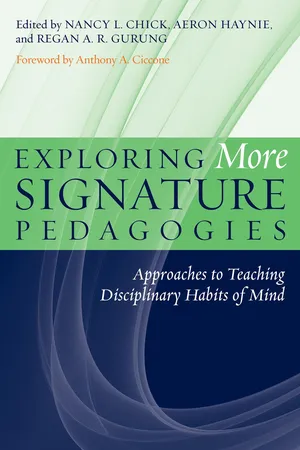
What is distinctive about the ways specific disciplines are traditionally taught, and what kinds of learning do they promote? Do they inspire the habits of the discipline itself, or do they inadvertently contradict or ignore those disciplines? By analyzing assumptions about often unexamined teaching practices, their history, and relevance in contemporary learning contexts, this book offers teachers a fresh way to both think about their impact on students and explore more effective ways to engage students in authentic habits and practices. This companion volume to Exploring Signature Pedagogies covers disciplines not addressed in the earlier volume and further expands the scope of inquiry by interrogating the teaching methods in interdisciplinary fields and a number of professions, critically returning to Lee S. Shulman's origins of the concept of signature pedagogies. This volume also differs from the first by including authors from across the United States, as well as Ireland and Australia.The first section examines the signature pedagogies in the humanities and fine arts fields of philosophy, foreign language instruction, communication, art and design, and arts entrepreneurship. The second section describes signature pedagogies in the social and natural sciences: political science, economics, and chemistry. Section three highlights the interdisciplinary fields of Ignatian pedagogy, women's studies, and disability studies; and the book concludes with four chapters on professional pedagogies – nursing, occupational therapy, social work, and teacher education – that illustrate how these pedagogies change as the social context changes, as their knowledge base expands, or as online delivery of instruction increases.
eBook - ePub
Exploring More Signature Pedagogies
Approaches to Teaching Disciplinary Habits of Mind
- 272 pages
- English
- ePUB (mobile friendly)
- Available on iOS & Android
eBook - ePub
Exploring More Signature Pedagogies
Approaches to Teaching Disciplinary Habits of Mind
About this book
Information
Topic
EducationSubtopic
Higher Education2
THE SOCRATIC METHOD
Teaching and Writing About Philosophy’s Signature Pedagogy1
People often point to Socrates’ dialogues as the quintessential method of philosophical thinking and teaching.
—Nahmias, 2005
From its very beginning and throughout almost all of its history, philosophers have given incredible attention to the question of how and why to teach philosophy. To show the importance of these issues, one need look no farther than Plato’s work—work that is central to just about all of Western Philosophy—which is almost all either explicitly or implicitly about how one learns and how one teaches philosophy. The protagonist in almost all of Plato’s writing and his philosophical hero, Socrates, was condemned to death largely because he was accused of corrupting the youth by teaching them things that were considered harmful. In fact, the question of how and what to teach is likely contemporaneous with philosophy itself.2 The warning of the danger of teaching philosophy is equally old and well known. It would, therefore, seem an easy case to make that philosophy has a long and glorious history of doing the scholarship of teaching and learning (SoTL).
Despite philosophy’s age-old concern with pedagogy, describing the past and current state of SoTL in philosophy, if there is such a thing, is actually a particularly vexed task. Asking whether there is a scholarship of teaching and learning in philosophy seems strange, given the prominent role pedagogical questions have played in the history of philosophy; even so, answering such a question is, in fact, quite difficult.
Is There a Scholarship of Teaching and Learning in Philosophy?
To explain why this is such a difficult question to answer, a bit of a background is needed. In his work, The Philosophy of Philosophy, Williamson (2007) asks, as a way to come to understand philosophy’s methods, “What can be pursued in an armchair?” (p. 1). He frames his inquiry with this question because the methods traditionally used in philosophy “consist of thinking, without any special interaction with the world beyond the chair, such as measurement, observation, or experiment would typically involve” (p. 1). He also offers this clarification: Because philosophers think in conversation with other philosophers, this armchair-work is likely done not in one armchair but in many. Finally, he explains why it is in the armchair that philosophers work: “For good or for ill, few philosophers show much appetite for the risky business of making predictions and testing them against observation, whether or not their theories in fact have consequences that could be so tested” (p. 1). What does this penchant for the armchair mean for how philosophers talk, write, and think about teaching and learning philosophy?
The answer can be found, in part, in a book review by Michael Goldman, the then editor of Teaching Philosophy (Goldman, 2005). In the review, he describes philosophy pedagogy as rather primitive, noting, in particular, that in this work, little is said about what constitutes improved learning or how one measures it, and when techniques are purported to work, we are rarely told why they work. He goes on to suggest:
It would be unreasonable to ask for much more. As philosophers we are not, and cannot be, experts in educational theory or the related disciplines that help provide the psychological underpinning for such theory. . . . What we can do, however, is create clear and measurable (or at least observable) criteria for success . . . and familiarize ourselves with existing literature on assessment, cognitive development, and cognitive domains. . . . [T]here is little evidence that anyone working in the scholarship of philosophical pedagogy has done this” (emphasis in the original). (p. 278)
As I will show, what was true of philosophy pedagogy when Goldman wrote this critique remains true today. There is still little evidence that philosophers have clear criteria for success or familiarity with cognitive development or other fields that might illuminate the way learning occurs, and, therefore, little evidence that philosophers can or are in a position to have measurable criteria for success for their pedagogical innovations. Furthermore, as Williamson notes, even if philosophers did, they would be unlikely to do the “risky” work of observing, predicting, and testing.
It is thus because of the methods that they choose that philosophers do not, and are not in a good position to, “create clear and measurable (or at least observable) criteria for success,” and without that, the scholarship of teaching and learning in philosophy, if one would say that there is one, takes on a bit of a strange tenor. In addition, one might reasonably suspect that there is actual observation (if not testing) going on. It is hard to think that these philosophers do not pay attention at all to their students and how their students perform in their courses, what questions they ask, and how they respond to what it taught. Yet whatever evidence there might be is either not presented at all or presented through anecdotes, as if these offered self-evident justification in need of no further exploration.3 What, then, is going on in the philosophy pedagogy literature?
To get a fair picture of what philosophers are doing, it might make sense to look at one very common way of proceeding for those who write about philosophy pedagogy: They explain a complex philosophical argument in a way that the author is convinced makes it easier to understand, more accessible, more direct, and thus would be more likely to be used in the classroom and more accessible for students (see, for examples, Brod, 2007; Hardwig, 2007; Passell, 2000). The unstated goal is to render clear for the reader of the article, presumably an instructor of philosophy, an argument that is intended to inform how she or he teaches that same argument. The unstated assumption is that one becomes a better teacher (primarily or to a large extent) by being able to make arguments for students in clear and precise language, such that they can see the relevance, assumptions, and implications of the argument; thus, articles about philosophy pedagogy tend to offer arguments that can be so passed on. That is, the argument as made by the author is intended to be repeated by the reader for his or her students. Because there is little evidence of what students find easy or hard to comprehend, embedded in this method is the assumption that what is clearer to the author will be clearer to the reader/philosopher and will also be clearer to her or his students, although what makes an argument clearer is never described.
Thus, it is not that these philosophers say nothing at all about criteria, but that they say little about their students and their students’ learning. They also rarely use other scholarship that could connect their work to student learning. Thus, when it comes time for the philosophers to produce careful and convincing evidence that their innovation or ideas work for actual students, they have said little (or nothing at all).4 In addition, the articles contain an almost total lack of discussion of the concrete circumstances and contexts in which their authors work, and thus, in which the pedagogical innovations have been used (this is noted, as well, in Goldman [2005]). The reader almost never knows how large the classes are, how well prepared the students are, what the purpose of the courses are, or how they fit into the program of study. There remain serious questions about the assumptions these authors make about the transferability of their work. I think the best way to describe these articles, in this regard, is as “transfer unfriendly”; that is, the authors do not take care to provide readers any clear or obvious way to link the suggestions to their own teaching context.
The same problem thus exists in philosophy that Bass and Linkon (2008) have identified in literary analysis in their examination of the journal Pedagogy. As they explain, as opposed to “articles in other venues for the scholarship of teaching and learning, where there is greater focus on student work as evidence of learning,” in Pedagogy, the “focus of analysis” is “the teacher’s practice, its intentions and process” (p. 249). Without knowing it, the real focus of the articles in Teaching Philosophy can thus be summed up where Biondi (2008), referring to insights of Heather Reid, writes that “it is Reid who suggests that we should pay additional attention not only to what Socrates does, but also what instructors do” (emphasis in the original, p. 122; see Reid, 1998). The impression, therefore, intended or not, is that philosophers offer a “what works” (see Hutchings, 2000), but that this “what works” remains entirely cut off from the learning of actual students, and because there are very few citations in these articles, it is cut off from the work of other scholars (who might do the dirty empirical work philosophers tend to shy away from).5 To put it another way: It is as if philosophers are concerned not with what actually works but with what ought to work, and the ought here is built primarily on theoretical rather than empirical evidence. Together, without citation of appropriate sources that could ground the work in the empirical and go beyond the anecdotal, what appears in these articles might, in fact, be an expanded analogue to “pedagogical narcissism” (Chick, 2009, p. 42). We see a certain form of self-regard that ignores other scholars and assumes others will find clear what the author finds clear and ignores actual students and their learning. Together, I think this can best be described as a scholarly myopia. If these articles are scholarship, they appear to be solely a scholarship of teaching, not the scholarship of teaching and learning.
Finally, let me make one other observation: Philosophers have turned to Socrates and his method of teaching for thousands of years, and yet, quite famously, in almost all of the Platonic texts in which Socrates appears, he fails as a teacher. As Scott (2000) notes: “Despite his ceaseless efforts to purge his fellow citizens of their unfounded opinions and bring them to care for what he believes are the most important things, Plato’s Socrates rarely seems to succeed. . . . More often than not, his target interlocutors leave their conversation with the philosopher wholly unchanged by the experience” (p. 1). It is hard to miss the irony here. I cannot help but wonder if there is a relationship among the pedagogical hero of philosophers, his own evident failures as a teacher, and how the work about him and his teaching method is taken up and written about by philosophers.
The Socratic Method: At What Price?
There are different conceptions of what the Socratic Method is, and here I will focus on descriptions as they have appeared between 2000 and 2010 in Teaching Philosophy.6 I turn to Teaching Philosophy because it is by far the most prominent venue for philosophy pedagogy. Although this type of work might appear occasionally in other places (e.g., Arts and Humanities in Higher Education) and there are journals that have as a larger part of their mission publishing work in philosophy (e.g., The Journal of Ethics Across the Curriculum and the British journal Discourse: Learning and Teaching in Philosophical and Religious Studies), there are only a few sources devoted solely to publishing work about the teaching of philosophy. There are the newsletters of the American Association of Philosophy Teachers and the American Philosophical Association Committee on the Teaching of Philosophy, and there is Teaching Philosophy. This journal, which was started in 1975, is widely and rightly regarded as the best of all of these outlets.7 Seventeen articles have appeared in the decade of the 2000’s in Teaching Philosophy focused on Socrates and his Method, and from these, one can glean a clear picture of how philosophers think about their teaching.8 It is, therefore, to those articles, in particular, that I turn in this investigation, although I will use other work to analyze what is found therein.
Before describing the Method they do highlight, it is helpful to note, first, that there is a consistent distancing by philosophers from the conception of the Socratic Method as these philosophers understand the term—and the pedagogy that goes by the term—used in law schools. In the conception of the Socratic Method practiced in law schools, faculty “aggressively question . . . randomly called-on students,” as exemplified in the Paper Chase (Biondi, 2008, p. 119), with the goal of preparing students for the highly charged atmosphere that “legal encounters entail” (Shulman, 2005, p. 55).
Philosophers’ conceptions of the Socratic Method are many and various; they can be seen on a spectrum from a minimalist conception that takes only the most basic elements from Socrates to others that emulate his teaching much more precisely. The most common conception of the Socratic Method, what Biondi calls the “traditional Socratic pedagogical model,” which is generally agreed upon in something like a similar form, is described by Biondi (2008) in this way: “I believed that it was important to educate students by asking questions and engaging in open dialogue, thereby allowing them to think for themselves. I took this, along with the method of elenchus, to be the essence of the Socratic method” (p. 120). Here, elenchus is understood to be a form of “refutation and cross-examination” (Boghossian, 2002, p. 348) where, “a thesis is debated by question and answer for the purpose of finding the truth” (p. 347).9 Whereas some philosophers identify (or focus on) the Socratic Method as only referring to a form of open dialogue, most define it and focus on the fuller, twofold meaning Biondi describes: open dialogue and the hypothesis/refutation/cross-examination of elenchus. So conceived, the Socratic Method focuses on one’s desire not to contradict oneself and thus allows the teacher to compel the student to examine her or his internal incoherences.
There are, in addition, some philosophers that hew closer to the Socrates they see in the dialogues, thus refining the method of elenchus. This more rigorous view includes all that Biondi describes as the “traditional” model and more; these are rarer, but still in evidence in the literature. Boghossian (2002), for example, advocates for a more specific and formal form of elenchus, which begins in wonder and moves through the formation of a thesis from the follower, leading to the formation of counter-theses that the leader argues from and that are formulated in such a way that they gain assent from the follower, and finally arriving at the use of these counter-theses and their entailments to refute the original thesis (p. 348). Another example of a more rigorous view is held by Passell (2000), who focuses on the task of defining terms as key to elenchus and thus conceives of elenchus as starting from and centering on this task.
An unstated assumption about the central goal of the Socratic Method seems to run through the descriptions of the Method in these articles. As Williamson (2007) explains: “David Lewis once wrote that ‘what we accomplish in philosophical argument’ is to ‘measure the price’ of maintaining a philosophical claim” (p. 8). From what I see in these articles, the Socratic Method is taken to be an exceptionally powerful tool in doing just that, because it focuses students on the price of their views and forces students to look at their long-held views and critique them in the name of coherence.10 In this way, the Socratic Method helps students learn core philosophical skills, teaching them fundamental ways to “think like” a philosopher (Shulman, 2005, p. 55).
However, holding on to a Socratic vision of teaching tends to encourage teachers to see themselves as the hero of the drama and envisions students as the dupes. Plato, whose writings have almost entirely defined how we think of Socrates, was Socrates’ student and portrays his mentor in almost all of his own work as the hero. This hero worship is so profound that Plato puts in Socrates’ mouth what must have been to the Greeks who heard it a blasphemous analogy: Socrates compares himself favorably to Achilles (Plato, Apology, 28b3-28d5, in Plato, 2002, 32-33). In addition, Plato rarely spares much in making Socrates’ interlocutors look like fools, idiots, sycophants, and impostors; as noted before, almost none of Socrates’ interlocutors is shown to have learned from the conversation. In addition, my students regularly get mad at Socrates’ interlocutors, seeing how silly they look in the conversation. My point here is that, to the extent that we have Socrates in mind when we think of ourselves as teachers, we are likely to bring along—maybe not consciously, maybe quite intentionally—the view that we are the heroes of the classroom and students are the bystanders of the real activity. At times, this can be seen in what philosophers write about their use of the Socratic Method. For a tell...
Table of contents
- Cover Page
- Title Page
- Copyright Page
- CONTENTS
- ACKNOWLEDGMENTS
- FOREWORD
- SIGNATURE PEDAGOGIES IN THE LIBERAL ARTS AND BEYOND
- PART ONE HUMANITIES AND FINE ARTS
- PART TWO SOCIAL AND NATURAL SCIENCES
- PART THREE INTERDISCIPLINARY FIELDS AND PROGRAMS
- PART FOUR PROFESSIONS
- ABOUT THE AUTHORS
- INDEX
Trusted by 375,005 students
Access to over 1.5 million titles for a fair monthly price.
Study more efficiently using our study tools.
Frequently asked questions
Yes, you can cancel anytime from the Subscription tab in your account settings on the Perlego website. Your subscription will stay active until the end of your current billing period. Learn how to cancel your subscription
No, books cannot be downloaded as external files, such as PDFs, for use outside of Perlego. However, you can download books within the Perlego app for offline reading on mobile or tablet. Learn how to download books offline
Perlego offers two plans: Essential and Complete
- Essential is ideal for learners and professionals who enjoy exploring a wide range of subjects. Access the Essential Library with 800,000+ trusted titles and best-sellers across business, personal growth, and the humanities. Includes unlimited reading time and Standard Read Aloud voice.
- Complete: Perfect for advanced learners and researchers needing full, unrestricted access. Unlock 1.5M+ books across hundreds of subjects, including academic and specialized titles. The Complete Plan also includes advanced features like Premium Read Aloud and Research Assistant.
We are an online textbook subscription service, where you can get access to an entire online library for less than the price of a single book per month. With over 1.5 million books across 990+ topics, we’ve got you covered! Learn about our mission
Look out for the read-aloud symbol on your next book to see if you can listen to it. The read-aloud tool reads text aloud for you, highlighting the text as it is being read. You can pause it, speed it up and slow it down. Learn more about Read Aloud
Yes! You can use the Perlego app on both iOS and Android devices to read anytime, anywhere — even offline. Perfect for commutes or when you’re on the go.
Please note we cannot support devices running on iOS 13 and Android 7 or earlier. Learn more about using the app
Please note we cannot support devices running on iOS 13 and Android 7 or earlier. Learn more about using the app
Yes, you can access Exploring More Signature Pedagogies by Nancy L. Chick, Aeron Haynie, Regan A. R. Gurung in PDF and/or ePUB format, as well as other popular books in Education & Higher Education. We have over 1.5 million books available in our catalogue for you to explore.